Mental Health Monday – One For The Road

Standard

While May’s Mental Health Awareness Month concluded last week that doesn’t conclude our need to be aware of our mental health and to remember to remain open to our feelings and release any stigma that remains in talking about our mental health, our ongoing recovery, and accepting our responsibility as allies to one another. I was made painfully aware of a Twitter friend’s struggle that he’s been very open about online. He has a good support system and he’s a somewhat well known personality, and he’s receiving complaints about his openness. That is not helpful when someone is going through a particularly depressive episode that’s lasting more than a week. We must remind those people that the stigma must be abolished; we are here for each other, and it is one reason that I try to be open with my own journey through depression, and my recovery through it (as I refer to it).

Posts and blogs like this (and Twitter) are no substitute for seeking professional help when its needed. As much as I offer my insight, I still have therapy and medication, and all of it combines in balancing my tools in coping. Remain vigilant and don’t be afraid to ask for help when it’s needed.

We’re also moving out of pandemic mode, many are not wearing masks, not keeping social distance especially as more and more of us receive the vaccine, so I would suggest being aware and accepting of other people’s boundaries.

About a week ago, I wrote about how beneficial lists can be, and that was proved again for myself today. I would not have survived today’s activities without my lists. I had no less than twelve things to get done. Some were drive-thrus, some were curbside pick ups, and one or two were phone calls, and I’m happy to say that I got it all done! Lists are your friend. Remember that as your days get a little busier.

And if you prefer not to get back into everything you did pre-pandemic, that’s okay too. Learn to be okay with saying no. I’m sorry, but I have another commitment. School is winding down, and my kids need me home. I can’t leave my dog alone (if you say cat, they’ll know you’re lying!)

But also normalize just saying that you need to stay home and take care of yourself, and then do that.

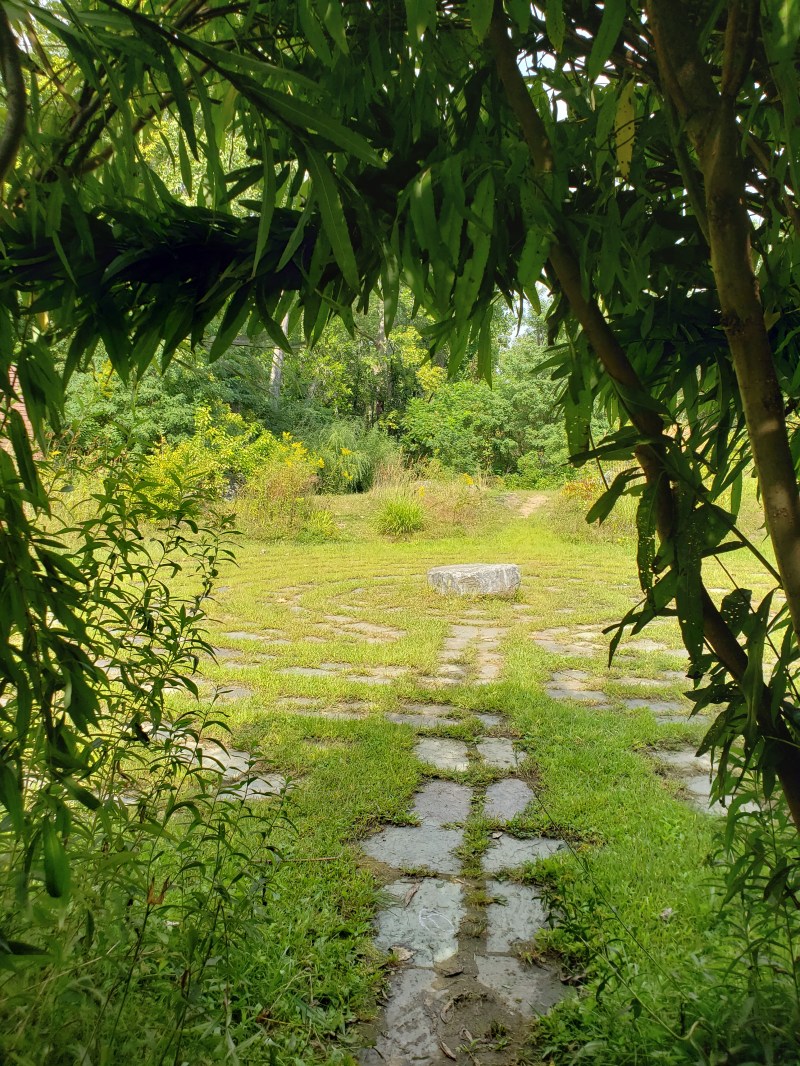
One of my plans for this week (or early next week) is taking some contemplative time at a local labyrinth. I’d like to do this before the kids are out of school, and I will wait until it’s not oppressively hot or expectant thunderstorms. I’ll bring my journal and clear my mind.

What’s something you can do for yourself this week?

Mental Health Monday – Lists

Standard

Mental Health Monday is all about those little reminders that we all, no matter our circumstances, no matter our levels of anxiety, we all need to stay aware of our mental health. I had intended this to publish yesterday despite a busy morning, but at the end of the day (literally), I still could have gotten it in under midnight on Monday, rushed, and (in my mind) unfinished or I could wait until Tuesday and let that be a reminder that not everything is an urgency. Yes, some things are, but not everything.

Today I wanted to talk about the benefits of lists, and the first thing on any Mental Health Monday list is to let yourself take a break when you feel its needed.

I needed it yesterday and I ignored that feeling all day. After church and my lunch meeting, I went home fully intending to sit at my laptop and do the Monday post. I thought I’d take a short break, read a chapter in one of the books I’m in the middle of before I got started.

I fell asleep.

I woke up with a crick in my neck, so I stretched and pulled out my book again.

I fell asleep again.

This happened on and off throughout the afternoon (including the painful crick), and each time it happened I became more and more frustrated and angry at myself. I didn’t think that I must have needed the rest; I was just angry that I wasn’t getting done what I had planned on getting done.

Once I decided that I would intentionally postpone the post until today, my anger and my anxiety* went away.

[*I don’t mean that I was now suddenly free of my chronic anxiety. We all have anxiety that crops up from time to time depending on circumstances, and this was in additional to the anxiety I take medication for. It’s important to differentiate between the two, but it’s also important to treat each of them and not ignore either one.]

I’ve written previously about lists. I find them a great tool in all kinds of situations. When I was undiagnosed (for depression and anxiety) I was very forgetful. I couldn’t remember the simplest of things – did I have breakfast? Did I take a shower? Why aren’t the kids in school? Oh right, it’s Saturday. I found ways to cope – giving myself a schedule was one, getting diagnosed was a big one. I was trying so hard to not let my family know that there was a problem that I was in “fake it til you make it” mode and whatever slack I left behind, my family picked up – like cooking. I missed many school deadlines in this time and that led to all kinds of guilt, especially concerning my middle child.

One of the lifesaving tools I discovered and still utilize was making lists.

The lists range from important appointments and deadlines to seemingly mundane items like eating and showering. Some days those mundane ones are needed just to get through.

My list for yesterday was (with completed items crossed out):

  • Mass
  • See Father J.
  • Donation to St. Vincent de Paul (as part of Spark/GISH)
  • Meet M & E at bank
  • Meet M at Panera to go over information for my new (volunteer) job
  • Check in with home to see if we need groceries while I was outwe didn’t
  • Home to write MHM
  • Refill pill box for the next two week period
  • Continue reading two books.
  • Begin reading final two chapters for book club.
  • Attendance form for kids’ school.
  • Check calendar for next month’s writing assignments.
  • Find free write prompt for next week’s group that I’m leading.
  • Group rosary by phone.
  • Dinner.

It looks like I got a lot done, and I did. Even if you do one thing on your list, it is important to acknowledge that. That one thing could be everything (and some weeks, it is). I did also have a lot of little things on my list. They may seem little (even to me) but when I forget something it can be very frustrating. Why continue reading those two books? They’re library e-books, and often the library will take them back before I’ve finished, and I’ve tried to read them more regularly so I don’t have to go back on the waiting list, which can be quite long sometimes.

Today’s list was much smaller:

  • Mass – opted not to go.
  • Get gas.
  • Check out po box at new post office for new volunteer job.
  • This is where I am at the moment ——–>Lunch to write first draft of MHM-Lists
  • Pick up daughter and go to Target (with lists for home and school supplies she needs immediately of course)
  • Publish this MHM before dinner.
  • Dinner.
  • Read books.
  • Bed (hopefully early).

I think I can get through the remainder of today’s list and I know that I can make up some of the ones that I missed on Monday (like refilling my pill box and finding a free-write prompt) on Wednesday.

As we get back into the swing of things, as masks come off, and more people find their new normal, it’s okay to give yourself some time to readjust to public life. Personally, I’m still wearing masks, and I’m okay with that. And as the school year winds down, I’m making daily lists, making sure that nothing important falls through the cracks.

Try making your own lists, and let me know how you did with your week.

Be well.

Mental Health Monday – Not Always According to Plan

Standard

Sometimes what you planned doesn’t work.

Take today for example.

My plan was to get up at my regular time – 8:30 – go to mass, maybe get some breakfast, and mail my taxes. And then come home and write and publish today’s Mental Health Monday.

I woke up at 8:30. That part happened. But I was exhausted. And I couldn’t figure out why I was so tired. While I didn’t get a lot of sleep on Friday, I did get a regular amount on Saturday, and I thought I did on Sunday as well. But at 8:30 this morning, I just felt tired and I had a low throbbing tired headache.

I reset my alarm for 8:50, and while I woke up at 8:50, I didn’t feel any less tired.

I made the choice to remain home and sleep. I would miss mass and that was going to have to be okay.

Sometimes it’s like that. You need to make that intentional decision not to do something. Even if that something is something that you really wanted to do, or thought you needed to do in order to have your day get started on the right foot.

This is one way that I care for my mental health.

When I did get up, my day was completely changed. It wasn’t just that I didn’t attend mass, but because I was still in bed, my daughter came in between classes and we had a nice conversation. We made some plans for the weekend.

I went downstairs and got dressed, ate breakfast, and thought I’d read a little before I went to the post office and mailed my taxes.

I did read for a short time, but I was again, just so, so tired. I didn’t nap, but I didn’t read. I alternated this way for quite some time.

But I was exhausted.

I made photocopies of the taxes and got them ready for the mail. It was then that I noticed that there was a major mistake on one of them. I got the white-out, made the corrections, redid those copies, and got them ready. I’ll mail them tomorrow.

My day feels like a failure. I didn’t get anything done that I wanted to do.

But was it a failure though?

But in the big picture, I took care of myself by sleeping a little later (and I can go to mass tomorrow). Since I was home, I took one more look at the taxes and was able to correct them. I’m almost finished with the book I’m reading, and I’m finishing this up for publication so I can attend my weekly rosary group.

What are some of the ways that you can proactively take care of your mental health?

If you’re in an office space, take a short walk to the restroom. Walk up a flight of stairs if you are able. Step outside for a moment for a breath of fresh air. Close your eyes and take a couple of deep breaths.

What are your suggestions?

Election Connection: Voter Suppression

Standard

Across this country, at least 43 states have over 250 laws proposed by Republicans to limit voting access (source: ACLU mailing), and these predominantly negatively affect minorities and lower income voters.

One of these bills that recently became law in Georgia is SB202, and when asked in Congressional committee about what it does, Stacey Abrams was cut off by Senator John Kennedy (R-LA), so she released a video on Twitter that explained it.

We cannot rest while Republicans continue to keep eligible voters from casting their ballots. Voting is a right and should be accessible to all eligible voters.

Follow Democracy Docket for more legal challenges to these proposals and laws as well as Stacey Abrams’ Fair Fight.

The below video of Stacey Abrams is a good example of the preconceived notions and misinformation that GOP lawmakers accept even when experts in voter suppression are willing to explain the situation to them. They just don’t accept it, and are willing to dismiss the voting rights of people unlike themselves (ie. middle class white men).

https://platform.twitter.com/widgets.js

Mental Health Monday – Mental Health Awareness

Standard

May is Mental Health Awareness Month, and we’re kicking it off with the first of a series of Mental Health Mondays.

Mental Health isn’t simply an awareness tool for those with mental illness or issues, but for all of us. We all have mental health, and we consistently ignore it, and as we’ve found during this last pandemic year, ignoring our mental health isn’t good for our…mental health. Or our physical health for that matter.

Right before I was diagnosed with depression and anxiety I was having knee problems. I went once a week (it should have been three times a week, but I couldn’t afford that even with “good” insurance) for physical therapy, and it did help a little bit, but it was really the action of going to the physical therapy building and having the schedule more than doing the exercises. I’m sure the exercises helped my knee, but the schedule of the appointment helped just as much. Once I began talk therapy, medication, and discovering my own self-help tools, my knee pain virtually disappeared.

I’m not suggesting that taking care of your mental health is all on your shoulders. I could not have come out on the other side without medication and therapy. Depression and anxiety (and a host of other mental health issues that I’m not qualified to speak on) are almost all chemical imbalance, and oftentimes, regardless of what some may insist, the only option is medication. And that’s okay. I take medicine for my diabetes and my high blood pressure. No one would suggest not taking it and just “relaxing” and/or “cheering up.” That’s not how recovery works.

And everything that’s working for me now may not work in the future. Being self-aware is important to know when to ask for changes, whether it’s for more therapy in the week or month or a change in medication. Schedule changes, eating habits, stress – all of these can contribute to changes in your mental health and may necessitate changes in your treatment.

For this first week of Mental Health Awareness Month, I would suggest sitting down with yourself in a quiet space and reflecting on what your feelings lately are. Take the time to sit with it and see if things are better or worse than they were a few weeks or months ago. It’s also important to accept that there may be temporary changes that will go away, especially if those changes developed during and because of the pandemic and the lockdowns. In your isolation, what worked for you? If you continued working, how did that effect you? Do you have needs that need addressing?

A really useful graphic appears below (with attribution). Read through it and ask yourself the questions that apply. Think about the suggestions, and seek out a professional for help. I am not a professional; I can only share what I’ve done, and what has worked and not worked for me. It may not seem it but our mental health is a community effort. As I heard on a retreat last week: Take what you need; leave the rest.

Continue reading

Inspire. April.

Standard

Your present circumstances don’t determine where you can go; they merely determine where you start.

– NIDO QUBEIN

As I contemplated this month’s Inspire post I began with the discovery of this quotation, which led me to the three photos that appear below.

I think this quotation is perfect for this time of year, especially in this second year of pandemic as things are slowly returning to some semblance of normal. Some of us have been lost in a fog of uncertainty and some of us remain in that fog as we await our turns for vaccines, for the return of jobs, the new rules for openings, community gatherings as it becomes safer, and yet, we still wear masks (as we should), we still wash our hands frequently and use hand sanitizer (as we absolutely should), we continue to maintain our distance (as we should), and we’re in a space of feeling the year is passing us by (again).

We need to look at our present circumstances, and then start.

The Easter season is upon us, spring is springing up all around us, Ramadan begins this evening. It’s as if a new year is dawning, and there’s no reason not to treat this time as a new year, setting goals, making choices, smelling the flowers on a few new paths.

The photos below are three places I never expected to be. Having taken the photos is proof that I was actually in those places, but to me it still remains extraordinary that I was actually, physically there. Gazing at these three photos show me the magic that can happen and the magic that is inherently in a place.

The first photo is of Glenariff Falls in Northern Ireland. We found it quite by accident while looking for a place to eat – there is a restaurant behind where I was standing to take the photo. What was remarkable is that our cousins had given us directions to this very place, only we hadn’t realized it until after we’d eaten and went to look for the falls they’d recommended. These woods have a fairy feel and there are reminders of fairies throughout them including in the falls themselves. It was very peaceful and soothing just standing and watching the water fall from the top.

Northern Ireland.
(c)2017-2021

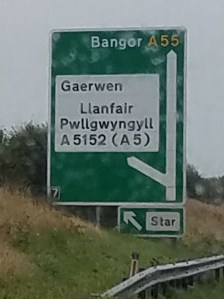
This second photo is just a road sign; however I was glad to get it when we couldn’t get to the town. We were running late to get to our hotel, still about an hour or more away, and it was raining, and at the beginning of a trip we always think there is more time to return than there really is. The sign depicts the longest town name, shortened for the sign as: Llanfair Pwllgwyngyll; also known as LlanfairPG, but known in its full glory as:

Llanfairpwllgwyngyllgogerychwyrnwllllantysiliogogogoch.

Small town, long name.

Ynys Mon, North Wales.
(c)2017-2021

This last photo is of the Menai Suspension Bridge. We drove across it from the island of Angelsey (known as Ynys Mon in Welsh) to get to mainland Wales and on to our destination. When I traveled alone to Wales in 2009 this bridge was the source of my greatest anxiety. I had truly wanted to go to Angelsey; I had heard of its beauty and there was an ancient cairn that I wanted to visit, but I could not make myself drive over this bridge. I could see it from my hostel along the Menai Strait, and I thought about for the entire three days I stayed there. I’d walk out to the Promenade and stare at the water below the stone wall, and then stare down the strait at this bridge. Every time I thought I might I didn’t. I just couldn’t do it.

As with the ferry that got me to Wales in 2017, this bridge got me to the mainland where I could complete my pilgrimage. I wasn’t driving, but it was still a monumental achievement and it’s part of one of the places that I started.

This mid-April is another new starting point.

Menai Suspension Bridge, Ynys Mon to Bangor.
(c)2017-2021

Election Connection: Impeachment, Take Two

Standard

By the time you read this, the second impeachment trial of former President Donald Trump will have begun. You can read about how the trial will proceed in this resolution, however beware that clicking the link will begin an automatic download of the pdf from the Senate website.

From attorney Marc Elias’, Democracy Docket: Second Impeachment, Explained

Here’s What You Need to Know About the Senate Impeachment Trial from NPR

If you’re not able to watch the trial live or choose not to, Elie Honig’s daily (approximately ten minute) podcast, Third Degree, is the way to go. His Twitter is here.

Jennifer Taub is also live-tweeting the trial.

Other reliable summaries should be found at Rachel Maddow’s nightly show at 9pm on MSNBC or on her Twitter.

Prior to watching the bulk of the trial, these podcast episodes are worth a listen:

House Managers for Impeachment (Follow on Twitter)
Rep. Jamie Raskin, Lead Manager
Rep. Diana DeGette
Rep. David Cicilline
Rep. Joaquin Castro
Rep. Eric Swalwell
Rep. Ted Lieu
Rep. Stacey Plaskett
Rep. Madeleine Dean
Rep. Joe Neguse

Also follow: Dan Goldman, former House Impeachment Lawyer

Inspire. February.

Standard

With the new day comes new strength and new thoughts.

Eleanor Roosevelt

What you do today can improve all your tomorrows.

Ralph Marston
Buffalo and Erie County Botanical Gardens, Buffalo, NY
(c)2021
Buffalo and Erie County Botanical Gardens, Buffalo, NY
(c)2021

Despite the new year’s beginning in January much like the old year had ended, we got through it. We inaugurated Joe Biden and Kamala Harris as our President and Vice President, and they hit the ground running.

Using Executive Orders to reverse some of the most heinous Trump Admin policies, reorganizing the Covid relief response so that it works for the American people, the Press Secretary giving daily briefings, answering all questions without lies and hedging, avoiding talking points and giving out real information has been a wonderful change of pace.

See the previous post for many of the Biden Admin Twitter follows to keep up on their news!

I’m optimistic as we head into the shortest month.

Lent is early this year, at least it seems that way, and so I’m already thinking about those forty days in the desert. You don’t have to be Catholic to think about the things that Lent brings out in many of us. Choose a random day, and begin your own forty days.

Change a habit.

Start a hobby.

Write a journal.

Take a breath.

Be inspired.

Election Connection: Welcome to the Biden Administration

Standard

The Election Connection series will be a bit more sporadic, posted on a need-to-know basis now that we have an Administration that cares about its citizens in all the important and even in the most mundane ways. I still feel waves of PTSD at moments and then I see Press Secretary Jen Psaki swatting stupid questions, not arguing with White House correspondents, and offering experts to give briefings and answer questions, and I remember that it’s all going to be okay. It’s like the last four years were a dream, and I’m Pamela Ewing.

Unfortunately, the last four years weren’t a dream, and as nightmarish as it was to live through, it wasn’t a nightmare either. It was very real.

We need to take that same energy from the last years, the same energy brought to the Georgia Senate race, the same energy brought by the summer protests, and we need to focus it unrelentingly on the next two years, and then the two after that, and then the two after. We can never get complacent again.

Complacent = Complicit

We came very close to losing our republic. As it was, we witnessed a coup attempt, an insurrection that struck at the heart of our democracy. Five people died, including a Capitol police officer, but hundreds of others were injured. Two members of law enforcement have committed suicide. And still, there are Republicans who refuse to comply with law enforcement requirements to go through a magnetometer before entering the House floor. I mean, let’s be realistic and honest here, they’re also refusing to wear masks despite common sense and Executive Order, putting their colleagues and staff at risk (four members of Congress plus one spouse became covid infected because of Republican negligence on January 6th, and that was without their obvious complicity in the attack on the Capitol).

So, it’s time for a Civics lesson, and I will go extra slow as if I were speaking to the newly elected Senator from Alabama (this one) who doesn’t know the three branches of government (see below*) or a Supreme Court justice (this one) who doesn’t know the five rights guaranteed in the First Amendment (see below*).

Some things are etched in stone – the Constitution including the Bill of Rights is one of those things. The Constitution may be amended, and there are procedures in place to do that. In fact, we have amended the Constitution twenty-seven times, most recently in 1992.

Some things are not – Number of Supreme Court justices, the use of the filibuster. Supreme Court justices were based on the number of circuit courts, which have increased to thirteen. This is why many experts feel that the Supreme Court should be expanded to cover each circuit court with its own justice (as established in 1869 with what is known as the Circuit Judges Act).

The filibuster is not part of the Constitution, which makes it easier to change than amending the Constitution would be.

A couple of points:

Unity does not mean to continue to allow ourselves be abused or gaslit.

Unity does not mean giving in to bullies.

Unity does not mean power sharing when Democrats have a clear mandate.

Below the cut are Twitter follows of the Biden Administration, the House Managers of the Impeachment Trial, a selection of podcasts, and other accounts that I follow regularly and find are very informative and honest. Add your own in the comments and I can include them in the next Election Connection.

*Branches of Government
| | |
Legislative Executive Judicial

*5 Rights Enumerated in the First Amendment:
1. Freedom of Speech
2. Freedom of Religion
3. Freedom of the Press
4. Freedom to Assemble
5. Freedom to Protest the Government

Continue reading

Black History Month – W.E.B. Du Bois and Nikole Hannah-Jones

Standard

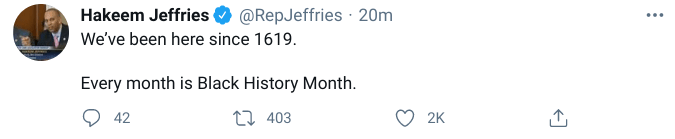
Today is February 1st, the traditional start of Black History Month. It would be good to remember, as Congressional Representative Hakeem Jeffries of NY’s 8th District tweeted this morning: “We’ve been here since 1619. Every month is Black History Month.”

I grew up in NYC in the 70s, at what seemed to be the height of bussing as well as a prominent Back to Africa movement. I didn’t understand why my Black friends didn’t live near me. One of them, Robert, moved with his family to Africa, although I don’t know if that was related to his father’s job or if they decided to “return” (I don’t know the proper term and I apologize for that).

In school, we learned about Harriet Tubman, Booker T. Washington, George Washington Carver, and of course Rosa Parks and Martin Luther King, Jr, but not nearly enough. No Medgar Evers, no Emmett Till; at least not that I remember. Thurgood Marshall, of course; he was currently on the Supreme Court at that time. As historic as their lives were, many were left out.

Malcolm X, for example was deemed too militant. It wasn’t until last year when I read his autobiography that I saw how little difference there was between him and the mainstream civil rights movement. Of course, no one agrees with anyone one hundred percent of the time, but students in school should be given all the information and use critical thinking skills to form their own opinions.

I can’t possibly make up for the lack of Black history within American history. As a country we can absolutely begin to try, and I do try in my small space of the internet. Since I am not part of the Black community, I try to draw on Black voices and offer links and some information to get you started.

What I had planned for today was postponed by another tweet I saw this morning; that of March for Our Lives activist, David Hogg who asked if anyone had the link to W.E.B. Du Bois PhD thesis on the history of slavery and abolition in the US, and so with the assistance of David Hogg and Carl Fonticella (who provided the link), I am sharing that to get us started.

W.E.B. Du Bois’ The Suppression of the African Slave Trade to the United States of America, 1638-1870, originally published March, 1896.

Relatedly, the 1619 Project would be important reading as well. The pdf is provided through this link from The Pulitzer Center and begins with an introduction from New York Times journalist, Nikole Hannah-Jones, who provided the idea for the project.