3. Something you love to smell:
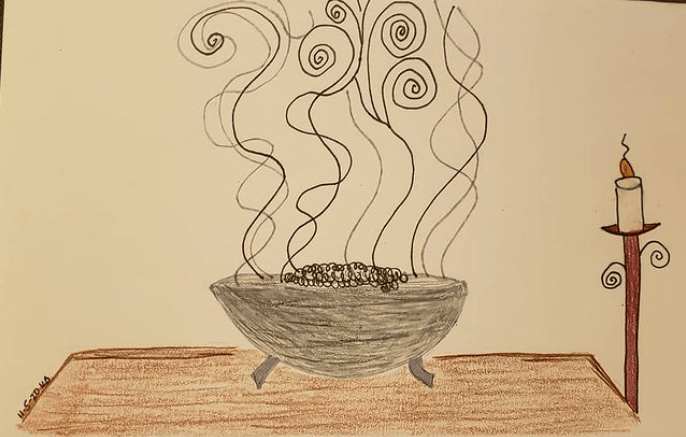
See original post for hunt items!
2. Something to give someone else to make them smile.
Flowers, Rocks, Trees.
What makes you smile?



Refer to the original post for the list.
1. Find something that makes you happy.
As with most of these lists, answers will vary depending on the time of year, my mood, and whatever else is going on in my life, so YMMV on these.
With Nanowrimo, spending some time at my local Starbucks makes me happy. It’s right in town, so I’m nearby if my family needs me to return home for any reason since we have only one car.
So what is that something that makes me happy?


Several months ago, April to be precise, I was given a series of reflection questions related to the losses I’ve had since the March 17th lockdown. I may have mentioned this in my original post, In the Midst of Loss about that retreat session and over the course of the month following that first hour I would bring up the subject to myself and think about those losses, the reasons for them, as well as trying to name my feelings about them, and then question how to say goodbye to what’s been lost. It is obviously much harder to say goodbye to a loved one who has died during this pandemic; that loss is astronomically deeper and more upsetting than the loss of work or routine or our regular habits, although the loss of work is catastrophic in its own way and those of us struggling with mental health issues like anxiety, depression, and others will feel that some of our losses are also catastrophic. How do we accept the losses we are experiencing and move forward even in the midst of the ongoing pandemic, a pandemic that will continue to be with us for many more months to come, if not at least another year or more? What strategies can be adopted and adapted to move on; to create a new ordinary for our lives?
There were two additional, important and hard to answer questions broached during that session. The first was do we really want back what we’ve lost? All of it? Are there some things that we have lost that we kind of want to stay lost? The second was to ask ourselves what was good about this time.
While we’ve all had losses, we’ve also had gains. There were good things that were perhaps only seen in retrospect. How do we find joy in the confusion and chaos of today?
Continue reading
In one week, a mere seven days after today, Supernatural begins with the first of seven final episodes in the show’s fifteen season series. It’s been a long road, and for the fans, there isn’t really an end. Some of us have grown up along the way, and watched as the actors got married, had children, and shared with us their other projects. Some of us found our voices, discovered new skills, met and overcame challenges and just enjoyed the stories. I am finding the ending of Supernatural a bittersweet time.
Supernatural came into my life about mid-way through its historic run although of course, I couldn’t have known that at the time. It was a dark time for me and the show filled a void, where I could watch it without having to think about the mental health issues that were nearly drowning me. As medication began and adjusted, as therapy began, as my faith took an unexpected turn, Supernatural was the light at the end of the tunnel that gently led me home. I can still feel a calm, soothing consciousness when I put on the reruns, either in syndication or on Netflix and let it play as the background music of my day whatever it is I’m doing at that moment.
I am glad that we will get an ending that is well thought out and does justice to the entirety of the series. Seeing old faces throughout season 15 has been a walk down memory lane, and I’ve enjoyed reliving some of their best moments despite the constant death of characters. Although to be fair to Supernatural, dead doesn’t always mean dead. Only time will tell.
One of the most valued things to come out of the series is the SPNFAM. A lot of that is through Misha Collins’ scavenger hunt, GISH and contributing to his charity, Random Acts. It has allowed us to become more politically aware and civic minded, especially here in the US. There is also the Stands shop where we can wear our fandom through merch while also supporting a variety of causes and charities that the actors find important. It has expanded my knowledge base of causes that I woudn’t necessarily have heard about otherwise. (I’ve shared some before, and I will share them again before the last episode airs.)
I’ve written love letters to Supernatural before and published them here and elsewhere; it has held me together when I was falling apart, and it brought me closer to people I wouldn’t ordinarily know across the country and the globe. It’s encouraged my writing, both in fan fiction and in exegesis as well as supporting my love of pop culture and puns, which Supernatural is full of. Plus there are the inside jokes, and online, there is a Supernatural gif for everything.
Supernatural is magical.
It will remain a special place in my heart forever.
While the series will end and there will be no new episodes to share and enjoy, we can still follow the actors we’ve grown to love on their various social medias, their future work and businesses, and through the fandom and fan-family.
It doesn’t need to be big.
It doesn’t need to be important.
It doesn’t even need to be political.
Or public.
Do one thing for you.
This morning my intention was to attend church. I woke up too late, but…I could still take a shower and attend church on FB Live, which I did, and then I went to Starbucks.
Three small things that loom large, but that’s okay. Any one of them would have been a success.
Your one thing matters to only one person: YOU.
Remember that everyone’s goals and wins are different from everyone else’s.
Own it.
Enjoy it.
Celebrate it.
Do one thing.
September is Suicide Prevention Month. Each year, too many people commit suicide and one thing that would prevent some of those suicides is knowing where to go to get help. Visit the websites of these three organizations and find out how you can get help or how you can help someone in crisis.
NAMI – National Alliance on Mental Illness.
NAMI is the nation’s largest grassroots mental health organization dedicated to building better lives for the millions of Americans affected by mental illness.
The Trevor Project – for LGBTQ+ and Trans Youth.
The Trevor Project provides confidential support for LGBTQ youth in crisis, 24 hours a day, 7 days a week
Early on in the pandemic, when we’d just begun the lockdown with work places shutting down, restaurants closed, and schools closing, we were only just getting used to having the kids at home, shopping once a week, avoiding people as much as possible, including even our son who lived on his own, plus being in a constant low level state of anxiety, keeping ongoing lists in my head, living, breathing, reading, and writing everything I could about coronavirus 20/7 with four hours leftover for sleep. Often, I couldn’t get through that minimum of four hours. I tried watching the White House’s coronavirus briefings; I thought they would be useful and informative. I thought they would quell my anxiety of those early days of unknown. My priest called them “dark days of confusion,” and they truly were. We’re still in them sometimes now. Those briefings didn’t help; they left me with higher levels of anxiety.
Continue readingMy retreat house recently began to offer some limited online experiences. The first one that I explored was about the losses we’ve confronted during this pandemic since March. This was a two hour session, split into two days one month apart. I know the presenter, Father K, through other classes and workshops I’ve taken through the Diocese. He’s a local priest who also works in the area of mental health and I really enjoy the way he approaches things. He also reminds me of my therapist. At the end of the first hour, I thought I had been given an extra therapy session this month! It really was a comforting hour that led me to spend the next twenty-four hours deep in thought. For the first time in a long time, I felt calm and thoughtful but also, in a way invigorated.
To start out, he asked us to think about the losses we’ve faced since March, and to write them down, and then to share a couple of them with the group. I was one of the first called on, and for me that meant that I hadn’t any time to prepare what I might say. I had a list, but it felt superficial. I began with a pseudo-apology; something that many of us do on a daily basis, especially women. That isn’t to say that men don’t do it, but women, I’ve found are the primary apologists for things they aren’t at fault for. For example, have you ever had someone walk into you on the street or in a store, and you apologize to them? I do this almost every time. Women apologize for taking up space, for taking too long, for a myriad of things that men just don’t apologize for, and really, that we shouldn’t apologize for.
I began by saying that I was fortunate that my family and I haven’t lost anyone to covid and we haven’t been ill, minimizing what we have been going through, and that while it hasn’t been life-threatening (so far) it has also not been easy for our family. My husband already works from home, so we continued receiving our salary. I feel guilty. All of my losses come from a place of privilege and I feel it’s my obligation to add the disclaimer of our privilege even while trying to be honest with the emotional and mental toll this pandemic crisis has put upon us. I mentioned a few things that we have lost since March, and as I listened to the others share their losses. I was reminded of things that I hadn’t thought of as losses and I added them to my list as well.
At the close of this part, Father K said what I already knew (and I’m paraphrasing): whatever I’m going through is just as valid as the next person. Their struggle may seem more difficult, harder to get through, having more emotional value, but my losses are still just that: my losses. These are the losses that I’m feeling every day; that my family is feeling every day and I shouldn’t dismiss them because someone else has had a more challenging time than I have; whose struggle appears more difficult or more painful.
My losses are real, and this session allowed me to accept that and confront the actual loss and how I can move forward.
What are the losses that I don’t feel measure up to others’ losses?
The loss of time. What day is it? Even trying to tell time based on a favorite television show has been eliminated with the shutdown of Hollywood and all the global acting studios. Anything that wasn’t completed before March 17th ceased production; how many season finales were postponed? How many cliffhangers left hanging? On March 31, more than one friend mentioned how long March had been. March was a year long. I felt it in my soul. Would April also be a year long?
The loss of routine. School was canceled for my kids, but their schoolwork continued. They slept until nine, did some work, took naps, grazed all day or skipped meals. We were eating breakfast at ten in the morning, and dinner at nine at night, bedtime after eleven even on a “school night”. Haphazard doesn’t scratch the surface of our “new routine”. The kids’ independent learning and creating their own schedule seemed to be working, but at what cost?
Mass was canceled, and it took a few weeks to get the livestreaming set up, so at least now I know when Sunday is. All of my spring retreats were postponed at first, then canceled entirely. Therapy moved to the phone. Meetings canceled or moved to Zoom. If school and work were gone, was there even a weekend to look forward to?
The loss of being lazy. That’s wrong and a little harsh on myself. It’s more the loss of choice. It could also fall under the loss of routines. If I didn’t feel like cooking, we couldn’t just go out to dinner. Even if we did takeout, the restaurants closed about two hours earlier than normal. Menus needed to be planned so groceries could be shopped for in a way that minimized our leaving the house and coming in contact with other people. Planning every meal. Having food for the kids to eat lunch when they would normally eat lunch in school.
The loss of of seeing and hugging my adult son. We barely saw him. He came by once every two weeks until I was exposed to covid, and then he stayed away until my fourteen day isolation was completed. He’s an essential worker and a first responder, and even if he wasn’t I wouldn’t want to expose him to something that we still know so little about. Fortunately, I did not have covid. We eventually had our family Easter dinner.
The loss of myself. I stopped being me. I had to become the covid expert. I had to tell everyone to wash their hands every time they came home from school (before the lockdown) or the grocery store after. The one time my husband needed to go into the office, it was half an hour of discussion weighing the pros and cons, and how to do it safely. I had to know how much toilet paper we needed and go shopping with all the others preparing for their own lockdown. I had to educate people about this virus and call out misinformation because if I didn’t do it, who would? I became teacher again.
And the burden that I put upon myself led to the loss or permanent change in status with some friends. It’s hard to maintain the reciprocal, balanced relationship with people when their fundamental values are so at odds with mine, like wearing a mask and isolating or simply the basic idea that covid was made in a lab somewhere to ruin the President’s term of office.
Some losses that others in the group brought up that resonated with me included the loss of purpose and the safety and peace of mind that I’d had from only a week before; the loss of trust especially in the authority of the federal government to take care of something so catastrophic as this and which they ignored so much and let us fall so far, and of course, the loss of the Eucharist and the rituals of mass, so much a part of my life.
I craved the Eucharist, but when the opportunity arrived to return to in person masses, I decided against going, and I surprised myself that as those in the pews received their communion while I was at home watching the livestream, I felt just as close as if I’d been there and received it in my hand and consumed it. I credit my parish and my priest for giving me that feeling of belonging and even though I wasn’t there in front of him and others, I was still present and G-d was still present for me. That was a good thing.
In the midst of the losses, there have been some gains, some good things to reflect on. What was good about this time as lockdown comes to a close? The last question asked in the session was how do we find joy in the confusion and the chaos? These are things I need to meditate on, to think about and discover the answers to. Reflecting more on the losses I’ve documented above and move toward accepting and then moving forward to finding the joy is a thing I want to work on between now and the next group meeting. I want to acknowledge the gains; find my joy.
In the coming days, I’ll share the one day back in March that kept me going, and then hopefully after that I can answer the question: how do we find the joy? At the moment, I don’t know, but I hope to find out.


