Frances Ellen Watkins Harper

Standard

We are all bound up together in one great bundle of humanity, and society cannot trample on the weakest and feeblest of its members without receiving the curse in its own soul.

Frances Harper, We Are All Bound Up Together, 1866

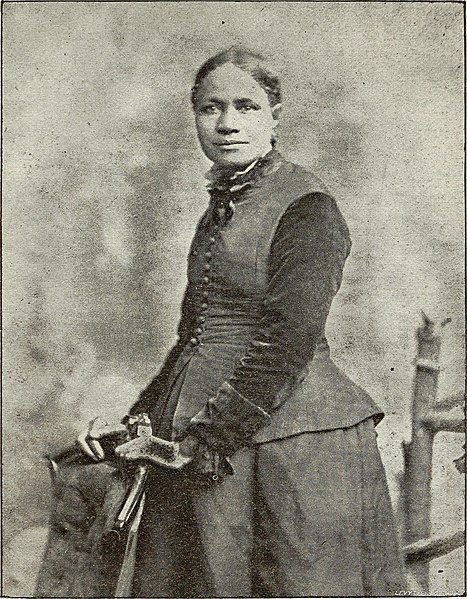
Frances Ellen Watkins Harper.
Public Domain

Frances Ellen Watkins Harper was a voice of Black Suffragists. She was born in 1825 in Maryland to free African American parents. Her parents died when she was young, and she was raised by her aunt and uncle. By the age of 21, she had written her first small book of poetry, Forest Leaves and ultimately published 80 poems. More than a decade later she became the first African American woman to have published a short story, The Two Offers. She co-founded the National Association of Colored Women’s clubs.

While working as a teacher in Pennsylvania, a law was passed that free African Americans in the North were no longer allowed into Maryland, her home state. They would be imprisoned and enslaved.

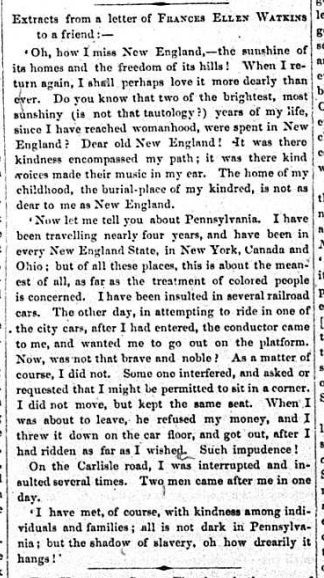
She refused to give up her seat on the trolley, and only got up when she reached her destination as chronicled in The Liberator, page 3 as seen below.

From The Liberator, Page 3
1858
Public Domain

Her famous speech, We Are All Bound Up Together, read in 1866 at the Eleventh Women’s Rights Convention held in New York City, can be read here.

She spoke at the National Woman’s Rights Convention in New York, held in 1866. The organization split over the suffrage of African American women and were opposed to supporting the fifteenth amendment. Harper left the group, and with Frederick Douglass and others supporting the amendment joined together to form the American Woman Suffrage Association. She was often the only Black woman at the women’s conferences. Through her life, she continued her advocacy for intersectionality (see- it’s not a new idea) in suffrage.

She spent the remainder of her life teaching and encouraging equal rights and education for African American women and founded and/or directed several clubs and organizations for African American women, including the National Association of Colored Women’s Clubs and the Pennsylvania Women’s Christian Temperance Union.

Some of her writings include:

  • Forest Leaves, poetry, 1845
  • Bury Me in a Free Land, poetry, 1858
  • Moses: A Story of the Nile, 1869
  • Light Beyond the Darkness, 1890
  • In Memoriam, Wm. McKinley, 1901
  • Trial and Triumph was one of three novels originally published between 1868-1888 as a serial.

Her first novel, Iola Leroy, or Shadows Uplifted was published in 1892. It was thought sentimental, but it also highlighted several serious social issues at the time, some of which remain today.

As a writer, I am always drawn to the writing lives of the people I choose to profile, and I was pleased to see that Harper was a mentor to other African American writers, including Mary Shadd Cary, Ida B. Wells, Victoria Earle Matthews, and Kate D. Chapman.

More information on Frances Harper can be found: National Women’s History Museum and Lift Every Voice, African-American Poetry

Friday Food. March. Meet Jamie Schler.

Standard
  • What you’ll find as you read on:
  • An unrelated note from me (see the Home Page)
  • An introduction to Jamie Schler
  • Links for her cooking, hotel, and books
  • French Onion Soup Recipe
  • Where to find Jamie and all her wonderful food expertise and recipes.

I “met” Jamie Schler in the midst of the pandemic and through the former guy’s administration and our mutual resistance. She offered recipes from her home in Chinon, France and brought her followers along as she went (post-pandemic) to a family reunion stateside. I downloaded her free e-book, Isolation Baking, which along with Chef Jose Andres#RecipesForThePeople kept us creatively cooking while “trapped” in our own homes and kitchens. She makes an amazing assortment of homemade jams that she offers as part of her bed and breakfast at her Hotel Diderot in the beautiful Loire Valley. I’m looking forward one day to actually make her French Onion Soup, which is one of my favorite things to eat, and whose recipe I share below.

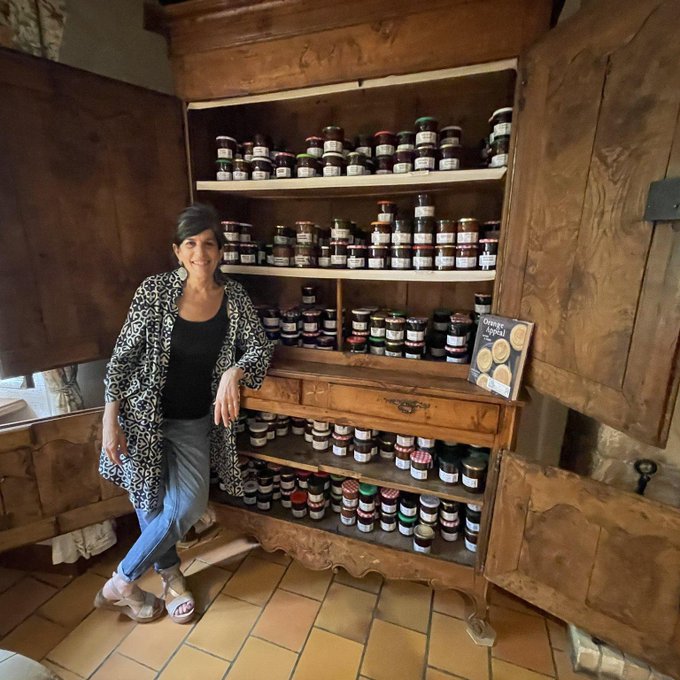
Jamie is generous with her time and love of food on social media and now on her Substack. She shares her techniques for making jam, which she does in abundance as well as recipes and insights. The jam is one of the highlights of the hotel’s breakfast and jam-making has been a hotel tradition since it’s early days of the 1960s. Each new owner has introduced new varieties of the jams, bringing the total to over 50 kinds.

Jamie Schler in front of her jam cabinet at her hotel, the Hotel Diderot. Her book, Orange Appeal has a prominent place on the cabinet.

The main building of the hotel dates from the 15th century. I can feel the history through the splendid pictures Jamie posts on her social media.

Hotel Diderot (from their website)
Continue reading

Stagecoach Mary

Standard
Stagecoach Mary (Mary Fields of Cascade, Montana)
Public Domain

Stagecoach Mary was a mail carrier on a star route between Cascade, Montana to St. Peter’s Mission. She held two four year contracts with the United States Postal Service beginning in 1895, and received her stagecoach that she drove to deliver the mail from her friend, the Mother Superior of an  Ursuline Convent, originally in Ohio, but now missioning in Montana.

I should also mention that she was the first African American woman to carry the mail (only the second woman to do so) and in her time she became a Wild West legend.

Sounds intriguing, doesn’t it?

Mary Fields was born in 1832, most likely in Tennessee, into slavery.


As times change, so does language. Since I’ve been in school and up until recently, we’ve referred to the “slaves” in the South (or elsewhere in the world). This denies the people their humanity. It tells the reader/listener that their only value was as a slave; that they are slaves at the heart of their being. But of course, that’s not true. They are people first. Men, women, and children who were kidnapped and enslaved and their children born into slavery and enslaved. These two links should help with the explanation:

Writing About Slavery: This Might Help

This column from the Chicago Tribune: Language Matters: The Shift from ‘slave’ to ‘enslaved person’ may be difficult, but it’s important.


She was freed with other enslaved people after the Civil War. From that time, she worked as a servant and laundrywoman on riverboats up and down the Mississippi River. She worked for the Dunne family until the wife died. John Dunne sent her to live with his sister, a nun and Mother Superior of a convent, where Mary lived and worked. She became very close with Mother Mary Amadeus Dunne and after Mother moved to Montana to mission with the Jesuits, Mary eventually followed her and helped nurse her back to health.

As if that wasn’t enough, Mary Fields wore men’s clothing, drank, smoked cigars, shot guns. She was tough and intimidating, two traits needed to be an independent contractor working alone on the frontier.

At some point, the bishop barred her from the convent after an altercation with a co-worker/colleague involving guns. To be fair, I can’t imagine that it would have been palatable for a man to be answering to a woman, an African-American woman and that may have played into some of the friction between them. Of course, it can be hard for any two headstrong people to work together.

It was then that she contracted with the Postal Service to become a star route carrier. She drove her stagecoach on the route with horses and a mule named Moses.


Star Routes were named such after their motto/mission of Celerity, Certainty, and Security in delivering the mail. They were denoted on paper with three asterisks: * * *, thereby becoming “star” routes. This name was renamed Highway Contract Routes in 1970.


She retired from her role as a mail carrier when she was 71 and lived on in town becoming one of the more popular figures of Cascade. She was praised for her generosity and kindness, especially to children. When she died in 1914 at 82, her funeral was one of the largest ever seen in the town.

She was very popular – schools closed on her birthday. When an ordinance was passed disallowing women from enjoying the saloons, the mayor exempted her. When her house burned down, volunteers rebuilt it.

Born a slave somewhere in Tennessee, Mary lived to become one of the freest souls ever to draw a breath, or a .38.

Gary Cooper, Montana native, writing for Ebony in 1959

Black Media & Black Culture

Standard

In a companion to my recent post Black History in Film, I’m sharing the NAACP Legal Defense Fund‘s link on Black Media & Black Culture. The NAACP LDF has put together a list of over 50 works recommended by the staff of the Legal Defense Fund. It showcases their mission to “defend, educate, empower.”

This single link offers links to their recommendations with how to view, read, or listen to them.

Included in the list are books, both non-fiction and fiction as well as for younger readers, television shows, movies and films, podcasts, and of course, music, which, as a white person, I say where would we be without Black music and its influences across every genre.

Visit your local library or e-library and see what’s available.

If you’d rather buy, this link will take you to a list of 149 Black-Owned Independent Book Stores.

In addition, Haymarket Books is offering three FREE e-books:

They also offer free books to the incarcerated through their Books Not Bars program. Donations for these programs can be made here.

As the Haymarket group said, “The struggle is long, but we are many.”

Election Connection – Abortion Access

Standard

It’s important to remember that one of the things left out of the abortion access discussion is that it is a freedom of religion issue. Banning abortion violates the tenets of some religions. It is also important to remind people that despite declarations of the opposite, this is not a Christian nation. It is not founded as a Christian nation, and many of us need to be reminded of that. More often it seems.

In fact, in the Treaty of Tripoli, signed in 1796 and ratified by the United States Senate in 1797, UNANIMOUSLY and without debate under the Presidency of John Adams stated that explicitly:

“…the Government of the United States of America is not, in any sense, founded on the Christian religion.”

Article 11, Treaty of Tripoli, rat. 1797

The below article was posted in USA Today on February 13, 2023. It is written by Christine Fernando and can be read here:

‘It’s time for us to be Bold’: Why Six Religious Leaders are Fighting to Expand Abortion Access

The six leaders highlighted in the article are:

  • Rev. Cindy Bumb of United Church of Christ
  • Rabbi Susan Talve of Central Reform Congregation
  • Jamie L. Manson, president of Catholics for Choice
  • Sheila Katz, CEO of the National Council of Jewish Women
  • Aliza Kazmi, co-executive director at HEART
  • Katey Zeh, Baptist minister and CEO of Religious Coalition for Reproductive Choice

Mental Health Monday – John Fetterman Edition

Standard

It’s extremely difficult to ask for help. No matter how big or small the problem, for many of us our reaction is often, “I’m good, I can do it, It’s fine.” Is it really? Whether we like to admit it or not, this can be more difficult for men, especially a man who is considered the head of his family, who just went through a health crisis, who is adjusting to unexpected changes in diet and lifestyle, who is being ridiculed for seeking help for a serious medical issue, whose family is mocked for nothing more than being his family, who went through a tough political race, and began a new job mere weeks ago.

It’s a lot.

It can be a lot without all of that going on.

For myself, I ignored a lot of my anxiety and depression. It didn’t occur to me that there was a problem. When you feel that something is off and search for help (today through Google), the wrong questions are asked. Do you skip out on work? Do you sleep a lot? Do you want to harm yourself? If your answers are no, you’re fine.

But you’re not.

I’m talking about myself, and not suggesting any of this is true for Senator Fetterman. Please don’t use this as an implication to some secret knowledge or diagnosis of the Senator. It’s not.

Continue reading

A Statement on President Carter’s Health

Standard

I came home from my day and tapped into my social media to find this statement from The Carter Center. I knew this day would come, and everytime I saw Jimmy Carter’s name in the news I would hold my breath until the all clear. I had considered (pre-covid) to try to attend one of his Sunday School classes/lectures that he holds at the Maranatha Baptist Church in Plains, Georgia. Cars line up at midnight waiting for his teaching, which he’d been doing for over forty years, only stopping as recently as 2020. I was not able to make it down to Georgia, things getting especially complicated after the bulk of the pandemic.

I have always thought of writing to him, but I never got up the courage. What could I say? Hey, Mr. President, I admire you. You inspire me. You’re a great man and humanitarian and a wonderful example of Christian love. I suppose I could have done just that.

I will tell you that I hold him up to the highest example of dedication, public service, and as a servant leader.

All of his books are a delight, but I would recommend Through the Year with Jimmy Carter: 366 Daily Meditations from the 39th President. I read it daily for one year, and it was a wonderful, calm, spiritual way to start each morning of that year.

I am glad that his family is with him at this bittersweet time, especially his wife of 76 years, Rosalynn, and pray his homegoing is tranquil and he and his family are at peace.

Official Photo of President Jimmy Carter. Library of Congress. Public Domain.
I was a kid when Jimmy Carter was elected President, and my Dad got all of us kids this Jimmy Carter Peanut transistor radio. He used to have a top hat, like the Planters Peanut. I still have it and I treasure it. I guess it falls into “crazy political paraphernalia”. (c) 2023

Read Banned Books

Standard

I’ve spent a couple of days looking at Florida’s list of banned books, and it is disproportionately authors of color. There are many with authors and references to LGBT+ issues and information, but diversity seems to be the “problem” for Florida’s governor, from banning books about Jackie Robinson and Roberto Clemente to calling the AP African-American course “contrary to Florida law” and states that it “significantly lacks educational value.”

There is a list of 176 books from one county alone. I’ve chosen a few to highlight the ridiculousness of this ban. I will say that some of the books on the list are not for all ages, but almost no book is. That is where parenting comes into play. I help my own kids choose books, and when I have a question (which I have had in the past) I speak to the teacher, and we sort it out. I try not to censor my kids, but I do if I need to base on age-appropriateness.

I will also say, in all fairness, that many of the books on the list will be returned to the school libraries after they are examined and approved. I wonder what is the point of having a professional educator and librarian who spend years becoming experts in their field only to have a parent, who has a bias against certain kinds of books make the decision for all the parents in the school system. It makes no sense. And yes, I will stand by my characterization of a biased parent. Look at some of these books (these are in no particular order, and you may google them for descriptions, but some are obvious).

  1. Wilma’s Way Home: The Life of Wilma Mankiller by Doreen Rappaport and Linda Kukuk
  2. Two Roads by Joseph Bruchac
  3. Time to Pray by Maha Addasi, Ned Gannon, and Nuha Albitar [If this book was about Christian prayer, do you think it would have been questioned?]
  4. Thank You, Jackie Robinson by Barbara Cohen & Richard Cuffari
  5. My Mother’s Sari by Sandhya Raot and Nina Sabnami
  6. Memphis, Martin, and the Mountaintop: The Sanitation Strike of 1968 by Alice Faye Duncan and R. Gregory Christie
  7. The Legend of the Bluebonnet by Tomie de Paola
  8. Knots on a Counting Rope by Bill Martin, Jr., John Archambault, and Ted Rand [These are the same authors of Here Are My Hands, and Brown Bear, Brown Bear, What Do You See?, preschool aged books that I used when I taught early-childhood.]
  9. Dim Sum for Everyone by Grace Lin [What could this book be about?]
  10. Celia Cruz: Queen of Salsa by Veronica Chambers and Julie Maren [In 2011, she appeared on a US postage stamp]
  11. Brother Eagle, Sister Sky by Chief Seattle and Susan Jeffers [This is a book I used in early childhood programs often.]
  12. Barbed Wire Baseball: How One Man Brought Hope to the Japanese Internment Camps of WWII by Marissa Moss and Yuko Marissa Shimizu
  13. Black Frontiers: A History of African American Heroes in the Old West by Lillian Schlissel

The #1 banned book is George Orwell’s 1984. Also banned are The Dictionary, The Bible, and Anne Frank: Diary of a Young Girl.

Profiles of banned books from Carnegie Mellon can be found here.

Banned Books Week will be the week of October 1 through 7 in 2023. In 2015, according to the Banned Books Week website, nine out of ten books banned contained diverse content. What does that tell you?

If you are having trouble finding a banned book in your area, and you are between the ages of 13 and 21, you can go online to the Brooklyn Library and get their e-card that lets you take out books online, so you can read the books. Email them at: booksunbanned@bklynlibrary.org

If you are a New York State resident and teenager, you can apply for BPL’s free e-card here.

Another place to get information on banned books (and other books) is the American Library Association. They are the oldest and largest library association in the world.


Read banned books. Read all books. Speak up against this authoritarianism. We are on the slippery slope.


Friday Food – A Blending of Two Cultures

Standard

Food and cooking are universal. We all eat, we all need to get food on the table, and even if it’s not us directly, someone needs to cook. From small galley kitchens in apartments to large farmhouse kitchens looking out over lush, green backyards, whatever kitchens we are destined to be “stuck with” we adapt and we learn how to work with what we have. If we don’t have an ingredient, we try a different one. When my kids were little, in the summer we held taste tests. I would get things they’d never eaten and we’d try them. It was great fun, and the kids had an awesome time choosing what new food, mostly fruit they wanted to try. Some (donut peaches) did better than others (anchovies).

I had the privilege of working one of my first jobs out of college as a civilian for the US Navy’s child development program and through that job met people from all over the country and we shared food and recipes and cultural traditions, and it was wonderful.

One of my mentors, Sylvia was an African-American woman from New Orleans. She had a demeanor of floating on air, gliding through our lives, and expressing and encouraging our wonder in the world and in diversity. I learned so much from her. She was ethereal and offered her words and advice as a sage. From her, I learned to make her sweet potato pie for Thanksgiving.

I followed her recipe exactly for years and my family loved this new item in our Thanksgiving celebration. My mother could not reconcile that sweet potato pie was served cold and as a dessert. She just could not get used to it, and soon it became a side dish in our house. The only difference between Sylvia’s and my version was temperature and time to eat.

After a while, after three kids and depression, and “I don’t have time for this” I converted it to a casserole, but I still miss that original version that Sylvia introduced me to. At the bottom, I’ll share my recipe, which, while excellent is not what you’d find in New Orleans.

Combining Sylvia’s traditions with mine was one way I blended her African American heritage with my Jewish heritage and then further blending Jewish and Christian traditions for holidays, in classrooms as a teacher and in my husband’s Catholic family.

This has been a longwinded introduction to a Twitter friend of mine, someone I met on the social media site in the last few months.

Michael W. Twitty is a proud African-American Jew who expresses himself through cooking and writing about food and culinary history. His Twitter handle is KosherSoul, which exemplifies his focus.

I’m going to quote from his website because this epitomizes how I think of my own cooking: Michael has introduced me to the term, “identity cooking.” “Identity cooking isn’t about fusion; rather its [sic] how we construct complex identities and then express them through how we eat.” This is a truism that if you follow me for any length of time and read my food posts, you’ll see that connecting different foods has always been my cooking style. Bringing together flavors that don’t necessarily go, but manage to surprise. None of us eats in a singular “culinary construct”. We often work with what we have and adapt. My mother-in-law was excellent at pulling things together from her cupboards and turning it into a gourmet meal. She had a rare talent.

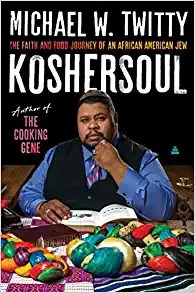
As for Twitty, I could easily just copy and paste his website to describe how he blends the two diasporas of African-Americans and the Jewish people and their food, but I’ll let you visit him yourself as he explores their crossroads. He is a two time James Beard award-winning author and his recent book, KOSHERSOUL: The Faith and Food Journey of an African-American Jew was the winner of the 2023 National Jewish Book Council Award for Book of the Year.


Find all his socials below as well as his website and links to purchase his books.

Afroculinaria on WordPress

Twitter

Instagram

The Cooking Gene

KosherSoul

He also offers classes in the DC/Baltimore area. Information here.


As promised, my recipe for Sweet Potato Casserole

To make this as a pie, pour into a graham cracker pie crust, cover with mini marshmallows and bake for about 35 minutes at 350, until marshmallows are golden brown.

Ingredients & Directions:

1 large can of sweet potatoes (cook, drain, mash)
1 stick of butter
1/4 cup of brown sugar (whatever variety you prefer – I use dark, Sylvia used light)
I don’t measure the spices, but I add about:
1 TB cinnamon
1/2 tsp nutmeg
Incorporate everything together and pour into a small, any shaped casserole dish. Cover the top with mini marshmallows and bake for 35 minutes at 350 degrees.

Scoop and serve.
If pie, let cool, slice, and serve.
Inspire. February 2023.

Standard

Do what you can, with what you have, where you are.

– Theodore Roosevelt

This is a picture I took in the hotel my daughter and I stayed at right before Covid. Her brother and father were visiting friends in Florida and we stayed in New York, so I took her for one night to a hotel for her to go swimming. It was a fun time. Little did we know how much would change in the next couple of weeks. I’m sharing this photo now because I came across it and it’s been in my phone as a photo that I want to draw and sketch, so I’m including it now to give them the push to try and get it done before the next inspiring post. Wish me luck. (c)2023

January almost always starts off with a bang. I’m organized, I’ve got my calendar, I’ve planned my blog and my classes up to a point, and then around now, not quite halfway through February, it flounders.

But…

It hasn’t floundered. Not really.

I think I may have found a routine, sort of, some motivation, kind of, and even though it’s not perfect, well, nothing is, it seems to be working (for the most part).

I’m still trying to find the perfect storm of organizing while not being overly fastidious and ridiculously detailed.

I’m sitting at my desk (read: dining room table that was actually cleaned last night for dinner, but is currently not even remotely close), surrounded by folders, papers, planner, notebooks, car keys (which actually have a home, but are not there at the moment), and my cell phone.

I have a meeting in ten minutes, and I’m still trying to get this post halfway done so I can put it up tomorrow (Wednesday). It would only be two days late (in my mind) so that’s okay, and that’s what I wanted to talk about.

Since the beginning of the new year, I’ve been on top of things. Not only on top of my website writing, but the site housekeeping is coming up this week (ch-ch-ch-changes), and I’ve been getting ready for my two new classes in March, and working on organizing my two books on Scrivener, my storyboard program.

And, the list goes on and on. Not sure if that’s such a good thing.

Since my success in November with NaNoWriMo, I’ve been really excited about writing. I’ve tried to keep track of my writing time, word counts, ideas for future items, and writing every day. Almost every day. This has been coupled with moving all of my computer folders onto an external hard drive to better organize my writing and be able to see what I have and what I can do with those old workshop pieces. Next up is transcribing those workshop notebooks that go back about a decade.

Things seem to be coming together, and I’m hoping that by writing about it, I won’t jinx it.

I had my final therapy appointment (until I find another therapist) last week. I’ve decided to take a month off and see how I’m feeling. It’s been ten years and therapy has been a lifeline as well as a mental comfort. I’m not sure how I’ll be, but I’m hyperaware of how I feel, and I have my coping. There have been so many changes recently and a lot of the positives began about ten years ago when I found therapy; my faith; my writing. It’s been a lot in ten years and the changes take some getting used to. Including deciding on a new therapist.

I had a funeral last week for a wonderful woman in my writing group. At her funeral (and unrelated to my friend), I believe that I was given inspiration for a short story.

Inspiration is everywhere.

I’ve been on a new social media site, Spoutible. It opens to the public on Thursday and despite its glitches and slowness, it’s amazing. The atmosphere is truly the anti-Twitter. Everyone is so nice and friendly and we’re all following each other. We’re helping each other figure things out and having conversations, and I think I’m going to really like it there.

It’s still in beta (and will continue to be on Thursday) but it’s a million times better than a week-old site should be. I feel safe, I feel lighter, something I didn’t feel on Twitter. I can feel my blood pressure remaining steady. And when I open it, I don’t see Jim Jordan, Ted Cruz, or Lauren Boebert like I do on Twitter at the top of my feed even though I don’t follow any of them. It’s kind of annoying. I mean, I can’t mute everyone, can I?

I will have a Spoutible account attached to this site, something I did not do with Twitter. I’m not sure how I’ll use it but come along for the ride.

That’s it for now. I have an exciting Friday Food coming up at the end of the week. Come back for that!