Reflection

Standard
(c)2025

I had the opportunity a few days ago to spend a couple of hours at Starbucks. I don’t know if the best part was the free breakfast or the writing I got done. It may have been the moment of Zen and bonding between the barista and me when we both agreed that this day was the fifth Monday in a row.

I typed and I scribbled – keyboard and paper both. I set my alarm for PT and didn’t worry one minute about the time. Whenever my rant became too vocal inside my head, I took a metaphorical step back and people-watched for a minute and I was able to step back from the edge and regain my focus. And I wrote some more.

Since I started working full time (which I am not complaining about), I have not been able to take my writing time on the road so to speak. I miss taking myself to a quiet meal, pulling out my notebook and jotting down some thoughts that eventually expand into something else; something more.

My witchy ghost straw and I enjoyed this quiet time, and it reminded me that I need to schedule these moments into my month. It doesn’t need to be a long time; it can be on one of my lunch hours, but it is so important to recharge the creativity.

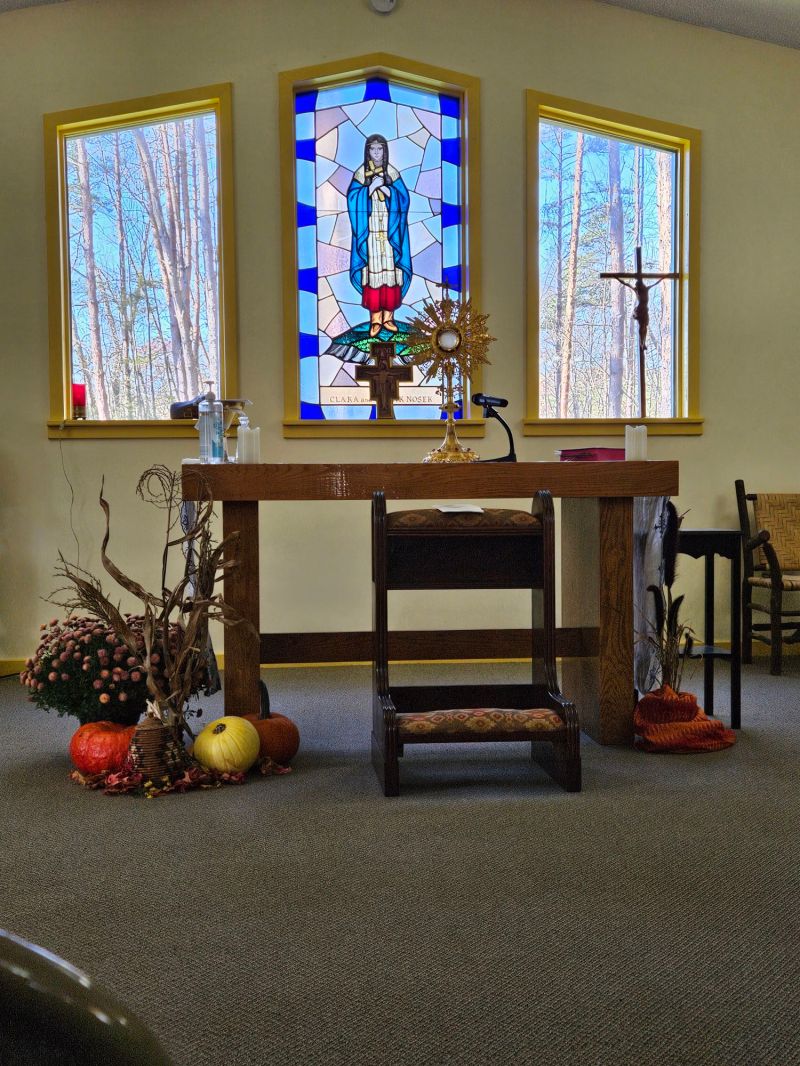
I had another wonderful day the Friday before, joining a pilgrimage at the St. Kateri Shrine in Fonda. I was able to meet new people, hear their reactions to the shrine, sit and listen and absorb the spirituality, the music, the moments in mass, and with the Sister who is part of St. Kateri’s story and miracle. The only word that comes close to describing it is glorious. It truly was that.

That one day there, and these couple of hours at the coffee shop will stay with me for the next few weeks, possibly a month or so, and carry me, push me, and let me move my book, as well as other writing, forward into the new year.

It’s a wonderful feeling.

Glorious.

Inspired, and More

Standard

The last few weeks have been nothing short of active, and I hope I’ve gotten through it with less scathing than would be normal for this kind of busyness. This post will be part mental health check-in, part inspired, part goal-setting.

I went back to my original post to see what the goals were that I thought I needed to focus on, and this was less than helpful. Goals and goalposts are constantly being adjusted. Looking at the biggest priorities, it’s still been iffy. Although to be fair to myself, I’ve been busy and not wasting time and opportunities, so while it’s been slow-going, it has still been going.

This is very much a positive.

Where are we this week?

  1. I was working on my presentation until about 7pm the night before. I realized there comes a point when it just needs to be done. I laid everything out on index cards, and did my thing. It was fantastic. I think everyone liked it and learned something new about St. Kateri Tekakwitha. I was able to constructively see things that I would change. I did a little improvisation and even though I finished later than planned, I was able to end on a decent note, and skipped a few slides at the end, and no one was the wiser. All in all, a good experience. I’m willing to do another powerpoint, although I’m hoping someone else presents it.
  2. Work. July 8th, I began working full-time. I haven’t worked full-time (outside the house) since my now-twenty-eight year old was two. It is a big adjustment for everyone, but my family is being supportive and picking up some tasks, and my co-workers and colleagues are amazing.
  3. Cursillo needs attention.
  4. I mentioned that I was going to avoid snoozing my alarms. I’ve still snoozed, but not as much and it’s made me more aware of what I need to do in the mornings to get out the door more efficiently.
  5. I’m disappointed in how our government is being run. I’m disgusted and repulsed by the Republican party, their hypocrisy, and their hatred. I don’t know how we come back from this precipice or how we survive.

Mental health check-in = EH.

I’m looking forward to taking my presentation and using it to push my book in the right direction. Below the cut are some of my inspiring and inspired photos from St. Kateri Tekakwitha’s feast day weekend.

Continue reading

June Inspired

Standard

When we were in Montreal last August, we were driving down one of the city’s streets on our way to Notre Dame Cathedral. It was our first time visiting the cathedral – it had been closed the year before when we tried. I was looking out the window – I’m always on the lookout for an unusual picture, and I saw a giant bird. Was that a bird? I asked my family. I think that was a dodo bird. I don’t know how I knew it was a dodo bird, but they thought I was seeing things. One google search showed that I wasn’t. It was really there. When we went last week, I made sure to put the dodo bird on my list of things to take a picture of.

It did not disappoint.

Most of the trip was to do research for the book I’m writing about St. Kateri Tekakwitha, and while I wasn’t able to look at documents, I did speak to some people, attended two masses, and received a wealth of information – all of it inspiring. The second mass was a surprise, and the priests were two traveling priests who said mass for the four of us in the church at the time. The homily was about Mary at the crucifixion, and I was moved to tears by not only this man’s words, his sermon, his preaching, but his excitement. He was just thrilled to be talking to us about our mother, Mary. It was a beautiful thing.

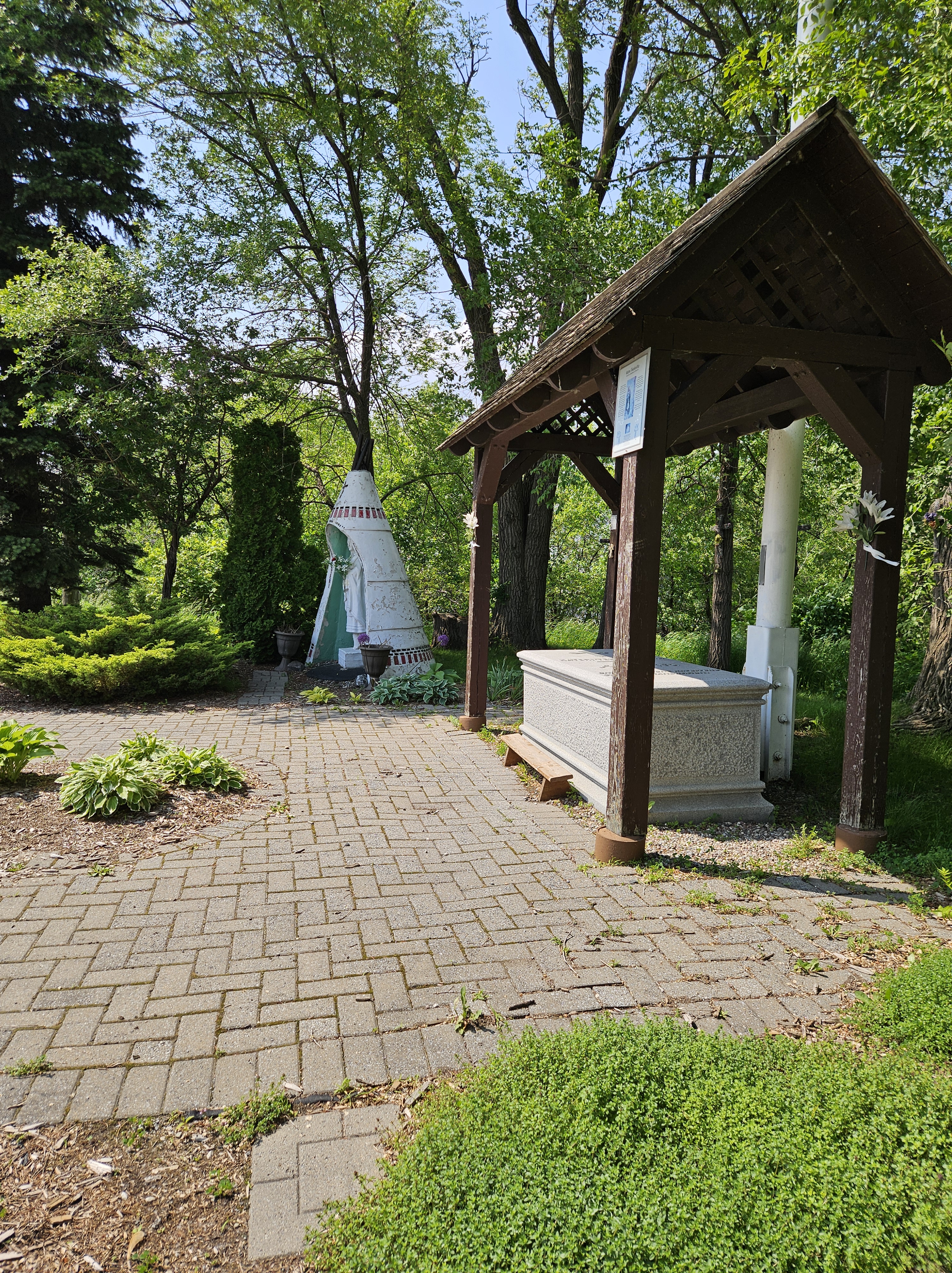
On our last day, we went to see the original burial place of St. Kateri, which is marked by an empty tomb (cenotaph) in Sainte-Catherine. I had been there before; this was the first Kateri place in Canada that I had been to initially, but I wanted some photos closer to the water that flowed behind the shrine. Water is important in the story of Kateri’s people and where they located their villages. I got there, and I stood for a moment, just looking around. I was overcome with the scent of flowers. It was so strong, like lilies or hyacinth. Hyacinth has that very strong, powerful, flowery aroma.

I looked around to find where the strong smell was coming from, but there was nothing. There were flowers, pines, grass, and a shrub or two. I even put my face into some of the colorful flowers that were budding there, but none of them gave off that smell. Nothing there could explain the scent. As one of my writing colleagues said the other night maybe St. Kateri was communicating something to me. She was called the Lily of the Mohawk, so maybe they were right. Whatever caused that remarkable moment I may never know, but it remains inspiring and wonderful all the same.


Dodo Bird. Montreal, Canada.
(c)2025
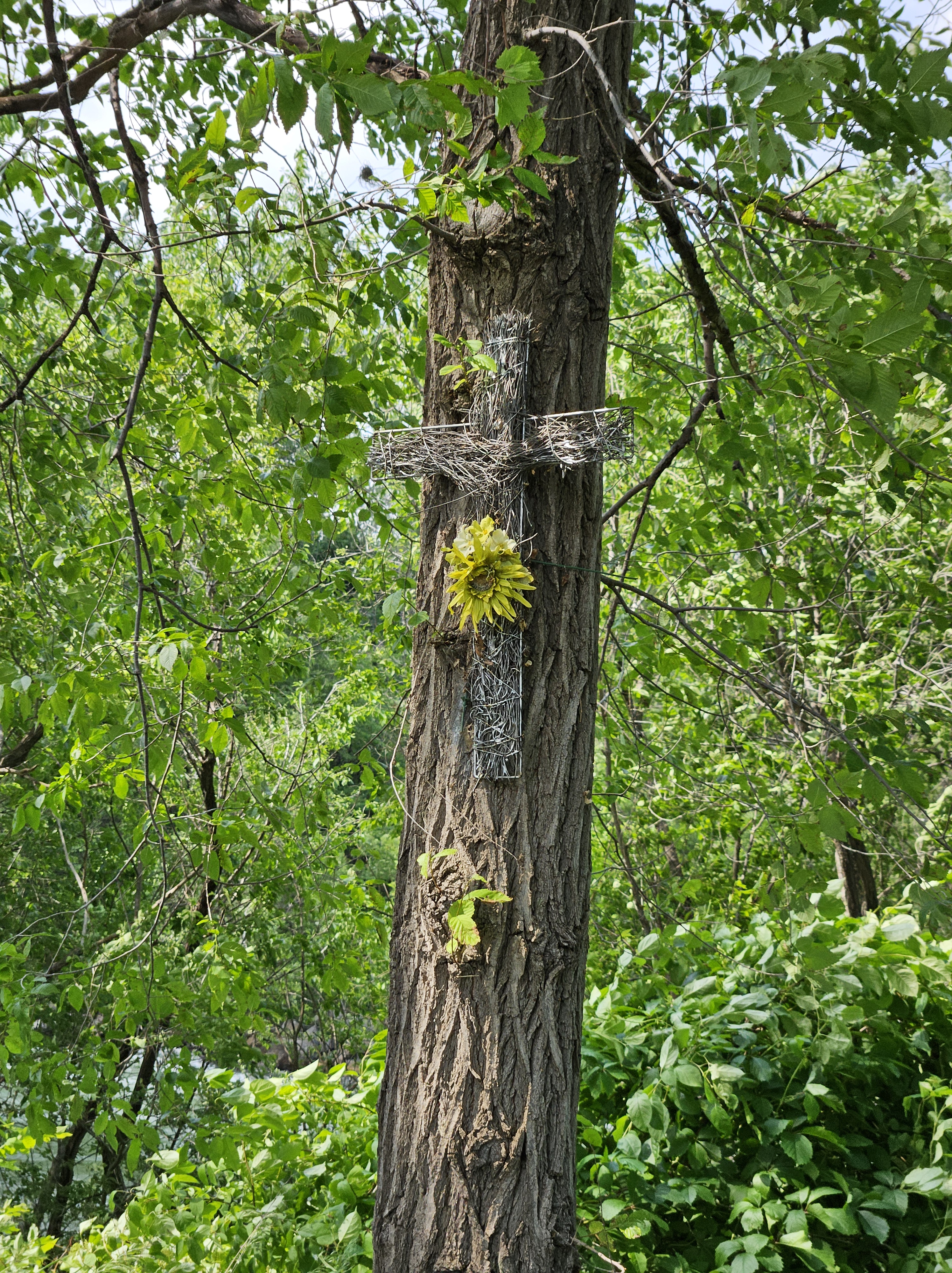
Cross on tree at the Tomb of St. Kateri Tekakwitha in Sainte-Catherine, Quebec. (c)2025
Tomb of
St. Kateri Tekakwitha in Sainte-Catherine, Quebec.
(c)2025

Feast Day of St. Kateri Tekakwitha (in Canada)

Standard
(c)2025

This is the feast day of St. Kateri Tekakwitha. She died on this day in 1680 at twenty-four years of age. Since that time, miracles have known to have occurred through her intercession. In two more days, is the anniversary of my own conversion.

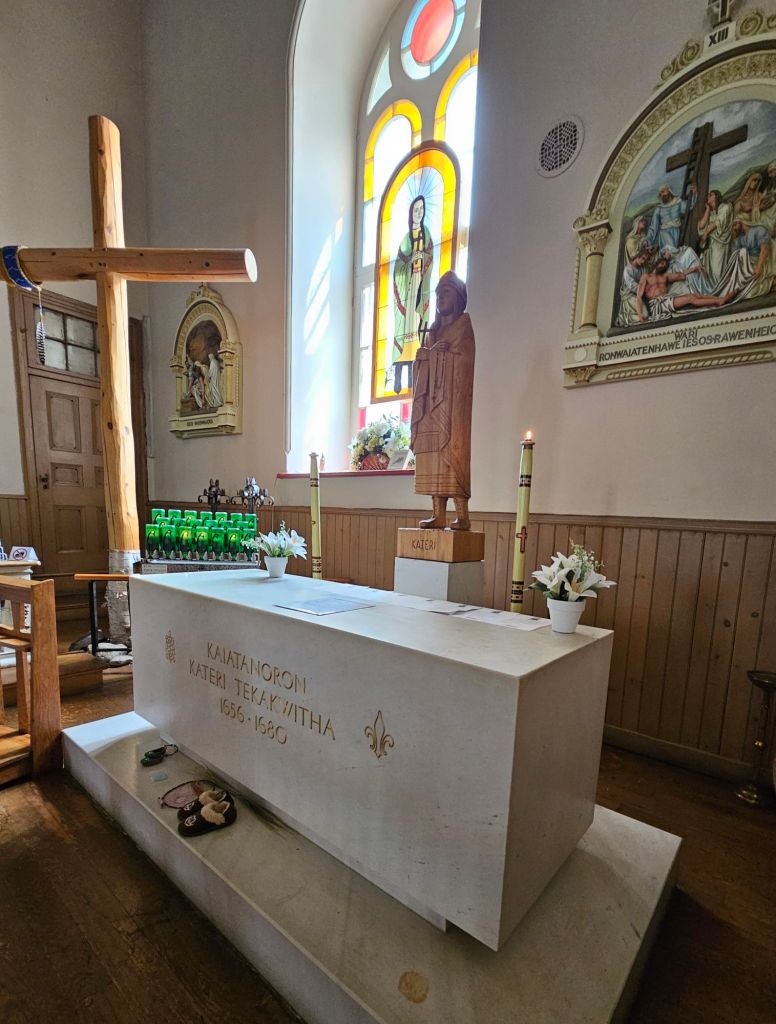
The photo above is at her tomb where her earthly remains rest at the St. Francis Xavier Mission Church in Kahnawake, Quebec. This is at the National Canadian Shrine of St. Kateri Tekakwitha.

I’m looking forward to the celebration of her feast day in the US in July, and my visit to this shrine and her tomb in June, partly for intensive research, but also hopefully to attend mass while we’re there.

St. Kateri, pray for us.

Native American Heritage Month Can Be All Year Long If You Know Where to Go

Standard

I think when it comes to marginalized groups in this country, it is important to remember that even though we attempt to celebrate them and honor them, we can still do that on the other 364 days of the year, and not just on “their” day.

Native American Heritage Month officially ended on November 30th, and Native American Heritage Day was commemorated on November 29th.

In addition to the post last week with links to the American Indian Museum in Washington, DC, I’d like to share the following links and travel recommendations for you to consider over the next 361 days.


The Akwesasne Cultural Center is located on State Route 37 in Akwesasne, New York, near the Canadian Border. They are a museum, library, and cultural center focusing on the history and culture of the Mohawk people as well as protecting Mohawk culture and artifacts. The museum and gift shop are open T – F, 10-6, and Sat, 10-2. The library is open additionally on Monday, 9-5.

The Kanien’keha’:ka Onkwawen:na Raotitiohkwa Language and Cultural Center was established in 1978. Its mission is to preserve and enrich the language and culture of the Kanien’keha:ka (Mohawk) of Kahnawa:ke. They are located in the Mohawk Territory of Kahanwa:ke, south of Montreal, Canada.

You can also find the Welcome Center, the Kateri Interpretive Center, and the St. Francis-Xavier Mission Church (on this site since 1716) in the Mohawk Territory of Kahnawa:ke. I have toured all three of these sites and it is well worth the visit.


From The National Museum of the American Indian at the Smithsonian: The “First Thanksgiving”: How Can We Tell a Better Story?

Bluesky Handle, Puff the Magic Hater has a thread of ways to support Native people, for everything from abortion care, defending voting rights, keeping Native families together, and more. Visit the thread here.

I’d like to close this post with the words of someone smarter than me. On Nov 29, 2024, historian Heather Cox Richardson wrote on Facebook:

Continue reading

Research and Rabbit Holes

Standard

For my May inspired I thought I would indulge a little. As many know I have been doing a lot of research for my book on St. Kateri, and as I was reminded of in a recent writing class I took, with research you will learn much more than you will actually include in your book, whether that book is fiction or non-fiction, and I have discovered the truth in that. The research that I’ve been doing for this book includes not only St. Kateri’s life before sainthood, but also Mohawk history, the Jesuits in New France, and various aspects of both Catholicism and the longhouse religion as well as many other details that help to inform the writing and the context, something that I’m learning the Jesuits at the time lacked when they spoke of the Native American ways.

I went down one rabbit hole recently that led me to three separate web pages regarding President Ulysses S. Grant’s “Indian Policy,” which was both informative and disheartening. I spent two hours reading, and it will only result in one or two sentences in the entire book.

In discussing 19th century treaties with one of my writing groups, I was sent a recent article on a court case from 2005 that referenced a treaty from 1794. There was also a recent Supreme Court case whose decision was based on a treaty from the 1800s regarding water rights. Another disheartening read as while the Supreme Court agreed that the Native tribe had rights to water, they did not however have the right to have the US government provide said water. Whew! What an acrobatic backflip!

One thing that surprised me in reading about the Jesuit way of converting the Natives to Catholicism was how they dismissed the Haudenosaunee’s spirituality and religious ceremonies when they were already so close to Christianity: a monotheistic society with one Creator, virgin births, miracles, and several other instances of commonalities.

I’ve read five books, two of which had nothing to do with St. Kateri but was wholly about Haudenosaunee Creation and the creation of their confederation and countless journal articles including one comparing the Jesuits’ use of incense to the Native American’s use of sacred fire and smudging. In reading Tom Porter’s book, And Grandma Said…, I have confirmed that we are more alike than we are different. In fact, when he was discussing how he prayed (by talking to his Creator), but was told that was the wrong way to pray by Christians, I was aggravated; that was exactly the way I prayed since childhood – through conversations with my G-d.

As appalled as I’ve been over the years at the treatment of Native Americans by colonialists (and modern people) I have become even more appalled and tell anyone who will listen about these judgments and discrimination foisted upon the Native population here on Turtle Island.

The second time we visited Kahnawake in Quebec, I told our tour guide that I wanted to visit, not only for the St. Kateri information where her tomb was, but also because what my children, who are 27, 19, and 18 have learned of their Iroquois history in 4th grade is the same as I learned in my 4th grade class forty years before that.

I’m reaching out to people with questions. I’m visiting places where Kateri lived both as a child and as a young adult, taking notes, creating lists of questions, looking through land buying archives, borrowing well-worn books out of the library. I’m getting help from places I hadn’t expected and advice on where to look for information. I’ve reached out to an artist for permission to use his art and I’ve signed up for journal access, which fortunately was granted for one month rather than requiring payment for the entire year.

While there is a struggle to find some material, I am reading from Mohawk sources to realize the context and seeing the misunderstandings of the Jesuits towards Kateri’s people. I also believe some of those characterizations were intentional to make Kateri seem more pure, more otherworldly, more worthy of the sainthood they coveted for her future.

My next two research jaunts I’m hoping to make are to the shrines in Fonda, New York and Kahnawake, Quebec to visit their archives. In both cases, I’m hoping the papers are in English rather than French. I also hope to interview one or two people and visit one area’s Strawberry Festival and one area’s Pow-Wow (both of which are open to the public). Those have less to do with Kateri the person and more to do with the Mohawk heritage.

Rabbit holes. They are deep and twisty, and the bucket is often not big enough for what is unearthed.

A Total Totality

Standard

We spent eclipse weekend in Montreal, Canada. Once we were shut out of Syracuse (too expensive) and Plattsburgh (no room at the – or any – inn), it wasn’t a difficult decision to go a short distance further. I love being that close to the border, and luckily our passports are current.

Because of the research I planned to do while we were up there, I thought we’d pop our chairs down at the park near the Ile de Tekakwitha on the Mohawk territory/Kahnawake. We scoped it out the night before and the parking looked extremely limited, but we were still hopeful. We would decide when the time came. As darkness settled in, we drove out to the main road for dinner – Robbie’s Smokehouse!

On Monday, we woke up bright and early; adventure awaited!

Continue reading

St. Francis Xavier Mission Church in Kahnawake, Quebec

Standard

When I was studying Catholicism and becoming Catholic, I wanted to know which saint shared my birthday. As it turned out, when I discovered that “my birthday saint” was St. Francis Xavier, I was a little underwhelmed. Every time I said his name I thought of Rufus Xavier Sarsaparilla, and I thought couldn’t I have had a better saint.

I bemoaned and ignored him, later discovering him as a follower of St. Ignatius of Loyola, who’s Spiritual Exercises and Daily Examen I was also looking into. Still, I was unsatisfied. I think I wanted someone like Joan of Arc or Mary Magdalene.

When I became interested in and devotional to St. Kateri Tekakwitha, a very local saint and the first Native American canonized saint, I wanted to visit her homes and her shrines. I’ve often been to Fonda, where she lived for most of her life, and tried to visit her tomb in Quebec. However, it was during covid, and they weren’t allowing non-parishioners or pilgrims to visit the shrine.

Where exactly is her shrine in Canada?

Kahnawake, Mohawk Territory at the, wait for it, St. Francis Xavier Mission Church.

Really. Her earthly bones, her relics are laid to rest in the church dedicated to “my birthday saint”. A truly remarkable and at the same time ordinary coincidence.

I’ve been to Kahnawake three times. The first was during that covid time when we could only explore the outside. And then this past summer, I was able to visit Kahnawake twice. The first time we visited, we knew the church would be closed on the only day we had available, but we did attend a tour of the village through the Kahnawake Tourism Center. We received a very detailed and informational tour about the area, the Mohawks past and present, St. Kateri, and a bit about the mission church. On our next visit at the end of August, we were able to not only visit and see the inside of the church, we were also able to attend mass, see the original and earliest painting of Kateri by Father Claude Chauchetiere (one of the Jesuit missionaries at the time) as well as her relic that was removed from the vault for us to observe and venerate (if we chose to).

This mission church is a permanent building and was erected in 1716. Before that it was a moveable mission that traveled with the Mohawks beginning in La-Prairie-de-la-Madeleine. They moved a total of five times each time their mission church was constructed the same as the other Mohawk buildings until this last time in its permanent location. St. Kateri’s remains were entombed here in 1972.

Inside the church, in addition to St. Kateri’s tomb, are two memorials: the first is to the Mohawk men lost in the Quebec Bridge disaster in 1907, and the second is an ironwork replica of the World Trade Center’s Twin Towers in honor of 9/11. Both are on the main altar. It should be noted that the Mohawk are known for their ironworking skills, and were large parts of crews building not only the World Trade Center, but the Empire State Building as well in addition to many other high-rise buildings and skyscrapers across the area.

[Photos below cut]

Continue reading

All Saints Day

Standard

I’ve written before about the saints in my spiritual life. The photo below shows the three I considered for my confirmation saint (next Easter it will be ten years!): Joan of Arc, Kateri Tekakwitha, and Elen of Caernarfon as well as a fourth devotion, Mary, Untier of Knots. I had hoped to have a new prayer for the St. Elen card I sketched, but it wasn’t ready for today. I hope to share it in the next week.

Who are the saints you ask to intercede for you in prayer?

(c)2023

Indigenous Peoples’ Day

Standard

On the Coloring Sheets page, there is a new sheet for Indigenous Peoples’ Day which is today. Below I will explain what each square represents. I’m glad that we are beginning to acknowledge the people who were here long before the Europeans arrived and drastically changed things through their way of life, their diseases, their concepts of ownership, and of course, their biases, which for many remain today.

I am determined to remind myself and others that the land I live and work on once belonged to the world, and the Haudenosaunee (in my specific area) were the caretakers. They were willing to help the new settlers, and did. And I’m sure regretted it. The Europeans weren’t exactly grateful in the long run.

Wherever you live look at the names of the towns. Across this country (the US) and Canada you will find many towns and streets are named with Native American names. I like to look into some of those names and see what they mean in the various languages.

Continue reading