Sweetgrass

Standard

A few weeks ago, I spent a couple of hours at the St. Kateri Shrine and Historic Site braiding sweetgrass for their gift shop. Sweetgrass is one of the four sacred plants of the Haudenosaunee and it is used along with cedar, sage, and tobacco in their sacred ceremonies. The shrine grows it there among other native-to-the-land plants. I tried to describe the sweet smell of it and all I could come up with is that it smells like sweet grass. Not grass clippings, or freshly mowed; it’s different, but that’s as far as my olfactory vocabulary would cooperate.

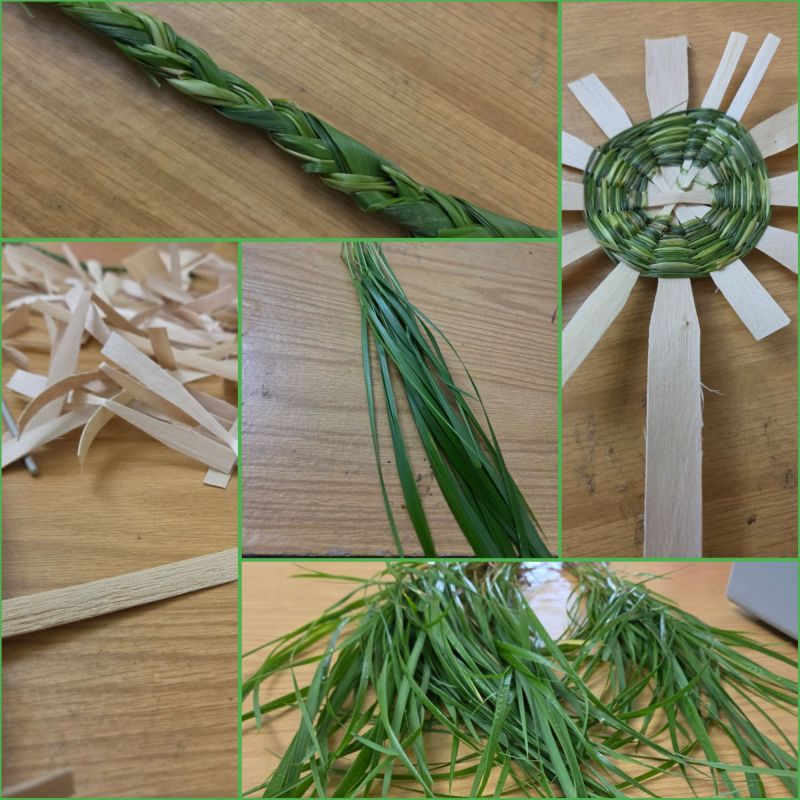
During St. Kateri’s weekend, they had a sweetgrass demonstration that I participated in with one of the elders from Akwesasne, one of the Mohawk communities in upstate New York, on the border with Canada. She showed us how to pick and clean the blades and then we braided some and she taught us how to make a bookmark.

The materials couldn’t be simpler, although I couldn’t tell you where to source them: wood splints – these are shaved birch bark, I believe and freshly grown sweetgrass. You’ll need a bucket of water as the sweetgrass is easier to manipulate when it’s moist. You will love the smell that permeates throughout the space and on your fingers.

It was a fun and educational experience, so when I was sent this video on how to make a sweetgrass bookmark, I thought I would share it here as part of my ongoing writings about St. Kateri Tekakwitha.

St. Kateri Tekakwitha

Standard

Today is St. Kateri Tekakwitha’s Feast Day. This year marks the special occasion of the 350th anniversary of St. Kateri’s baptism here in New York. On Thursday, I’ll have a special travel edition with information on visiting her shrine for her feast day weekend happening in a few days.

In the meantime, I’m announcing a new page here on the website called Traveling with St. Kateri Tekakwitha found here. I wanted to celebrate and commemorate her baptismal anniversary while also including some of my visits to her spaces and the Mohawk lands as well as some of my research adventures as I write the book about her and her shrines.

A little something about St. Kateri:

  1. She was born in 1656 in what is known as the Mohawk Valley region of New York State. Her father was a Mohawk chief and her mother an Algonquin Christian.
  2. When she was about four, both of her parents and her younger brother died from smallpox. She contracted smallpox and survived with lifelong health ailments, a frail constitution, and semi-blindness.
  3. She was adopted by her uncle and was raised in the  Turtle clan longhouse.
  4. When she was ten, the village moved across the Mohawk River and formed the village of  Caughnawaga. This site is the only fully excavated Iroquois site in the world. In 1666/1667, the Jesuits came to convert the Native population. They were allowed into the village as part of the peace treaties signed with the French government.
  5. Kateri was baptized on Easter Sunday, April 5, 1676 by Fr. Jacques de Lamberville.
  6. In the fall of that year, she left the Mohawk Valley to live with her sister and brother-in-law in Kahnawake, a Mohawk/Jesuit village along the St. Lawrence River in what was known then as New  France and known today as southern Quebec.
  7. At Christmas of that year, she received her First Communion.
  8. Despite being denied joining or forming a religious order, she formed a sisterhood with two other women and in 1679 took a vow of perpetual virginity, consecrating herself to Jesus, the son of Mary.
  9. She died April 17, 1680. Her smallpox scars cleared up and she was in what was called the odor of sanctity.
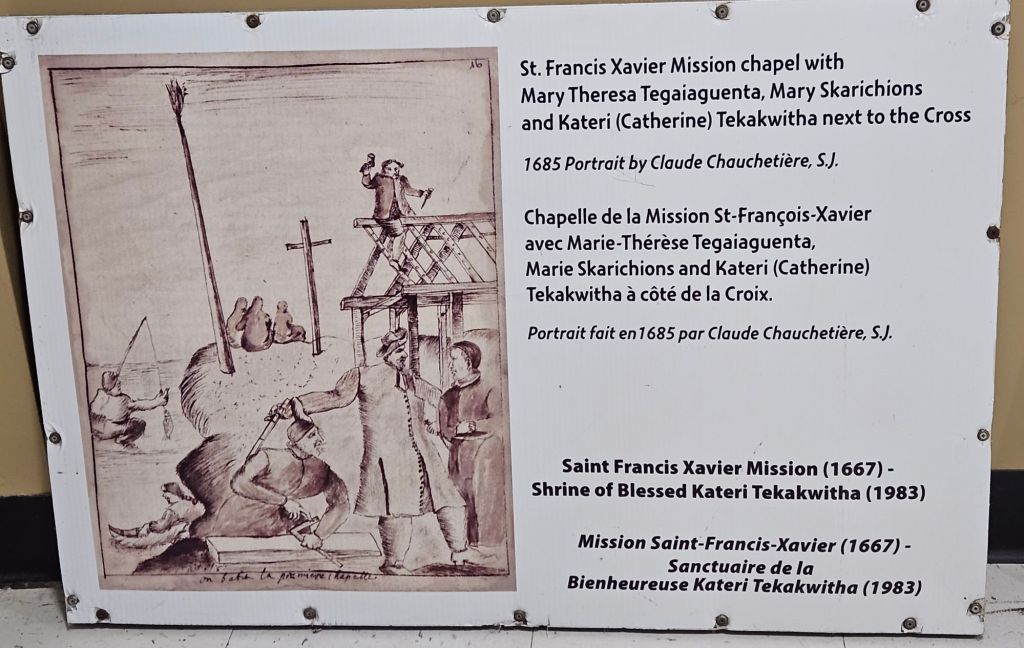
  10. The sketch below was done from memory by one of her spiritual directors, Fr. Claude Chauchetiere, SJ in 1685, five years after her death. She and her two companions watch as the mission chapel is being built.

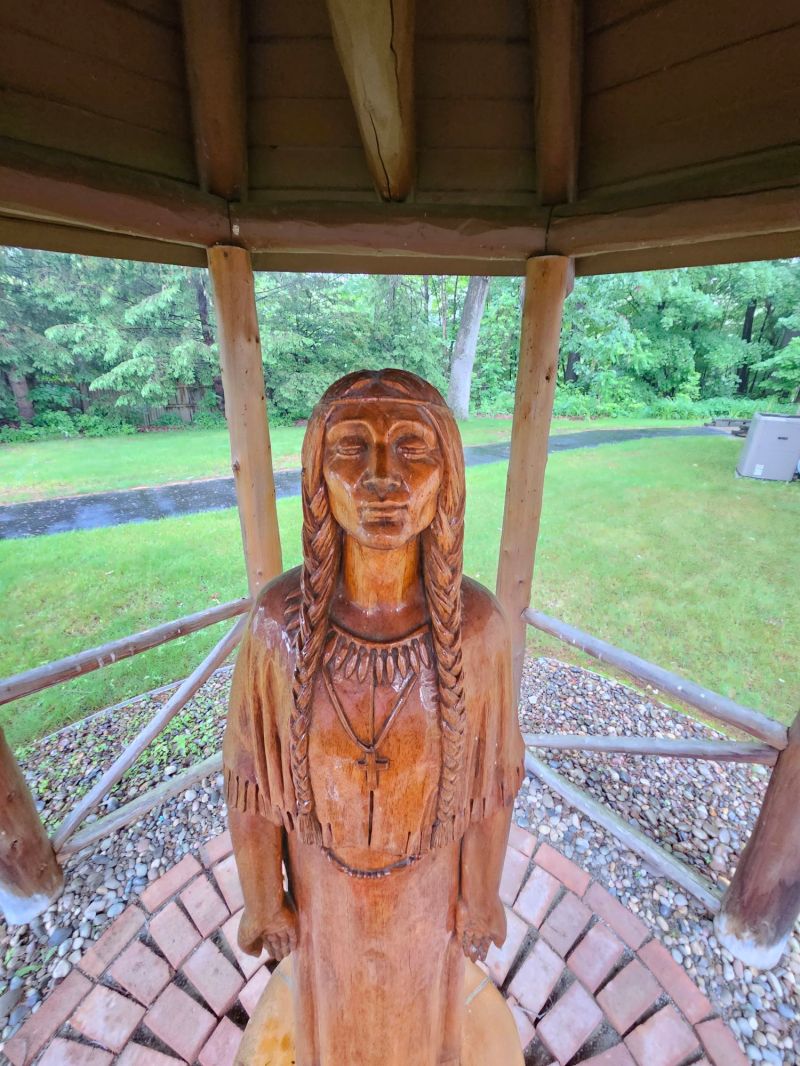
The topmost photo is of the statue at the shrine at Sacred Heart Roman Catholic Church in Lake George, NY. The simplicity and elegance of the wood carving is an inspiration in my devotion to St. Kateri as well as the spiritual, sacred feeling it evokes when I visit it.

Friday Food – An Inspiration

Standard

Strawberry Festivals

While I know something of Native American culture, in writing my current book, I’ve discovered so much more, and it excites and inspires me. June is an important month in the Native American calendar, especially for the Haudenosaunee, as it is the season of strawberries. In addition to the three sisters (corn, beans, and squash), strawberries are a significant part of the culture, food source, and creation story. They are the first fruits of spring, and a leader of the berries. They are singled out for thanksgiving in the welcoming address before ceremonies.

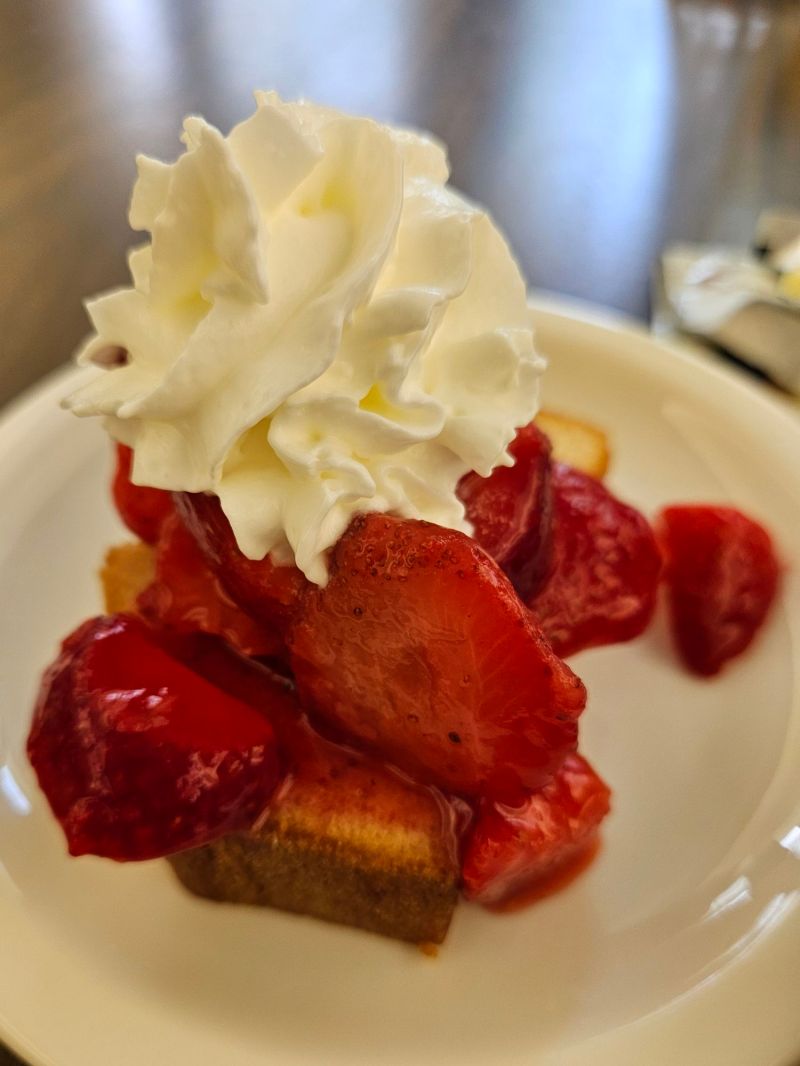
Strawberries are sweet and tart, red and juicy. They can be enjoyed on their own or in other foods, mixed into salads, pureed into ice cream or yogurt, sat atop cakes or baked right in. They are refreshing and if you’re lucky, plentiful in June.

There are two Strawberry Festivals that you should know about happening in the next few weeks:

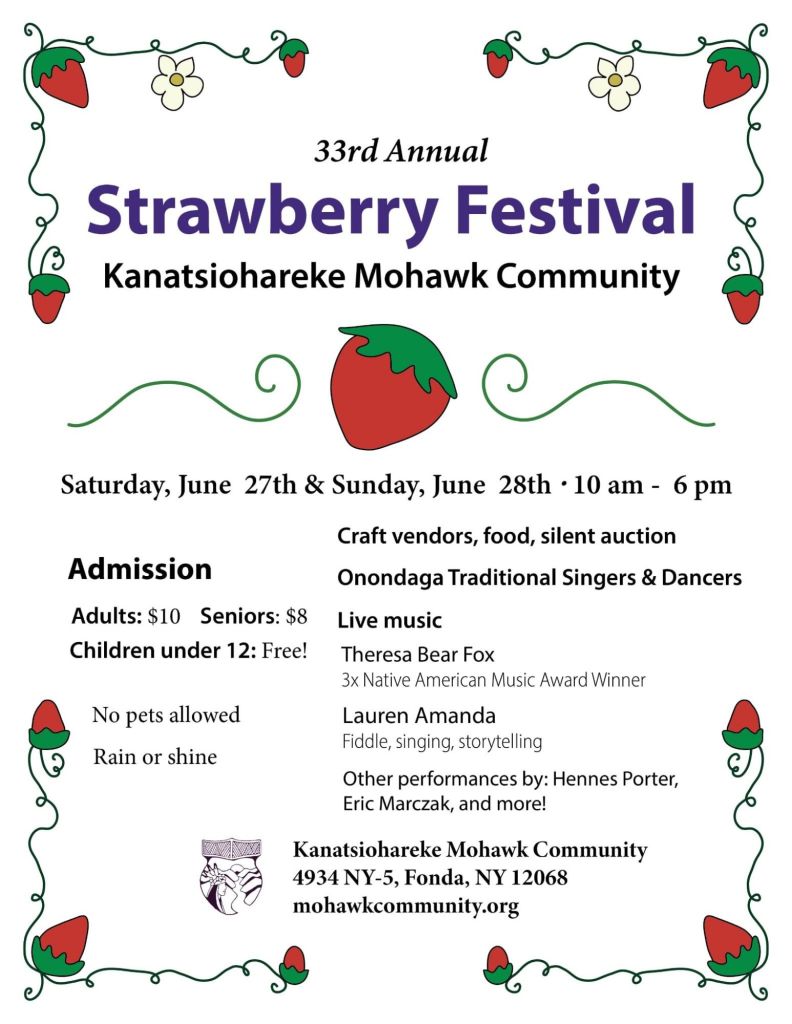
The 33rd Annual Strawberry Festival at the Kanatsiohareke Mohawk Community west of Fonda, New York on Saturday, June 27 and Sunday, June 28, and

The 11th Annual Kahnawa:ke Strawberry Food Fest just over the border in Kahnawake, Quebec, in southern Canada on Saturday, June 20, 2026.

Both events are filled with strawberry goodness, Haudenosaunee Mohawk culture, Native music and dancers, and much more! Check their flyers and websites for admission prices.

If you are in Fonda, stop by up the road and visit the St. Kateri Tekakwitha: National Shrine & Historic Site, celebrating the 350th anniversary of St. Kateri’s baptism on the site. She is the first North American Native Saint canonized by the Catholic Church.

If you decide on Kahnawake, don’t forget your passport for the border! You can also visit the Canadian National Shrine for St. Kateri where her relics are entombed. Contact the Kahnawake Tourism also to set up a tour of the village which sits on the St. Lawrence Seaway.

St. Kateri Tekakwitha

Standard

I didn’t start out writing a book about St. Kateri. I’d never heard of her before a chance encounter with a random church in 2012, but that is an entire other story and a lifetime away, or at least that’s how it seems. As

I’ve written about before, I was drawn to her at the time very near to her canonization, and when I went through the conversion process, RCIA at the time, she was on my short list for confirmation saints. I went in another direction, partly for my attachment to Wales and partly because I still held onto the fear of appropriation. That might have been that, but in my discernment of joining the Catholic faith, I visited the shrine of the North American Martyrs and discovered holiness there. I found out that this palisade was the footprint of the original Mohawk village, Ossernenon where Kateri was born. She was born about ten years after the Jesuits martyrdom, but it never really resonated with me as her place. Over time, I discovered the Fonda shrine where Kateri had grown up. I visited the museum, the archaeological site, had a picnic there with the Cursillo group, a Catholic organization, and gradually began to read about her life. Her life in Fonda, her ‘escape’ to Quebec, the reception of her sacraments as a young adult, and her death at a very young age.

I’ve written about a lot of this, and some of it will feature in my book, but through it I learned more and more, and thought I’d visit her shrine in Canada to complete my journey with and alongside Kateri.

I’ve spent many meaningful hours at the shrine in Fonda, New York and the people there have been gracious and generous with their time and resources as I continue my research and writing. I feel a part of their community, and the first time I received an unexpected hug it came with a large smile welcoming me back. I felt it deep inside. I am drawn there more and more, each visit a gift. Learning about Kateri through different sources is also a gift.

She was born in 1656, parents died in 1659; she was baptized in 1676, received her first communion in 1677, and died in 1680. In 1980 she was beatified, and in 2012 canonized.

I give you the litany of her statistics to remind when big things happened in her life in order to inform that this year is a big deal anniversary. One member of the community did some math and as I said, Kateri was baptized in 1676. This was an Easter Sunday, and the date was April 5th. Because of that uncovering, it was realized that this year Easter Sunday also falls on April 5th! It is exactly to the day, and the Easter celebration that St. Kateri was baptized three hundred fifty years ago.

To commemorate this event, once in a lifetime I dare say, the Kateri Shrine in Fonda, NY requested ad received permission from the bishop of the Albany Diocese where the shrine resides to hold an Easter Mass on that auspicious day. The Shrine typically doesn’t open it’s buildings until May 1st when the weather is warmer as the public buildings have no heat, so this is a special day in so many ways.

The presider will be Fr. Michael Heine, OFM Conv., the Minister Provincial of the Conventual Franciscan Friars. They are the custodians of the shrine since its founding in 1938 by Conventual Franciscan Friar, Fr. Thomas Grassman.

It is a day or so away as I write this, but I am beyond excited to be going to the mass and to be part of this extraordinary event commemorating her baptism and we renew our own baptismal vows.

Information on attending this mass or any other events at the shrine can be found on their website: Saint Kateri Tekakwitha National Shrine & Historic Site

Reflection

Standard
(c)2025

I had the opportunity a few days ago to spend a couple of hours at Starbucks. I don’t know if the best part was the free breakfast or the writing I got done. It may have been the moment of Zen and bonding between the barista and me when we both agreed that this day was the fifth Monday in a row.

I typed and I scribbled – keyboard and paper both. I set my alarm for PT and didn’t worry one minute about the time. Whenever my rant became too vocal inside my head, I took a metaphorical step back and people-watched for a minute and I was able to step back from the edge and regain my focus. And I wrote some more.

Since I started working full time (which I am not complaining about), I have not been able to take my writing time on the road so to speak. I miss taking myself to a quiet meal, pulling out my notebook and jotting down some thoughts that eventually expand into something else; something more.

My witchy ghost straw and I enjoyed this quiet time, and it reminded me that I need to schedule these moments into my month. It doesn’t need to be a long time; it can be on one of my lunch hours, but it is so important to recharge the creativity.

I had another wonderful day the Friday before, joining a pilgrimage at the St. Kateri Shrine in Fonda. I was able to meet new people, hear their reactions to the shrine, sit and listen and absorb the spirituality, the music, the moments in mass, and with the Sister who is part of St. Kateri’s story and miracle. The only word that comes close to describing it is glorious. It truly was that.

That one day there, and these couple of hours at the coffee shop will stay with me for the next few weeks, possibly a month or so, and carry me, push me, and let me move my book, as well as other writing, forward into the new year.

It’s a wonderful feeling.

Glorious.

Research and Rabbit Holes

Standard

For my May inspired I thought I would indulge a little. As many know I have been doing a lot of research for my book on St. Kateri, and as I was reminded of in a recent writing class I took, with research you will learn much more than you will actually include in your book, whether that book is fiction or non-fiction, and I have discovered the truth in that. The research that I’ve been doing for this book includes not only St. Kateri’s life before sainthood, but also Mohawk history, the Jesuits in New France, and various aspects of both Catholicism and the longhouse religion as well as many other details that help to inform the writing and the context, something that I’m learning the Jesuits at the time lacked when they spoke of the Native American ways.

I went down one rabbit hole recently that led me to three separate web pages regarding President Ulysses S. Grant’s “Indian Policy,” which was both informative and disheartening. I spent two hours reading, and it will only result in one or two sentences in the entire book.

In discussing 19th century treaties with one of my writing groups, I was sent a recent article on a court case from 2005 that referenced a treaty from 1794. There was also a recent Supreme Court case whose decision was based on a treaty from the 1800s regarding water rights. Another disheartening read as while the Supreme Court agreed that the Native tribe had rights to water, they did not however have the right to have the US government provide said water. Whew! What an acrobatic backflip!

One thing that surprised me in reading about the Jesuit way of converting the Natives to Catholicism was how they dismissed the Haudenosaunee’s spirituality and religious ceremonies when they were already so close to Christianity: a monotheistic society with one Creator, virgin births, miracles, and several other instances of commonalities.

I’ve read five books, two of which had nothing to do with St. Kateri but was wholly about Haudenosaunee Creation and the creation of their confederation and countless journal articles including one comparing the Jesuits’ use of incense to the Native American’s use of sacred fire and smudging. In reading Tom Porter’s book, And Grandma Said…, I have confirmed that we are more alike than we are different. In fact, when he was discussing how he prayed (by talking to his Creator), but was told that was the wrong way to pray by Christians, I was aggravated; that was exactly the way I prayed since childhood – through conversations with my G-d.

As appalled as I’ve been over the years at the treatment of Native Americans by colonialists (and modern people) I have become even more appalled and tell anyone who will listen about these judgments and discrimination foisted upon the Native population here on Turtle Island.

The second time we visited Kahnawake in Quebec, I told our tour guide that I wanted to visit, not only for the St. Kateri information where her tomb was, but also because what my children, who are 27, 19, and 18 have learned of their Iroquois history in 4th grade is the same as I learned in my 4th grade class forty years before that.

I’m reaching out to people with questions. I’m visiting places where Kateri lived both as a child and as a young adult, taking notes, creating lists of questions, looking through land buying archives, borrowing well-worn books out of the library. I’m getting help from places I hadn’t expected and advice on where to look for information. I’ve reached out to an artist for permission to use his art and I’ve signed up for journal access, which fortunately was granted for one month rather than requiring payment for the entire year.

While there is a struggle to find some material, I am reading from Mohawk sources to realize the context and seeing the misunderstandings of the Jesuits towards Kateri’s people. I also believe some of those characterizations were intentional to make Kateri seem more pure, more otherworldly, more worthy of the sainthood they coveted for her future.

My next two research jaunts I’m hoping to make are to the shrines in Fonda, New York and Kahnawake, Quebec to visit their archives. In both cases, I’m hoping the papers are in English rather than French. I also hope to interview one or two people and visit one area’s Strawberry Festival and one area’s Pow-Wow (both of which are open to the public). Those have less to do with Kateri the person and more to do with the Mohawk heritage.

Rabbit holes. They are deep and twisty, and the bucket is often not big enough for what is unearthed.
Travel – National Shrine of the North American Martyrs, Auriesville, NY and St. Kateri Tekakwitha, National Shrine & Historic Site, Fonda, NY

Standard

I hadn’t intended for this series on travel to wholly encompass shrines, but I was asked yesterday about visiting these two later in the summer and thought it would be a good opportunity to share their information with you.

The sites are spiritually connected by both St. Kateri Tekakwitha and the Jesuits. The site in Auriesville has a coliseum, one of the first circular churches built in the US. It holds about 6000 people. Across their 600 acres of land is a museum, one or two chapels, a grotto dedicated to Our Lady of Fatima, and Theresa’s Rosary, a rosary made of rocks embedded in the ground. I have walked and prayed this rosary on one of my visits.

There is also the ravine where Rene Goupil’s body was found. In visiting there, I found it very spiritual and a place of holiness. The way to the ravine is quite steep. On the way there are several statues and grottos to pray at as well as signs that tell the story of the Martyrs.

Prior to his martyrdom, Isaac Jogues had been held in captivity and tortured by the Mohawk (a different group) for over a year. With help he escaped in New Netherland or Albany, NY. He returned to France, where he visited his mother in Orleans (where Joan of Arc led France’s army 219 years before) and was considered a “living martyr” by Pope Urban VIII, but soon again returned to this area, longing for and meeting his martyrdom in what is now Auriesville. It had been the Mohawk village of Ossernenon. He, Jean de Lalande, and Rene Goupil were tortured and killed here. Jogues weighted Goupil’s body and placed it in the water of the ravine in order to return and bury him properly. He did return, but he was gone. He later found some of his body parts, and reverently buried them. I’ve heard others say that the ravine itself is a reliquary. As I said, the spirituality felt here is palpable.

At this same village, ten years after their deaths, Kateri Tekakwitha was born. She became ill with smallpox and both of her parents died. She was scarred, and it was difficult for her to see, needing to put her hands out and feel her way. Her name Tekakwitha translates into she who bumps into things. Her mother had been baptized Catholic and educated by the e missionaries. Her village moved from Ossernenon across the Mohawk River and rebuilt their village, named Caughnawaga, which means place of the rapids. She was bullied for practicing her Catholic faith. She refused to be married, and that did not make her popular within her adoptive family and aunts. She also practiced mortification, praying for the conversion of her family and for forgiveness.

Her name Kateri is for her baptismal name of Catherine, which she received after her baptism at the age of 19. It took me several years, but I was able to walk to the spring (it’s a bit of a steep incline) from the village footprint that archeologists uncovered. Her Native people still felt that the Catholic religious rituals and items were sorcery and opposed her conversion. At some point after her conversion, she was helped to leave and went north to the new Mohawk village where other Native converts had gone. This village was also named Kahnawake (this is the Mohawk spelling), just south of Montreal. She died in 1680.

When I visited her empty tomb (where she was first laid to rest until her relics were removed to the St. Francis Xavier Mission Church on the Mohawk land), the sound of the rushing water nearby was nearly deafening. I have had so many spiritual experiences in visiting the sites of Kateri and her people that it only makes me more in awe of the Holy Spirit.

For those who are not religious, but want to visit a pastoral, serene, place of comfort, both shrines offer that in the beautiful Mohawk valley. The sights and sounds are lovely, and it is easy to get lost in your own thoughts. Of course, that’s until the train comes roaring by, but that is in its own way an affirmation of the space we are in.


National Shrine of the North American Martyrs
Auriesville, NY

Open May 1 – October 19, 2023
Hours:
Grounds: Open daily 9-7
Museum: Open daily 11-3:30
Gift Shop/Visitor Center: Open daily 10-3
There is no fee for admission or parking.
If you are interested in attending mass or other events, visit their website.

National Shrine of the North American Martyrs.
(c)2023

St Kateri Tekakwitha, National Shrine & Historic Site
Fonda, NY

Summer Season: May 1st to October 31st
Hours:
Grounds are open sunrise to sunset daily.
Saint Peter’s Chapel and Native American Museum open daily, 9-5
Gift shop open: Sat, 10-6, Sun – Wed, 9-5, Thurs – Fri, 10-4
Office open daily 9-4
Candle Chapel, Caughnawaga Village Site, Kateri Spring and grotto, outdoor sanctuary, and hiking trails are open sunrise to sunset year-round.
If you are interested in attending mass (scroll down at the link) or other events, visit their website.

St. Kateri Tekakwitha statue with a sign of her last words:
Jesus, I love you!
(c)2023

June Inspiration, Expanded

Standard

As I mentioned in the June Inspire last week, I’ve been awed by the number of inspiring events I’ve been privileged to have participated in since the very beginning of the month. Since I was unable to choose one or two to write about, I thought I’d write about most of them, and include some photos and links so you can explore on your own in your own timeframe and let them capture your imagination and inspire you as well.

One warning before I really get into it: this will be picture heavy (as well as, from my estimate, word heavy).

June began with a weekend retreat that I’m still feeling. June is also the end of the school year, and so during finals and Regent’s exams, my youngest often doesn’t have to go to school, and since the whole crew at home took a day off to see The Flash movie (no spoilers ahead), we decided to take a road trip to Connecticut. And then finally, a field trip to a college outside of Albany to tour a set of books (a Bible actually) of Biblical calligraphy and illuminations. And in between all of that it’s been busy with driving my kids, funeral for a colleague and friend, interfaith doings, Red Hats lunch, a broken hearing aid, weekly rosary, and Father’s Day, an interfaith prayer service, and a fellowship luncheon.

June has been a lot more than usual, and it’s still got a few days left; Indiana Jones will be inspiring in its own way. I don’t want it to sound as though I’m complaining; I’m really not, although once I get started it’s hard to turn off the listing; it’s like a waterfall. However, I can’t say it’s been dull or uninspiring; it’s definitely been the opposite of both of those.

Continue reading

Inspire. June.

Standard

Inspire is a little late this month…okay, it’s a lot late this month. It’s not that I’ve been procrastinating as much as I’ve been absorbing and acting on the plethora of inspiration that I’ve been exposed to in the last several weeks. Sometimes there is a lull or a slight time of unknowing what I’ll write about, but this month was the opposite. How do I choose from the things that inspired me this month, and continue to inspire me? This paragraph formed the introduction to a much longer article on some of the inspirational things I’ve been exposed to throughout June; however, I decided to share some stories from last night’s World Peace & Prayer Day Interfaith Service that I attended at the Historic St. Kateri Tekakwitha Shrine in upstate New York and save the longer writing for another day.

World Peace and Prayer Day was started in 1994 by Avrol Looking Horse to honor the birth two years before of a white buffalo calf, which was a sign of changing times to come as well as the “coming of the mending of the Hoop of All Nations”. She was named Miracle. June 21st was chosen because it is a powerful time to pray for peace as well as being the Summer Solstice and the longest day of the year. It is an offering and hope to heal all of Mother Earth’s gifts that live on the earth, including the Earth herself.


Speak evil of no one. If you can say no good of a person, then be silent..

Let not your tongues betray you into evil,

For these are words of our Creator.

Let all strive to cultivate friendship with those who surround them.

Handsome Lake, Iroquois Prophet

Continue reading

Native American Heritage Month (2)

Standard

When we travel to places with Native American distinction and I plan to buy something to remember my visit, I look to see if the object is Native made. There are so many knock-offs and items appropriated out there that I feel that if I’m going to buy Native crafts, symbols, and jewelry, it should be genuinely made by Native peoples and the income should benefit them.

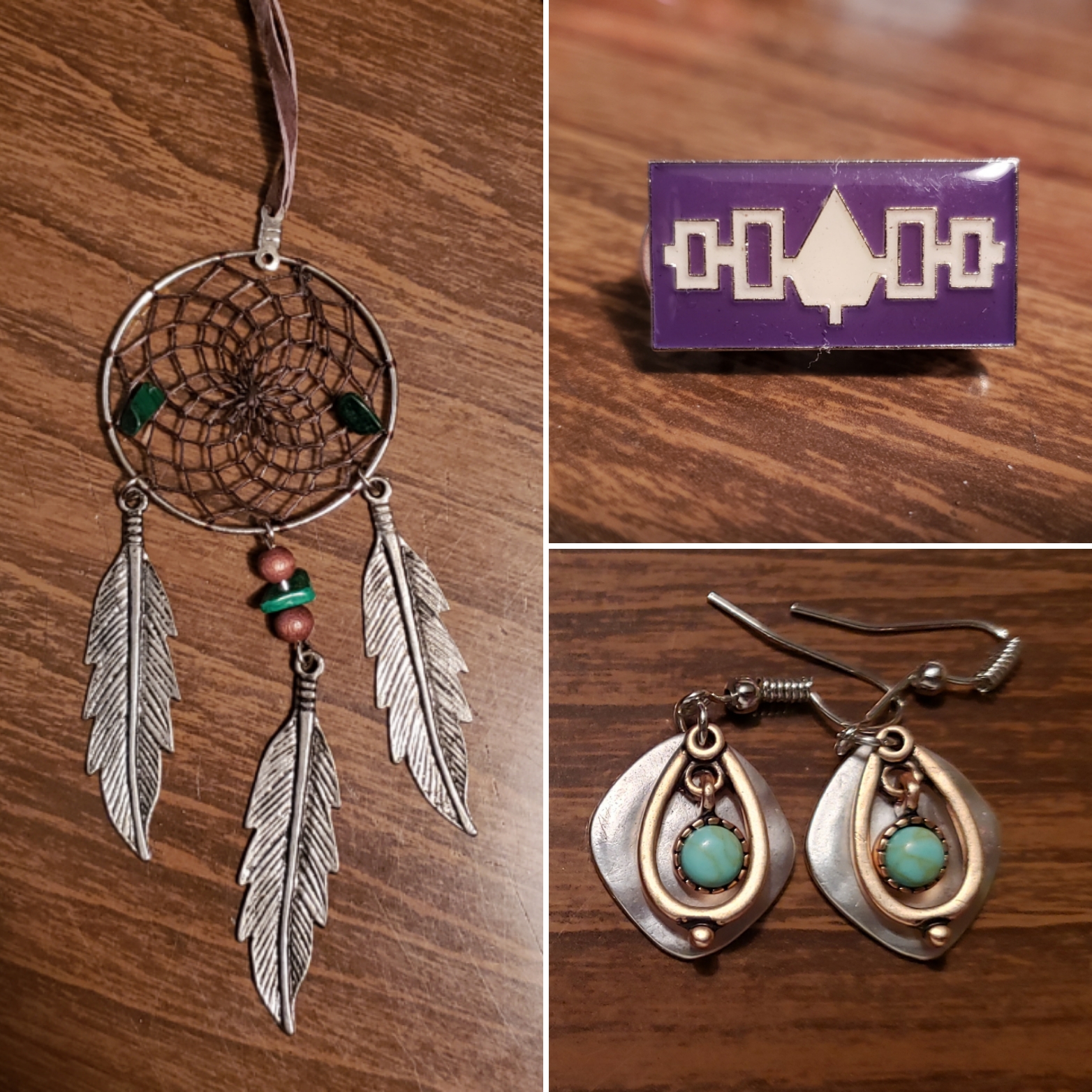
The picture below highlights my three most recent crafts:

(c)2021

The photo on the left is a dream catcher. I have had one in my bedroom for decades. I had received a small one but it has been mislaid. I chose this one while we were in Montreal. I didn’t realize it at first but it is a necklace. I have hung it over the lamp on my bedstand to keep away bad spirits and dreams.

The top right is a simple lapel pin that I purchased at the St. Kateri Shrine in Fonda, New York. It is the flag of the Iroquois Confederation. These flags can be seen flying in many places across New York State and lower Canada.

The bottom right picture is a pair of earrings I discovered in Niagara Falls, Ontario. I was drawn several times to the three colors – the silver, the bronze, and the turquoise. While this design could easily be Native American jewelry or ancient Egyptian, and I was so happy to find that they were indeed Native made. As my birthstone is turquoise, I am often drawn to the stone and color.