Sweetgrass

Standard

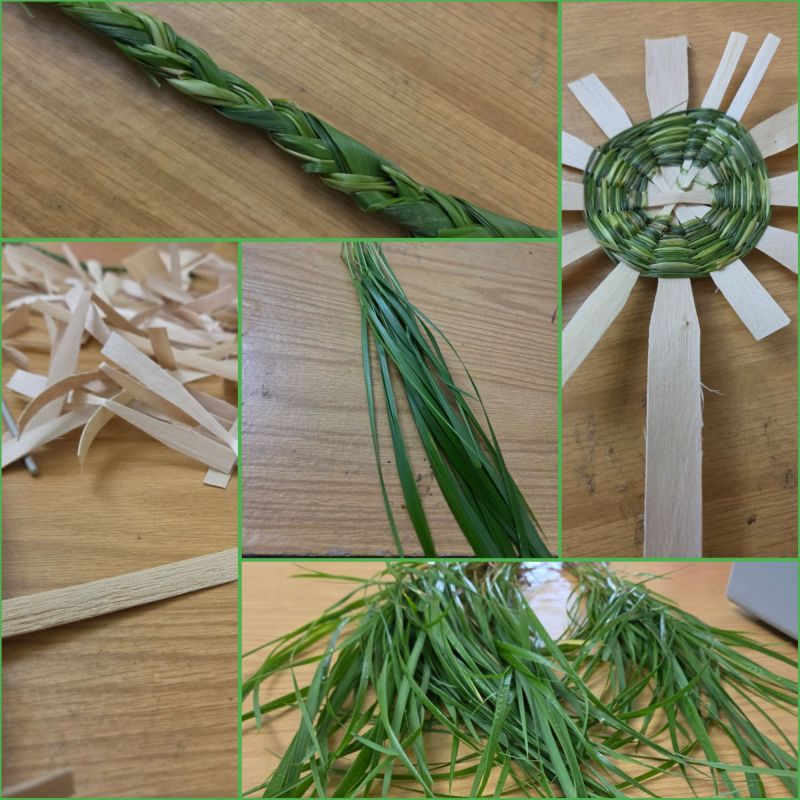
A few weeks ago, I spent a couple of hours at the St. Kateri Shrine and Historic Site braiding sweetgrass for their gift shop. Sweetgrass is one of the four sacred plants of the Haudenosaunee and it is used along with cedar, sage, and tobacco in their sacred ceremonies. The shrine grows it there among other native-to-the-land plants. I tried to describe the sweet smell of it and all I could come up with is that it smells like sweet grass. Not grass clippings, or freshly mowed; it’s different, but that’s as far as my olfactory vocabulary would cooperate.

During St. Kateri’s weekend, they had a sweetgrass demonstration that I participated in with one of the elders from Akwesasne, one of the Mohawk communities in upstate New York, on the border with Canada. She showed us how to pick and clean the blades and then we braided some and she taught us how to make a bookmark.

The materials couldn’t be simpler, although I couldn’t tell you where to source them: wood splints – these are shaved birch bark, I believe and freshly grown sweetgrass. You’ll need a bucket of water as the sweetgrass is easier to manipulate when it’s moist. You will love the smell that permeates throughout the space and on your fingers.

It was a fun and educational experience, so when I was sent this video on how to make a sweetgrass bookmark, I thought I would share it here as part of my ongoing writings about St. Kateri Tekakwitha.

St. Kateri Tekakwitha

Standard

Today is St. Kateri Tekakwitha’s Feast Day. This year marks the special occasion of the 350th anniversary of St. Kateri’s baptism here in New York. On Thursday, I’ll have a special travel edition with information on visiting her shrine for her feast day weekend happening in a few days.

In the meantime, I’m announcing a new page here on the website called Traveling with St. Kateri Tekakwitha found here. I wanted to celebrate and commemorate her baptismal anniversary while also including some of my visits to her spaces and the Mohawk lands as well as some of my research adventures as I write the book about her and her shrines.

A little something about St. Kateri:

  1. She was born in 1656 in what is known as the Mohawk Valley region of New York State. Her father was a Mohawk chief and her mother an Algonquin Christian.
  2. When she was about four, both of her parents and her younger brother died from smallpox. She contracted smallpox and survived with lifelong health ailments, a frail constitution, and semi-blindness.
  3. She was adopted by her uncle and was raised in the  Turtle clan longhouse.
  4. When she was ten, the village moved across the Mohawk River and formed the village of  Caughnawaga. This site is the only fully excavated Iroquois site in the world. In 1666/1667, the Jesuits came to convert the Native population. They were allowed into the village as part of the peace treaties signed with the French government.
  5. Kateri was baptized on Easter Sunday, April 5, 1676 by Fr. Jacques de Lamberville.
  6. In the fall of that year, she left the Mohawk Valley to live with her sister and brother-in-law in Kahnawake, a Mohawk/Jesuit village along the St. Lawrence River in what was known then as New  France and known today as southern Quebec.
  7. At Christmas of that year, she received her First Communion.
  8. Despite being denied joining or forming a religious order, she formed a sisterhood with two other women and in 1679 took a vow of perpetual virginity, consecrating herself to Jesus, the son of Mary.
  9. She died April 17, 1680. Her smallpox scars cleared up and she was in what was called the odor of sanctity.
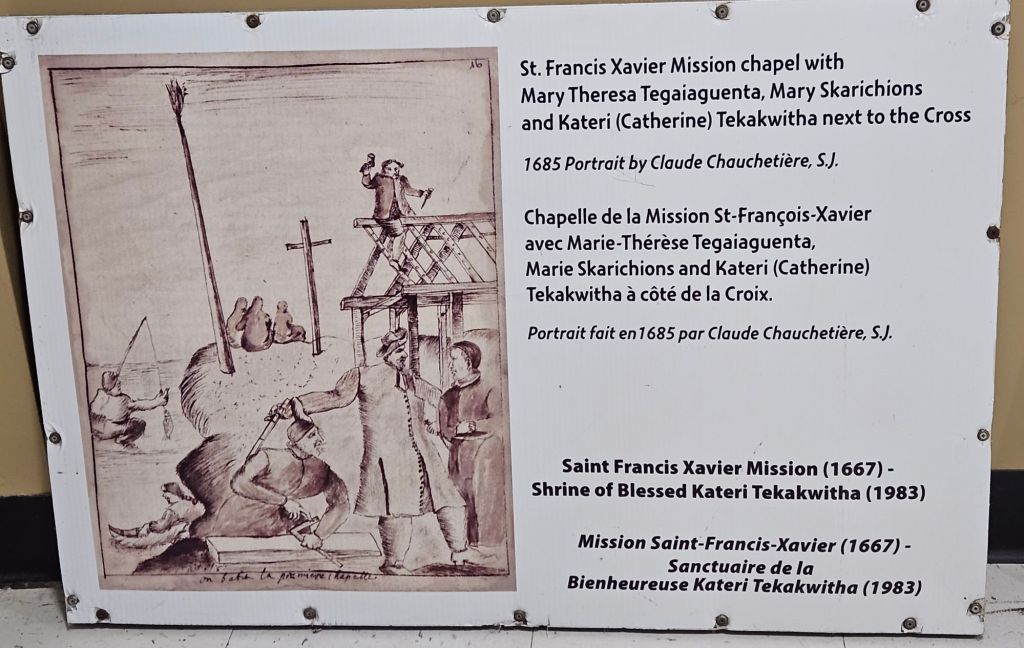
  10. The sketch below was done from memory by one of her spiritual directors, Fr. Claude Chauchetiere, SJ in 1685, five years after her death. She and her two companions watch as the mission chapel is being built.

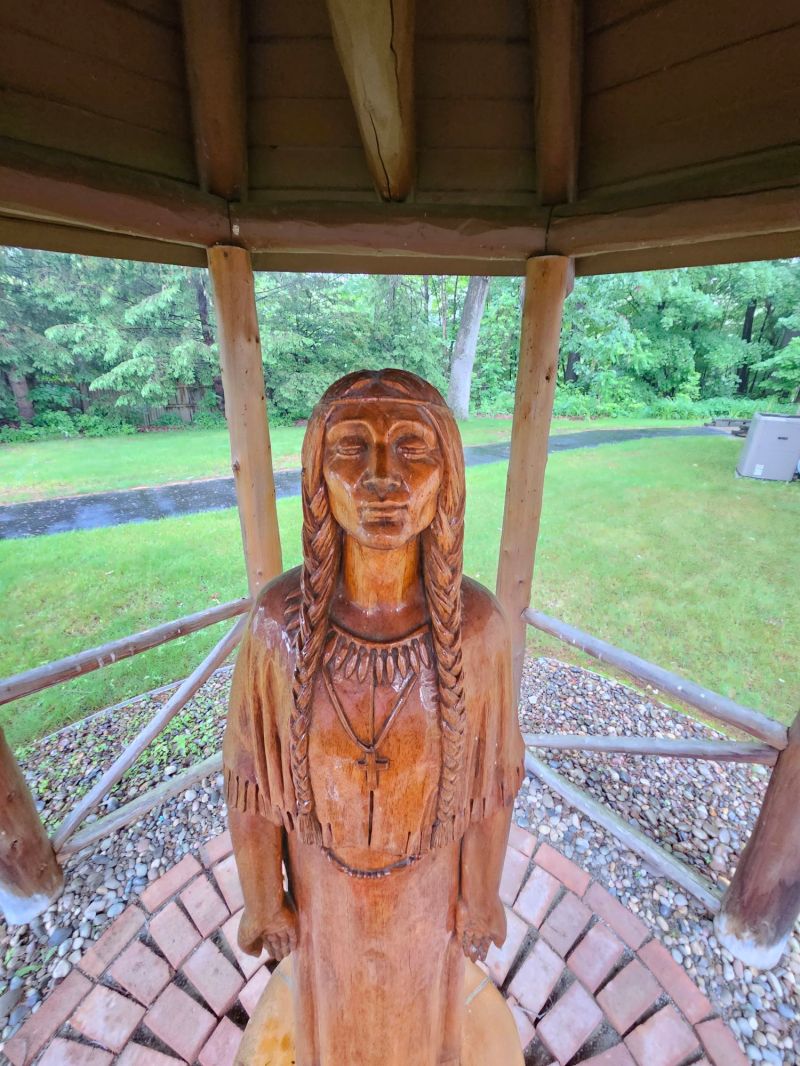
The topmost photo is of the statue at the shrine at Sacred Heart Roman Catholic Church in Lake George, NY. The simplicity and elegance of the wood carving is an inspiration in my devotion to St. Kateri as well as the spiritual, sacred feeling it evokes when I visit it.

St. Kateri Tekakwitha

Standard

I didn’t start out writing a book about St. Kateri. I’d never heard of her before a chance encounter with a random church in 2012, but that is an entire other story and a lifetime away, or at least that’s how it seems. As

I’ve written about before, I was drawn to her at the time very near to her canonization, and when I went through the conversion process, RCIA at the time, she was on my short list for confirmation saints. I went in another direction, partly for my attachment to Wales and partly because I still held onto the fear of appropriation. That might have been that, but in my discernment of joining the Catholic faith, I visited the shrine of the North American Martyrs and discovered holiness there. I found out that this palisade was the footprint of the original Mohawk village, Ossernenon where Kateri was born. She was born about ten years after the Jesuits martyrdom, but it never really resonated with me as her place. Over time, I discovered the Fonda shrine where Kateri had grown up. I visited the museum, the archaeological site, had a picnic there with the Cursillo group, a Catholic organization, and gradually began to read about her life. Her life in Fonda, her ‘escape’ to Quebec, the reception of her sacraments as a young adult, and her death at a very young age.

I’ve written about a lot of this, and some of it will feature in my book, but through it I learned more and more, and thought I’d visit her shrine in Canada to complete my journey with and alongside Kateri.

I’ve spent many meaningful hours at the shrine in Fonda, New York and the people there have been gracious and generous with their time and resources as I continue my research and writing. I feel a part of their community, and the first time I received an unexpected hug it came with a large smile welcoming me back. I felt it deep inside. I am drawn there more and more, each visit a gift. Learning about Kateri through different sources is also a gift.

She was born in 1656, parents died in 1659; she was baptized in 1676, received her first communion in 1677, and died in 1680. In 1980 she was beatified, and in 2012 canonized.

I give you the litany of her statistics to remind when big things happened in her life in order to inform that this year is a big deal anniversary. One member of the community did some math and as I said, Kateri was baptized in 1676. This was an Easter Sunday, and the date was April 5th. Because of that uncovering, it was realized that this year Easter Sunday also falls on April 5th! It is exactly to the day, and the Easter celebration that St. Kateri was baptized three hundred fifty years ago.

To commemorate this event, once in a lifetime I dare say, the Kateri Shrine in Fonda, NY requested ad received permission from the bishop of the Albany Diocese where the shrine resides to hold an Easter Mass on that auspicious day. The Shrine typically doesn’t open it’s buildings until May 1st when the weather is warmer as the public buildings have no heat, so this is a special day in so many ways.

The presider will be Fr. Michael Heine, OFM Conv., the Minister Provincial of the Conventual Franciscan Friars. They are the custodians of the shrine since its founding in 1938 by Conventual Franciscan Friar, Fr. Thomas Grassman.

It is a day or so away as I write this, but I am beyond excited to be going to the mass and to be part of this extraordinary event commemorating her baptism and we renew our own baptismal vows.

Information on attending this mass or any other events at the shrine can be found on their website: Saint Kateri Tekakwitha National Shrine & Historic Site

Check in for Lent

Standard

Lent has snuck up on us again this year. It is quite early with Easter happening the first weekend in April.  I just finished listening to Fr. James Martin’s Ash Wednesday podcast, and it reminded me of many of the things that I want to do to make my Lent intentional. As with the last few years, I am not giving anything specific up. I am going to continue to be intentional in what I am taking in whether that is food, candy, drink, or media. I want to put more thought into the things I’m doing, saying, and bringing into my life.

This year marks the 800th anniversary of the death of St. Francis, and Pope Leo has declared this to be a Jubilee Year in his honor from January 10, 2026 through January 10, 2027. There are all kinds of ways to earn plenary indulgences and what not, but that’s for someone else.

Another exciting event this year is that it is the 350th anniversary of St. Kateri Tekakwitha’s baptism. This happened right here in New York state, and the shrine in Fonda will be celebrating. One way is by having mass on Easter Sunday, which is her baptismal anniversary to the day.

Some of my other Lenten Intentions include:

Continue reading

Reflection

Standard
(c)2025

I had the opportunity a few days ago to spend a couple of hours at Starbucks. I don’t know if the best part was the free breakfast or the writing I got done. It may have been the moment of Zen and bonding between the barista and me when we both agreed that this day was the fifth Monday in a row.

I typed and I scribbled – keyboard and paper both. I set my alarm for PT and didn’t worry one minute about the time. Whenever my rant became too vocal inside my head, I took a metaphorical step back and people-watched for a minute and I was able to step back from the edge and regain my focus. And I wrote some more.

Since I started working full time (which I am not complaining about), I have not been able to take my writing time on the road so to speak. I miss taking myself to a quiet meal, pulling out my notebook and jotting down some thoughts that eventually expand into something else; something more.

My witchy ghost straw and I enjoyed this quiet time, and it reminded me that I need to schedule these moments into my month. It doesn’t need to be a long time; it can be on one of my lunch hours, but it is so important to recharge the creativity.

I had another wonderful day the Friday before, joining a pilgrimage at the St. Kateri Shrine in Fonda. I was able to meet new people, hear their reactions to the shrine, sit and listen and absorb the spirituality, the music, the moments in mass, and with the Sister who is part of St. Kateri’s story and miracle. The only word that comes close to describing it is glorious. It truly was that.

That one day there, and these couple of hours at the coffee shop will stay with me for the next few weeks, possibly a month or so, and carry me, push me, and let me move my book, as well as other writing, forward into the new year.

It’s a wonderful feeling.

Glorious.

Inspired, and More

Standard

The last few weeks have been nothing short of active, and I hope I’ve gotten through it with less scathing than would be normal for this kind of busyness. This post will be part mental health check-in, part inspired, part goal-setting.

I went back to my original post to see what the goals were that I thought I needed to focus on, and this was less than helpful. Goals and goalposts are constantly being adjusted. Looking at the biggest priorities, it’s still been iffy. Although to be fair to myself, I’ve been busy and not wasting time and opportunities, so while it’s been slow-going, it has still been going.

This is very much a positive.

Where are we this week?

  1. I was working on my presentation until about 7pm the night before. I realized there comes a point when it just needs to be done. I laid everything out on index cards, and did my thing. It was fantastic. I think everyone liked it and learned something new about St. Kateri Tekakwitha. I was able to constructively see things that I would change. I did a little improvisation and even though I finished later than planned, I was able to end on a decent note, and skipped a few slides at the end, and no one was the wiser. All in all, a good experience. I’m willing to do another powerpoint, although I’m hoping someone else presents it.
  2. Work. July 8th, I began working full-time. I haven’t worked full-time (outside the house) since my now-twenty-eight year old was two. It is a big adjustment for everyone, but my family is being supportive and picking up some tasks, and my co-workers and colleagues are amazing.
  3. Cursillo needs attention.
  4. I mentioned that I was going to avoid snoozing my alarms. I’ve still snoozed, but not as much and it’s made me more aware of what I need to do in the mornings to get out the door more efficiently.
  5. I’m disappointed in how our government is being run. I’m disgusted and repulsed by the Republican party, their hypocrisy, and their hatred. I don’t know how we come back from this precipice or how we survive.

Mental health check-in = EH.

I’m looking forward to taking my presentation and using it to push my book in the right direction. Below the cut are some of my inspiring and inspired photos from St. Kateri Tekakwitha’s feast day weekend.

Continue reading

June Inspired

Standard

When we were in Montreal last August, we were driving down one of the city’s streets on our way to Notre Dame Cathedral. It was our first time visiting the cathedral – it had been closed the year before when we tried. I was looking out the window – I’m always on the lookout for an unusual picture, and I saw a giant bird. Was that a bird? I asked my family. I think that was a dodo bird. I don’t know how I knew it was a dodo bird, but they thought I was seeing things. One google search showed that I wasn’t. It was really there. When we went last week, I made sure to put the dodo bird on my list of things to take a picture of.

It did not disappoint.

Most of the trip was to do research for the book I’m writing about St. Kateri Tekakwitha, and while I wasn’t able to look at documents, I did speak to some people, attended two masses, and received a wealth of information – all of it inspiring. The second mass was a surprise, and the priests were two traveling priests who said mass for the four of us in the church at the time. The homily was about Mary at the crucifixion, and I was moved to tears by not only this man’s words, his sermon, his preaching, but his excitement. He was just thrilled to be talking to us about our mother, Mary. It was a beautiful thing.

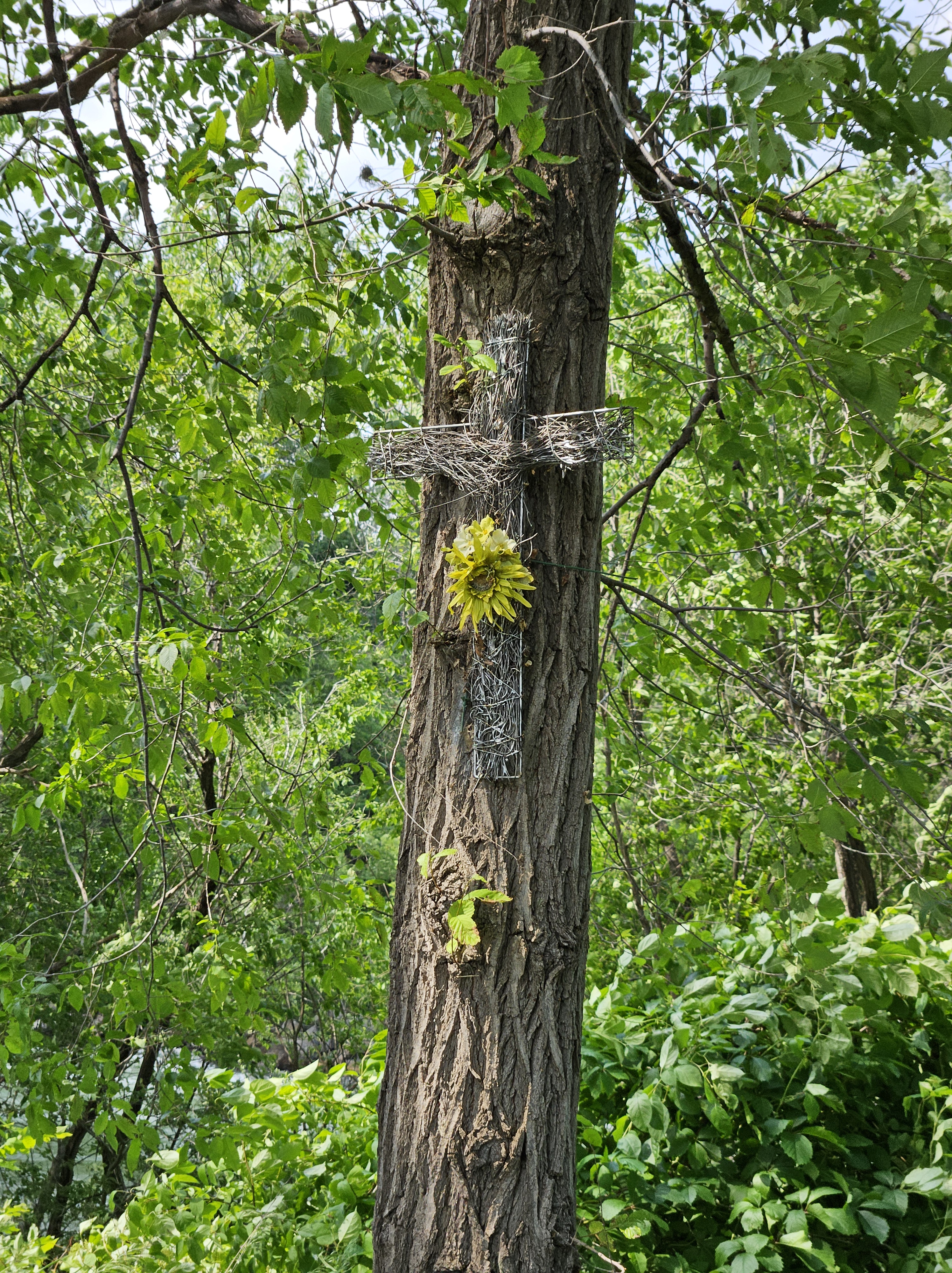
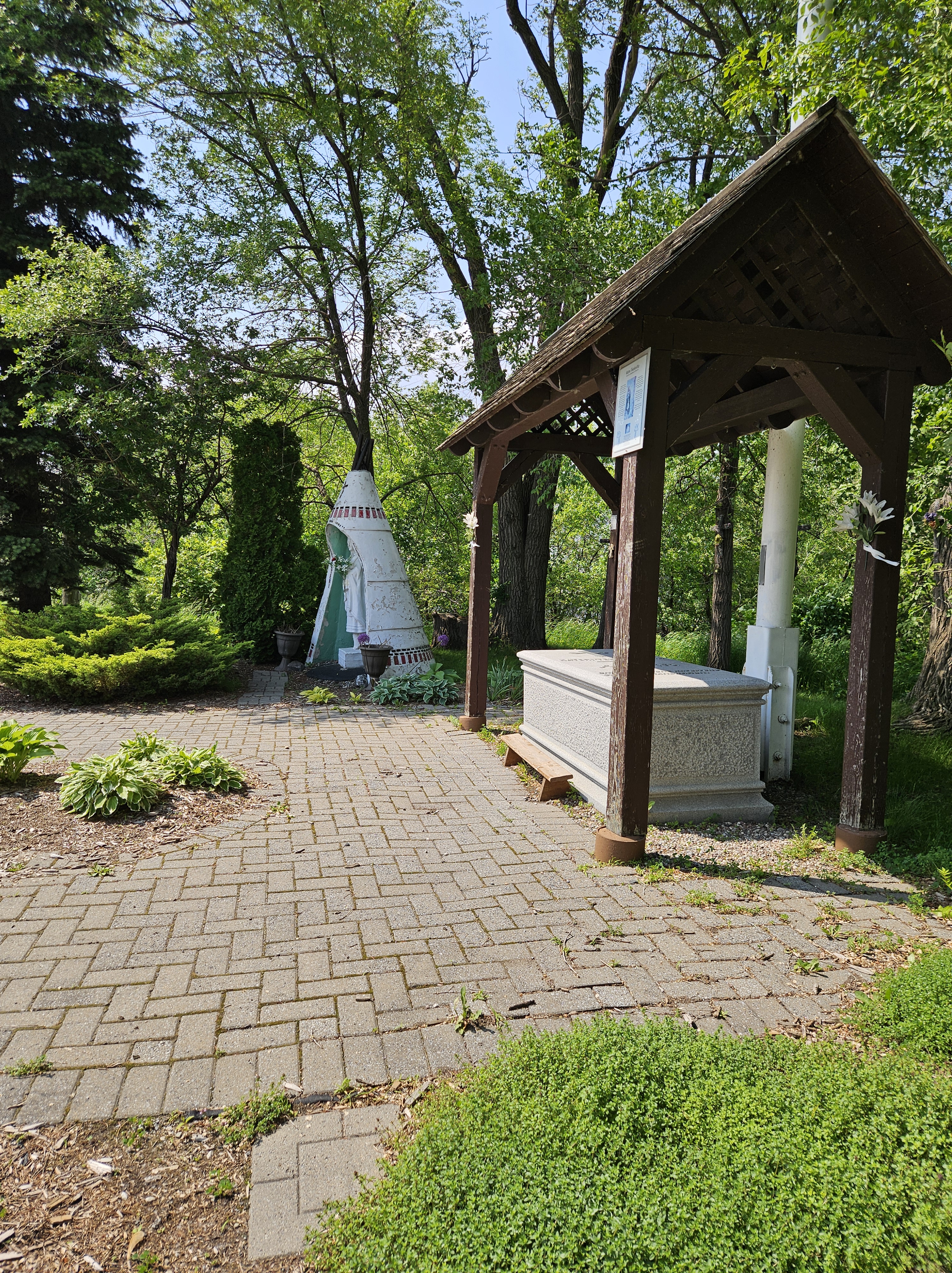
On our last day, we went to see the original burial place of St. Kateri, which is marked by an empty tomb (cenotaph) in Sainte-Catherine. I had been there before; this was the first Kateri place in Canada that I had been to initially, but I wanted some photos closer to the water that flowed behind the shrine. Water is important in the story of Kateri’s people and where they located their villages. I got there, and I stood for a moment, just looking around. I was overcome with the scent of flowers. It was so strong, like lilies or hyacinth. Hyacinth has that very strong, powerful, flowery aroma.

I looked around to find where the strong smell was coming from, but there was nothing. There were flowers, pines, grass, and a shrub or two. I even put my face into some of the colorful flowers that were budding there, but none of them gave off that smell. Nothing there could explain the scent. As one of my writing colleagues said the other night maybe St. Kateri was communicating something to me. She was called the Lily of the Mohawk, so maybe they were right. Whatever caused that remarkable moment I may never know, but it remains inspiring and wonderful all the same.


Dodo Bird. Montreal, Canada.
(c)2025
Cross on tree at the Tomb of St. Kateri Tekakwitha in Sainte-Catherine, Quebec. (c)2025
Tomb of
St. Kateri Tekakwitha in Sainte-Catherine, Quebec.
(c)2025

Feast Day of St. Kateri Tekakwitha (in Canada)

Standard
(c)2025

This is the feast day of St. Kateri Tekakwitha. She died on this day in 1680 at twenty-four years of age. Since that time, miracles have known to have occurred through her intercession. In two more days, is the anniversary of my own conversion.

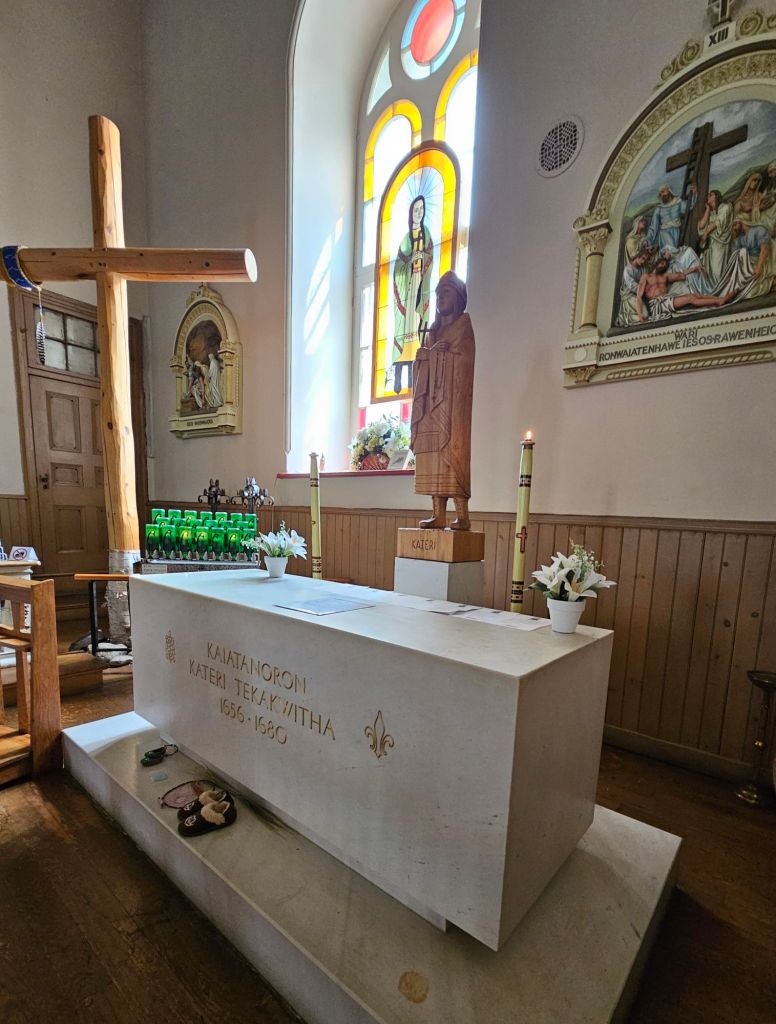
The photo above is at her tomb where her earthly remains rest at the St. Francis Xavier Mission Church in Kahnawake, Quebec. This is at the National Canadian Shrine of St. Kateri Tekakwitha.

I’m looking forward to the celebration of her feast day in the US in July, and my visit to this shrine and her tomb in June, partly for intensive research, but also hopefully to attend mass while we’re there.

St. Kateri, pray for us.

Native American Heritage Month Can Be All Year Long If You Know Where to Go

Standard

I think when it comes to marginalized groups in this country, it is important to remember that even though we attempt to celebrate them and honor them, we can still do that on the other 364 days of the year, and not just on “their” day.

Native American Heritage Month officially ended on November 30th, and Native American Heritage Day was commemorated on November 29th.

In addition to the post last week with links to the American Indian Museum in Washington, DC, I’d like to share the following links and travel recommendations for you to consider over the next 361 days.


The Akwesasne Cultural Center is located on State Route 37 in Akwesasne, New York, near the Canadian Border. They are a museum, library, and cultural center focusing on the history and culture of the Mohawk people as well as protecting Mohawk culture and artifacts. The museum and gift shop are open T – F, 10-6, and Sat, 10-2. The library is open additionally on Monday, 9-5.

The Kanien’keha’:ka Onkwawen:na Raotitiohkwa Language and Cultural Center was established in 1978. Its mission is to preserve and enrich the language and culture of the Kanien’keha:ka (Mohawk) of Kahnawa:ke. They are located in the Mohawk Territory of Kahanwa:ke, south of Montreal, Canada.

You can also find the Welcome Center, the Kateri Interpretive Center, and the St. Francis-Xavier Mission Church (on this site since 1716) in the Mohawk Territory of Kahnawa:ke. I have toured all three of these sites and it is well worth the visit.


From The National Museum of the American Indian at the Smithsonian: The “First Thanksgiving”: How Can We Tell a Better Story?

Bluesky Handle, Puff the Magic Hater has a thread of ways to support Native people, for everything from abortion care, defending voting rights, keeping Native families together, and more. Visit the thread here.

I’d like to close this post with the words of someone smarter than me. On Nov 29, 2024, historian Heather Cox Richardson wrote on Facebook:

Continue reading

Research and Rabbit Holes

Standard

For my May inspired I thought I would indulge a little. As many know I have been doing a lot of research for my book on St. Kateri, and as I was reminded of in a recent writing class I took, with research you will learn much more than you will actually include in your book, whether that book is fiction or non-fiction, and I have discovered the truth in that. The research that I’ve been doing for this book includes not only St. Kateri’s life before sainthood, but also Mohawk history, the Jesuits in New France, and various aspects of both Catholicism and the longhouse religion as well as many other details that help to inform the writing and the context, something that I’m learning the Jesuits at the time lacked when they spoke of the Native American ways.

I went down one rabbit hole recently that led me to three separate web pages regarding President Ulysses S. Grant’s “Indian Policy,” which was both informative and disheartening. I spent two hours reading, and it will only result in one or two sentences in the entire book.

In discussing 19th century treaties with one of my writing groups, I was sent a recent article on a court case from 2005 that referenced a treaty from 1794. There was also a recent Supreme Court case whose decision was based on a treaty from the 1800s regarding water rights. Another disheartening read as while the Supreme Court agreed that the Native tribe had rights to water, they did not however have the right to have the US government provide said water. Whew! What an acrobatic backflip!

One thing that surprised me in reading about the Jesuit way of converting the Natives to Catholicism was how they dismissed the Haudenosaunee’s spirituality and religious ceremonies when they were already so close to Christianity: a monotheistic society with one Creator, virgin births, miracles, and several other instances of commonalities.

I’ve read five books, two of which had nothing to do with St. Kateri but was wholly about Haudenosaunee Creation and the creation of their confederation and countless journal articles including one comparing the Jesuits’ use of incense to the Native American’s use of sacred fire and smudging. In reading Tom Porter’s book, And Grandma Said…, I have confirmed that we are more alike than we are different. In fact, when he was discussing how he prayed (by talking to his Creator), but was told that was the wrong way to pray by Christians, I was aggravated; that was exactly the way I prayed since childhood – through conversations with my G-d.

As appalled as I’ve been over the years at the treatment of Native Americans by colonialists (and modern people) I have become even more appalled and tell anyone who will listen about these judgments and discrimination foisted upon the Native population here on Turtle Island.

The second time we visited Kahnawake in Quebec, I told our tour guide that I wanted to visit, not only for the St. Kateri information where her tomb was, but also because what my children, who are 27, 19, and 18 have learned of their Iroquois history in 4th grade is the same as I learned in my 4th grade class forty years before that.

I’m reaching out to people with questions. I’m visiting places where Kateri lived both as a child and as a young adult, taking notes, creating lists of questions, looking through land buying archives, borrowing well-worn books out of the library. I’m getting help from places I hadn’t expected and advice on where to look for information. I’ve reached out to an artist for permission to use his art and I’ve signed up for journal access, which fortunately was granted for one month rather than requiring payment for the entire year.

While there is a struggle to find some material, I am reading from Mohawk sources to realize the context and seeing the misunderstandings of the Jesuits towards Kateri’s people. I also believe some of those characterizations were intentional to make Kateri seem more pure, more otherworldly, more worthy of the sainthood they coveted for her future.

My next two research jaunts I’m hoping to make are to the shrines in Fonda, New York and Kahnawake, Quebec to visit their archives. In both cases, I’m hoping the papers are in English rather than French. I also hope to interview one or two people and visit one area’s Strawberry Festival and one area’s Pow-Wow (both of which are open to the public). Those have less to do with Kateri the person and more to do with the Mohawk heritage.

Rabbit holes. They are deep and twisty, and the bucket is often not big enough for what is unearthed.