I think when it comes to marginalized groups in this country, it is important to remember that even though we attempt to celebrate them and honor them, we can still do that on the other 364 days of the year, and not just on “their” day.
Native American Heritage Month officially ended on November 30th, and Native American Heritage Day was commemorated on November 29th.
In addition to the post last week with links to the American Indian Museum in Washington, DC, I’d like to share the following links and travel recommendations for you to consider over the next 361 days.
The Akwesasne Cultural Center is located on State Route 37 in Akwesasne, New York, near the Canadian Border. They are a museum, library, and cultural center focusing on the history and culture of the Mohawk people as well as protecting Mohawk culture and artifacts. The museum and gift shop are open T – F, 10-6, and Sat, 10-2. The library is open additionally on Monday, 9-5.
The Kanien’keha’:ka Onkwawen:na Raotitiohkwa Language and Cultural Center was established in 1978. Its mission is to preserve and enrich the language and culture of the Kanien’keha:ka (Mohawk) of Kahnawa:ke. They are located in the Mohawk Territory of Kahanwa:ke, south of Montreal, Canada.
You can also find the Welcome Center, the Kateri Interpretive Center, and the St. Francis-Xavier Mission Church (on this site since 1716) in the Mohawk Territory of Kahnawa:ke. I have toured all three of these sites and it is well worth the visit.
Bluesky Handle, Puff the Magic Hater has a thread of ways to support Native people, for everything from abortion care, defending voting rights, keeping Native families together, and more. Visit the thread here.
I’d like to close this post with the words of someone smarter than me. On Nov 29, 2024, historian Heather Cox Richardson wrote on Facebook:
“Each of us is put here in this time and this place to personally decide the future of humankind. Did you think the Creator would create unnecessary people in a time of such terrible danger? Know that you yourself are essential to this world. Understand both the blessing and the burden of that. You yourself are desperately needed to save the soul of this world. Did you think you were put here for something less? In a Sacred Hoop of Life, there is no beginning and no ending.”
Nearly one year ago, I attended the first of what I hope will be an annual event at the National Shrine and Historic Site of St. Kateri Tekakwitha in Fonda, New York. It was World Peace and Prayer Day and was being held around the world on the same day, the Summer Solstice.
Please watch this video as told by Chief Arvol Looking Horse about how the day came to begin, starting with his own life history and the tragic past and present of the reservation system. The words are weighty, and the music only adds to the chills I felt, and I think you will feel as you watch:
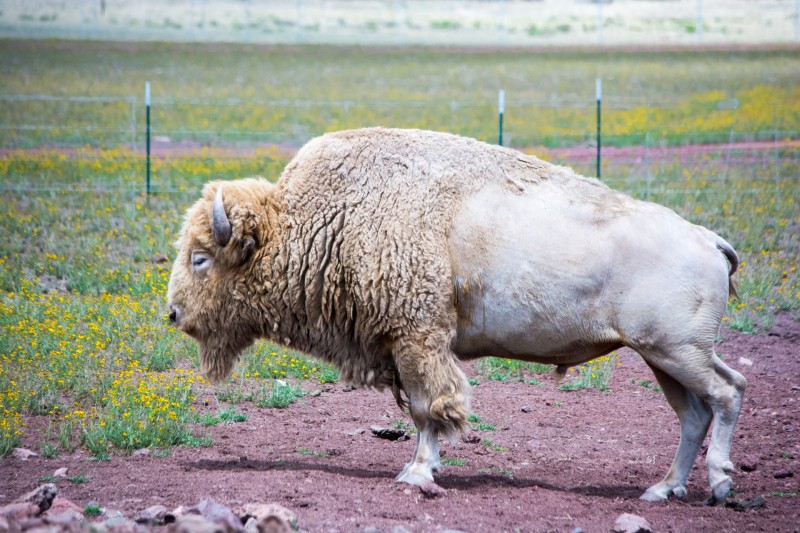
In 1994, Miracle, a rare white buffalo calf was born in Wisconsin. It was the first white buffalo calf born since 1933. White buffalo calves are sacred to many Native American nations in the US and Canada. The World Peace & Prayer Day began in 1996 and for a time, rotated to different sites until expanding to individual events held at sacred sites globally. The Kateri Shrine is one of those sacred sites and why the administration decided to hold this interfaith prayer service. The Shrine is sacred to the Native peoples who lived and nurtured the land and there is a Mohawk community nearby as well, and it is also sacred to Catholics who believe the Saint Kateri Tekakwitha lived there in the village of Caughnawaga throughout her child- and young adult-hood. This village is the only fully excavated Mohawk village in the country. I’ve written before about my experience there and how profound it was for me and others who attended it.
The Shrine is planning a second World Peace & Prayer Day service on the Summer Solstice, June 21.
Two days ago, it was revealed that another rare white buffalo was born in Montana, in Yellowstone National Park and according to Lakota prophecy and tradition this foretells better times coming as well as a caution that more must be done to protect the earth. This new calf and Miracle are said to be true white buffalo and not albino – they both have a black nose, hooves, and dark eyes.
In the article I’ve linked about this recent white buffalo calf, there is discussion about the killing and removal of bison every winter to keep the herds at about 5000 animals. There is opposition to increasing the numbers in herds from ranchers and the governor, but I don’t see any input from local tribes or from across the nation. Perhaps because they also oppose transferring the buffalo to the tribes. I wonder why they can’t go back to having the Native tribes participate in their traditional hunting of buffalo which kept the population manageable naturally.
That political segue is important to be aware of, but a digression to this joyous event of another white buffalo calf.
Whatever you’re doing and wherever you are on June 21, take a moment to pray on the continuing vitality of the earth, our home, and all of those who live here. I will be at the Kateri Shrine in Fonda participating in the ceremonies and listening to the prayers both spoken through the participants and in the air swaying the trees.
With my ongoing research into St. Kateri’s life, I thought instead of a retelling of the first Thanksgiving today, I would set my table with the First People in mind, sharing with my family the Three Sisters as the Mohawk call these three plants that grow side by side: corn, beans, and squash.
My table setting. (c)2023
Sign about the Three Sisters at the St. Kateri Shrine in Fonda, NY. (c)2023
The Three Sisters. St. Kateri Shrine, Fonda, NY. (c)2023
The cake plate I used was a wedding gift from a friend who worked at the Jewish Museum in NYC. I like to blend our cultures in our interfaith family, and this was one way to join two ancient peoples and their symbols. (c)2023
A few days ago, the honoring of Native American Heritage Month began. Like Indigenous Peoples Day, I think this is timed for us to remember that there were both sides to Columbus’ landing in the New World and how we perceive the Thanksgiving story. The Thanksgiving story in and of itself isn’t as problematic to my mind as other European centered celebrations. We know and should acknowledge that the English settlers could not have survived their first (and to be honest, many subsequent) year in a new land without the help of the Native Peoples they met and who helped them immensely. I have always been a history buff and drawn especially to people of my own heritage and Jewish ancestry as well as people I feel somewhat paralleled that history including African- and Native- Americans. One of my favorite books as a child is The Magic Tunnel by Caroline Emerson. It had everything a young me could want in a book: time travel, the NYC subway system, NY history, American Indians. The perspective is of about a fourth-grade child’s view of history, but it’s a fun adventure for the elementary school age and a great jumping off point to discovering what’s true in their depictions and what is not.
As I’ve grown and became more of an in-depth reader, I’ve been exposed to more and more books about Native history both by Native and non-Native scholars. Living in New York state my whole life, we have a rich history of the Iroquois, and every place I’ve lived has had several towns still using names found from and in the variety of Native American languages found in the state. Some examples include: Shinnecock, Massapequa, Copiague, Hauppauge, Schenectady, Oneonta, Oneida, the Mohawk Valley, Chautauqua, Ontario, Otsego, Tioga, Cheektowaga, Ticonderoga, and of course, Niagara and Manhattan.
Over the next few weeks and through the end of November, I hope to offer you some resources to expand your knowledge of Native American history and culture as well as books, movies, and photos that you can enjoy in your explorations.
About a week ago, I was asked to give a meditation for what’s called an Ultreya, a gathering of Catholic Cursillistas for community and fellowship. I elected to read a Haudenosaunee Thanksgiving Address. It is called Ohen:ton Karihwatehkwen, which are the Words Before All Else. This is recited before any gathering or ceremony. At the beginning, prior to starting the reading, I explained to them that this is often different each time it’s told as it depends on the speaker to choose their own words. I explained that I, however, would be reading it. Two important things I stated before I began were who the Haudenosaunee were; we knew them as the Iroquois, which is the French word assigned to them by Canadian and French missionaries, and that we were currently on their traditional lands, the lands of the Mohawk. I also stated that I am not Mohawk, nor am I of First Nations descent. I have included a statement on my FAQ page.
I think it’s important to acknowledge whose land we’re on, and if we’re speaking authoritatively or in entertainment or spiritually, that we acknowledge when we are not Native and/or Indigenous People. I will also use Native American, American Indian, Native Peoples, Indigenous Peoples, and First Nations interchangeably unless asked specifically not to.
As we celebrate what we view as the first thanksgiving, it’s important to remember that the English settlers didn’t “give this tradition” to the Native Wampanoag people they met. The Native people across the continent had harvest festivals and days of giving thanks for their harvests towards the end of the fall and the coming of winter. This is what they shared with the settlers.
For my own Thanksgiving, I am thankful for my family and spending time with them, but I also think back to the historical first thanksgiving and look back on what could have been and look towards that future.
In this opening for me of Native American Heritage Month, I give you a few places to visit and learn from:
Killers of the Flower Moon – the movie is in theatres now, and it was wonderful. Don’t be scared off by its length; I barely noticed and easily sat through the whole thing. I also read the book about a year ago. I highly recommend both: Book
The Thanksgiving holiday is full of disharmony as we come to grips with our historic (and recent) treatment of the Native American peoples who were here before we arrived from Europe.
A few personal thoughts:
Growing up Jewish, this was always my favorite holiday. We didn’t need to explain our religious holidays and we weren’t excluded from the mainstream Christian holidays. This was an American holiday, one that everyone could participate in, both as a harvest holiday and as a day of gratitude. It brought our family together as well as allowing us to be a part of the greater family of our community.
This year comemorates the 400th anniversary of that traditional first Thanksgiving hosted by the Pilgrims who survived that first harsh winter. The basics of that first holiday, a gathering in gratitude brought two different communities together to share what each had. The helped each other and maintained a friendship against great odds. In modern days, we have much to be thankful for. I won’t list mine, but take a moment to reflect on your own blessings.
At mass this morning, we continued a tradition at my parish that I have always loved. Instead of a collection, we bring a bag of non-perishable food to the altar (for our food pantry and Christmas baskets), and at the end of mass, each family is given a small loaf of bread that has been blessed to share at our dinner table. We are called to pray and to break bread.
Give us this day, our daily bread…
(I apologize for the blurry picture) (c)2021
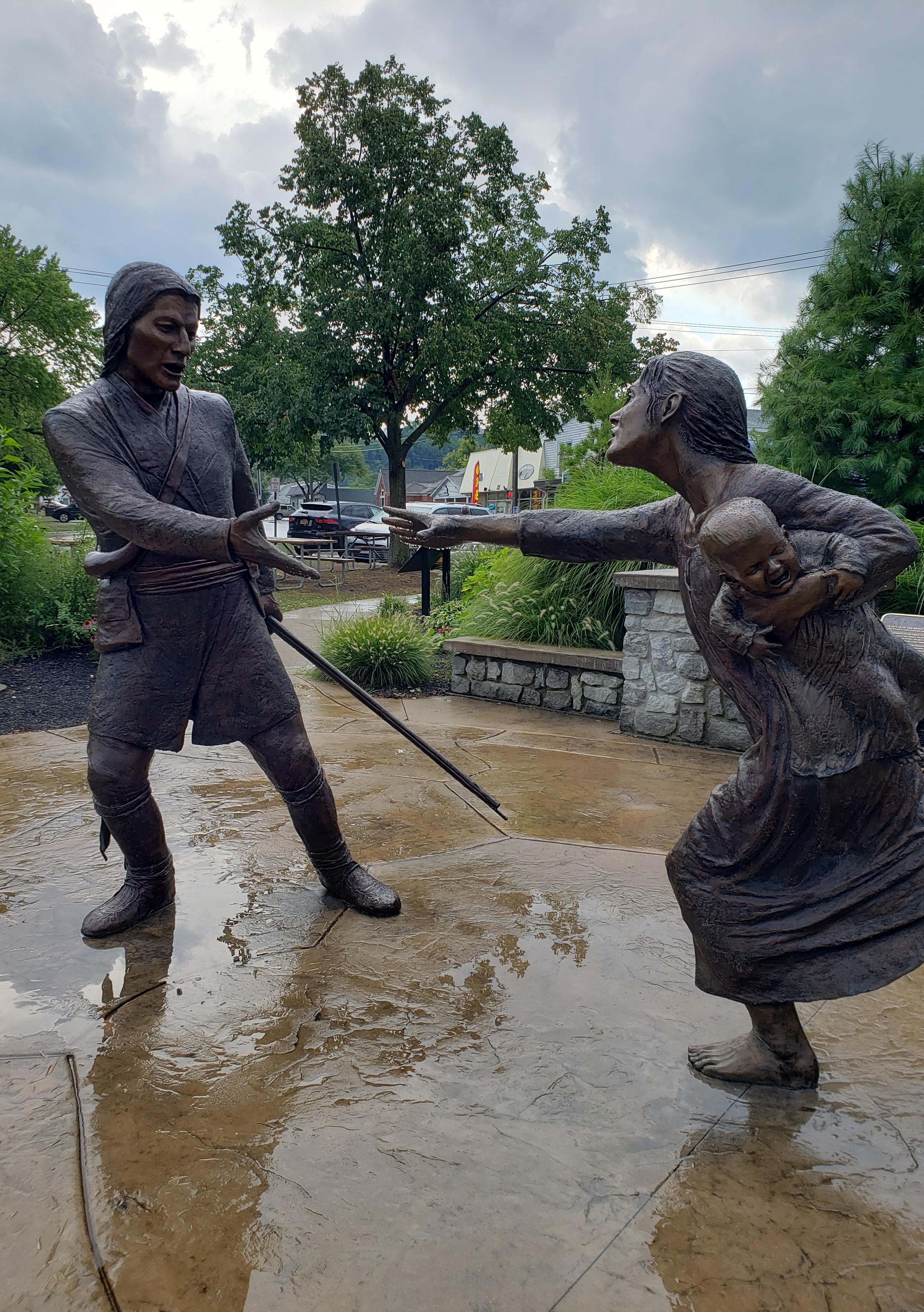
Last year while visiting Niagara Falls, New York, we learned of a nearby monument in Lewiston that commemorates the Tuscarora Indians coming to the rescue of American citizens during the War of 1812. The British invaded from Canada to the north and were mobilizing an attack on the village with their Indian allies. The Tuscarora, being outnumbered gave the appearance of greater numbers and were able to give the Lewiston families time to escape the inevitable horrors of death and watching their loved ones brutally murdered.
This monument is breathtaking in its emotion. The sculpted faces of both the mother and child fleeing and the Tuscarora helping them is so vivid, it tells the story in deeper and more profound ways than reading about it could ever do. I stood in awe of it for several minutes, even though it was pouring rain for much of the time.
Tuscarora Monument, Lewiston, NY. (c)2021
A closer look, Tuscarora Monument, Lewiston, NY. (c)2021
Enjoy the day with family and friends or alone, in peaceful quiet or boisterous noise, with turkey, stuffing, and cranberry sauce or whatever your family traditions call for.
Thanksgiving today is fraught with its past and the reckoning that is still to come in many ways.
For those of us who grew up in non-Christian households, Thanksgiving was and is the great equalizer. We can all celebrate it without the religious baggage and without not fitting in. We gather as a family, we express our gratitude and our love, and it’s the one day of the year that nearly everyone has the day off, at least until a couple of years ago when retailers began to open on Thanksgiving Day.
There are of course exceptions, but it is a day for everyone.
Of course, that is also not the entire story. From the Native American prospective, settlers coming to the new world caused trauma beyond belief. We are only beginning to open up and discuss and educate ourselves to be inclusive, but also to move forward as a country.
While I believe the original Thanksgiving story despite knowing its clear embelllishments, I think it’s important to distinguish between the Columbus and future expeditions’ theft of land and genocide and that early settlers and Native Indians, as they were known at the time, did work together, and to celebrate the help that the Native Peoples gave to the Pilgrims should be recognized. The Pilgrims, and other Native-friendly settlers wouldn’t have survived the new world without the help of the indigenous people already living here.
Beginning tomorrow on Crooked Media is an eight episode podcast with Rebecca Nagle about two murders, a Supreme Court case and the land in Oklahoma. I can’t wait to hear what this journalist and Cherokee Nation citizen has to say about this compelling story.
You can subscribe now and then get notified when it’s available for download and listening. I’m already subscribed on PlayerFM, and can’t wait for it to be downloaded.
Find it wherever you regularly get your podcasts.
This is how Crooked Media describes it:
“An 1839 assassination of a Cherokee leader. A 1999 small town murder. Two crimes collide in a Supreme Court case that will decide the fate of one man and nearly half of the land in Oklahoma. Hosted by Rebecca Nagle, Oklahoma journalist and citizen of Cherokee Nation, This Land traces how a cut and dry homicide opened up an investigation into the treaty rights of five Native American tribes. Tune in, beginning June 3rd to Crooked Media’s 8-episode series to find out how this unique case could result in the largest restoration of tribal land in US history when it answers one fundamental question: Who owns this land?”
[Note: This reflection ended up encompassing many things: travel, spirituality, prayer, politics, and again part of my year of mercy. I hope you enjoy all that it is, and that you see the National Shrine in Fonda, NY one day yourselves. It is a very peaceful place to visit, to sit, and to pray.]
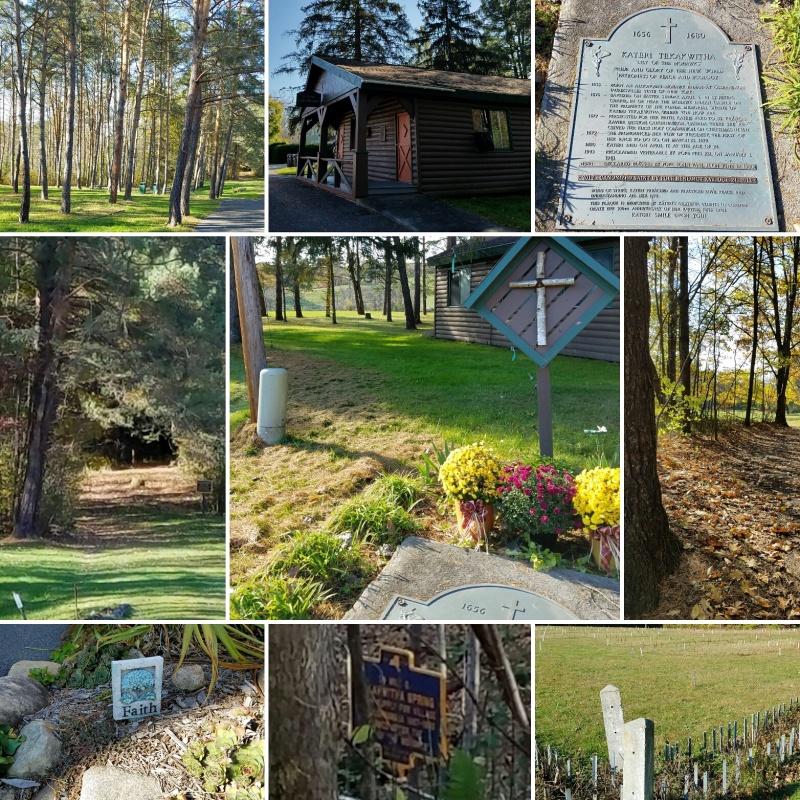
In the early part of November, just because I was in the neighborhood, I decided to visit the Shrine of St. Kateri Tekakwitha. I had a lot on my mind and in watching what was continually unfolding at Standing Rock in North Dakota, I felt helpless towards a people that had captured my imagination and inspiration since I was a child.
I remember playing cowboys & Indians. That was a thing in the 1970s. I always wanted to be an Indian. In college I chose a class titled North American Indians as my anthropology elective. As a preschool teacher, I changed the curriculum for Thanksgiving to avoid making headdresses. I added Native foods to our school’s Thanksgiving feast. Instead of the headdresses, we made more Native American crafts and listened to the drum beats and chanting of Native American music. I can still hear the cassette in my mind as I write this.
On the hill above the Shrine, I went up to the spring, but when I followed the signs to the spring, and walked through the crunchy leaves carpeting the path, I saw the way down and the supporting handrails. I could hear the water.
But I was alone and the rest of the way was steep and I was afraid I wouldn’t be able to climb back up, so I missed the spring. I chose not to go down on the slippery leaves. I still felt okay, though, because the spring was the cherry.
At the Shrine, I stood by St. Kateri’s plaque which included the dates of her veneration and canonization. I looked out passed the sign of the cross to the rustic looking buildings to the close knit trees, their narrow trunks rising into the sun. The sun was bright that day, coming down in rays through the pines. The green grass was beginning to be covered in their shedding pine needles.
The buildings themselves were closed for the season, but you can’t close the sky or the air or the land.
I stood there and I prayed. I asked St. Kateri for her intercession for North Dakota and the Sioux and their companions and their supporters. Water protectors. An end to DAPL. An end to the violence against them by more people trying to take their land. Again.
There were water protectors in Bismarck – the citizens and politicians. Dogs weren’t sicced on them. They changed the route to the pipeline. Maybe if there were water protectors in Flint, Michigan they wouldn’t have allowed lead to be in the water.
I guess you could call this a kind of pilgrimage; with purpose and spirit. It was spontaneous and it felt right and it fit in with everything I was trying to do in this past Year of Mercy. I was guided to action, something I could actually do and my heart swelled.
I prayed for peace and I prayed for resistance and strength and the outcome that protects the land and the spirit of the land for everyone who comes after us.
At the Shrine, at the Native American Peace Grove, is the following prayer:





 Griffins and Ginger Snaps