My Jewish History, Part One

Standard
A family piece that’s come down from my mother. A Rabbi, praying.
(c)2024

This is the first part of a three-part series. The impetus was something I read in Braiding Sweetgrass by Robin Wall Kimmerer, which I will reflect on in the last part. Part One delves into my childhood, growing up Jewish in what I consider a fairly religious household, although it was less religious than my grandparents’ households that my parents grew up in. Looking back, it is certainly more religious than I raised my own kids in, and that will be discussed in Part Two. Part Three, funny enough is the part I wrote first, but then kept expanding and writing and re-writing, and realized there was more backstory than I could fit into that section. I hope you enjoy reading about my past lives, and my reflections and reconciliations with who I am today and how I became that person, at least in this one aspect of my life.

Continue reading

Inspire. December. Chanukah.

Standard

I’ve been searching for the write inspiration for December, and this first night of Chanukah brought things into perspective. A little bit of perspective. While the internet and the news are filled with antisemitism and protests from people intent on gaslighting the Jewish experience and deny Jewish people the indigeneity of their homeland, I have been on a quest to celebrate Chanukah publicly. I’m a little wary about it. I live in a nice neighborhood, but I don’t put my head in the sand and think that it couldn’t happen here. I know it can.

Still….

I went out and bought blue and white lights for outside, something I’ve never done. I have an interactive menorah hanging on my front door, again, something I’ve never done. In fact, since I’ve been on my own (and with my own family) I have not put Chanukah lights in the window. That unfortunately will continue because I know that if I put candles on my windowsill, my mother would come back from the grave and blow them out with a raucous, and loud message of fire safety.

Most people don’t know the story of Chanukah; perhaps some teachers wanting to bring multiculturalism to their classrooms, and now the story of the Maccabees is being co-opted to match the narrative, anything to turn the words of Jews and their history against them. The Festival of Lights isn’t about war. It isn’t about victory. It is about faith. The miracle isn’t that the Maccabees won against their most recent oppressor. The miracle is the lights themselves. When we retook the temple, amid the destruction, they went to light the candelabra to rededicate the temple, the menorah – not the nine-branch one that most are familiar with, but the regular, ordinary menorah that is always lit in the temple. There was only enough oil to keep it lit for one night. There was no other oil. So, what did they do? They lit it anyway.

And it remained lit, not one night, not two, not three or four, not even five or six or seven, but it remained lit for eight days. One day’s oil lasted for eight days. That is the miracle. And that is why we light eight candles on a new type of menorah used just for this holiday: a hanukkiah.

Tonight, I will say the prayers (that I don’t normally say). I will fry the latkes in oil. I will fry the chicken in oil. I will light the first candle on the same menorah that I lit as a child; the one that I grew up watching the candles burn down on the dining room table that was my grandmother’s. It will be placed on that same dining room table in my own house. My kids will see the lights on the same menorah, the same table, and they will be able to see through my eyes, even amidst the clutter that seems to grow multi-generationally on this dining room table.

This year, however, this old menorah has a special, additional meaning. I saw this menorah in Toronto at the Royal Ontario Museum in their Judaica exhibit, in the Chanukah window. A copy/replica of MY Chanukah menorah sits in the largest museum in Canada. The exhibit label states that it is from Gdansk, Poland, brass, from the early 1900s.

Happy Chanukah.

My family menorah.
(c)2023
Royal Ontario Museum Judaica Exhibit.
Hanukkah menorah, “Danzig” type,
Gdansk, Poland, early 1900s.
(c)2023
Ready for sundown.
You can view it lit later tonight on Instagram (link in sidebar).
(c)2023

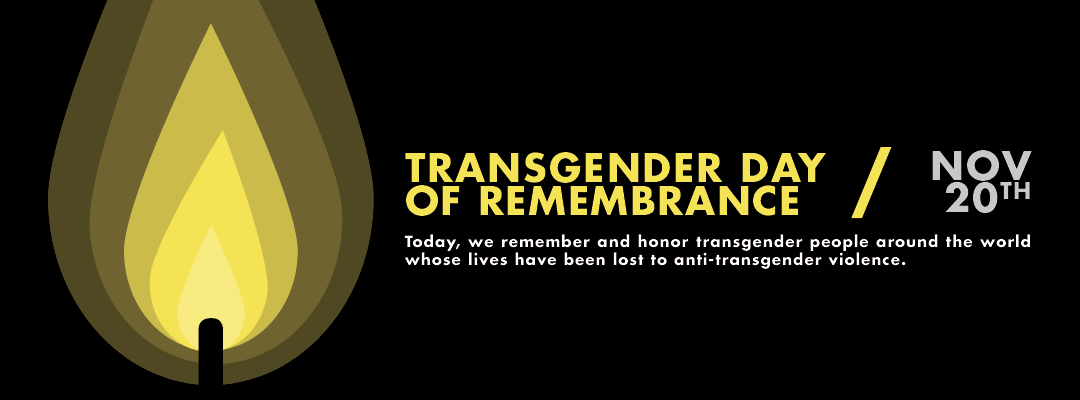
Transgender Day of Remembrance

Standard

I wanted to observe this day of remembrance for the transgender people who have been assaulted and murdered in the last year. I wanted to do this especially this year when transphobic rhetoric has been at an all time high, at least in my experience. This day reminds me of those people lost, and it reminds me how I can continue to speak out and make the world safer for trans people. That is what makes me an ally. Wearing a t-shirt or a pin doesn’t make me one. Speaking out with general information, corrections to misconceptions and misinformation, and calling out transphobia when I see/hear it is what makes me an ally.

I thought about this a lot this weekend. I was on retreat and without getting into private details, I was in the presence of two mothers of transgender sons. One was accepting and one was not. The one who was accepting walked her road, steady over the potholes, and came to understand and accept her son’s new place in her life, never once wavering in her love for them. The second mother was not accepting. She detailed some medical experiences her child had, she shared their new name, but in that, she was not accepting of that name, and would continue to call her child by their birth name. I had a choice to speak out and possibly offend someone; or speak out and educate or really take a stand on that child’s side. I chose to speak out. I think I did it tactfully. The point of speaking out wasn’t to make the mother feel bad or guilty or angry; the point was to make her think, to consider what she’s saying versus the reality of her situation with her child. Silently, I felt that if she continued with this way of thinking, she will lose this child, and I don’t think that’s what she wanted.

Last week, I had a similar opportunity with someone else. He said something that I considered transphobic. It was a small thing, and it wasn’t to a trans person or about anyone, and really it wasn’t that bad in the great, big world of transphobia, but I called it out anyway. It caused an argument with the other person saying that I was being overly sensitive – it was not transphobic. The only response that I could make was that trans people will let you know what’s transphobic.  My point here was that it is the small stuff that tells a trans person they’re not welcome or safe with you. You don’t have to murder a trans person to make them feel unsafe with you. I did let it go. People need to hear what’s said and then be given time to think about it, coming to the realization in their own time.

However, knowing that today was coming so soon after these conversations, I knew that I needed to acknowledge this day and these conversations. Those of us who are not transgender do need to have conversations that encourage our questions, that enable us to move beyond our internal biases, that allow us to change our hearts and become un-transphobic. It is not easy for any of us who love people that change before our eyes, but when we look deeper, I think we’ll see that they changed very little. They were always who they were, and it is not up to us to accept them; it is up to us to continue to love them.

I think that when we look at trans folks, the biggest change that we may or may not see is that they are comfortable. They are happy. They are lighter than they used to be now that they are who they are supposed to be, who they’ve always been, hidden away. This is who they’ve always been, except now they’re smiling.

Today is to honor the dead, but it is also to save the living through our acceptance and love. Please consider my words with the intention they were meant, and for everyone, but especially trans people, to have a peaceful day in contemplation and commemoration. I will prayerfully be considering those who lost their lives this past year, but also those who are journeying their own paths and that they remain safe on their journeys.

Native American Heritage Month – Beginnings & Endings

Standard

The photo below represents both the start and the end of the day.

Beginning with the end, I have slept with a Dream Catcher for most of my life. I notice a change in my sleep when I don’t sleep with one. It creates a calm and peaceful rest as it catches the bad and lets the good continue through. This particular dream catcher is one I got in Niagara Falls, Canada. I was drawn to the colors of the beads that represent the four directions as well as the uniqueness of the center stone.

The booklet is something that I was more recently introduced to through Mohawk Elder Tom Porter of the Kanatsiohareke Community in New York. Since then, I’ve seen it in other Haudenosaunee writings and readings. It is called the Thanksgiving Address, but it has nothing to do with the Thanksgiving holiday, but in giving thanks for all that is around us in the natural world, all that we have, all that we see. It is said at the beginning of all important gatherings, ceremonial and/or governmental. The Haudenosaunee call them the Words Before All Else.

I recently used a form of this address for a meditation that I was tasked to share, and it was very well received. I read mine, but most are recited and because of that they are often never the same twice since the words change with the speaker and the timing of the gathering.

As I said at my own (non-Native) gathering, as a shared meditation, I acknowledged the land we were standing on (Mohawk), and reaffirmed that I am a non-Mohawk, non-Native, sharing their wise words.

‘Tis the Season

Standard

I have not been to Starbucks in quite some time. Today is Red Cup Day, so I planned a quick in-and-out/grab-and-go, get my drink, get my cup, and go home to do some work. On the way out the door I grabbed my pouch and keyboard, just in case.

I walked in, and this place is hopping. Seven baristas behind the counter, all moving, creating the dance that has everyone doing their parts, seeing the rhythm that is so natural to them, and yet in that small space, no one is tripping over any of the others, smoothly weaving in and out, and the one barista who seems to be tracking everyone’s drinks, knows all of our names, our orders, who’s waiting for what, greeting, smiling, conversating.

It’s a joy to be here.

I chose my drink, which is a feat in itself since I don’t like coffee, and for the red cup you’re limited on what you can order – they want to show off their seasonal treats and have you try those. I finally settled on the caramel brulee latte, but no coffee; comes with whipped cream and a caramel-ish drizzle. There is a tray of free samples – cranberry bliss bar, which I haven’t had yet this year.

I got my breakfast wrap, and was offered a second sample. I was going to decline, but the customers all have, and this is my favorite treat, so why not.

I settle in, and decide to share with you the wonder of the holidays at Starbucks, especially this one that is my local, well-run, friendly, and makes me remember what joy in the everyday is.

Yes, it’s children laughing and choirs singing. It’s songbirds and sunrises, it’s well-worn jeans and waking up before the alarm, but it’s also the simplicity of the coffee shop where they learn your name, and make your morning that much lighter and brighter, and add just a little bit of joy to the regular.

Red Cup and Hot Drink on a Cold Day. (c)2023
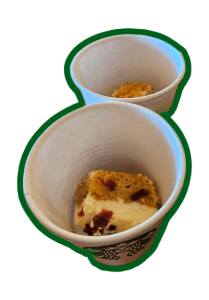
Cranberry Bliss Bar – Free Samples. (c)2023
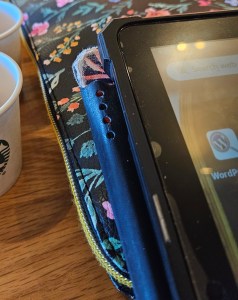
Settling in for an hour’s work. (c)2023

Providence

Standard

Fate. Coincidence. Providence.

Are they real? Really real?

Thinking about them happening, they might be far off and existential and not as real as touch, but when they happen –

BOOM!

The slight increase in heartbeat, a hitch in breath, the exhilaration of being aware as something remarkable happens right in front of you.

I’ve been aware of the spiritual, the extra-natural, and they are few and far between. Sometimes they travel to my consciousness after the fact, but when they happen within the moment, in the context, they become something special, something extraordinary, something to be held close for all time, and beyond time.

I had two times this week that something like that occurred.

Fate?

Coincidence?

Providence. All the above.

Several months ago, my memoir teacher recommended a book to me – one of many – The Cartographers. I presumed it was about maps or map-making, and I wasn’t able to find it in the library app on my Kindle. In the meantime, I read a bunch of other books. On Monday, I decided it was time to try again, so I checked the library app, and there it was: The Cartographers. I checked it out and began to read. Even in the pre-table of contents pages, I wasn’t sure about it – there was a warning of suicidal ideation and self-harm and to take care reading it. I burrowed on.

The main gist is a high school graduate who is lying to her mother about going to college; she lives in NYC with two roommates, meets an odd boy and just shows us her life and gives us some insight and lessons along the way. This did not seem like a book my memoir teacher would be drawn to, but I was definitely drawn to it. I couldn’t believe how much the main character, Ocean, resonated with me in very familiar and emotional ways, sometimes painful. I really related to her, the existential crisis that was continually her personality – I feel that in my bones. As Queen sings, “Is this the real life; is this just fantasy?” Or a simulation on some alien being’s computer. As Ocean asks, “Are you dead too?” I don’t feel that despondency, but it’s a good question.

Are the fate moments real and everything else is fluff? Or the opposite: all the misery and doldrums are real, and the fate moments are the fluff – the golden fleece, the silver lining, the gold at the end of the rainbow.

About halfway through the book, I suggested to my daughter that she would really like this book. She’s seventeen, and it seemed like her kind of style and subject that she might enjoy. She told me to text her. I searched for the book on Amazon to give her the link, so she’d know the title and the author, and I told her to borrow it from the library. It popped up on Amazon: The Cartographers by Peng Shepherd, but the cover seemed different. I thought it was the difference between hardcover and softcover editions, and then I realized that I was reading The Cartographers by Amy Zhang.

Not the same book at all.

My teacher had recommended a book about maps and murder and mystery – all in my wheelhouse, and I was reading a book about teen angst and friendship (and loving it by the way), and I suddenly realized that I was reading the wrong book.

Although was it really the wrong book?

It was the perfect book for me, at this moment in time.

Is that fate?

I don’t know, but it was perfect.

Then today. This morning, I had time to attend mass. The homily was about the poor. Blessed are the poor. But not just bless them but look at them. See them. We all come to the poor and houseless with preconceived notions and judgments; even me. Some of the things my priest said resonated with me, and tears welled in my eyes – I felt seen. I wasn’t, and haven’t been at a poverty level, but I understand not being able to move up, not being able to break even, being embarrassed and isolated. I was seen, but that’s not why I’m writing this.

While my priest was talking about seeing the poor and understanding how difficult it was for the poor to rise from their circumstances, I was wishing that a friend of mine could have been there to hear this homily. This friend is a good and decent person. They do so much for so many without asking for anything in return; it is just in their nature to give more; to volunteer; to be Christ in the world. I’ve witnessed that and have been the beneficiary of that. But I’ve heard them talk about people helping themselves and wanting to do more to get people back on their feet, and I wished they were there in the church this morning, listening to this homily that I thought was something they should hear.

The mass goes on, we say the Our Father, and offer peace. I turned to acknowledge the parishioners behind me with a hand wave of peace, and there they were – the one person I wanted to be there listening to the homily – they were there in the pew a few feet behind me listening to the homily.

I smiled.

I was pleased with how the world works.

And I guess that’s how the world works: being where you’re supposed to be when you’re supposed to be there.

Providence, maybe.


The Cartographers by Amy Zhang

The Cartographer by Peng Shepherd

September 11th

Standard

In our travels, I’ve been touched by how other countries have commemorated 9/11. We saw a tree that had been planted on the grounds of Belfast’s City Hall with an adjacent plaque that touched me deeply.

In our recent tour of the Mohawk village of Kahnawake in southern Quebec, we learned quite a bit about the Mohawk people of the area and their history, including their history of building many parts of New York City. One of the things our tour guide brought to our attention was the primary economy of Kahnawake; it’s easy to see once entering the village boundaries that cigarettes are one of the dominant businesses for the tribe. The second largest career for the Mohawk of Kahnawake is ironwork. This began long ago and continues to this day with many Mohawk men traveling each week to New York City to work as ironworkers, and then returning to their families on the weekend.

We were told about, and I subsequently read about a tribute that the ironworkers did for the 9/11 attacks on the World Trade Center, creating a replica that is kept in the chapel at the St. Francis Xavier Mission Church. With the WTC replica is a cross made from iron that came from the NYC site, and an artistic sketch showing the relationship of the traditional Mohawk with their older tools of their trade and the more modern Mohawk with their modern tools of the trade. There are also eagles and eagle feathers, both a symbol for the United State as well as an important symbol for First Nations/Native people, all set in front of the buildings rendered before the attacks on one side and the longhouse on the other, with both traditional and modern skylines reflected at the base. The visualization evokes many emotions and feelings for so many thoughts and for me, the pride depicted on the Mohawk faces supplants the sadness and creates a new somberness that dulls the pain and raises the heart.

Looking at the workmanship brings an emotion that welled in my chest: the work put into creating such a piece that is both simple and stunning while respecting the lives lost and the lives changed on that day.

When we returned to Quebec a couple of weeks later, we were able to tour the church itself and it was then that I took the pictures that I’m glad to share with you today on this twenty-second anniversary of 9/11.

Continue reading

Mental Health Monday – September 11th

Standard

Today is one of those days that needs some extra quiet.

I drove my son to work, and then sat in the car for over 30 minutes, discussing what I wanted to eat for breakfast with myself. Having not really decided, I just sat there. I knew what day it was, but it hadn’t imprinted on my mind yet. When it did, I at least understood my unexplainable melancholy.

In the interim between 2001 and today, I have met and befriended a few people who were there, in lower Manhattan when the World Trade Center fell, who were in one of the buildings when it was hit. We’ve heard stories of friends with near misses, where fate – or providence – kept them from being there that day, and others who found their way home, ghost-like.

I have pangs of guilt, feeling the strong feelings of Nine-Eleven when I wasn’t physically there, but in the ensuing years, I have come to accept and be at one with my own trauma. No, I wasn’t in attendance, but I had been affected more than a previous tourist, visiting once or twice. This was my home. Both of my parents were from the Bronx. I was born in the Bronx and grew up in Queens and on Long Island. At the time of the attacks, we had just returned from visiting my parents and my mother-in-law the day before, crossing the Throgs Neck Bridge, pointing out the New York City skyline to our four-year-old son. We viewed that sight not twenty-four hours before, the same perfect blue sky guiding our way north.

I resent out of state politicians using 9/11 as their fundraising, their inspo-porn, trauma-porn, and call to arms that they have no right to.

For more than a year after, when I traveled on our local highway to the state capital, I would shudder at the sight of a plane flying overhead, sinking lower and lower in the sky as it descended to the airport runway that I was passing. Our house is in the flight path of two small, local airports, and every time a plane flew low, I would have a visceral reaction. I felt that these reactions and feelings were not mine to have – I wasn’t there!

But in a way, I was.

This was my home. These were my people.

And I’ve decided to own my pain and my trauma of that day.

That’s my mental health Monday suggestion this week: don’t let others tell you how to feel. Only you know how you feel, and you should let yourself feel the things. It’s possible that the feelings can be too much, but if that’s the case, seek out a professional. Talking to someone who is a professional can do wonders for your mental health, not only today, but any day.

Have a peaceful, blessed, quiet, tea-filled day.

Abstinence and Dispensation

Standard
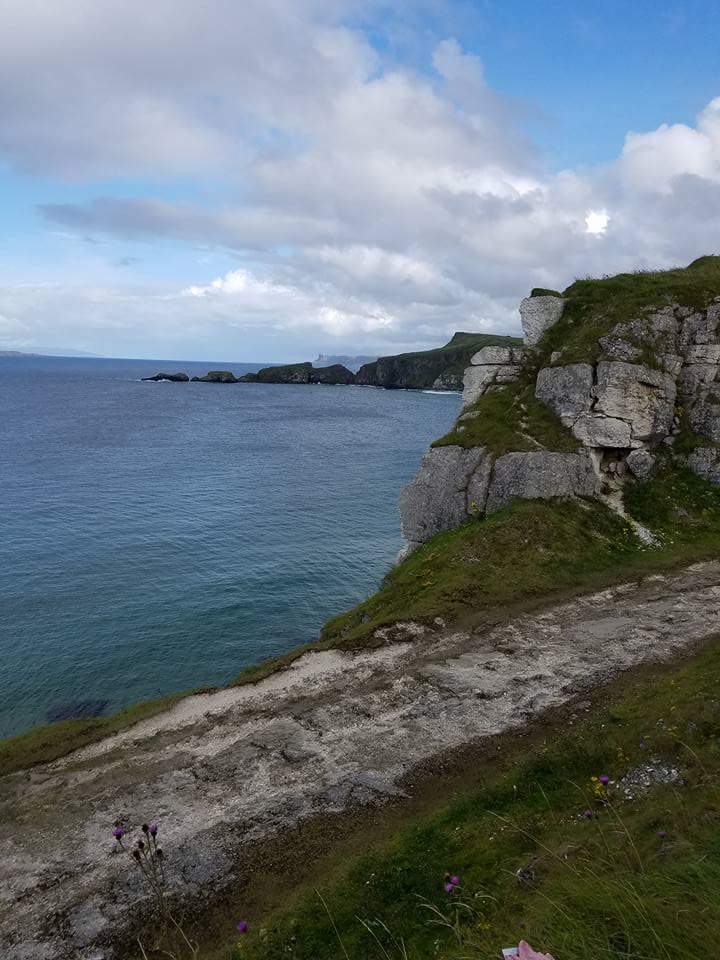
Ballintoy Harbor. Northern Ireland. (c)2018

St. Patrick’s Day has long been one of my favorite holidays. Long before I met and married my husband with Irish roots, and well before I set foot on the Emerald Isle. I have always been fascinated by the Celts, their people, their land, their culture, especially in relation to ancient and medieval culture. I have also been a questioner. Why? Why do we do this? Why don’t we do that? As a young child being told that I couldn’t write during Rosh Hashanah, I was devastated. But writing isn’t work; it’s writing, I whined to no avail. Becoming Catholic has not broken me of that – is it really a – failing.

And so, I question – why?

Why can’t we eat meat on Friday? Is it because Peter was a fisherman? Will there be a dispensation for today? It is a saint’s feast day after all. I waited for Pope Francis, and then was told that it’s up to the local bishops. I still couldn’t find it, so I texted my godmother and she okayed the corned beef which made my husband happy (as if he wasn’t going to indulge on his holiday).

But I still wondered: Why?

In googling and asking my questions of the internet, I discovered the controversy that is North Dakota. Apparently, they have three dioceses, and two have them have allowed meat today, and one has not. The idea that North Dakota has three dioceses makes little sense to me, but I found no less than twenty-five separate links about St. Patrick’s Day in North Dakota. Amazing.

Archbishop Nelson Perez of Philadelphia popped up as did Cardinal Dolan in New York City’s Diocese. I didn’t see Boston, but I came to the logical conclusion that there would be dispensation for Boston Catholics. What holy hell would be raised if even one of those cities banned meat on St. Patrick’s Day? I hope we never find out.

During Pope Nicholas I in 866 CE, Friday abstinence became a universal rule. Fasting also on Fridays was common by the twelfth century. It was expected for everyone, including those as young as twelve with very few exceptions.

It also used to be that you couldn’t eat any animal products on Fridays, not just during Lent, but ALL YEAR. I learned that Fat Tuesday began as a way to use up all of the animal products that you couldn’t eat – butter, cheese, eggs, lard, and of course, meat.

Pope Paul VI changed things in 1966 in his Paenitemini. His object wasn’t to end abstinence and fasting but for Catholics to choose to abstain and fast as part of their own penance practices; let their conscience be their guide.

With Sunday being a weekly Easter, shouldn’t every Friday be a Good Friday? This was asked by the US Bishops in 1966 and I tilt my head wondering the same thing.

Lent is an opportunity to lend mutual support on our spiritual and faith journey. We are in it together and have a shared experience through Christ’s death and resurrection.

So why the exception for St. Patrick’s Day?

Filled Soda. Randalstown, NI. (c)2023

I mean, look at this filled soda from Northern Ireland! Resistance is futile. This was a breakfast sandwich shared between my husband and myself (and after twenty-three years of marriage he still had to take it under consideration).

But also, according to Mental Floss, it’s complicated.

I can imagine that they might have thought they’d lose all the Irish American Catholics if they said no corned beef on Friday of St. Pat’s Day, although this quandary occurs once or twice a decade, so it isn’t exactly a pressing issue.

I would also note that the traditional St. Patrick’s Day celebration food in Ireland is different from the traditional food eaten in the US. In Ireland, sausage is usually eaten, and not your teeny-tiny frozen breakfast sausage, but a lovely, large, grilled bit of deliciousness. Bangers and mash. In the US, we serve corned beef and cabbage with mashed potatoes and carrots. Yesterday, I had cabbage with leeks, and it really boosted the flavor.

What are you to do?

It becomes a crisis of conscience.

Well, as I mentioned, dispensations are local, so check with your diocese.

Is it a pass? Not really. You’re expected to abstain from meat on a different day during the week.

Usually, you’re expected to give up meat on a day before the next Friday after St. Patrick’s Day and (or) perform acts of charity and good deeds to atone or call it even with the meat eating.

We’ll be having corned beef, cabbage, mashed potatoes (possibly champ), carrots, and Irish Soda bread with Kerrygold butter.

My mouth is watering in anticipation.

Travel Thursday – Hostels

Standard

When I was in college, my friend was in England student teaching. When she invited me to fly over and meet her and travel the United Kingdom, I thought there was no way I could afford it. She told me we’d be staying in hostels.

I had never heard of hostels before. I had to join the association (for an annual membership) and then I could pay a small fee and spend the night in a safe, clean, dormitory. The Youth Hostel Association was for young adults, between the ages of 16 (without a parent) and 25. This is less common now. At the time, they also suggested that before you stay at a foreign hostel you should have a dry-run at a local, American run one. I did not do this, and it worked out fine for me. Of course, I haven’t gone hosteling in a couple of decades, so I can only imagine how much has changed. Part of that was because of my friend, who was the expert in my opinion, having been in England and traveled about quite a bit during her days off from teaching.

Continue reading