As I mentioned in the June Inspire last week, I’ve been awed by the number of inspiring events I’ve been privileged to have participated in since the very beginning of the month. Since I was unable to choose one or two to write about, I thought I’d write about most of them, and include some photos and links so you can explore on your own in your own timeframe and let them capture your imagination and inspire you as well.
One warning before I really get into it: this will be picture heavy (as well as, from my estimate, word heavy).
June began with a weekend retreat that I’m still feeling. June is also the end of the school year, and so during finals and Regent’s exams, my youngest often doesn’t have to go to school, and since the whole crew at home took a day off to see The Flash movie (no spoilers ahead), we decided to take a road trip to Connecticut. And then finally, a field trip to a college outside of Albany to tour a set of books (a Bible actually) of Biblical calligraphy and illuminations. And in between all of that it’s been busy with driving my kids, funeral for a colleague and friend, interfaith doings, Red Hats lunch, a broken hearing aid, weekly rosary, and Father’s Day, an interfaith prayer service, and a fellowship luncheon.
June has been a lot more than usual, and it’s still got a few days left; Indiana Jones will be inspiring in its own way. I don’t want it to sound as though I’m complaining; I’m really not, although once I get started it’s hard to turn off the listing; it’s like a waterfall. However, I can’t say it’s been dull or uninspiring; it’s definitely been the opposite of both of those.
Inspire is a little late this month…okay, it’s a lot late this month. It’s not that I’ve been procrastinating as much as I’ve been absorbing and acting on the plethora of inspiration that I’ve been exposed to in the last several weeks. Sometimes there is a lull or a slight time of unknowing what I’ll write about, but this month was the opposite. How do I choose from the things that inspired me this month, and continue to inspire me? This paragraph formed the introduction to a much longer article on some of the inspirational things I’ve been exposed to throughout June; however, I decided to share some stories from last night’s World Peace & Prayer Day Interfaith Service that I attended at the Historic St. Kateri Tekakwitha Shrine in upstate New York and save the longer writing for another day.
World Peace and Prayer Day was started in 1994 by Avrol Looking Horse to honor the birth two years before of a white buffalo calf, which was a sign of changing times to come as well as the “coming of the mending of the Hoop of All Nations”. She was named Miracle. June 21st was chosen because it is a powerful time to pray for peace as well as being the Summer Solstice and the longest day of the year. It is an offering and hope to heal all of Mother Earth’s gifts that live on the earth, including the Earth herself.
Speak evil of no one. If you can say no good of a person, then be silent..
Let not your tongues betray you into evil,
For these are words of our Creator.
Let all strive to cultivate friendship with those who surround them.
St. Patrick’s Day has long been one of my favorite holidays. Long before I met and married my husband with Irish roots, and well before I set foot on the Emerald Isle. I have always been fascinated by the Celts, their people, their land, their culture, especially in relation to ancient and medieval culture. I have also been a questioner. Why? Why do we do this? Why don’t we do that? As a young child being told that I couldn’t write during Rosh Hashanah, I was devastated. But writing isn’t work; it’s writing, I whined to no avail. Becoming Catholic has not broken me of that – is it really a – failing.
And so, I question – why?
Why can’t we eat meat on Friday? Is it because Peter was a fisherman? Will there be a dispensation for today? It is a saint’s feast day after all. I waited for Pope Francis, and then was told that it’s up to the local bishops. I still couldn’t find it, so I texted my godmother and she okayed the corned beef which made my husband happy (as if he wasn’t going to indulge on his holiday).
But I still wondered: Why?
In googling and asking my questions of the internet, I discovered the controversy that is North Dakota. Apparently, they have three dioceses, and two have them have allowed meat today, and one has not. The idea that North Dakota has three dioceses makes little sense to me, but I found no less than twenty-five separate links about St. Patrick’s Day in North Dakota. Amazing.
Archbishop Nelson Perez of Philadelphia popped up as did Cardinal Dolan in New York City’s Diocese. I didn’t see Boston, but I came to the logical conclusion that there would be dispensation for Boston Catholics. What holy hell would be raised if even one of those cities banned meat on St. Patrick’s Day? I hope we never find out.
During Pope Nicholas I in 866 CE, Friday abstinence became a universal rule. Fasting also on Fridays was common by the twelfth century. It was expected for everyone, including those as young as twelve with very few exceptions.
It also used to be that you couldn’t eat any animal products on Fridays, not just during Lent, but ALL YEAR. I learned that Fat Tuesday began as a way to use up all of the animal products that you couldn’t eat – butter, cheese, eggs, lard, and of course, meat.
Pope Paul VI changed things in 1966 in his Paenitemini. His object wasn’t to end abstinence and fasting but for Catholics to choose to abstain and fast as part of their own penance practices; let their conscience be their guide.
With Sunday being a weekly Easter, shouldn’t every Friday be a Good Friday? This was asked by the US Bishops in 1966 and I tilt my head wondering the same thing.
Lent is an opportunity to lend mutual support on our spiritual and faith journey. We are in it together and have a shared experience through Christ’s death and resurrection.
So why the exception for St. Patrick’s Day?
Filled Soda. Randalstown, NI. (c)2023
I mean, look at this filled soda from Northern Ireland! Resistance is futile. This was a breakfast sandwich shared between my husband and myself (and after twenty-three years of marriage he still had to take it under consideration).
I can imagine that they might have thought they’d lose all the Irish American Catholics if they said no corned beef on Friday of St. Pat’s Day, although this quandary occurs once or twice a decade, so it isn’t exactly a pressing issue.
I would also note that the traditional St. Patrick’s Day celebration food in Ireland is different from the traditional food eaten in the US. In Ireland, sausage is usually eaten, and not your teeny-tiny frozen breakfast sausage, but a lovely, large, grilled bit of deliciousness. Bangers and mash. In the US, we serve corned beef and cabbage with mashed potatoes and carrots. Yesterday, I had cabbage with leeks, and it really boosted the flavor.
What are you to do?
It becomes a crisis of conscience.
Well, as I mentioned, dispensations are local, so check with your diocese.
Is it a pass? Not really. You’re expected to abstain from meat on a different day during the week.
Usually, you’re expected to give up meat on a day before the next Friday after St. Patrick’s Day and (or) perform acts of charity and good deeds to atone or call it even with the meat eating.
We’ll be having corned beef, cabbage, mashed potatoes (possibly champ), carrots, and Irish Soda bread with Kerrygold butter.
My parish priest was my parish priest before my parish was my parish. There were rest stops on the journey my life was on that were not on the brochure. Detours I guess might be the right word. Every time I had my path laid out, circumstances created change and change created opportunities. Not all of those opportunities were fruitful. Surprise children, unplanned moves, family deaths, loss of self and missed chances.
It’s important to recognize the changes within us. Eventually we can no longer hide them and they burst without. Better to be prepared when that happens.
When the calling came to join the Catholic faith, it wasn’t that I wanted to delay my official, sacramental entry, but I didn’t want to come in cold. For myself, I wanted to attend to join the fall group of RCIA* in 2013. I also felt as though I was already Catholic. I wasn’t receiving communion, but in every other way. I had faith, I believed, and I was content in a way.
My massaversary as I like to call it happened on that Holy Week of 2013. In one year, I would be attending my own Easter Vigil. Despite not starting RCIA until the fall months, I was excited for this Holy Week.
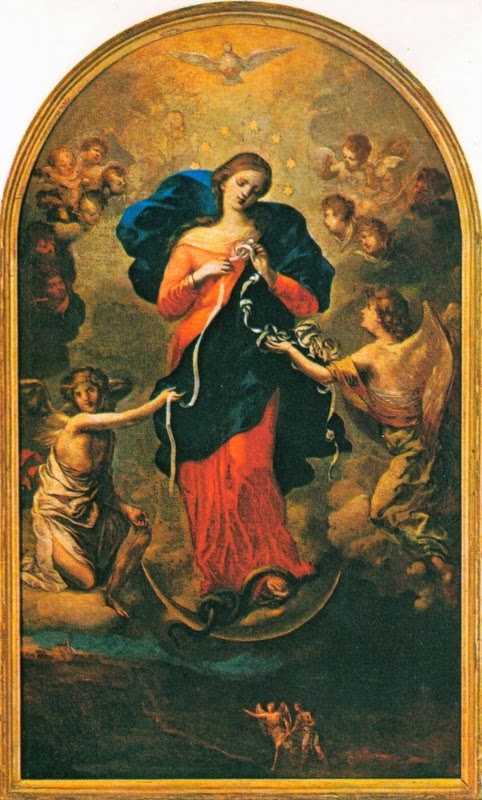
At the same time, or near enough, Pope Benedict retired and Jorge Bergoglio was elected to be the next Pope, the 265th successor to St. Peter. Jorge was a bishop in Argentina and a Jesuit. He chose Francis for his name in honor of St. Francis of Assisi whose model for caring for the poor he wanted the church to emulate. I don’t know why I was excited to be joining the church when Francis became Pope but being drawn to him also drew me to one of his favorite devotions of Mary, which very quickly became one of my favorite devotions. It is Mary, Untier or Undoer of Knots.
She appealed to me so much and she has stayed with me as this decade has passed.
Unlike Pope Francis, I have not seen the original painting in Augsburg, Bavaria, Germany, but I have managed to find medals, coins, and prayer cards. I am too intimidated to sketch something for this Mary, but perhaps one day.
Pope Francis’ humility and inclusivity to all is one of the reasons I am so fond of him. He walks the walk, exhibited in one way by his living, not in the Papal Residence but in the Vatican guesthouse.
He influenced the change in US policy towards Cuba and diplomatic relations and he supports the causes of refugees across the world.
He is clearly interested in evangelization, the environment, the poor, and real religious persecution.
He is the first Pope from the Society of Jesus, the first from the Americas as well as the first from the Southern Hemisphere, and he is the first Pope outside of Europe since Gregory III of Syria in the 700s. He is the first to choose the name Francis.
He speaks seven languages.
He has a common touch, which I think made me like him more. He is of the people, something as an American I can relate to.
He is quoted as choosing St. Francis of Assisi because “the man gives us this spirit of peace, the poor man, …how I would like a poor church, and for the poor.”
From William Bole’s 2018 article at jesuits.org, he states (and I paraphrase), that it’s not so much about rule following but about discerning what G-d is calling them to do. He purports an ethic of service. This truly speaks to me. I am in constant discernment as to what I’m being called to do. It has given me a new confidence in making decisions when I’m asked to do something and I try to be of service or to offer resources that can be of service to others. It is said that giving feels better than receiving, and when you are the one giving, it is a palpable sensation that remains long after the gift or the day has passed.
Pope Francis is who a leader of the church should be – putting the poor and the earth first and foremost, reminding us of our invitation to be humble and merciful, not only to the people we meet, but to ourselves as well.
Happy 10th Anniversary, Pope Francis. I pray for many more years under your guidance and wisdom.
*RCIA – Rite of Christian Initiation of Adults, which is the process of joining in full communion with the Church.
Ash Wednesday was just over a week ago and I still haven’t settled into my Lenten routine. I read the two devotionals I have at some point during the day, every day, but I haven’t found the perfect time and space for prayerful reading. I want it; I just can’t seem to settle into it. By the time I do, Lent will be over and I’ll have a case of regrets and guilty feelings.
I didn’t give up anything either. I couldn’t come up with anything that felt right. Nothing felt … well, actually everything I considered felt performative and had no deep meaning. What I’ve been doing so far this last week, is thinking more deeply about what I’m choosing to do with my time and choosing to eat and choosing to spend money on. I’m trying to make that part of my contemplations, but I feel as though I’m falling short.
My March is full of study and action and days of reflection and retreat, but even that is missing an emotional component. At least, that’s how it feels to me. Sleep walking through the steps but not genuinely getting anywhere. I even just added another retreat evening to my schedule, but it’s facilitated by two of my favorite religious women and that alone is worth the time spent.
Writing classes are going well – the first class of each are both great groups. I’m very excited for these six weeks. (Surreptitiously waves at any of them reading this right now.)
I have calendars and checklists and fancy colored markers but none of it is giving me any of the impressions they’re supposed to do.
Although Wednesday’s soup delivery is a good time to sit in quiet and peace, smell the soup, taste the bread, and pray on what got that soup to my door. Maybe I can draw a soup prayer. Draw a soup prayer. That’s something different, I think.
Goal for the week to include on my Apostolic Action – look back at my Heart and Soul Quest Letter to myself from November and the green sheet/handout that Sister gave us and use that to try to get into the Lenten frame of mind and after that I can check back next week. It’ll be a date: Tuesday. That comes after grouping on Monday and after planning this week’s lessons and right before I arrange April’s calendar for this site.
It’s important to remember that one of the things left out of the abortion access discussion is that it is a freedom of religion issue. Banning abortion violates the tenets of some religions. It is also important to remind people that despite declarations of the opposite, this is not a Christian nation. It is not founded as a Christian nation, and many of us need to be reminded of that. More often it seems.
In fact, in the Treaty of Tripoli, signed in 1796 and ratified by the United States Senate in 1797, UNANIMOUSLY and without debate under the Presidency of John Adams stated that explicitly:
“…the Government of the United States of America is not, in any sense, founded on the Christian religion.”
Article 11, Treaty of Tripoli, rat. 1797
The below article was posted in USA Today on February 13, 2023. It is written by Christine Fernando and can be read here:
Food and cooking are universal. We all eat, we all need to get food on the table, and even if it’s not us directly, someone needs to cook. From small galley kitchens in apartments to large farmhouse kitchens looking out over lush, green backyards, whatever kitchens we are destined to be “stuck with” we adapt and we learn how to work with what we have. If we don’t have an ingredient, we try a different one. When my kids were little, in the summer we held taste tests. I would get things they’d never eaten and we’d try them. It was great fun, and the kids had an awesome time choosing what new food, mostly fruit they wanted to try. Some (donut peaches) did better than others (anchovies).
I had the privilege of working one of my first jobs out of college as a civilian for the US Navy’s child development program and through that job met people from all over the country and we shared food and recipes and cultural traditions, and it was wonderful.
One of my mentors, Sylvia was an African-American woman from New Orleans. She had a demeanor of floating on air, gliding through our lives, and expressing and encouraging our wonder in the world and in diversity. I learned so much from her. She was ethereal and offered her words and advice as a sage. From her, I learned to make her sweet potato pie for Thanksgiving.
I followed her recipe exactly for years and my family loved this new item in our Thanksgiving celebration. My mother could not reconcile that sweet potato pie was served cold and as a dessert. She just could not get used to it, and soon it became a side dish in our house. The only difference between Sylvia’s and my version was temperature and time to eat.
After a while, after three kids and depression, and “I don’t have time for this” I converted it to a casserole, but I still miss that original version that Sylvia introduced me to. At the bottom, I’ll share my recipe, which, while excellent is not what you’d find in New Orleans.
Combining Sylvia’s traditions with mine was one way I blended her African American heritage with my Jewish heritage and then further blending Jewish and Christian traditions for holidays, in classrooms as a teacher and in my husband’s Catholic family.
This has been a longwinded introduction to a Twitter friend of mine, someone I met on the social media site in the last few months.
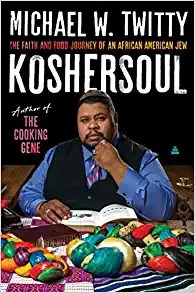
Michael W. Twitty is a proud African-American Jew who expresses himself through cooking and writing about food and culinary history. His Twitter handle is KosherSoul, which exemplifies his focus.
I’m going to quote from his website because this epitomizes how I think of my own cooking: Michael has introduced me to the term, “identity cooking.” “Identity cooking isn’t about fusion; rather its [sic] how we construct complex identities and then express them through how we eat.” This is a truism that if you follow me for any length of time and read my food posts, you’ll see that connecting different foods has always been my cooking style. Bringing together flavors that don’t necessarily go, but manage to surprise. None of us eats in a singular “culinary construct”. We often work with what we have and adapt. My mother-in-law was excellent at pulling things together from her cupboards and turning it into a gourmet meal. She had a rare talent.
As for Twitty, I could easily just copy and paste his website to describe how he blends the two diasporas of African-Americans and the Jewish people and their food, but I’ll let you visit him yourself as he explores their crossroads. He is a two time James Beard award-winning author and his recent book, KOSHERSOUL: The Faith and Food Journey of an African-American Jew was the winner of the 2023 National Jewish Book Council Award for Book of the Year.
Find all his socials below as well as his website and links to purchase his books.
He also offers classes in the DC/Baltimore area. Information here.
As promised, my recipe for Sweet Potato Casserole
To make this as a pie, pour into a graham cracker pie crust, cover with mini marshmallows and bake for about 35 minutes at 350, until marshmallows are golden brown.
Ingredients & Directions:
1 large can of sweet potatoes (cook, drain, mash) 1 stick of butter 1/4 cup of brown sugar (whatever variety you prefer – I use dark, Sylvia used light) I don’t measure the spices, but I add about: 1 TB cinnamon 1/2 tsp nutmeg Incorporate everything together and pour into a small, any shaped casserole dish. Cover the top with mini marshmallows and bake for 35 minutes at 350 degrees.
Scoop and serve. If pie, let cool, slice, and serve.
A couple of years ago, I bought this Kindle book through a discount posting, and I read it daily for one year. It was eye-opening in many ways. The first was my introduction to Thomas Merton and his way of thinking and his life as a mystic. Another thing that struck me as mystifying was how much Merton’s words, written from 1952 to 1968 made perfect sense in today’s world with the upheaval here in the states with the 2016 election and subsequent events. It was hard for me to reconcile the timelessness of his words that fit so well in our modern world and with his death in 1968. I couldn’t believe that this wasn’t written that year or the year before I read it.
Each month’s journal entries begin with Merton’s pen and ink drawing or black & white photograph. Each day is an easy to read, thought-provoking way to begin your day. The entries have been chosen and edited by Jonathan Montaldo. As much as I wanted to read ahead, I disciplined myself and stuck to the meditation per day schedule that the book is written in.
Celebrate the anniversary of Merton’s birth (108 years) by beginning this yearly devotional today.







 Griffins and Ginger Snaps