Inspire. December. Chanukah.

Standard

I’ve been searching for the write inspiration for December, and this first night of Chanukah brought things into perspective. A little bit of perspective. While the internet and the news are filled with antisemitism and protests from people intent on gaslighting the Jewish experience and deny Jewish people the indigeneity of their homeland, I have been on a quest to celebrate Chanukah publicly. I’m a little wary about it. I live in a nice neighborhood, but I don’t put my head in the sand and think that it couldn’t happen here. I know it can.

Still….

I went out and bought blue and white lights for outside, something I’ve never done. I have an interactive menorah hanging on my front door, again, something I’ve never done. In fact, since I’ve been on my own (and with my own family) I have not put Chanukah lights in the window. That unfortunately will continue because I know that if I put candles on my windowsill, my mother would come back from the grave and blow them out with a raucous, and loud message of fire safety.

Most people don’t know the story of Chanukah; perhaps some teachers wanting to bring multiculturalism to their classrooms, and now the story of the Maccabees is being co-opted to match the narrative, anything to turn the words of Jews and their history against them. The Festival of Lights isn’t about war. It isn’t about victory. It is about faith. The miracle isn’t that the Maccabees won against their most recent oppressor. The miracle is the lights themselves. When we retook the temple, amid the destruction, they went to light the candelabra to rededicate the temple, the menorah – not the nine-branch one that most are familiar with, but the regular, ordinary menorah that is always lit in the temple. There was only enough oil to keep it lit for one night. There was no other oil. So, what did they do? They lit it anyway.

And it remained lit, not one night, not two, not three or four, not even five or six or seven, but it remained lit for eight days. One day’s oil lasted for eight days. That is the miracle. And that is why we light eight candles on a new type of menorah used just for this holiday: a hanukkiah.

Tonight, I will say the prayers (that I don’t normally say). I will fry the latkes in oil. I will fry the chicken in oil. I will light the first candle on the same menorah that I lit as a child; the one that I grew up watching the candles burn down on the dining room table that was my grandmother’s. It will be placed on that same dining room table in my own house. My kids will see the lights on the same menorah, the same table, and they will be able to see through my eyes, even amidst the clutter that seems to grow multi-generationally on this dining room table.

This year, however, this old menorah has a special, additional meaning. I saw this menorah in Toronto at the Royal Ontario Museum in their Judaica exhibit, in the Chanukah window. A copy/replica of MY Chanukah menorah sits in the largest museum in Canada. The exhibit label states that it is from Gdansk, Poland, brass, from the early 1900s.

Happy Chanukah.

My family menorah.
(c)2023
Royal Ontario Museum Judaica Exhibit.
Hanukkah menorah, “Danzig” type,
Gdansk, Poland, early 1900s.
(c)2023
Ready for sundown.
You can view it lit later tonight on Instagram (link in sidebar).
(c)2023

Mark Twain’s Study

Standard
(c)2023

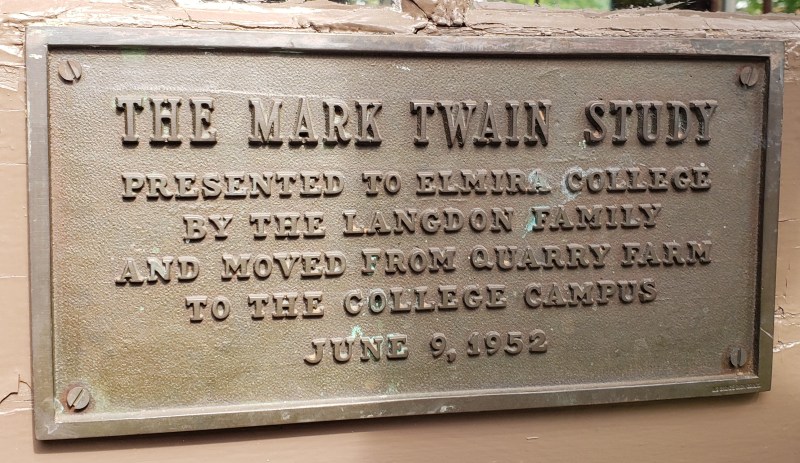
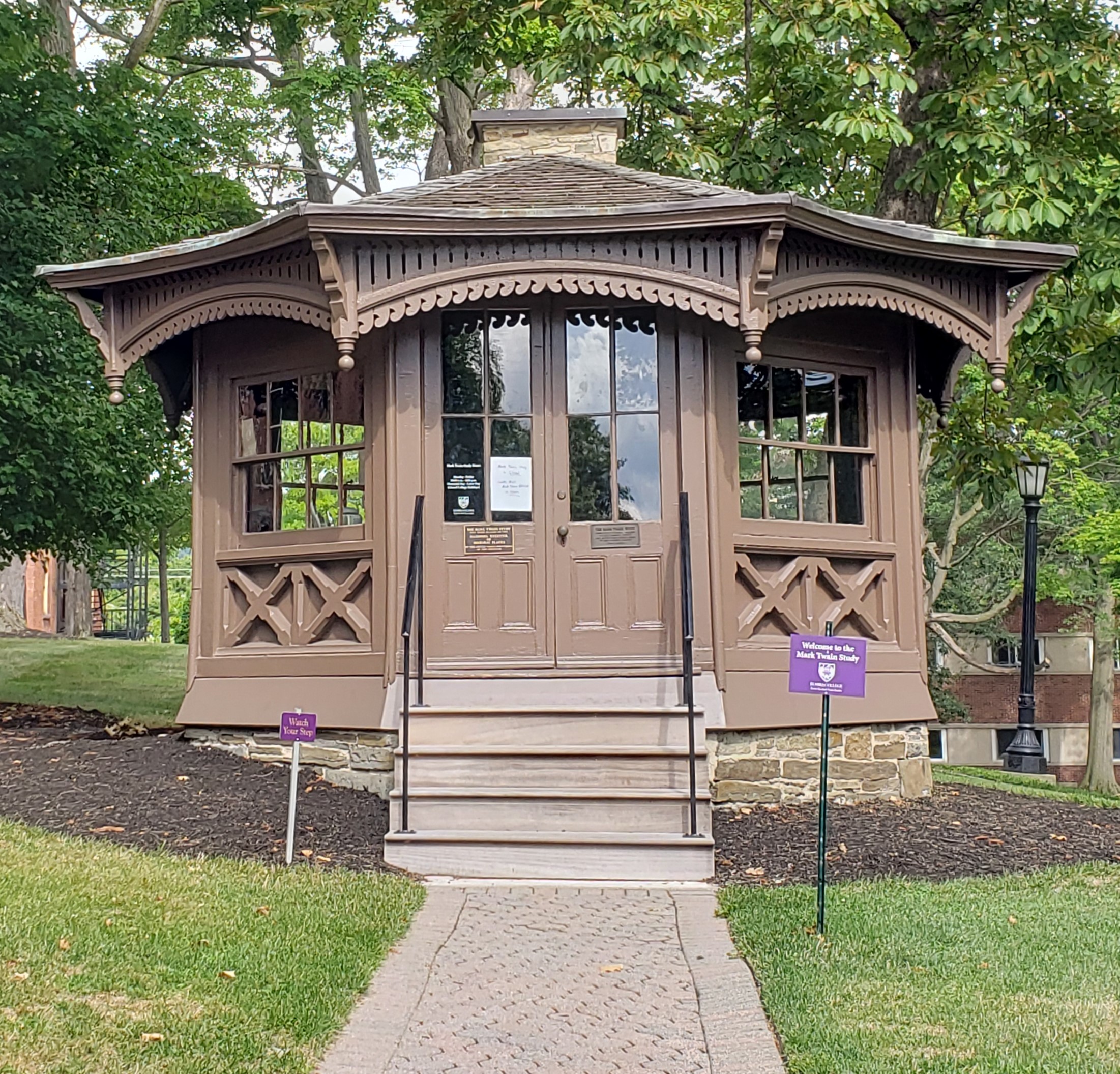
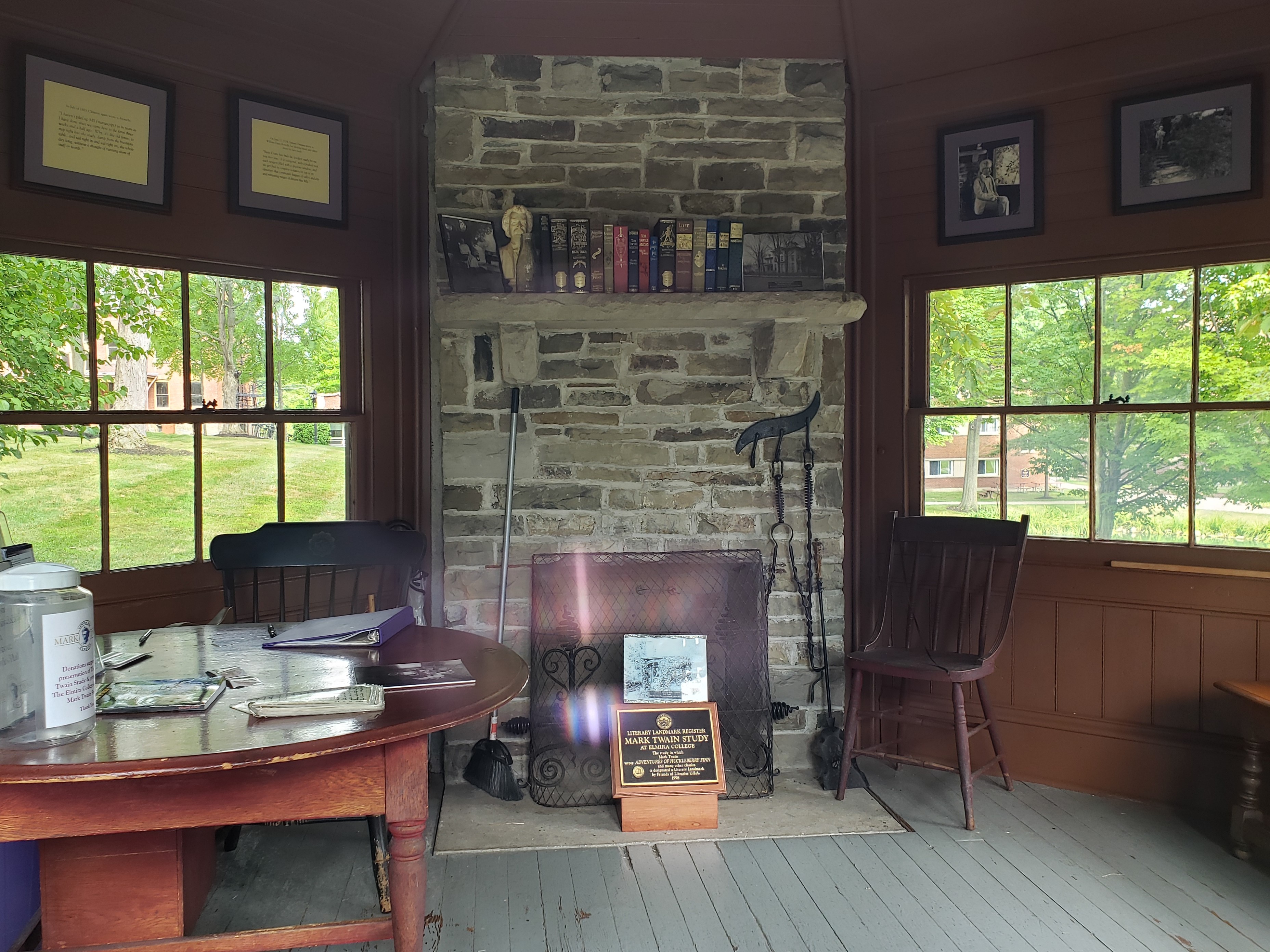
On Mark Twain’s birthday, I wanted to share some of the photos we took when we traveled to his study’s current location at Elmira College in Elmira, New York. The study was originally on the Langdon land where he did his writing in this small building. He wrote many of his classic stories here. I’ve included an information sign from the site.

(c)2023
(c)2023
(c)2023
(c)2023
(c)2023

Happy Thanksgiving.

Standard

With my ongoing research into St. Kateri’s life, I thought instead of a retelling of the first Thanksgiving today, I would set my table with the First People in mind, sharing with my family the Three Sisters as the Mohawk call these three plants that grow side by side: corn, beans, and squash.

My table setting.
(c)2023
Sign about the Three Sisters at the St. Kateri Shrine in Fonda, NY.
(c)2023
The Three Sisters.
St. Kateri Shrine, Fonda, NY.
(c)2023
The cake plate I used was a wedding gift from a friend who worked at the Jewish Museum in NYC. I like to blend our cultures in our interfaith family, and this was one way to join two ancient peoples and their symbols.
(c)2023

Native American Heritage Month – Beginnings & Endings

Standard

The photo below represents both the start and the end of the day.

Beginning with the end, I have slept with a Dream Catcher for most of my life. I notice a change in my sleep when I don’t sleep with one. It creates a calm and peaceful rest as it catches the bad and lets the good continue through. This particular dream catcher is one I got in Niagara Falls, Canada. I was drawn to the colors of the beads that represent the four directions as well as the uniqueness of the center stone.

The booklet is something that I was more recently introduced to through Mohawk Elder Tom Porter of the Kanatsiohareke Community in New York. Since then, I’ve seen it in other Haudenosaunee writings and readings. It is called the Thanksgiving Address, but it has nothing to do with the Thanksgiving holiday, but in giving thanks for all that is around us in the natural world, all that we have, all that we see. It is said at the beginning of all important gatherings, ceremonial and/or governmental. The Haudenosaunee call them the Words Before All Else.

I recently used a form of this address for a meditation that I was tasked to share, and it was very well received. I read mine, but most are recited and because of that they are often never the same twice since the words change with the speaker and the timing of the gathering.

As I said at my own (non-Native) gathering, as a shared meditation, I acknowledged the land we were standing on (Mohawk), and reaffirmed that I am a non-Mohawk, non-Native, sharing their wise words.

Friday Food. Experimenting.

Standard

Experimenting in the kitchen can be very freeing as well as inspiring. I sometimes feel very creative in other areas after making a great meal from scratch. For me, “from scratch” doesn’t necessarily mean a two-to-three-hour production. In the third photo below, the rice I used was Minute Rice. Both dishes can be made with leftover chicken. I used baby potatoes, but you could easily take the larger russets or reds and cut them into the smaller pieces, and again it’s a great way to finish your bag of potatoes.

Both meals used one pan and one metal bowl, and the second meal used a pot to make the Minute Rice. As I finished cooking something on its own, I moved it to the metal bowl until the next item was cooked and then everything was combined and simmered for a short time.

Continue reading

The Royal Ontario Museum and Sitting Bull

Standard

When we visited the Royal Ontario Museum this past August, I knew that I could not visit every nook and cranny as much as I might have liked to. I also knew that with five of us having different interests that we were going to get very frustrated very quickly if we stuck together. Upon entering and deciding who wanted to pay extra for the special dinosaur exhibit, I announced the three places that I wanted to focus on and whoever came with would be welcome, but if they wanted to explore on their own and meet back through texts, that would be great.

As an aside, I do miss my little ones, but I really appreciate going on vacation with teenagers and older kids because of this freedom for all of us. I didn’t want to see the dinosaurs; more to the point, I didn’t want to PAY to see them, so I didn’t. My daughter was not a fan of medieval arms and armor and so she veered away from that. The technology of texting let us know where the others were when we were engrossed in our little worlds. It was fantastic! And I think we all benefited from the freedom to explore our interests and the freedom from each other for an hour or so.

My three focuses were in the areas of First Nations, Medieval History and Arms & Armor, and Judaica.

Continue reading

Terry and Darlene Wildman and Rain Song

Standard
From their website.
(c)2023

I’ve mentioned earlier in the year about a retreat I went on in June, which had stayed with me for weeks, and now, for many months. It still reverberates in me. I was privileged to be in attendance as it was guided by Terry and Darlene Wildman. Terry and Darlene are known for their music, which ironically, I did not know until they arrived and began playing and singing.

The retreat was primarily centered around the First Nations Version of the New Testament, and the weekend was filled with music, Scripture, prayer, Native American spirituality and ceremony, and really good, deep conversation.

When I awoke on the first morning, I knew that there was something special about this weekend retreat. I was awake early; not drowsy, and ready to start my day. I was reinvigorated. This is very unusual for me. While I’m very comfortable at this retreat house, I can never quiet my mind down enough to sleep at a reasonable time. On this weekend, this retreat gave me the exact opposite experience. I went to sleep every night before midnight (sometimes long before) and woke up refreshed at around seven in the morning, without an alarm, and with the sunrise shining out of my window.

The evening before and again on that first morning, we went into the warm courtyard where a sacred fire was burning. Darlene held an abalone shell with burning sage, smoke rising, guided by a large feather. We prayed in the seven directions, and then each of us had the opportunity to purify ourselves with the smoke, using our hands to bring it in, while the feather helped the smoke. I think we also had the opportunity to add a pinch of tobacco to the fire.

This table held the sacred plants for smudging and purifying: braided sweetgrass, sage, cedar, and tobacco as well as a large feather, traditionally an eagle feather along with an abalone shell to hold the smoking sage.
(c)2023

It was a very profound experience, and it enhanced the rest of the prayers that we each would do that day. I found it very natural and complementary to my own rituals. It was a wonderful experience.

In the months since, I’ve immersed myself in local Native American history. I haven’t changed my religion or coopted anyone else’s, but I have found a place in my daily readings for the First Nations version. I read from this Bible every day in June and continue to do so during my weekly prayer time. While I was on vacation, I recorded the daily readings in my notebook, and took photos of those pages to bring with me for my daily prayers.

I spent time with other experiences of Native American spirituality and storytelling, reading a book by Mohawk Elder Tom Porter, and completing a historical account of Wounded Knee. I’ve also spent time in the museum at the St. Kateri Shrine in Fonda, examining the Caughnawaga archaeological site, and touring the Mohawk village of Kahnawake in Quebec. Next year, I plan on attending the Strawberry Festival in Kanatsiohareke, just west of Fonda, New York.

All of this was a direct result of that holy weekend.

I’ve spent weeks listening to the music of RainSong, the music of Terry and Darlene whenever I get into the car. I sing along and it brings me back to that weekend and the feelings of being closer to G-d, and of being uplifted spiritually. My favorite CD so far is Hoop of Life, which has many of the songs that Terry and Darlene shared with us on our weekend.

Use the links throughout this post to meet Terry and Darlene and find your own way to their wonderful sounds.

Kahnawake, Quebec

Standard

Indigenous Peoples’ Day was Monday, nearly a week ago, but that doesn’t mean that now we can forget about an entire culture, language, history, or a people. I usually will say that especially in the Northeast, where the Iroquois, more properly known as the Haudenosaunee lived, we should remember them. There are several things wrong with that sentiment though, and I am embarrassed to admit them. For one thing, the Haudenosaunee live, now, among us. They cover the six nations: Mohawk, Onondaga, Oneida, Cayuga, Seneca, and Tuscarora, across all of New York State and the international border with Canada. For another thing, Native tribes have lived on this continent from ocean to ocean, from the time when there were no borders at all. Just like our states, their nations had rivalries with others, they had distinctive cultures separate from one another. It’s important to remember that Native culture, whatever nations are represented, they are a living, breathing group of people, and it is well past time to recognize their contribution and their sacrifices. I’ve had several people (non-Native, I should note) that it was in the past, it’s history, there is nothing I can do, and that attitude disturbs me on many levels. I don’t know if it’s a connection I feel to the people whose land I live and work on. I don’t know if it’s from my childhood admiration and longing to be more involved in the limited Native culture around me as a child. I don’t know if it’s because of my Jewish background where people will say the same sentiment: it’s history, why are you still upset about…? I will call out some by saying that the same people who say that the Trail of Tears and stolen land in the 1880s and 1890s is “ancient history” and we “need to move on” are the same people who insist on the rest of the country worshipping a man who died over two thousand years ago. The continued hypocrisy is staggering in so many ways.

I have a few thoughts and photos that didn’t make it onto the website on Monday, and I hope to share them with you today and in the early part of next week.

I have been fortunate to have visited the village of Kahnawake in Quebec, Canada three times. Kahnawake piqued my interest through my studies and research of St. Kateri Tekakwitha who was born, lived, and was baptized very near to where I sit right now. Each visit was unique in that I saw new things and learned new things each time. The first time during covid was very limited to the outside world and was a superficial encounter. The second time had a decidedly Mohawk perspective, and the third time was more of a Catholic and Mohawk-Catholic perspective. Each visit gave me a new outlook, answering questions and thoughts, and offering insights that raised more questions and contemplations. I expect and look forward to returning next year to do some more research as well as visiting their language and cultural center that we were unable to see previously.

These photos are a little taste of the village. I will also share the one thing that really surprised me. The Mohawk in Kahnawake primarily speak English and Mohawk. Their street signs and stop signs are in those two languages. I thought the second language would be French. As I said, there is always something new to learn.

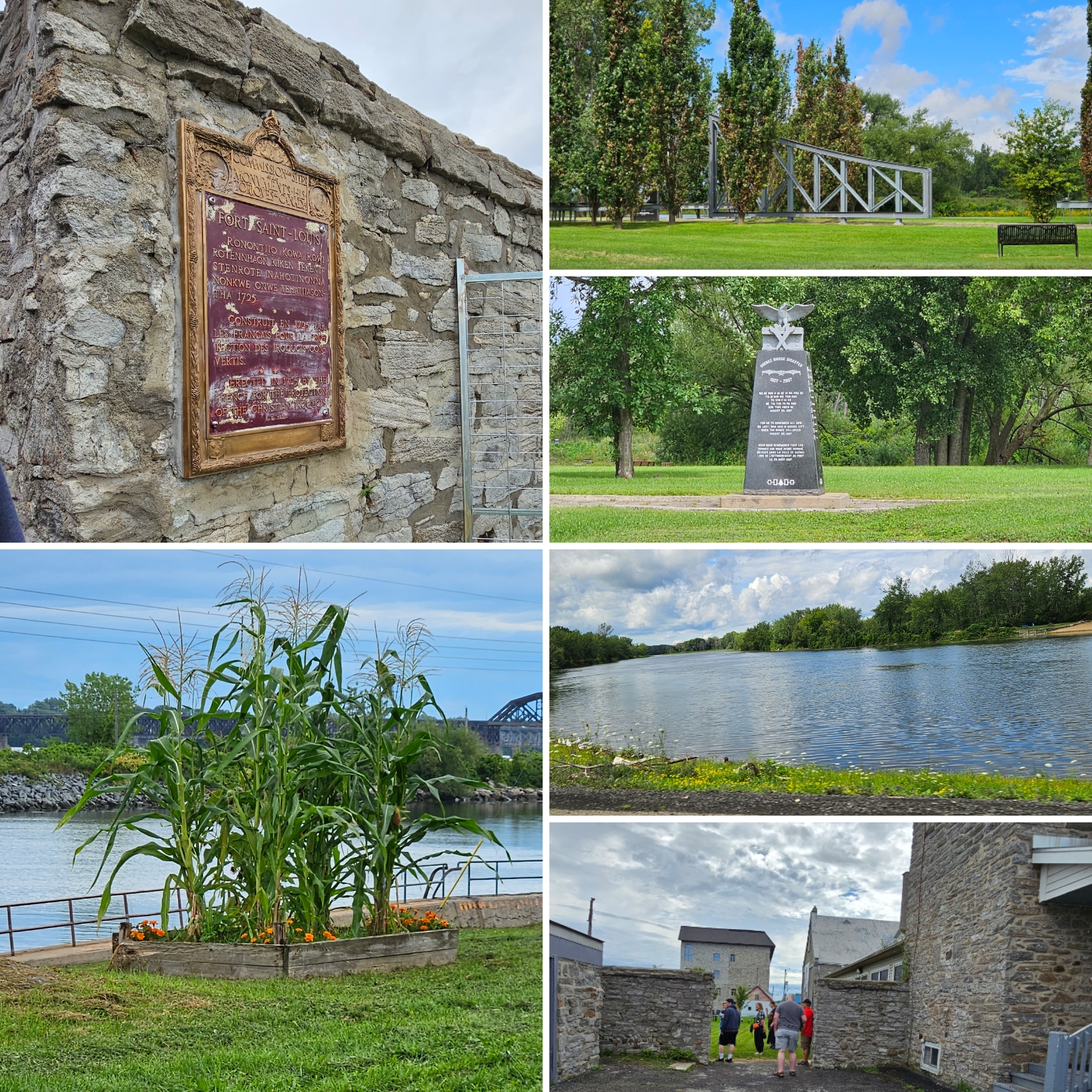
From the top, clockwise: Original wall of the Fort Saint Louis, Replica of the Quebec Bridge, Memorial to those who perished in the Quebec Bridge Disaster, part of the St. Lawrence Seaway, the back of the St. Francis Xavier Mission Church, what I presume are the Three Sisters, which are grown on Mohawk land.
Kahnawake, Quebec.
(c)2023

I just wanted to add one or two notes about the above photos:

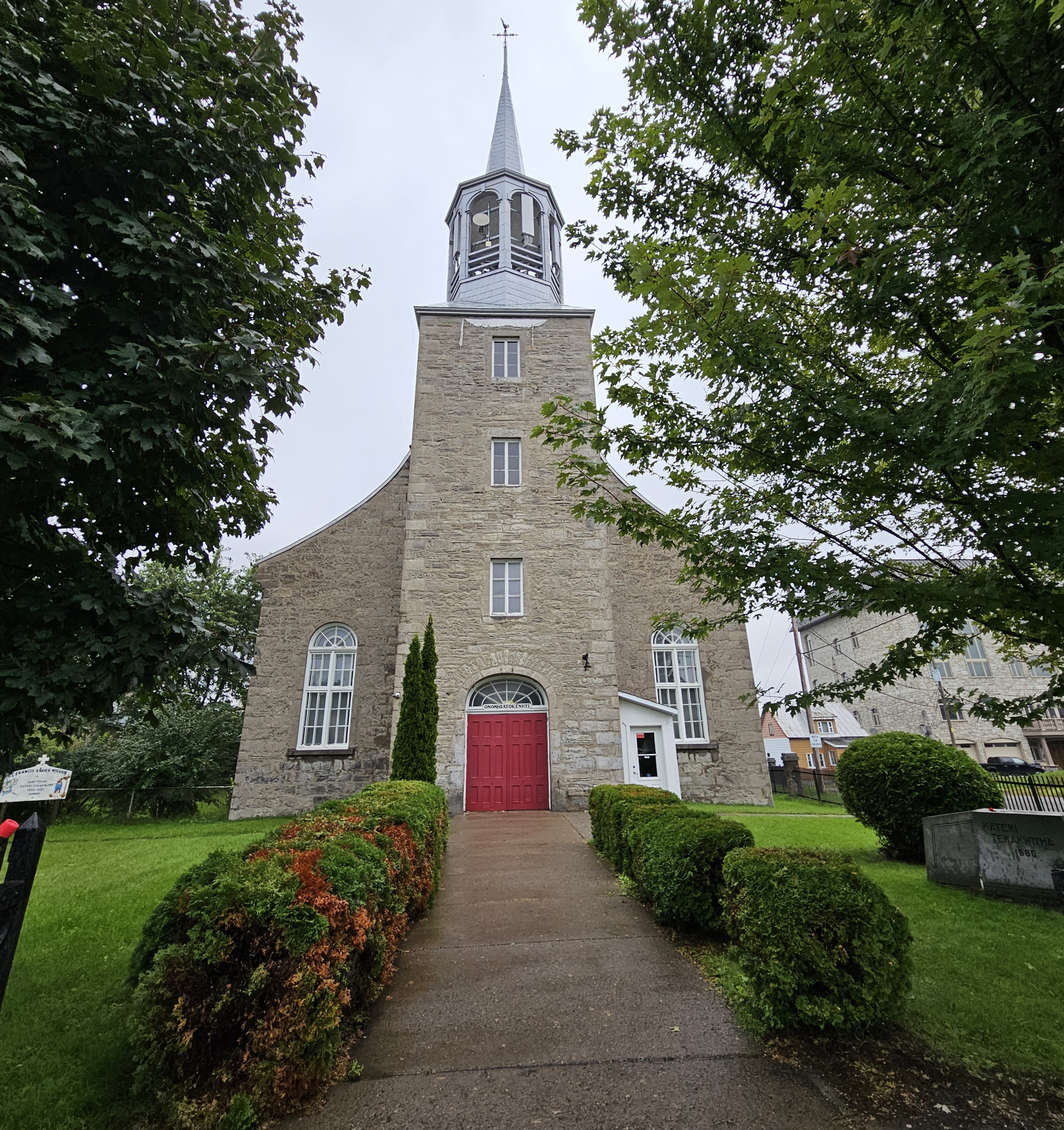
The St. Francis Xavier Mission Church moved with the Mohawk. It moved four times,
I believe, before it settled permanently here and was built as a permanent structure in 1716. St. Kateri’s relics were moved here in 1973.

The Quebec Bridge Disaster killed 32 Mohawk ironworkers from Kahnawake. This left 25 widows and over fifty children fatherless. The compensation from the Canadian government was negligible. The Clan Mothers decided from then that so many members from one family could not work on such a dangerous job.

The Canadian government changed how the St. Lawrence River flowed, so it moved it away from Kahnawake and left the still St. Lawrence Seaway. The River was more profitable and was able to accommodate boats and fishermen as the Seaway was not. This is still an issue today.

The Three Sisters are known to the Haudenosaunee as the most important crops, sacred, and include corn, beans, and squash. They grow together in the same area and help each other thrive.

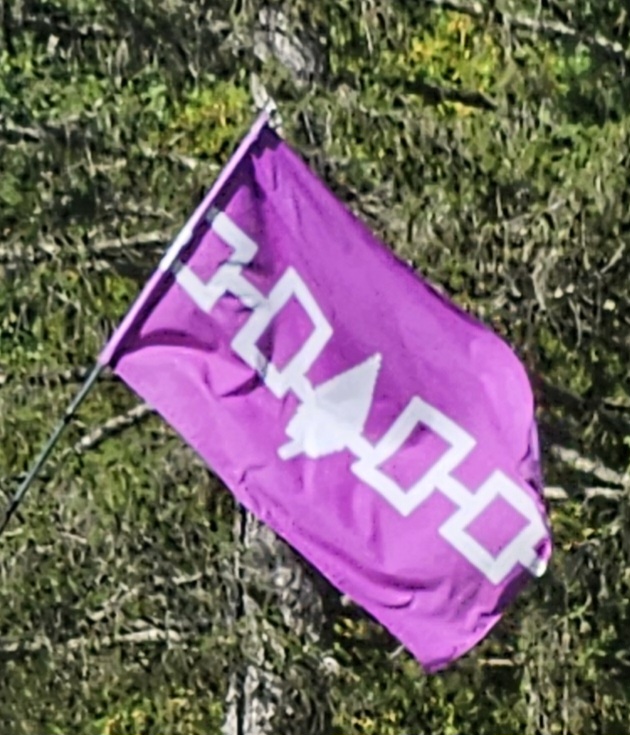
Haudenosaunee Confederacy Flag, which is a depiction of the Hiawatha wampum belt.
(c)2023
Front of the St. Francis Xavier Mission Church.
Kahnawake, Quebec.
(c)2023
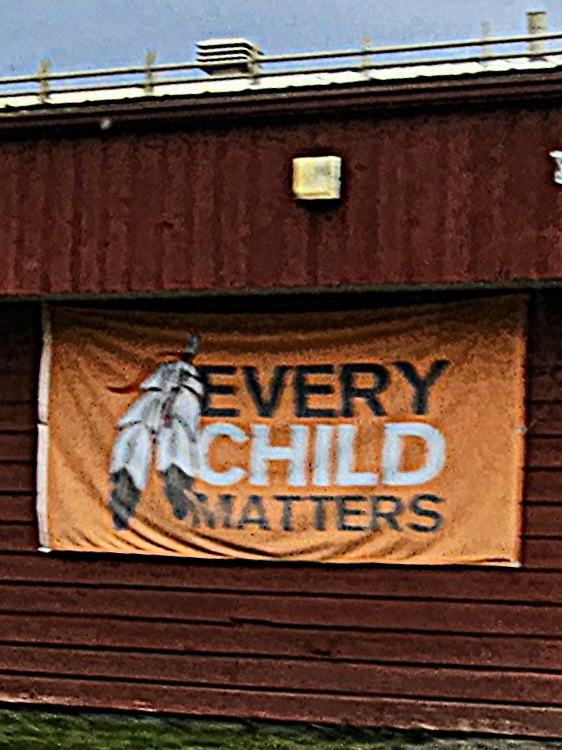
Signs and flags of Every Child Matters on orange are seen in many places. Despite Canada’s Truth and Reconciliation Committee, there is still much to be answered for.
(c)2023