St. Jerome was known for his writing. He translated the Hebrew Scriptures from Hebrew to Latin, which was unusual at the time since most people translated it from a controversial text called the Septuagint, also called The Greek Old Testament. He is the second most prolific writer of in ancient Latin Christianity. The first is Augustine of Hippo, who actually had no problem with the original Septuagint.
As a result, perhaps, he is the patron of translators, librarians, and encyclopedists as well as archaeologists, students, Biblical Scholars, and against anger, the latter of which I believe stems from his widely known bad temper.
As a student in Rome, he indulged his hedonistic side, but also attended the catacombs of Rome to visit the martyrs and Apostles there. There were early inscriptions and wall art that I imagine he studied, although he referred to the place as giving the feeling of the terrors of hell.
To put it simply, Jerome was a person of contradictions, some of which can be sourced as his being a student, a constant learner, and a voracious reader and writer. He had a group of women who surrounded him that read his scholarly works, and several were turned towards a life of consecrated virginity and the ascetic monastic life. This had a negative impact on these wealthy women’s donations, and he became at odds with the Roman clergy.
He is considered a saint in the Catholic Church (and a Doctor of the Church there), Eastern Orthodox, Lutheran, and Anglican.
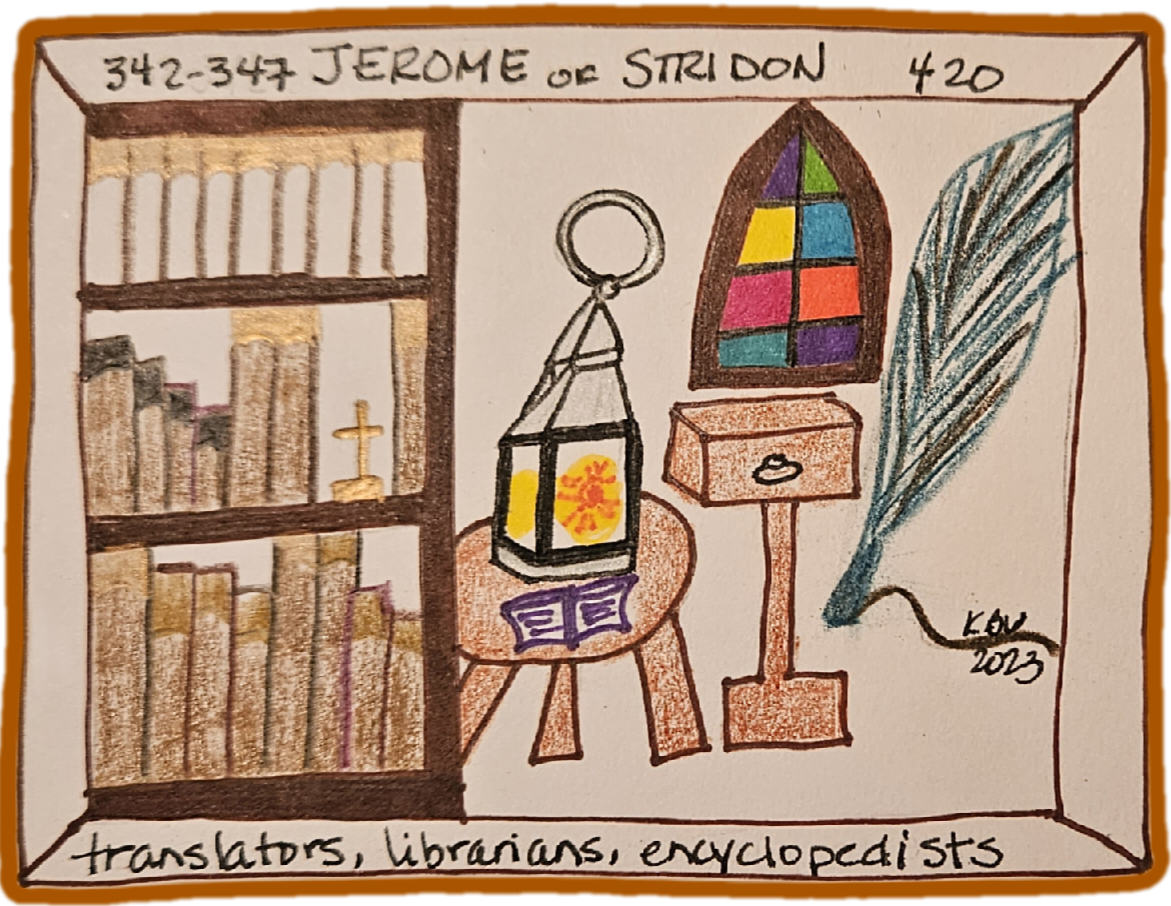
His iconography is often depicted in libraries and/or scriptoriums surrounded by books, parchment, vellum, and writing implements. He sits at a desk, holding a quill. He is also depicted with a lion having apocryphally removed a thorn from one’s paw.
In my sketch below, I have chosen to leave the lion and the saint outside the view as we look into his small cell of scholarly works.
For the next four weeks, I’ll be posting some information, links, art, and photos for Pride and hopefully including some LGBT+ history. I’d like to start by saying that last week I heard some complaints by folks with nothing better to do asking why Pride gets a month and our veterans only get one day. This is obviously meant to create an issue where there is none. First, Memorial Day is not about veterans in that way; it’s about the war dead, which most people are glad to ignore until it suits their agenda. If they really felt this way, they’d spend Memorial Day at the cemetery, at a house of worship, volunteering instead of barbecuing and at baseball games and concerts. Second, there are many, many veterans (and war dead) who are in the LGBT+ community, and Pride is as much for them as any other person. Third, for those who declare that “pride” is a venal sin, I’d like to suggest that those divorced, adulterous, lying, hypocrites stay quiet and/or remove the log from their eye.
I wonder if, when these people see a rainbow in the sky if they shake a fist at it and complain loudly to the Creator about how woke He is.
Pride was born in revolution, even though LGBT+ people were around long before 1969. The ones who are out and open and celebrate Pride are not only celebrating themselves but are celebrating those of the community who are still not out, for personal reasons as well as safety ones.
My friend has a denim vest with the stenciled words: The first pride was a riot. I’ve used that to influence the art I created last night for this post. Sometimes the simplest designs tell a greater story.
I’m including two links. One is the original article I read: How Cornrows Were Used by Slaves [sic] to Escape Slavery in South America, which details the idea that women braided escape maps into their hair as well as messages. The second article is from Snopes that doesn’t discredit this theory despite no tangible evidence. As been told, just because we don’t know if it happened, doesn’t mean that it didn’t happen. There are many ways that African Americans used to keep themselves safe in order to survive slavery and emancipation from slavery, including communicating with each other and traveling north to freedom. Whether mythology or history, it is important to know all aspects of the African American experience from their arrival on these shores, almost exclusively involuntarily.
An additional thing that I learned in regards to language is that in South America this type of hair braiding was known as “cane rows” as opposed to “corn rows” because the crop there was sugar cane.
St. Patrick’s Day has long been one of my favorite holidays. Long before I met and married my husband with Irish roots, and well before I set foot on the Emerald Isle. I have always been fascinated by the Celts, their people, their land, their culture, especially in relation to ancient and medieval culture. I have also been a questioner. Why? Why do we do this? Why don’t we do that? As a young child being told that I couldn’t write during Rosh Hashanah, I was devastated. But writing isn’t work; it’s writing, I whined to no avail. Becoming Catholic has not broken me of that – is it really a – failing.
And so, I question – why?
Why can’t we eat meat on Friday? Is it because Peter was a fisherman? Will there be a dispensation for today? It is a saint’s feast day after all. I waited for Pope Francis, and then was told that it’s up to the local bishops. I still couldn’t find it, so I texted my godmother and she okayed the corned beef which made my husband happy (as if he wasn’t going to indulge on his holiday).
But I still wondered: Why?
In googling and asking my questions of the internet, I discovered the controversy that is North Dakota. Apparently, they have three dioceses, and two have them have allowed meat today, and one has not. The idea that North Dakota has three dioceses makes little sense to me, but I found no less than twenty-five separate links about St. Patrick’s Day in North Dakota. Amazing.
Archbishop Nelson Perez of Philadelphia popped up as did Cardinal Dolan in New York City’s Diocese. I didn’t see Boston, but I came to the logical conclusion that there would be dispensation for Boston Catholics. What holy hell would be raised if even one of those cities banned meat on St. Patrick’s Day? I hope we never find out.
During Pope Nicholas I in 866 CE, Friday abstinence became a universal rule. Fasting also on Fridays was common by the twelfth century. It was expected for everyone, including those as young as twelve with very few exceptions.
It also used to be that you couldn’t eat any animal products on Fridays, not just during Lent, but ALL YEAR. I learned that Fat Tuesday began as a way to use up all of the animal products that you couldn’t eat – butter, cheese, eggs, lard, and of course, meat.
Pope Paul VI changed things in 1966 in his Paenitemini. His object wasn’t to end abstinence and fasting but for Catholics to choose to abstain and fast as part of their own penance practices; let their conscience be their guide.
With Sunday being a weekly Easter, shouldn’t every Friday be a Good Friday? This was asked by the US Bishops in 1966 and I tilt my head wondering the same thing.
Lent is an opportunity to lend mutual support on our spiritual and faith journey. We are in it together and have a shared experience through Christ’s death and resurrection.
So why the exception for St. Patrick’s Day?
Filled Soda. Randalstown, NI. (c)2023
I mean, look at this filled soda from Northern Ireland! Resistance is futile. This was a breakfast sandwich shared between my husband and myself (and after twenty-three years of marriage he still had to take it under consideration).
I can imagine that they might have thought they’d lose all the Irish American Catholics if they said no corned beef on Friday of St. Pat’s Day, although this quandary occurs once or twice a decade, so it isn’t exactly a pressing issue.
I would also note that the traditional St. Patrick’s Day celebration food in Ireland is different from the traditional food eaten in the US. In Ireland, sausage is usually eaten, and not your teeny-tiny frozen breakfast sausage, but a lovely, large, grilled bit of deliciousness. Bangers and mash. In the US, we serve corned beef and cabbage with mashed potatoes and carrots. Yesterday, I had cabbage with leeks, and it really boosted the flavor.
What are you to do?
It becomes a crisis of conscience.
Well, as I mentioned, dispensations are local, so check with your diocese.
Is it a pass? Not really. You’re expected to abstain from meat on a different day during the week.
Usually, you’re expected to give up meat on a day before the next Friday after St. Patrick’s Day and (or) perform acts of charity and good deeds to atone or call it even with the meat eating.
We’ll be having corned beef, cabbage, mashed potatoes (possibly champ), carrots, and Irish Soda bread with Kerrygold butter.
We are all bound up together in one great bundle of humanity, and society cannot trample on the weakest and feeblest of its members without receiving the curse in its own soul.
Frances Harper, We Are All Bound Up Together, 1866
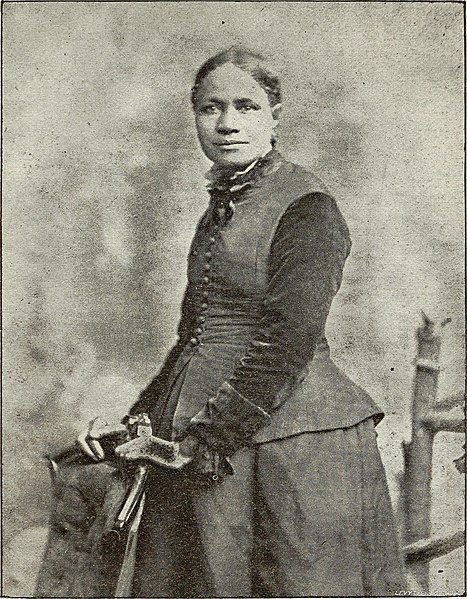
Frances Ellen Watkins Harper. Public Domain
Frances Ellen Watkins Harper was a voice of Black Suffragists. She was born in 1825 in Maryland to free African American parents. Her parents died when she was young, and she was raised by her aunt and uncle. By the age of 21, she had written her first small book of poetry, Forest Leaves and ultimately published 80 poems. More than a decade later she became the first African American woman to have published a short story, The Two Offers. She co-founded the National Association of Colored Women’s clubs.
While working as a teacher in Pennsylvania, a law was passed that free African Americans in the North were no longer allowed into Maryland, her home state. They would be imprisoned and enslaved.
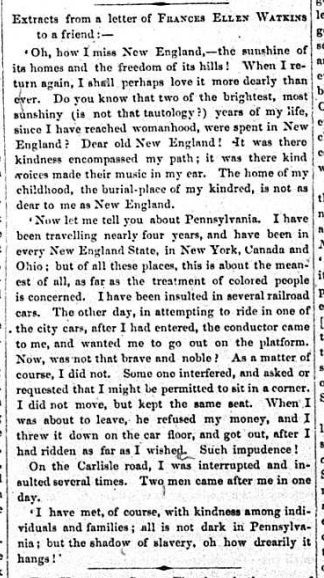
She refused to give up her seat on the trolley, and only got up when she reached her destination as chronicled in The Liberator, page 3 as seen below.
From The Liberator, Page 3 1858 Public Domain
Her famous speech, We Are All Bound Up Together, read in 1866 at the Eleventh Women’s Rights Convention held in New York City, can be read here.
She spoke at the National Woman’s Rights Convention in New York, held in 1866. The organization split over the suffrage of African American women and were opposed to supporting the fifteenth amendment. Harper left the group, and with Frederick Douglass and others supporting the amendment joined together to form the American Woman Suffrage Association. She was often the only Black woman at the women’s conferences. Through her life, she continued her advocacy for intersectionality (see- it’s not a new idea) in suffrage.
She spent the remainder of her life teaching and encouraging equal rights and education for African American women and founded and/or directed several clubs and organizations for African American women, including the National Association of Colored Women’s Clubs and the Pennsylvania Women’s Christian Temperance Union.
Some of her writings include:
Forest Leaves, poetry, 1845
Bury Me in a Free Land, poetry, 1858
Moses: A Story of the Nile, 1869
Light Beyond the Darkness, 1890
In Memoriam, Wm. McKinley, 1901
Trial and Triumph was one of three novels originally published between 1868-1888 as a serial.
Her first novel, Iola Leroy, or Shadows Uplifted was published in 1892. It was thought sentimental, but it also highlighted several serious social issues at the time, some of which remain today.
As a writer, I am always drawn to the writing lives of the people I choose to profile, and I was pleased to see that Harper was a mentor to other African American writers, including Mary Shadd Cary, Ida B. Wells, Victoria Earle Matthews, and Kate D. Chapman.
Stagecoach Mary (Mary Fields of Cascade, Montana) Public Domain
Stagecoach Mary was a mail carrier on a star route between Cascade, Montana to St. Peter’s Mission. She held two four year contracts with the United States Postal Service beginning in 1895, and received her stagecoach that she drove to deliver the mail from her friend, the Mother Superior of an Ursuline Convent, originally in Ohio, but now missioning in Montana.
I should also mention that she was the first African American woman to carry the mail (only the second woman to do so) and in her time she became a Wild West legend.
Sounds intriguing, doesn’t it?
Mary Fields was born in 1832, most likely in Tennessee, into slavery.
As times change, so does language. Since I’ve been in school and up until recently, we’ve referred to the “slaves” in the South (or elsewhere in the world). This denies the people their humanity. It tells the reader/listener that their only value was as a slave; that they are slaves at the heart of their being. But of course, that’s not true. They are people first. Men, women, and children who were kidnapped and enslaved and their children born into slavery and enslaved. These two links should help with the explanation:
She was freed with other enslaved people after the Civil War. From that time, she worked as a servant and laundrywoman on riverboats up and down the Mississippi River. She worked for the Dunne family until the wife died. John Dunne sent her to live with his sister, a nun and Mother Superior of a convent, where Mary lived and worked. She became very close with Mother Mary Amadeus Dunne and after Mother moved to Montana to mission with the Jesuits, Mary eventually followed her and helped nurse her back to health.
As if that wasn’t enough, Mary Fields wore men’s clothing, drank, smoked cigars, shot guns. She was tough and intimidating, two traits needed to be an independent contractor working alone on the frontier.
At some point, the bishop barred her from the convent after an altercation with a co-worker/colleague involving guns. To be fair, I can’t imagine that it would have been palatable for a man to be answering to a woman, an African-American woman and that may have played into some of the friction between them. Of course, it can be hard for any two headstrong people to work together.
It was then that she contracted with the Postal Service to become a star route carrier. She drove her stagecoach on the route with horses and a mule named Moses.
Star Routes were named such after their motto/mission of Celerity, Certainty, and Security in delivering the mail. They were denoted on paper with three asterisks: * * *, thereby becoming “star” routes. This name was renamed Highway Contract Routes in 1970.
She retired from her role as a mail carrier when she was 71 and lived on in town becoming one of the more popular figures of Cascade. She was praised for her generosity and kindness, especially to children. When she died in 1914 at 82, her funeral was one of the largest ever seen in the town.
She was very popular – schools closed on her birthday. When an ordinance was passed disallowing women from enjoying the saloons, the mayor exempted her. When her house burned down, volunteers rebuilt it.
Born a slave somewhere in Tennessee, Mary lived to become one of the freest souls ever to draw a breath, or a .38.
Gary Cooper, Montana native, writing for Ebony in 1959
In a companion to my recent post Black History in Film, I’m sharing the NAACPLegal Defense Fund‘s link on Black Media & Black Culture. The NAACP LDF has put together a list of over 50 works recommended by the staff of the Legal Defense Fund. It showcases their mission to “defend, educate, empower.”
This single link offers links to their recommendations with how to view, read, or listen to them.
Included in the list are books, both non-fiction and fiction as well as for younger readers, television shows, movies and films, podcasts, and of course, music, which, as a white person, I say where would we be without Black music and its influences across every genre.
Visit your local library or e-library and see what’s available.
If you’d rather buy, this link will take you to a list of 149 Black-Owned Independent Book Stores.
In addition, Haymarket Books is offering three FREE e-books:
Food and cooking are universal. We all eat, we all need to get food on the table, and even if it’s not us directly, someone needs to cook. From small galley kitchens in apartments to large farmhouse kitchens looking out over lush, green backyards, whatever kitchens we are destined to be “stuck with” we adapt and we learn how to work with what we have. If we don’t have an ingredient, we try a different one. When my kids were little, in the summer we held taste tests. I would get things they’d never eaten and we’d try them. It was great fun, and the kids had an awesome time choosing what new food, mostly fruit they wanted to try. Some (donut peaches) did better than others (anchovies).
I had the privilege of working one of my first jobs out of college as a civilian for the US Navy’s child development program and through that job met people from all over the country and we shared food and recipes and cultural traditions, and it was wonderful.
One of my mentors, Sylvia was an African-American woman from New Orleans. She had a demeanor of floating on air, gliding through our lives, and expressing and encouraging our wonder in the world and in diversity. I learned so much from her. She was ethereal and offered her words and advice as a sage. From her, I learned to make her sweet potato pie for Thanksgiving.
I followed her recipe exactly for years and my family loved this new item in our Thanksgiving celebration. My mother could not reconcile that sweet potato pie was served cold and as a dessert. She just could not get used to it, and soon it became a side dish in our house. The only difference between Sylvia’s and my version was temperature and time to eat.
After a while, after three kids and depression, and “I don’t have time for this” I converted it to a casserole, but I still miss that original version that Sylvia introduced me to. At the bottom, I’ll share my recipe, which, while excellent is not what you’d find in New Orleans.
Combining Sylvia’s traditions with mine was one way I blended her African American heritage with my Jewish heritage and then further blending Jewish and Christian traditions for holidays, in classrooms as a teacher and in my husband’s Catholic family.
This has been a longwinded introduction to a Twitter friend of mine, someone I met on the social media site in the last few months.
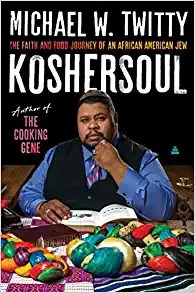
Michael W. Twitty is a proud African-American Jew who expresses himself through cooking and writing about food and culinary history. His Twitter handle is KosherSoul, which exemplifies his focus.
I’m going to quote from his website because this epitomizes how I think of my own cooking: Michael has introduced me to the term, “identity cooking.” “Identity cooking isn’t about fusion; rather its [sic] how we construct complex identities and then express them through how we eat.” This is a truism that if you follow me for any length of time and read my food posts, you’ll see that connecting different foods has always been my cooking style. Bringing together flavors that don’t necessarily go, but manage to surprise. None of us eats in a singular “culinary construct”. We often work with what we have and adapt. My mother-in-law was excellent at pulling things together from her cupboards and turning it into a gourmet meal. She had a rare talent.
As for Twitty, I could easily just copy and paste his website to describe how he blends the two diasporas of African-Americans and the Jewish people and their food, but I’ll let you visit him yourself as he explores their crossroads. He is a two time James Beard award-winning author and his recent book, KOSHERSOUL: The Faith and Food Journey of an African-American Jew was the winner of the 2023 National Jewish Book Council Award for Book of the Year.
Find all his socials below as well as his website and links to purchase his books.
He also offers classes in the DC/Baltimore area. Information here.
As promised, my recipe for Sweet Potato Casserole
To make this as a pie, pour into a graham cracker pie crust, cover with mini marshmallows and bake for about 35 minutes at 350, until marshmallows are golden brown.
Ingredients & Directions:
1 large can of sweet potatoes (cook, drain, mash) 1 stick of butter 1/4 cup of brown sugar (whatever variety you prefer – I use dark, Sylvia used light) I don’t measure the spices, but I add about: 1 TB cinnamon 1/2 tsp nutmeg Incorporate everything together and pour into a small, any shaped casserole dish. Cover the top with mini marshmallows and bake for 35 minutes at 350 degrees.
Scoop and serve. If pie, let cool, slice, and serve.
I am trying to share Black History, especially if I can find it through Black voices. I saw this on my timeline on Spoutible (open to the public on Thursday – there will be a review coming then). As a studier of history, I am always surprised to discover something else that I didn’t know. It is so important to keep our minds open to learning new things. If you know of someone not on this extensive list, please add them in the comments.
Somehow it is expected to fit all of Black History into the shortest month, and the more we study Black History, we find that it encompasses all history, from the African continent to the New World. I usually post a link to a terrific Black History Resource, but unfortunately, it is coming up with a 404 error. I hope to find it again soon. I’m hoping it has just moved since it really covered so many aspects of the diaspora.
This post will share links to some online offerings to get everyone started.
First, beginning on February 6, you can sign up to join the Black-owned Tw*tter alternative, Spoutible. It is definitely having some growing pains, but as a pre-registrant I’ve been using it since yesterday and it looks like this could be the one. On the 6th, I’ll be creating an account linked to this website, so join me.
Second, this link highlights free online resources for kids, and while the website says, “It’s never too early to teach children about Black history,” I believe it is also never too late for anyone to learn what’s been missing from mainstream curriculums, and in the case of Florida, being eliminated.