Election Connection – Republicans will Never Change their Spots

Standard

I don’t even know where to begin with this bullshit.

The weakest Speaker of the House in US history has been ousted and the Speaker’s position is vacant for the first time in the House of Representative’s 243 years of existence.

Good riddance.

Kevin McCarthy is nothing more than a sycophantic, lying, piece of garbage scraped off the bottom of my shoe. Partisan hack and chaos agent doesn’t begin to cover the contempt I have for this phony.

I haven’t even gotten into his smarmy, self-satisfied, failing up brand, and contemptuous face.

But you may say, tell me how you really feel.

And judging by his recent tantrum, Interim Speaker, Patrick McHenry isn’t much better.

Let me actually begin by answering the media’s pressing question: Why are Democrats to blame for this debacle?

Well…they’re not.

At all.

The Democrats have a speaker. The Minority Leader. His name is Hakeem Jeffries. They voted for him at the same time Republicans voted for Kevin McCarthy. For the Democrats, nothing has changed. They support their speaker 100%.

It is not their job to bail out his weak ass.

It is not their job to create a safe space for the Republicans to continue their attack on the American people by their reverse Robin Hood of taking from the least of us and giving to the wealthiest. This isn’t politics as usual.

Except that for the Republicans, it is.

I am currently reading Wounded Knee: Party Politics and the Road to an American Massacre by historian, Heather Cox Richardson. It is more than the journey taken by the United States government that led directly to the Wounded Knee massacre, but it is the politics of the day that led to.

The greed.

The corruption.

Basically, the Republican way of life.

I don’t say this lightly.

Prior to this book, I finished reading Hear That Lonesome Whistle Blow: The Epic Story of the Transcontinental Railroads by Dee Brown about the building of the transcontinental railroad from the Atlantic to the Pacific, and it is full of the double-dealing, cheating, corrupt railroad tycoons who did everything in their power to steal the land from the Native Americans while committing genocide along the way. (As an aside, Dee Brown also wrote the seminal work, Bury My Heart at Wounded Knee: An Indian History of the American West – I highly recommend it.)

The railroad tycoons did not manage to do this alone. They had help, a lot of help from the US government and the military, all Republican run.

But I diverge from the focus of this writing which for our purposes only touches on the railroads and the Native Americans tangentially to the Republicans’ lying and cheating to win any election.

As I read Cox Richardson’s detailed descriptions of how things went down in the 1890s and beyond, the Republican representatives did everything in their power during the Harrison Administration to retain control of the Congress and the Presidency. They bought off election workers. They kept the Black vote suppressed. They refused to consider Native American citizenship because for some reason, having been born here wasn’t enough to be a voting citizen. Not to mention they weren’t land-owning, a prerequisite for the ability to vote.

They CREATED four new states, and only Montana surprised them by electing a Democratic governor, but other than that, they, as well as Wyoming, North and South Dakota were Republican in every other way. These four NEW REPUBLICAN states received at least four Congressmen and EIGHT senators. This heavily weighted the Electoral College to almost guarantee a Republican victory in 1892.

Which was exactly the point.

Our biggest mistake as a country is letting land vote.

And this was the least duplicitous thing they did to gain votes and money for their personal coffers.

They continually suggested that the land on the Great Plains was great for farming. It wasn’t. And it still isn’t without irrigation which hadn’t been discovered yet as a viable alternative to natural rain. They falsified weather reports, giving the opposite information than the Farmer’s Almanac predicted.

Reading this history, I was becoming incensed. I needed to stop often after I read a paragraph and then highlighted some other Republican misdeed. I was having flash-forwards to modern times and seeing this exact scenario playing out today.

Just look at the last few days of the Speaker vote. One Republican motioned for the speaker to vacate. Eight Republicans voted against Kevin McCarthy. REPUBLICANS. When the interim speaker took over, a small man who thinks smaller, slammed his temporary gavel so hard, he missed the block he’s supposed to hit. His first act as Interim Speaker wasn’t to speak to Democrats, to try to unite the parties or even to unite his own split, petty party, he used that first act to evict Speaker Emerita Pelosi and former Majority Leader Steny Hoyer out of their Capitol offices. Speaker Pelosi wasn’t even in Washington, D.C. She was attending her friend Dianne Feinstein’s funeral in California. Fortunately, her staff had help from Leader Jeffries’ staff to move her office. That’s all you need to know about the parties.

You may not agree with Democratic party policies, but most of the country does. And regardless of even that, when the Democrats are in power, they spend their time trying to make things better for ALL Americans. They’re not out there sabotaging each other and the rest of the country. They’re not holding the debt ceiling and the paychecks of the military hostage. They are working for the people. Always.

What have the Republicans gotten done for the American people?

Nothing.

They’re too busy whining, creating havoc, name-calling, lying, suppressing the vote and everything possible to stay in power.

But when they’re in power, what do they do?

Nothing.

Look back on the last few Republican Administrations. They screw us up so badly and put us deeper into debt, we elect a Democrat who fixes the mess, and then we get collective amnesia.

Remember this on Election Day.

Remember this on every Election Day.

Remember.
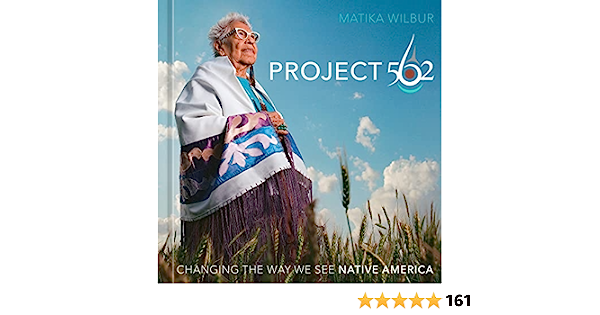
Book Rec (And a Bit More): Project 562: Changing the Way We See Native America by Matika Wilbur

Standard

I’ve been really immersed in Native American spirituality and history. I have always been intrigued and felt kinship with Native American/First Nation people, being drawn to their stories, their history, and their lives since I was a child. It’s been something that has ebbed and flowed throughout my life, even with the insensitive and appropriated costumes of my childhood. I know better now, and I hope that in my past teaching in early childhood, I’ve lessened some of those stereotypical ideas as those children grow up and remember their experiences of the culture as best offered by an outsider and non-Native person.

I’ve recently mentioned attending a weekend retreat with Terry and Darlene Wildman and learning about the First Nations Version of the New Testament. It was enlightening and eye-opening, and I enjoyed the ceremonies we were invited to participate in. I’ve been a visitor and participant at the nearby St. Kateri Shrine when they’ve had those ceremonies open to the public.

I spent all of June reading the Daily Readings from the FNV New Testament; it really highlighted the beauty of Native American storytelling, and I felt that I was hearing some of these Scriptures for the first time and in a completely new way.

Which brings me to the most recent book that I’ve been reading: Project 562: Changing the Way We See Native America by Matika Wilbur. I must say that I started the book in a naive headspace. I was looking forward to her interviews with modern Native people across Turtle Island (North America), hearing about how they keep their culture and religious rituals alive, and while I’m aware (more than the average person) of the history of the US’s forced removal, forced assimilation, and truly what can only be called genocide of the Native Americans, I was still surprised by so many things in this book that took  me by surprise.

Author/Photographer, Matika Wilbur.
Continue reading

Anti-Social Media

Standard

That title’s not really fair.

I’ve met people through social media that I consider friends and close acquaintances: Yvette Nicole Brown, Devin’s Cow, Alt-Immigration, Giselle Fetterman, I mean Frank Figliuzzi followed me – *mind-blown*

Just when we finally put tweeting, twittering, retweets, and doomscrolling into the daily vernacular, Twitter is sold to a childish narcissist (no offense to children, the childish or narcissists) who decides to not only let it implode, but actively sabotages it. Not to mention the racism and antisemitism. I’ve been on Twitter since the beginning, and while I lovingly described it as a cesspool, it was more than the sum of its parts. It was my first stop when I woke up in the morning, knowing that among the outrage and memes was whatever was the most important in the news of that day. From there, I’d dig deeper.

In the last few months, really since the new owner came in, my newsfeed has been a mix of ads some of which are so sus that I’d question their actual existence, inappropriate propositions, nudity, and right-wing nut jobs, ninety-nine percent of which I don’t even follow.

I joined a new social media network (to be named later), followed a friend of mine, and have seen her more today on the new network than in the last three months on Twitter. The same goes for many of the pundits and entertainment blogs that I follow. Scrolling through the new site is like attending a school or job reunion: Hey! You’re here! I’ve missed you! What have you been doing the last six months when you were hidden on Twitter?!

I’ve said it before, and I’ll continually say it again: I go to the new techy thing. I go kicking and screaming, but I still go. Twitter was probably the first to prove that statement. Then Tumblr. I didn’t question Instagram as much; just went. Post. Mastodon. I waited with breath held for Spoutible, and when the opportunity came to sign up for Threads, it took me all of three minutes to get two accounts going. I’m on the waiting list for bluesky, but I’m not sure that I’ll even sign up if Spoutible and Threads continue on the way they’ve begun.

Will I use all of these?

Man, I hope not.

I can’t recommend Threads yet; I’ve barely been on forty-eight hours but give it a try. It can only be accessed by the app, no browser yet. It’s connected to your Instagram account, although I don’t know how, and I have no idea about cross-posting. I plan to use it the way I use twitter – politics, news, voting rights, social justice, and website promotion.

I will not delete my Twitter account. I may even use it to comment on some things, but I have hopes that it might return. It was comfortable when it worked.

I’ve begun a Mailchimp Email Subscription for reaching out monthly to my in-person class attendants and I’m considering expanding it to my online community. I’m not sure what I could offer for a subscription fee that I’m not already publishing on the site, but my writing and publishing are always evolving. If you’re interested in a free preview for the next three months, drop me an email with Mailchimp subscription in the subject line and your email in the body.

This month I’m continuing the writing of my prayer book, and outlining my Wales Discovery book, some of which I may talk about on social media.

These are my official accounts:

Facebook Page
Instagram
Spotify
Spoutible
Threads

Pride

Standard

For the next four weeks, I’ll be posting some information, links, art, and photos for Pride and hopefully including some LGBT+ history. I’d like to start by saying that last week I heard some complaints by folks with nothing better to do asking why Pride gets a month and our veterans only get one day. This is obviously meant to create an issue where there is none. First, Memorial Day is not about veterans in that way; it’s about the war dead, which most people are glad to ignore until it suits their agenda. If they really felt this way, they’d spend Memorial Day at the cemetery, at a house of worship, volunteering instead of barbecuing and at baseball games and concerts. Second, there are many, many veterans (and war dead) who are in the LGBT+ community, and Pride is as much for them as any other person. Third, for those who declare that “pride” is a venal sin, I’d like to suggest that those divorced, adulterous, lying, hypocrites stay quiet and/or remove the log from their eye.

I wonder if, when these people see a rainbow in the sky if they shake a fist at it and complain loudly to the Creator about how woke He is.

Pride was born in revolution, even though LGBT+ people were around long before 1969. The ones who are out and open and celebrate Pride are not only celebrating themselves but are celebrating those of the community who are still not out, for personal reasons as well as safety ones.

My friend has a denim vest with the stenciled words: The first pride was a riot. I’ve used that to influence the art I created last night for this post. Sometimes the simplest designs tell a greater story.


Marsha P. Johnson

Sylvia Rivera

Stonewall Riots

Library of Congress Research Guides: 1969: The Stonewall Uprising

(c)2023

Election Connection – Book Banning/Challenge Update

Standard

This is specific to a Texas school district, but challenges are happening across the country.

A federal judge has ruled that the books in question be returned to the library within twenty-four hours and left accessible while the case is ongoing. They are prohibited from removing any books while the case is in litigation.

According to this CNN article, while the Texas school said the books were removed as part of their normal weeding procedures it is clear that there were outside influences at play based on the subjects removed, including topics of race and LGBT+.

Disagreeing with the subject matter is not a reason to remove the books from the library. I also disagree with the comment in the article that pastors should be involved. Absolutely not. The separation of church and state is critically important both to the founding of this country and its ongoing evolution of welcoming all, despite the recent contradictions to that.

Part of the problem is the ignorance of those complaining about the books. They call many LGBT+ books pornographic when they are not sexual in nature and simply talk about feelings and gender as any adolescent character in a book would do. They are also trying to restrict CRT (critical race theory) which none of these books teach despite perhaps being written by a person of color or are about a person of color. As has been explained over and over again, CRT is not something that is taught in the schools, not even at a high school level. It is typically a subject in post-graduate and law schools.

As a writer, I understand that not all books are for everyone, and I agree that parents can determine the appropriateness of books for their children within reason (as I have done for my children without banning books for everyone), but I expect that we should trust in the schooling and expertise of librarians and teachers who have studied this field for a number of years.

I am also concerned about a random group of uneducated people coming in and removing books rather than letting individual parents and children make the determinations for their families on what is age-appropriate.

I hope the country steps back from the abyss; we are well beyond the slippery slope, and we need to offer modern books with timely subject matter while also encouraging the reading of classics while explaining the reasons that some of the material isn’t appropriate, and maybe never was.

Times change. We should change with them.

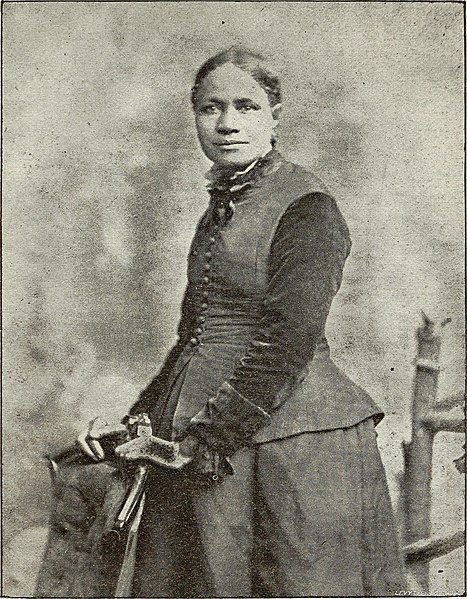
Frances Ellen Watkins Harper

Standard

We are all bound up together in one great bundle of humanity, and society cannot trample on the weakest and feeblest of its members without receiving the curse in its own soul.

Frances Harper, We Are All Bound Up Together, 1866

Frances Ellen Watkins Harper.
Public Domain

Frances Ellen Watkins Harper was a voice of Black Suffragists. She was born in 1825 in Maryland to free African American parents. Her parents died when she was young, and she was raised by her aunt and uncle. By the age of 21, she had written her first small book of poetry, Forest Leaves and ultimately published 80 poems. More than a decade later she became the first African American woman to have published a short story, The Two Offers. She co-founded the National Association of Colored Women’s clubs.

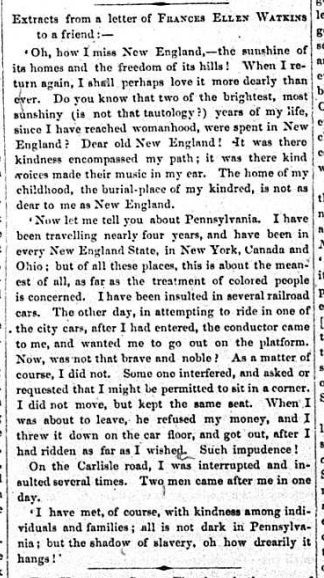
While working as a teacher in Pennsylvania, a law was passed that free African Americans in the North were no longer allowed into Maryland, her home state. They would be imprisoned and enslaved.

She refused to give up her seat on the trolley, and only got up when she reached her destination as chronicled in The Liberator, page 3 as seen below.

From The Liberator, Page 3
1858
Public Domain

Her famous speech, We Are All Bound Up Together, read in 1866 at the Eleventh Women’s Rights Convention held in New York City, can be read here.

She spoke at the National Woman’s Rights Convention in New York, held in 1866. The organization split over the suffrage of African American women and were opposed to supporting the fifteenth amendment. Harper left the group, and with Frederick Douglass and others supporting the amendment joined together to form the American Woman Suffrage Association. She was often the only Black woman at the women’s conferences. Through her life, she continued her advocacy for intersectionality (see- it’s not a new idea) in suffrage.

She spent the remainder of her life teaching and encouraging equal rights and education for African American women and founded and/or directed several clubs and organizations for African American women, including the National Association of Colored Women’s Clubs and the Pennsylvania Women’s Christian Temperance Union.

Some of her writings include:

  • Forest Leaves, poetry, 1845
  • Bury Me in a Free Land, poetry, 1858
  • Moses: A Story of the Nile, 1869
  • Light Beyond the Darkness, 1890
  • In Memoriam, Wm. McKinley, 1901
  • Trial and Triumph was one of three novels originally published between 1868-1888 as a serial.

Her first novel, Iola Leroy, or Shadows Uplifted was published in 1892. It was thought sentimental, but it also highlighted several serious social issues at the time, some of which remain today.

As a writer, I am always drawn to the writing lives of the people I choose to profile, and I was pleased to see that Harper was a mentor to other African American writers, including Mary Shadd Cary, Ida B. Wells, Victoria Earle Matthews, and Kate D. Chapman.

More information on Frances Harper can be found: National Women’s History Museum and Lift Every Voice, African-American Poetry

Black Media & Black Culture

Standard

In a companion to my recent post Black History in Film, I’m sharing the NAACP Legal Defense Fund‘s link on Black Media & Black Culture. The NAACP LDF has put together a list of over 50 works recommended by the staff of the Legal Defense Fund. It showcases their mission to “defend, educate, empower.”

This single link offers links to their recommendations with how to view, read, or listen to them.

Included in the list are books, both non-fiction and fiction as well as for younger readers, television shows, movies and films, podcasts, and of course, music, which, as a white person, I say where would we be without Black music and its influences across every genre.

Visit your local library or e-library and see what’s available.

If you’d rather buy, this link will take you to a list of 149 Black-Owned Independent Book Stores.

In addition, Haymarket Books is offering three FREE e-books:

They also offer free books to the incarcerated through their Books Not Bars program. Donations for these programs can be made here.

As the Haymarket group said, “The struggle is long, but we are many.”

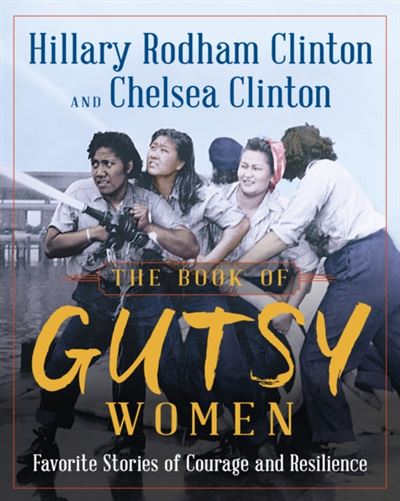
Book Rec – The Book of Gutsy Women: Favorite Stories of Courage and Resilience by Hillary Rodham Clinton and Chelsea Clinton

Standard

Secretary Clinton and Dr. Clinton are the perfect choices to co-author a book on women’s courage and resilience with over 100 examples of other courageous and resilient women throughout their lives. Each profile is given respect and admiration and both Clintons strive to express how these women influenced and affected their lives. It is such an important book for young girls to see and read about those who have come before and led the way to our present. One day, some of us will be in a similar book recounting how we changed the world for the better.

I have a daughter who I would describe as courageous and resilient. She’s as kind and generous as she is self-absorbed (as all teenagers are wont to do), but while being kind, she is also someone who stands up for herself, and will not hesitate to give you her opinion. She is the best of me. I hope to be her when I grow up.

The Book of Gutsy Women can be found for purchase in any bookstore, online retailer, and as an e-book as well as borrowing it from the library. However you can get the book, you should read it. I read about five profiles a day, sometimes more.

It’s a great way to start off Women’s History Month.

Read Banned Books

Standard

I’ve spent a couple of days looking at Florida’s list of banned books, and it is disproportionately authors of color. There are many with authors and references to LGBT+ issues and information, but diversity seems to be the “problem” for Florida’s governor, from banning books about Jackie Robinson and Roberto Clemente to calling the AP African-American course “contrary to Florida law” and states that it “significantly lacks educational value.”

There is a list of 176 books from one county alone. I’ve chosen a few to highlight the ridiculousness of this ban. I will say that some of the books on the list are not for all ages, but almost no book is. That is where parenting comes into play. I help my own kids choose books, and when I have a question (which I have had in the past) I speak to the teacher, and we sort it out. I try not to censor my kids, but I do if I need to base on age-appropriateness.

I will also say, in all fairness, that many of the books on the list will be returned to the school libraries after they are examined and approved. I wonder what is the point of having a professional educator and librarian who spend years becoming experts in their field only to have a parent, who has a bias against certain kinds of books make the decision for all the parents in the school system. It makes no sense. And yes, I will stand by my characterization of a biased parent. Look at some of these books (these are in no particular order, and you may google them for descriptions, but some are obvious).

  1. Wilma’s Way Home: The Life of Wilma Mankiller by Doreen Rappaport and Linda Kukuk
  2. Two Roads by Joseph Bruchac
  3. Time to Pray by Maha Addasi, Ned Gannon, and Nuha Albitar [If this book was about Christian prayer, do you think it would have been questioned?]
  4. Thank You, Jackie Robinson by Barbara Cohen & Richard Cuffari
  5. My Mother’s Sari by Sandhya Raot and Nina Sabnami
  6. Memphis, Martin, and the Mountaintop: The Sanitation Strike of 1968 by Alice Faye Duncan and R. Gregory Christie
  7. The Legend of the Bluebonnet by Tomie de Paola
  8. Knots on a Counting Rope by Bill Martin, Jr., John Archambault, and Ted Rand [These are the same authors of Here Are My Hands, and Brown Bear, Brown Bear, What Do You See?, preschool aged books that I used when I taught early-childhood.]
  9. Dim Sum for Everyone by Grace Lin [What could this book be about?]
  10. Celia Cruz: Queen of Salsa by Veronica Chambers and Julie Maren [In 2011, she appeared on a US postage stamp]
  11. Brother Eagle, Sister Sky by Chief Seattle and Susan Jeffers [This is a book I used in early childhood programs often.]
  12. Barbed Wire Baseball: How One Man Brought Hope to the Japanese Internment Camps of WWII by Marissa Moss and Yuko Marissa Shimizu
  13. Black Frontiers: A History of African American Heroes in the Old West by Lillian Schlissel

The #1 banned book is George Orwell’s 1984. Also banned are The Dictionary, The Bible, and Anne Frank: Diary of a Young Girl.

Profiles of banned books from Carnegie Mellon can be found here.

Banned Books Week will be the week of October 1 through 7 in 2023. In 2015, according to the Banned Books Week website, nine out of ten books banned contained diverse content. What does that tell you?

If you are having trouble finding a banned book in your area, and you are between the ages of 13 and 21, you can go online to the Brooklyn Library and get their e-card that lets you take out books online, so you can read the books. Email them at: booksunbanned@bklynlibrary.org

If you are a New York State resident and teenager, you can apply for BPL’s free e-card here.

Another place to get information on banned books (and other books) is the American Library Association. They are the oldest and largest library association in the world.


Read banned books. Read all books. Speak up against this authoritarianism. We are on the slippery slope.