Mourning

Standard

I have come to realize that “pro-life” is a misnomer. The people who espouse it, who embrace it, who shout it from the rooftops, don’t actually know what it means. When I hear the phrase “pro-life” I’m supposed to think that the person shouting it believes in life. But they don’t believe in life when the life is gay, when the life is Black, when the life is an immigrant or someone who’s accented, when the life is poor or homeless or addicted to drugs. They don’t believe in life when they allow three people, three human beings, a mother and her two small children drown while watching, and actively stop help from getting to them. They don’t believe in life if they are killed by guns, which are more sacred to them than the life it takes. They claim to care about the life of people who aren’t people yet, still unborn, still getting their life from their host woman, but if that woman dies because she can’t receive a lifesaving abortion, well, that’s life. But it’s not pro-life.

They lie about the services at Planned Parenthood.

They lie about the activities inside “crisis pregnancy centers.”

They lie about women’s* bodies or they simply don’t understand how women’s bodies work, which should be the first clue that they shouldn’t be legislating on women’s bodies.

I’ve seen legislators who don’t understand the basics of puberty or menstruation or how babies are conceived, thinking that the only party is the woman who holds the responsibility for her actions and the future of three people.

They sound pathetic and stupid, and it’s embarrassing.

On this anniversary of the now reversed Roe v. Wade, I’m in mourning. I’m in mourning for what pro-life people did to Roe, the person: manipulating, gaslighting, and abandoning. I’m in mourning for my daughter. I’m in mourning for her friends. I mourn for the residents of Texas and Florida especially.

The only pro-life option is safe and legal abortions for anyone who needs one.

Why is there upset and indignation when the “pro-life” set is called pro-birth or forced birth, but what else are they if not that? No one comes to pray outside of social services or the WIC offices for the children once they are born. No one prays outside of counseling centers, real counseling centers for victims of sexual assault and incest. The only prayers are for doctor’s offices and clinics that offer full service reproductive health services. Why is that?

How can you be anti-abortion and pro-death penalty?

How can you be pro-war?

Things to think about because your hypocrisy is showing, and it has been for a very long time. With the Dobbs ruling, women are dying, women are being prosecuted and persecuted for having miscarriages, women are being denied life-saving care, women are left to die of sepsis, are left to infertility, and families are just left.


*When I say women, read: all child-bearing people.

Inspire. December. Chanukah.

Standard

I’ve been searching for the write inspiration for December, and this first night of Chanukah brought things into perspective. A little bit of perspective. While the internet and the news are filled with antisemitism and protests from people intent on gaslighting the Jewish experience and deny Jewish people the indigeneity of their homeland, I have been on a quest to celebrate Chanukah publicly. I’m a little wary about it. I live in a nice neighborhood, but I don’t put my head in the sand and think that it couldn’t happen here. I know it can.

Still….

I went out and bought blue and white lights for outside, something I’ve never done. I have an interactive menorah hanging on my front door, again, something I’ve never done. In fact, since I’ve been on my own (and with my own family) I have not put Chanukah lights in the window. That unfortunately will continue because I know that if I put candles on my windowsill, my mother would come back from the grave and blow them out with a raucous, and loud message of fire safety.

Most people don’t know the story of Chanukah; perhaps some teachers wanting to bring multiculturalism to their classrooms, and now the story of the Maccabees is being co-opted to match the narrative, anything to turn the words of Jews and their history against them. The Festival of Lights isn’t about war. It isn’t about victory. It is about faith. The miracle isn’t that the Maccabees won against their most recent oppressor. The miracle is the lights themselves. When we retook the temple, amid the destruction, they went to light the candelabra to rededicate the temple, the menorah – not the nine-branch one that most are familiar with, but the regular, ordinary menorah that is always lit in the temple. There was only enough oil to keep it lit for one night. There was no other oil. So, what did they do? They lit it anyway.

And it remained lit, not one night, not two, not three or four, not even five or six or seven, but it remained lit for eight days. One day’s oil lasted for eight days. That is the miracle. And that is why we light eight candles on a new type of menorah used just for this holiday: a hanukkiah.

Tonight, I will say the prayers (that I don’t normally say). I will fry the latkes in oil. I will fry the chicken in oil. I will light the first candle on the same menorah that I lit as a child; the one that I grew up watching the candles burn down on the dining room table that was my grandmother’s. It will be placed on that same dining room table in my own house. My kids will see the lights on the same menorah, the same table, and they will be able to see through my eyes, even amidst the clutter that seems to grow multi-generationally on this dining room table.

This year, however, this old menorah has a special, additional meaning. I saw this menorah in Toronto at the Royal Ontario Museum in their Judaica exhibit, in the Chanukah window. A copy/replica of MY Chanukah menorah sits in the largest museum in Canada. The exhibit label states that it is from Gdansk, Poland, brass, from the early 1900s.

Happy Chanukah.

My family menorah.
(c)2023
Royal Ontario Museum Judaica Exhibit.
Hanukkah menorah, “Danzig” type,
Gdansk, Poland, early 1900s.
(c)2023
Ready for sundown.
You can view it lit later tonight on Instagram (link in sidebar).
(c)2023

Happy Thanksgiving.

Standard

With my ongoing research into St. Kateri’s life, I thought instead of a retelling of the first Thanksgiving today, I would set my table with the First People in mind, sharing with my family the Three Sisters as the Mohawk call these three plants that grow side by side: corn, beans, and squash.

My table setting.
(c)2023
Sign about the Three Sisters at the St. Kateri Shrine in Fonda, NY.
(c)2023
The Three Sisters.
St. Kateri Shrine, Fonda, NY.
(c)2023
The cake plate I used was a wedding gift from a friend who worked at the Jewish Museum in NYC. I like to blend our cultures in our interfaith family, and this was one way to join two ancient peoples and their symbols.
(c)2023

Native American Heritage Month – Beginnings & Endings

Standard

The photo below represents both the start and the end of the day.

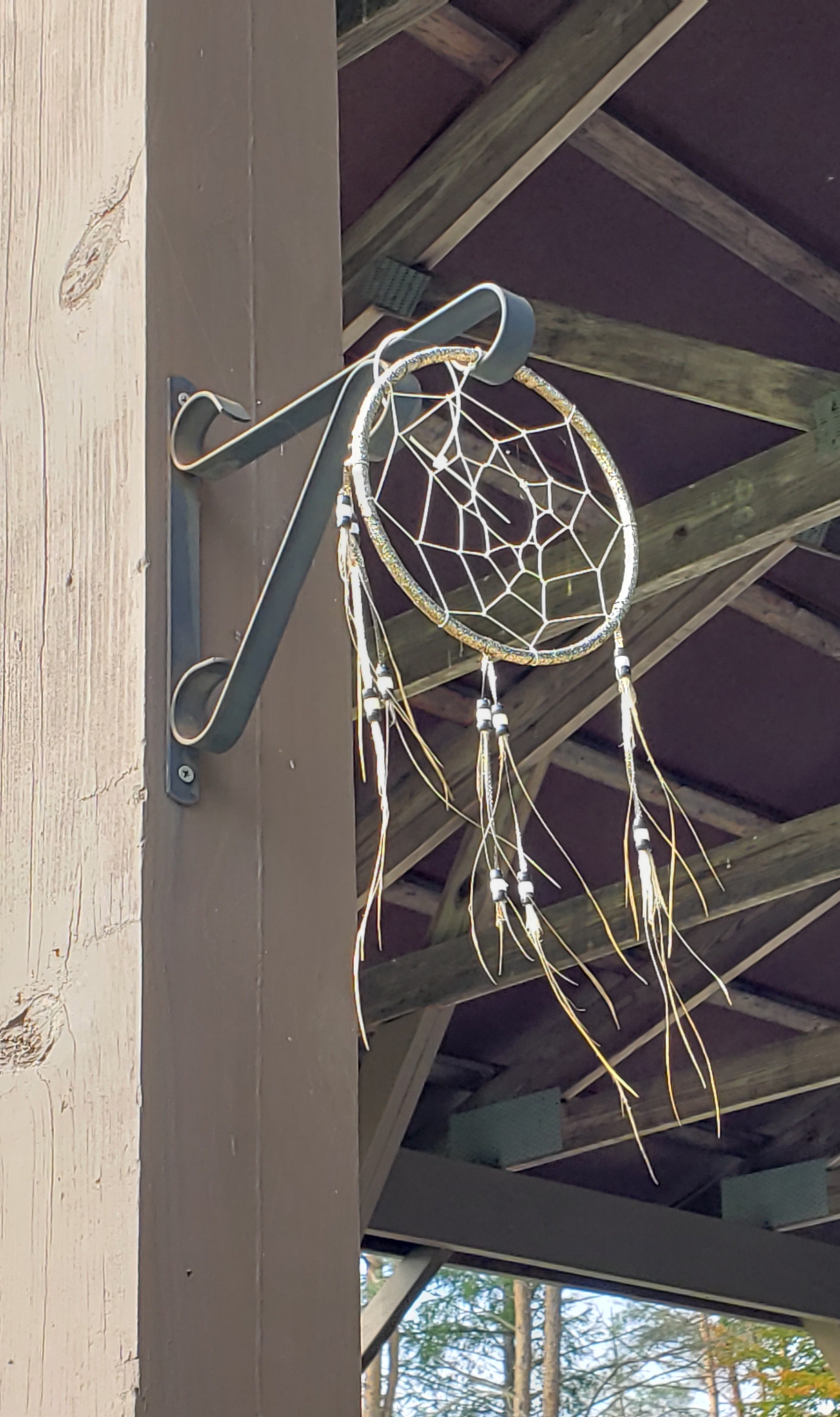
Beginning with the end, I have slept with a Dream Catcher for most of my life. I notice a change in my sleep when I don’t sleep with one. It creates a calm and peaceful rest as it catches the bad and lets the good continue through. This particular dream catcher is one I got in Niagara Falls, Canada. I was drawn to the colors of the beads that represent the four directions as well as the uniqueness of the center stone.

The booklet is something that I was more recently introduced to through Mohawk Elder Tom Porter of the Kanatsiohareke Community in New York. Since then, I’ve seen it in other Haudenosaunee writings and readings. It is called the Thanksgiving Address, but it has nothing to do with the Thanksgiving holiday, but in giving thanks for all that is around us in the natural world, all that we have, all that we see. It is said at the beginning of all important gatherings, ceremonial and/or governmental. The Haudenosaunee call them the Words Before All Else.

I recently used a form of this address for a meditation that I was tasked to share, and it was very well received. I read mine, but most are recited and because of that they are often never the same twice since the words change with the speaker and the timing of the gathering.

As I said at my own (non-Native) gathering, as a shared meditation, I acknowledged the land we were standing on (Mohawk), and reaffirmed that I am a non-Mohawk, non-Native, sharing their wise words.

The Royal Ontario Museum and Sitting Bull

Standard

When we visited the Royal Ontario Museum this past August, I knew that I could not visit every nook and cranny as much as I might have liked to. I also knew that with five of us having different interests that we were going to get very frustrated very quickly if we stuck together. Upon entering and deciding who wanted to pay extra for the special dinosaur exhibit, I announced the three places that I wanted to focus on and whoever came with would be welcome, but if they wanted to explore on their own and meet back through texts, that would be great.

As an aside, I do miss my little ones, but I really appreciate going on vacation with teenagers and older kids because of this freedom for all of us. I didn’t want to see the dinosaurs; more to the point, I didn’t want to PAY to see them, so I didn’t. My daughter was not a fan of medieval arms and armor and so she veered away from that. The technology of texting let us know where the others were when we were engrossed in our little worlds. It was fantastic! And I think we all benefited from the freedom to explore our interests and the freedom from each other for an hour or so.

My three focuses were in the areas of First Nations, Medieval History and Arms & Armor, and Judaica.

Continue reading

Native American Heritage Month

Standard
Dream Catcher
(c)2023

A few days ago, the honoring of Native American Heritage Month began. Like Indigenous Peoples Day, I think this is timed for us to remember that there were both sides to Columbus’ landing in the New World and how we perceive the Thanksgiving story. The Thanksgiving story in and of itself isn’t as problematic to my mind as other European centered celebrations. We know and should acknowledge that the English settlers could not have survived their first (and to be honest, many subsequent) year in a new land without the help of the Native Peoples they met and who helped them immensely. I have always been a history buff and drawn especially to people of my own heritage and Jewish ancestry as well as people I feel somewhat paralleled that history including African- and Native- Americans. One of my favorite books as a child is The Magic Tunnel by Caroline Emerson. It had everything a young me could want in a book: time travel, the NYC subway system, NY history, American Indians. The perspective is of about a fourth-grade child’s view of history, but it’s a fun adventure for the elementary school age and a great jumping off point to discovering what’s true in their depictions and what is not.

As I’ve grown and became more of an in-depth reader, I’ve been exposed to more and more books about Native history both by Native and non-Native scholars. Living in New York state my whole life, we have a rich history of the Iroquois, and every place I’ve lived has had several towns still using names found from and in the variety of Native American languages found in the state. Some examples include: Shinnecock, Massapequa, Copiague, Hauppauge, Schenectady, Oneonta, Oneida, the Mohawk Valley, Chautauqua, Ontario, Otsego, Tioga, Cheektowaga, Ticonderoga, and of course, Niagara and Manhattan.

Over the next few weeks and through the end of November, I hope to offer you some resources to expand your knowledge of Native American history and culture as well as books, movies, and photos that you can enjoy in your explorations.

About a week ago, I was asked to give a meditation for what’s called an Ultreya, a gathering of Catholic Cursillistas for community and fellowship. I elected to read a Haudenosaunee Thanksgiving Address. It is called Ohen:ton Karihwatehkwen, which are the Words Before All Else. This is recited before any gathering or ceremony. At the beginning, prior to starting the reading, I explained to them that this is often different each time it’s told as it depends on the speaker to choose their own words. I explained that I, however, would be reading it. Two important things I stated before I began were who the Haudenosaunee were; we knew them as the Iroquois, which is the French word assigned to them by Canadian and French missionaries, and that we were currently on their traditional lands, the lands of the Mohawk. I also stated that I am not Mohawk, nor am I of First Nations descent. I have included a statement on my FAQ page.

I think it’s important to acknowledge whose land we’re on, and if we’re speaking authoritatively or in entertainment or spiritually, that we acknowledge when we are not Native and/or Indigenous People. I will also use Native American, American Indian, Native Peoples, Indigenous Peoples, and First Nations interchangeably unless asked specifically not to.

As we celebrate what we view as the first thanksgiving, it’s important to remember that the English settlers didn’t “give this tradition” to the Native Wampanoag people they met. The Native people across the continent had harvest festivals and days of giving thanks for their harvests towards the end of the fall and the coming of winter. This is what they shared with the settlers.

For my own Thanksgiving, I am thankful for my family and spending time with them, but I also think back to the historical first thanksgiving and look back on what could have been and look towards that future.

In this opening for me of Native American Heritage Month, I give you a few places to visit and learn from:

Native American Heritage Month

National Museum of the American Indian

Killers of the Flower Moon – the movie is in theatres now, and it was wonderful. Don’t be scared off by its length; I barely noticed and easily sat through the whole thing. I also read the book about a year ago. I highly recommend both:  Book

And Grandma Said…Iroquois Teachings & Traditions by Tom Porter

Project 562 by Malika Wilbur

First Nations Version: An Indigenous Translation of the New Testament

RainSong: The Music of Terry & Darlene Wildman

Kahnawake, Quebec

Standard

Indigenous Peoples’ Day was Monday, nearly a week ago, but that doesn’t mean that now we can forget about an entire culture, language, history, or a people. I usually will say that especially in the Northeast, where the Iroquois, more properly known as the Haudenosaunee lived, we should remember them. There are several things wrong with that sentiment though, and I am embarrassed to admit them. For one thing, the Haudenosaunee live, now, among us. They cover the six nations: Mohawk, Onondaga, Oneida, Cayuga, Seneca, and Tuscarora, across all of New York State and the international border with Canada. For another thing, Native tribes have lived on this continent from ocean to ocean, from the time when there were no borders at all. Just like our states, their nations had rivalries with others, they had distinctive cultures separate from one another. It’s important to remember that Native culture, whatever nations are represented, they are a living, breathing group of people, and it is well past time to recognize their contribution and their sacrifices. I’ve had several people (non-Native, I should note) that it was in the past, it’s history, there is nothing I can do, and that attitude disturbs me on many levels. I don’t know if it’s a connection I feel to the people whose land I live and work on. I don’t know if it’s from my childhood admiration and longing to be more involved in the limited Native culture around me as a child. I don’t know if it’s because of my Jewish background where people will say the same sentiment: it’s history, why are you still upset about…? I will call out some by saying that the same people who say that the Trail of Tears and stolen land in the 1880s and 1890s is “ancient history” and we “need to move on” are the same people who insist on the rest of the country worshipping a man who died over two thousand years ago. The continued hypocrisy is staggering in so many ways.

I have a few thoughts and photos that didn’t make it onto the website on Monday, and I hope to share them with you today and in the early part of next week.

I have been fortunate to have visited the village of Kahnawake in Quebec, Canada three times. Kahnawake piqued my interest through my studies and research of St. Kateri Tekakwitha who was born, lived, and was baptized very near to where I sit right now. Each visit was unique in that I saw new things and learned new things each time. The first time during covid was very limited to the outside world and was a superficial encounter. The second time had a decidedly Mohawk perspective, and the third time was more of a Catholic and Mohawk-Catholic perspective. Each visit gave me a new outlook, answering questions and thoughts, and offering insights that raised more questions and contemplations. I expect and look forward to returning next year to do some more research as well as visiting their language and cultural center that we were unable to see previously.

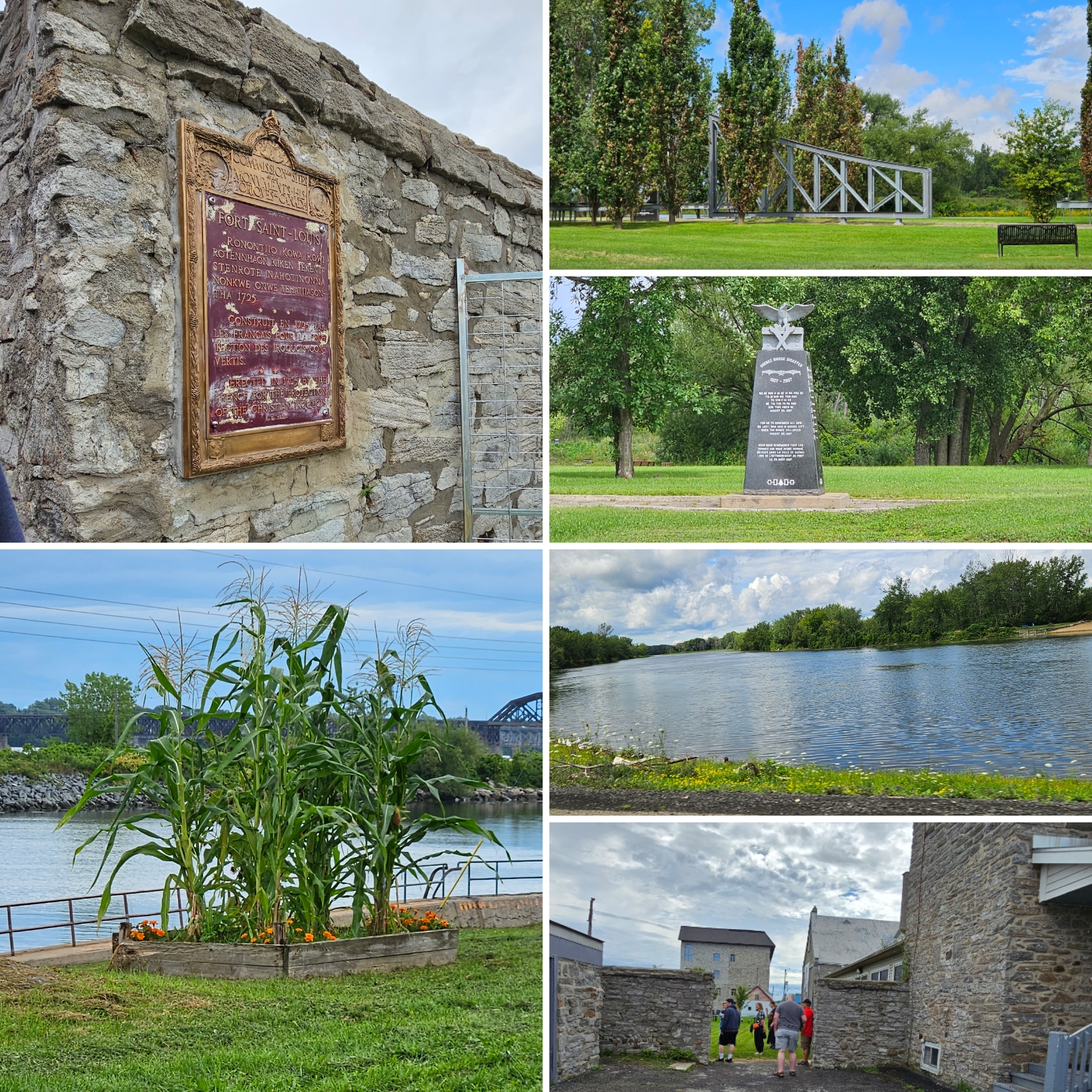
These photos are a little taste of the village. I will also share the one thing that really surprised me. The Mohawk in Kahnawake primarily speak English and Mohawk. Their street signs and stop signs are in those two languages. I thought the second language would be French. As I said, there is always something new to learn.

From the top, clockwise: Original wall of the Fort Saint Louis, Replica of the Quebec Bridge, Memorial to those who perished in the Quebec Bridge Disaster, part of the St. Lawrence Seaway, the back of the St. Francis Xavier Mission Church, what I presume are the Three Sisters, which are grown on Mohawk land.
Kahnawake, Quebec.
(c)2023

I just wanted to add one or two notes about the above photos:

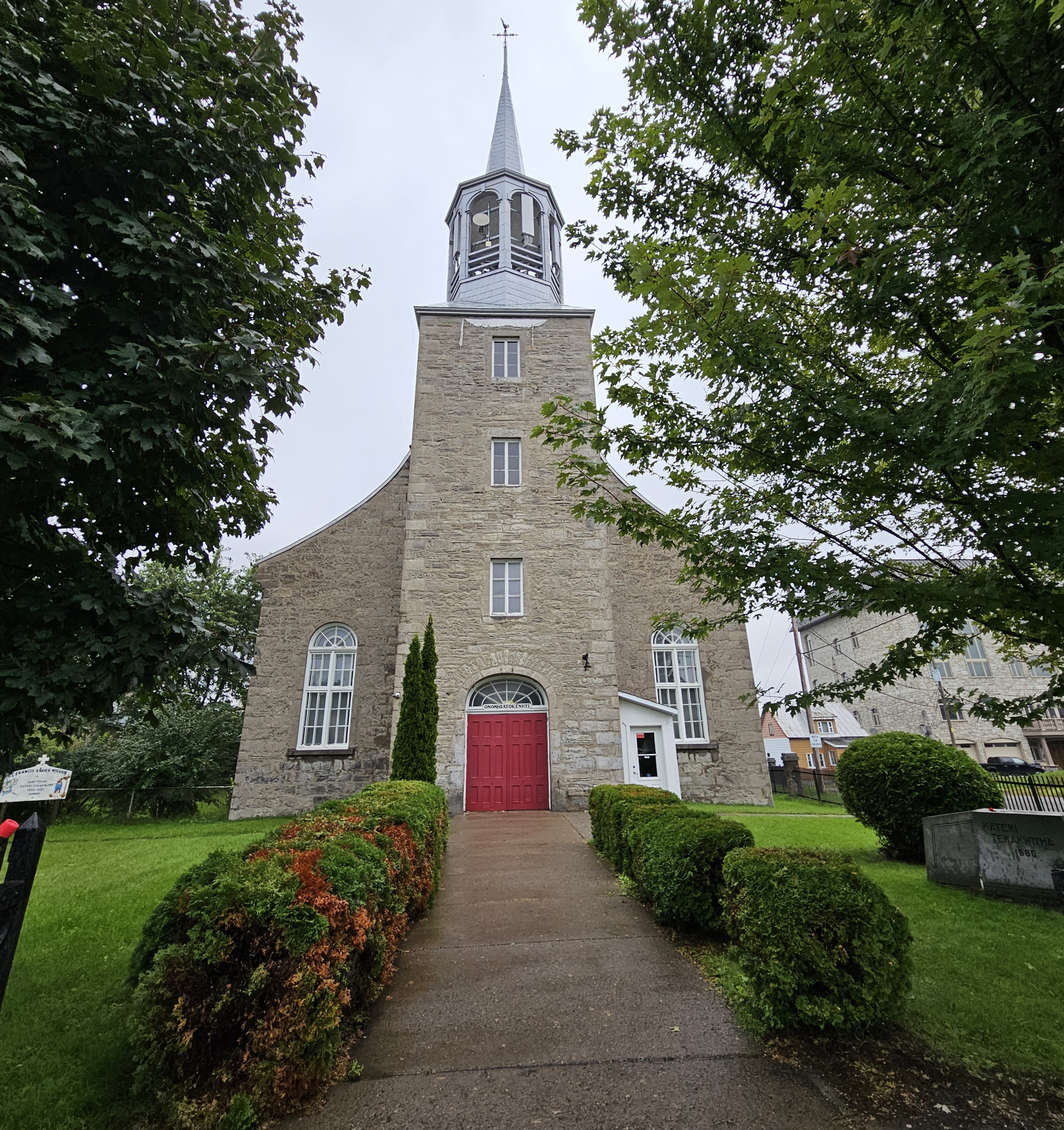
The St. Francis Xavier Mission Church moved with the Mohawk. It moved four times,
I believe, before it settled permanently here and was built as a permanent structure in 1716. St. Kateri’s relics were moved here in 1973.

The Quebec Bridge Disaster killed 32 Mohawk ironworkers from Kahnawake. This left 25 widows and over fifty children fatherless. The compensation from the Canadian government was negligible. The Clan Mothers decided from then that so many members from one family could not work on such a dangerous job.

The Canadian government changed how the St. Lawrence River flowed, so it moved it away from Kahnawake and left the still St. Lawrence Seaway. The River was more profitable and was able to accommodate boats and fishermen as the Seaway was not. This is still an issue today.

The Three Sisters are known to the Haudenosaunee as the most important crops, sacred, and include corn, beans, and squash. They grow together in the same area and help each other thrive.

Haudenosaunee Confederacy Flag, which is a depiction of the Hiawatha wampum belt.
(c)2023
Front of the St. Francis Xavier Mission Church.
Kahnawake, Quebec.
(c)2023
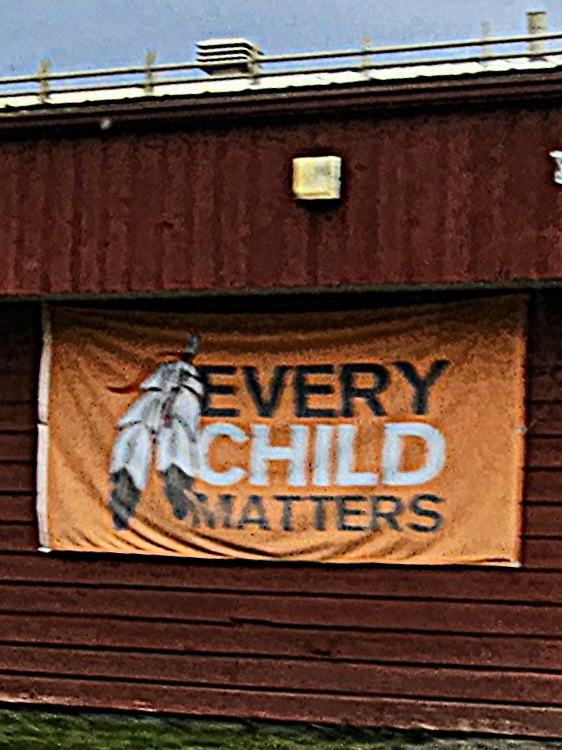
Signs and flags of Every Child Matters on orange are seen in many places. Despite Canada’s Truth and Reconciliation Committee, there is still much to be answered for.
(c)2023

Indigenous Peoples’ Day

Standard

On the Coloring Sheets page, there is a new sheet for Indigenous Peoples’ Day which is today. Below I will explain what each square represents. I’m glad that we are beginning to acknowledge the people who were here long before the Europeans arrived and drastically changed things through their way of life, their diseases, their concepts of ownership, and of course, their biases, which for many remain today.

I am determined to remind myself and others that the land I live and work on once belonged to the world, and the Haudenosaunee (in my specific area) were the caretakers. They were willing to help the new settlers, and did. And I’m sure regretted it. The Europeans weren’t exactly grateful in the long run.

Wherever you live look at the names of the towns. Across this country (the US) and Canada you will find many towns and streets are named with Native American names. I like to look into some of those names and see what they mean in the various languages.

Continue reading

Election Connection – Republicans will Never Change their Spots

Standard

I don’t even know where to begin with this bullshit.

The weakest Speaker of the House in US history has been ousted and the Speaker’s position is vacant for the first time in the House of Representative’s 243 years of existence.

Good riddance.

Kevin McCarthy is nothing more than a sycophantic, lying, piece of garbage scraped off the bottom of my shoe. Partisan hack and chaos agent doesn’t begin to cover the contempt I have for this phony.

I haven’t even gotten into his smarmy, self-satisfied, failing up brand, and contemptuous face.

But you may say, tell me how you really feel.

And judging by his recent tantrum, Interim Speaker, Patrick McHenry isn’t much better.

Let me actually begin by answering the media’s pressing question: Why are Democrats to blame for this debacle?

Well…they’re not.

At all.

The Democrats have a speaker. The Minority Leader. His name is Hakeem Jeffries. They voted for him at the same time Republicans voted for Kevin McCarthy. For the Democrats, nothing has changed. They support their speaker 100%.

It is not their job to bail out his weak ass.

It is not their job to create a safe space for the Republicans to continue their attack on the American people by their reverse Robin Hood of taking from the least of us and giving to the wealthiest. This isn’t politics as usual.

Except that for the Republicans, it is.

I am currently reading Wounded Knee: Party Politics and the Road to an American Massacre by historian, Heather Cox Richardson. It is more than the journey taken by the United States government that led directly to the Wounded Knee massacre, but it is the politics of the day that led to.

The greed.

The corruption.

Basically, the Republican way of life.

I don’t say this lightly.

Prior to this book, I finished reading Hear That Lonesome Whistle Blow: The Epic Story of the Transcontinental Railroads by Dee Brown about the building of the transcontinental railroad from the Atlantic to the Pacific, and it is full of the double-dealing, cheating, corrupt railroad tycoons who did everything in their power to steal the land from the Native Americans while committing genocide along the way. (As an aside, Dee Brown also wrote the seminal work, Bury My Heart at Wounded Knee: An Indian History of the American West – I highly recommend it.)

The railroad tycoons did not manage to do this alone. They had help, a lot of help from the US government and the military, all Republican run.

But I diverge from the focus of this writing which for our purposes only touches on the railroads and the Native Americans tangentially to the Republicans’ lying and cheating to win any election.

As I read Cox Richardson’s detailed descriptions of how things went down in the 1890s and beyond, the Republican representatives did everything in their power during the Harrison Administration to retain control of the Congress and the Presidency. They bought off election workers. They kept the Black vote suppressed. They refused to consider Native American citizenship because for some reason, having been born here wasn’t enough to be a voting citizen. Not to mention they weren’t land-owning, a prerequisite for the ability to vote.

They CREATED four new states, and only Montana surprised them by electing a Democratic governor, but other than that, they, as well as Wyoming, North and South Dakota were Republican in every other way. These four NEW REPUBLICAN states received at least four Congressmen and EIGHT senators. This heavily weighted the Electoral College to almost guarantee a Republican victory in 1892.

Which was exactly the point.

Our biggest mistake as a country is letting land vote.

And this was the least duplicitous thing they did to gain votes and money for their personal coffers.

They continually suggested that the land on the Great Plains was great for farming. It wasn’t. And it still isn’t without irrigation which hadn’t been discovered yet as a viable alternative to natural rain. They falsified weather reports, giving the opposite information than the Farmer’s Almanac predicted.

Reading this history, I was becoming incensed. I needed to stop often after I read a paragraph and then highlighted some other Republican misdeed. I was having flash-forwards to modern times and seeing this exact scenario playing out today.

Just look at the last few days of the Speaker vote. One Republican motioned for the speaker to vacate. Eight Republicans voted against Kevin McCarthy. REPUBLICANS. When the interim speaker took over, a small man who thinks smaller, slammed his temporary gavel so hard, he missed the block he’s supposed to hit. His first act as Interim Speaker wasn’t to speak to Democrats, to try to unite the parties or even to unite his own split, petty party, he used that first act to evict Speaker Emerita Pelosi and former Majority Leader Steny Hoyer out of their Capitol offices. Speaker Pelosi wasn’t even in Washington, D.C. She was attending her friend Dianne Feinstein’s funeral in California. Fortunately, her staff had help from Leader Jeffries’ staff to move her office. That’s all you need to know about the parties.

You may not agree with Democratic party policies, but most of the country does. And regardless of even that, when the Democrats are in power, they spend their time trying to make things better for ALL Americans. They’re not out there sabotaging each other and the rest of the country. They’re not holding the debt ceiling and the paychecks of the military hostage. They are working for the people. Always.

What have the Republicans gotten done for the American people?

Nothing.

They’re too busy whining, creating havoc, name-calling, lying, suppressing the vote and everything possible to stay in power.

But when they’re in power, what do they do?

Nothing.

Look back on the last few Republican Administrations. They screw us up so badly and put us deeper into debt, we elect a Democrat who fixes the mess, and then we get collective amnesia.

Remember this on Election Day.

Remember this on every Election Day.

Remember.