Follow this handy graphic from The Writer magazine. My usual technique for prompts of this sort is to write a minimum of 200 words, no maximum. If it comes, let it keep coming!
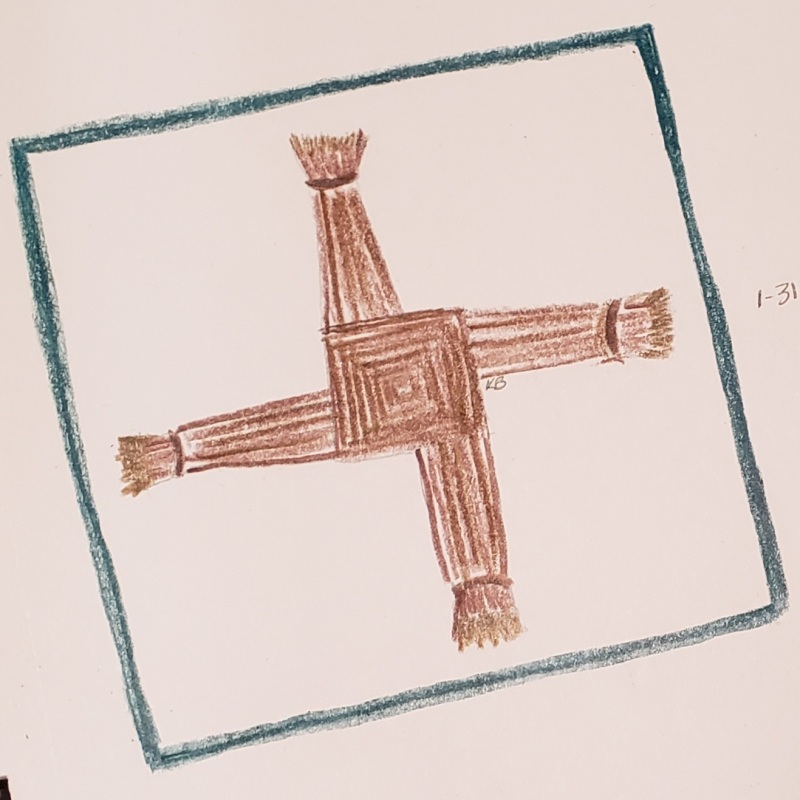
St. Brigid may be remembered as turning water into beer or the legend that she midwifed Mary in the birth of Jesus, but for those of us hoping for women’s advancement in the church, she preached to her flock, and founded a monastery for men and women, and became abbess there. Several of her images are shown with her holding a Bishop’s crosier. While there is some dispute if she was an actual bishop, she was the leader of both monasteries and the Abbess of Kildare is considered as the superior general of the monasteries in Ireland. Regardless of her official capacity as a pastor, Brigid’s oratory at Kildare became a centre of religion and learning, and developed into a cathedral city. [1]
Personally, I’m disappointed that when I visited Ireland a few years ago that I was so close to Downpatrick and didn’t visit. Her relics aren’t there any longer (not since 1538) but I still would have liked to have visited especially since the relics of Patrick, Brigid, and Columba (Columcille) had been there and all are said to have been buried there.
Imbolc dates back to ancient times and Celtic tradition has it beginning the night of February 1st and continuing through February 2nd. This speaks volumes, to me at least that this tradition was adopted/co-opted by the early Christians in the Celtic world. February 2nd is Candlemas, which commemorates the presentation of Jesus in the church. Imbolc is about halfway between the winter solstice and the spring equinox and foretells the coming of spring. Groundhog’s Day is February 2nd and he also foretells the coming of spring, whether after six more weeks of winter or right around the corner.
So many things in our myths, traditions, and religions are interconnected; not all of them by chance or coincidence. Some were intentionally brought forward by the church to include the “pagans” in their conversion to Christianity. This feels almost like a “gentle Crusade” rather than at the point of a sword when they encouraged Jews and Muslims.
I’ve just completed reading a Celtic spirituality book that has nine chapters describing different Celtic ways along with the intertwining of Christianity. The second chapter was focused on St. Brigid and what she brought to Celtic spirituality in this author’s opinion: the Sacred Feminine. Celts had a tremendous respect for the feminine and how it balanced the world they lived, and we live in.
The book is an easy read. I chose to read one chapter a day. That let the information gradually process. There is also prayer and an appendix that would lend itself to daily prayer and meditation in the Celtic tradition.
Sacred Earth, Sacred Soul by J. Philip Newell can be found or ordered from bookstores, national and independent. I read most of my books on my Kindle; this is the link for Amazon Kindle’s version.
[1]Herbermann, Charles. St. Brigid of Ireland, Catholic Encyclopedia, 1913. Public Domain.
[In my interpretations of St. Brigid’s religious life, I would appreciate any corrections from those expert in such things.]
As regular readers know, I don’t need a national day commemorating tea to drink tea. Tea is a staple as much as water and air. Hot tea is good for a cold, a sore throat, a mental health pick me up. There are so many varieties to choose from, not to mention the tisanes (herbal “teas” that don’t use actual tea leaves). In the above photo is my most recent cut of hot tea and two of my favorite flavors. With these two in particular, I add two teaspoons of sugar and a little bit of milk. The PG Tips takes especially good this way. If you want to complete the British tea experience, add a cucumber sandwich with marscapone. However you prefer your tea, drink up, but be careful: it’s hot!
Since joining the church I discovered something about Christmas that had, up until then been unknown to me. The Christmas season doesn’t end on Christmas Day, but begins. The twelve days of Christmas aren’t the twelve days preceding December the twenty-fifth, but the twelve days after. Christmas Day is a beginning, not just of the season of Christmas, but of a way of thinking, of letting us move forward in our journeys, becoming more in relationship with Jesus than we had been previously.
In my parish, and in many parishes across the world, there is a visual documentation of this journey, from the Birth of Christ through His Baptism: the travel of the three kings from one side of the altar to the other, on their way to meet the Christ child, awaiting them in the manger.
We go through a similar journey ourselves; from Christ’s Nativity to His Crucifixion and Resurrection, the journey from his life to his death, and to his life again, a never ending circle that continues through time.
We try to put ourselves in Jesus’ shoes, walking through his childhood in a quick one-two-three and then move suddenly into the Acts of the Apostles to see what his disciples did after his ministry, death, and resurrection. Were they able to put aside their fears, their doubts, the uncertainness about their own personal futures to follow his example? Are we? The Acts show us what the disciples did in those days after, and give us examples of how we can go ahead sharing the Word in our world, and being examples ourselves. They give us a path to emulate, reaching across and around the globe, introducing Jesus to the people and making him accessible. We still do this today.
Today is Epiphany, a word that by itself has several meanings, all of which are relevant. We see with new eyes. We come to the realization. We indulge in our thoughts and find our way with that one seed, that one kernal, that one thing that moves us forward in whatever we do, and hopefully in all of these journeys we carry Jesus with us, as He carries us; with concern, with care, with hope, and with love.
In one week, Jesus will be baptized, like I was – as an adult. It is something I can relate to. When the priest asks if we remember our baptisms, most in the pews will shake their heads and laugh, but I, and a few others, can raise our hands and declare, yes, I remember my baptism. It was one of the greatest days in my life. It was the one time, literally, the only time where I did something without second thoughts. When asked if I was nervous, I readily and confidently stated, Not at all. And I meant it.
In one week, we return to ordinary time for a scant amount of weeks until Lent begins another journey. From now until then, we can set out to learn more about our relationship with Jesus and try to put ourselves into his shoes. We can never fill them, but we can muddle along and do our best. That is all any of us can do.
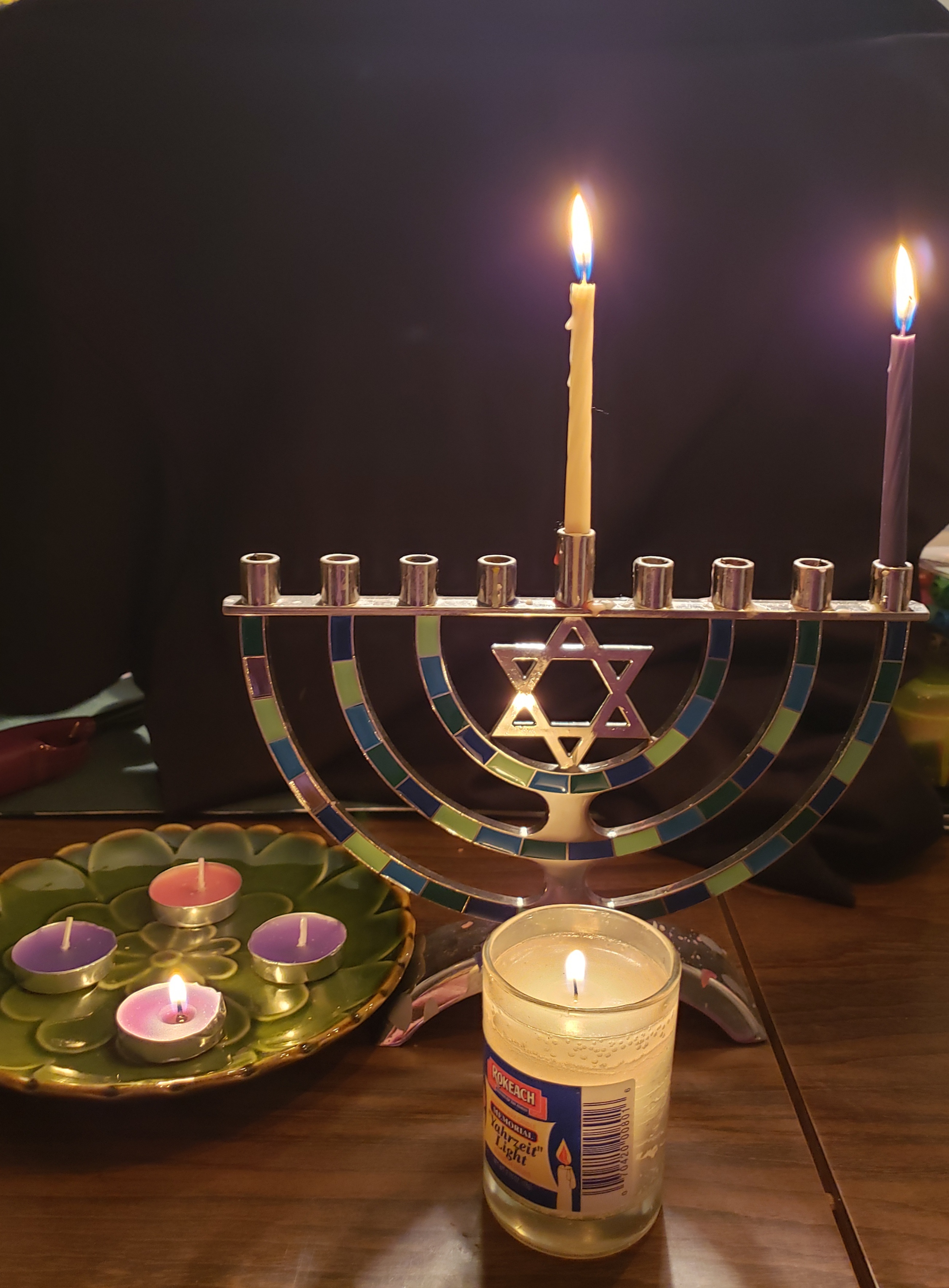
Today is the first Sunday of Advent. Accordingly we light the first purple candle.
Today is also the first night of Chanukah. We light the shamash and the first candle.
Tonight is also the anniversary of my mother’s death. It’s been seventeen years. Some days it still feels like yesterday. I’ve lit the yartzeit candle to commemorate the day.
So many things have come together tonight that it reminds me to be still, to meditate, to remember, and to wonder.
August can be a tough month. Summer is both at its peak and winding down. Back to School is far off, and yet just around the corner. It’s too hot for home maintenance especially in the garage and basement as my husband wants to focus on. For our family, it’s time to get ready for our annual vacation as we stress about covid – getting it and not getting it but having our vacation canceled as so many others are having happen. There is also GISH. The annual, Guinness Book of World Record-holding scavenger hunt is about a third of the way complete, and while I can’t share actual items, I have four things that you can do at your own home that are inspirational and GISH-adjacent. But first:
“Education must, then, be not only a transmission of culture but also a provider of alternative views of the world and a strengthener of the will to explore them.”
Jerome S. Bruner
This photo will be added to my post about my recent visit to a labyrinth. I went back and found these newly painted rocks as well as a new plant, a rainbow flag, a fallen tree branch, and a basket of bubbles.
It is a good reminder to revisit places because even in the shortest times, they will change; some for the better (new rocks) and some not so much (a bit of overgrowth).
However there is always something new to see if you just open your eyes, your heart, and observe the world around you.
Those four things I mentioned above:
1. Find a cloud in the sky that you like. What does it look like to you? Take a photo. Or draw it. Whatever you do, enjoy it.
2. Write a poem. Any topic.
3. What direction do you want to travel in today? Draw a compass and make a map, like a treasure map, but all your own. What (and where) is your buried treasure?
4. Do some good. Donate time or treasure. One good organization is Random Acts and a second is the ACLU.
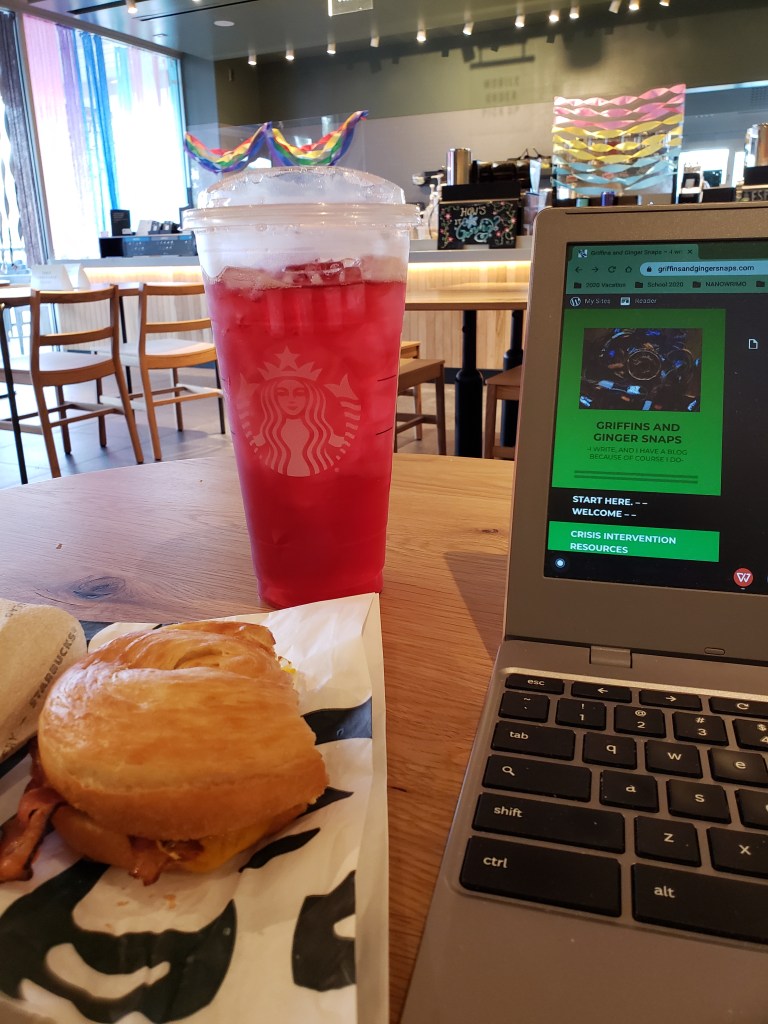
It’s been a good day, and I may post about that in the delayed Inspire post later today or this weekend, but after my mental health break this morning, I returned to my favorite Starbucks, computer and backpack in tow, and they are open for seating (with appropriate social distancing), and I am thrilled.
I have set myself up at my favorite seat and am deliciously enjoying a breakfast sandwich and Very Berry Hibiscus Refresher.
Sometimes it’s the food that makes the Friday, and sometimes it’s the place that you’re enjoying the food.
In this case, it’s both.
We are slowing returning to pre-pandemic times, although I hope we’ve grown in the last year plus. Time will tell, but today maybe time can stand still for just a little longer.
I never miss an opportunity to celebrate the glorious nature of tea. Below is a selection of the variety of United Kingdom teas in my collection. Not pictured is a Scottish afternoon tea, Earl Grey, Lady Grey, and others that I’ve tried and liked.
One of my perennial go-to’s at Starbucks is a London Fog, which is made with classic Earl Grey with steamed milk and hints of lavender, vanilla, and Italian bergamot which lends a citrusy element.
There is no bad time to enjoy a cup of hot British tea.
A little over two years ago I discovered labyrinths. I happened upon one at a local church and it immediately drew me in and down the proverbial rabbit hole. I was fascinated by it. It wasn’t just the shape, the circular path, but also in this case the courtyard it was in. There were windows set in stone walls with worn wooden benches separated by narrow walls giving it a medieval structured look. Opposite the entrance to the courtyard were a pair of French doors and around the boundary of the space were a variety of plants and flowers. The first time I was there was a bright sunny day, but on my second visit when I actually prayed with the labyrinth it was much colder and overcast. It didn’t dampen my enthusiasm for my hour in the labyrinth and meditating in the courtyard.
I started reading about them, and in an unexpected coincidence I met a woman in my writing group who used to teach a workshop about labyrinths. She loaned me a few of her books for my reading that semester.
The first thing I learned in my studies is that labyrinths and mazes, though the words are often used interchangeably, are not the same thing. Mazes are meant to be a little confusing, they dead end and may have more than one path to get to the center and the goal or treasure. Labyrinths usually have one path to the center and then either a second path out or a reversal of the original path and the treasure is in the journey through the labyrinth rather than a golden prize.