Presbyters

Standard

Here we are in the first full week of Lent. I think we’re all getting used to the idea of what this year’s Lent entails. As I mentioned last week, I am trying to organize my thoughts around the Lenten pillars of prayer, fasting, and almsgiving and incorporating those pillars with the tripod of my way through Cursillo of piety, study, and action. Something the priest said at Monday’s mass stood out to me, and that was that we are all presbyters, as opposed to proselytizers. Public prayer, not conversion. That was the word [presbyter] used in that day’s Reading from the First Letter of Peter, and defined in Father’s homily as someone who prays in public. We may recognize that word as the basis for Presbyterian, a Protestant sect of Christianity.

If we are all called to be presbyters as Peter exalts us to “tend the flock of G-d in [our] midst” [1 Peter 5: 1-4], how do we reconcile that with Jesus’ call to not be like the hypocrites and go to our rooms and pray in private [Matt 6.6]?

How should, how can we pray in public and not become like those hypocrites?

As I set this aside earlier in the week, I thought about the ways in which I was praying in public and yet hoping to avoid hypocrisy. I am definitely thinking more about prayer and ways to be closer to G-d during these forty days leading up to the Easter Vigil. I spent time discerning what actions and tasks were important to me and which ones I needed to give up to make my time more effective and positive, not only for me, but for those people I would be working with.

Sometimes prayer is a conversation between yourself and G-d and sometimes it is contemplative, thinking on a scripture passage or meditation. We ask for things – petitions, we ask for things for others – intercessory prayer and sometimes we just sit in the quiet and hope G-d can understand what it is we’re seeking even if we don’t necessarily know.

On Wednesday night, I participated in a centering prayer group. We met on Zoom. I had been to a workshop on centering prayer last month, and this was a good opportunity to put what I learned into practice with others.
While we were each in our own spaces and muted, we were also all together, hearing the same reading, listening to the bell that started off our quiet, contemplative time, the screen sharing a single candle if we chose to keep our eyes open to see it. Solitary and in group at the same time.

Private and public.

Admittedly, I had some trouble focusing. My house was empty and silent. The group was silent, not even a buzz from the lights or clock in the room, no airplanes flying low overhead like they’d done all morning. And still, I needed to continue to draw on my sacred word to bring me back to my prayer. By the time, I felt settled, the bell rang and it was the end of the twenty minute sit (what the prayer time is called).

It reminded me of those early days of the pandemic, when the sun was out, the snow was gone, and the cold was bearable. I would take out my camp chair to the front lawn and just sit. On occasion I took a photo of the trees or the sky. I’d write in my journal. I’d pray the rosary.

But often, I would just sit, noticing each flutter of a breeze, each chirp of a bird, and before I even realized it, an hour had passed. I’d unconsciously been doing centering prayer a year ago, but didn’t have the language to name it then.

One way I can be a presbyter is to take my chair outside (when my lawn doesn’t have the mounds of snow that it currently has) with my prayer book and journal, my pashmina and just sit. Let myself be drawn into G-d’s world and let the nearby church bells lift me from my reverie and gently bring me back to this world refreshed.

What’s Missing?

Standard

Back in July, I published a list of the five things I missed most during the pandemic. It was a way of putting down on paper/screen some of the “normal” things that had been interrupted in what is becoming this lost year. They were mostly superficial, little things that I wouldn’t normally notice throughout the day or week, but that by July were obviously missing from my life.

Online, I saw parents in chaos as they tried to juggle their work from home, their lack of day care, and homeschooling their kids with and without wifi and other resources. I couldn’t relate to that experience either. My two youngest children are teenagers in high school. We are fortunate, in more ways than one, that they no longer share a room. They went to their respective corners, closed the door, and went to class (if there was online class) and did their homework. We’d see them each once a day as they emerged from their cocoon of isolation for lunch. I kind of missed them.

We cooked more, and our kids cooked more. We did takeout now and again, but it wasn’t special anymore. It felt like more work. Masks on, rush in, rush out, masks off. Eat, clean, repeat.

Television was postponed when filming was postponed. We signed up for a bunch of streaming services and watched things we’d missed on the first go-round. Hamilton came to Disney+ early. Wonder Woman 1984 came to HBOMax. Supernatural returned (finally) and then finished its series run seven episodes later.

Glancing back at my original list, I was able to get most of it back in the summer and fall when covid numbers fell. Our Chinese take out place re-opened. My town’s new Starbucks was the only Starbucks in the area that had indoor seating. I was thrilled. Target was my getaway – we were always looking for toilet paper and soap. I mean with four people home twenty-four hours a day, we were always in need of one or the other. We stayed in our state, one of the safest and were able to actually go on vacation before school started again. I returned to in person mass on Mondays, although therapy remained by phone. My retreat house went hybrid and I was able to enjoy a few retreat days and two weekends before they closed again due to an increase in covid numbers.

Recently, I realized what I was really missing. The lingering.

It wasn’t church that I missed, although I definitely missed the sacraments and the liturgy and the homily, but it was the standing around talking to people I only saw once or twice a week. Our Cursillo group stopped meeting when the parish center closed. All our community events were cancelled. No parish picnic, no in person day of service, no hospitality at Sunday mass, no Lenten fish fry, no Holy Thursday lasagna dinner.

I couldn’t go to the library to work on things in different surroundings.

When my writing group met in the park after weeks of not meeting, we sat far apart. It was hard to hear. It was cold. We didn’t linger. And then winter came.

Even when I was able to go to Starbucks, before they closed the indoor seating, I’d go for a limited amount of time: eat breakfast, write for an hour (which does seem like a lot, but I was used to going for two or three at a time), and then either head directly home or get groceries and then go home.

I stopped taking myself out to writing lunches, which in my pre-pandemic days I didn’t realize how much I relished and needed.

I had one telemedicine visit, which was convenient and helpful, but I did that in my dining room. I wanted to get in the car and go somewhere else after the appointment. I didn’t.

My retreat house moved to Zoom, which was great in many aspects, but in others, the camaraderie was missing; no compliments on my scarf or my earrings. No handshakes or hugs. No breaking bread and no chapel prayer.

The word lingering came to me the other day, and it summed it up so succinctly that as I thought more about it, and what it meant, it just clicked and created a small space of melancholy and understanding.

I began to linger in the mornings in bed. Not the same thing, not a great idea either, although with my Kindle, I listened to my daily morning podcast, I took my medicine, I paid the bills, and read and replied to emails, I scheduled appointments. It became an office space, and that led to sleepless nights. My actual office became overrun with papers and pocketbooks and receipts, and was unusable. I commandeered a space in the dining room and now I work in there, although my time is spent organizing and decorating. Not helpful for a writer.

And I don’t linger there.

I work. I move to another chair to read. I move back to work some more; to write. And then I move again.
Rinse. Repeat.

I want to linger. I want a weekend to write and rejuvenate. To reenergize and reemerge a better person; a better writer perhaps. I don’t mind being home so much, but I mind not having the choice; not having anywhere to linger anymore. I dislike going out only with a purpose and losing that freedom of myself, alone with my thoughts or my own brand of quiet.

When will I be able to linger again without rushing off to the next thing?

A Gratitude Scavenger Hunt

Standard

With Thanksgiving in two weeks, the Election over, and despite the continuing pandemic, we do have much to be grateful for.

This graphic will give you eight days to have your own scavenger hunt for the things you hold dear, that you’re grateful for.

I’ll be following up this afternoon and throughout the eight days, although not in a row of where I hold my gratitude, especially this year.

Graphic from Simple Acres Blog dot com. (c)2020

Halloween or Hallowon’t

Standard

Halloween during a pandemic. Well, at least everyone’s already wearing masks, right? My kids are in high school, so it’s less of an issue for us. They’re planning on going to friends’ houses and celebrating with a party instead of traditional trick or treating. They’ve already been hanging out with these friends since summer, so it’s equally safe as doing homework together.

On my neighborhood Facebook group, there have been some questions about neighborhood plans as well as some suggestions. One neighbor wants to do treat bags on a table at the end of the driveway, and limit trick or treating to certain hours – from five until eight. I thought that seemed reasonable.

Another thought was of a scavenger hunt with houses providing clues to their kids to find candy. The parents would do all the work and the neighbors who participated would volunteer so the kids weren’t randomly going to people’s houses who had no idea what was going on. I thought this was a great idea.

We usually have a bucket of toys and comic books in addition to candy, so the kids can choose which treat they prefer. They toys are the kind you get from McDonald’s Happy Meals or similar small items. Some are packaged, but some are gently used. We’ve decided to suspend this practice until next year (hopefully). I know our items are safe, but why put the parents in the position of having to say no to a toy if they have (legitimate) concerns.

I also thought that instead of having the kids reach into our candy bowl and choose their preference, we would have more of the same candies and hand it out ourselves. Two candies per child. We can wear gloves and put it right into their basket or bag.

I know some doctors and experts have talked about avoiding family during the holidays like Thanksgiving and Christmas, which are closer than we think they are. We haven’t decided our holiday plans, but I also think that Halloween is a different circumstance. I don’t mean it’s more important than our traditional family holidays, but in some ways it kind of is. It’s fun. It’s dressing up. It’s candy. And it can be done in a responsible and socially distant way. Kids can come to the door one or two at a time. The candy givers can wear masks and gloves. There’s no hugging, shaking hands, sitting around a table talking and eating.

To be honest, it really sounds a lot easier.

Maybe we can have a Halloween inspired Thanksgiving. Drive thru. Go to Grandma’s house and she’ll give everyone a Tupperware filled with a portioned out turkey dinner. Same with Christmas; just add presents to the drive thru lane.

I don’t know. I’m still working on that one. In the meantime, let’s enjoy Halloween as best as we can. Teach our kids that we need to make some changes this year to keep everyone safe, and we can do that and still have fun. I’m planning on dressing up as a postal carrier if I can find my parents’ old work shirts.

We’ll find out in one week.

What are your plans for Halloween? Do you have any suggestions for making it fun and safe for kids in this unusual year?

Signs of the Pandemic

Standard

When our state went into lockdown, school was moved online and we converted to remote learning; church was cancelled, little by little restaurants closed, libraries closed, museums closed, playgrounds closed.

We stayed home for the most part.

We did go to the grocery store and to Target for our household supplies. We did this about once a week. My husband would go out between grocery shopping trips to get milk, which we always seemed to run out of. We began to buy two gallons at a time.

We also went for drives, sometimes grabbing lunch through a drive thru and parking in the park or near the river and ate our lunch. At least we were out of the house for a couple of hours.

I began to notice some things on our drives and our trips to the supermarket: Signs.

Here, there,  everywhere signs were popping up.

Signs for delivery, signs for take-out, signs for curbside pick-up, signs for new hours, signs for limits on purchasing necessities as toilet paper and soap ran out in our houses and on store shelves. Food and dry goods also. Everyone was home and everyone needed more of what they used while no one was leaving the house for work or school.

The signs popped up like dandelions in spring.

I said to my husband: I know one business that’s doing better during the lockdown. Sign makers.

They were literally everywhere.

As the rules changed and we adapted, more signs were brought out. One way and wrong way signs in the aisles. Limited capacity signs. Xs crossed in six feet spaces for shoppers to stand in and wait for their turn to enter the store. or to check out with their purchases.

Soon, there were mask signs, social distancing signs, and after awhile, all of the signs temporary closed signs were replaced with We’re Open signs. Single entrances and separate exits. We deliver signs were joined  by Dining Room Now Open and Dine In – Limited Capacity.

I began to document all the signs I came across. The photos below are only a small sampling of what I found. Once I started this project, I discovered signs in the strangest places and for the strangest things, and I drove my family a little batty pulling out my cell phone and taking photos of the signs everywhere.

Let me know if I’ve missed any.

Continue reading

Election Connection: 13 Weeks: A Biden Covid Response with Ron Klain

Standard

The following video features Ron Klain, a member of the Biden campaign. In addition to his current role with the campaign, he is a two time Vice Presidential Chief of Staff (Al Gore (1995-1999), and Joe Biden (2009-2011). He is a lawyer and clerked for Supreme Court Justice Byron White as well as a Capitol Hill counsel.

He served as the Ebola Reponse Coordinator from 2014-2015 and has been an outspoken critic of the Trump Administration’s response to the Covid-19 virus which has, as of this writing, killed more than 150,000 people in the U.S.

For a time, he co-hosted a podcast addressing these concerns with Dr. Celine Gounder.

On a personal note, when I’m asked when I’ll be taking a vaccine (how soon after it’s ready), my answer is always, “When this guy [Ron Klain] says it’s safe.

The following video was made for the Biden campaign and outlines what a President Biden would do to curb the ongoing virus and epidemic.

Writing Prompt – Pandemic Days

Standard

I am missing my writing workshops, but that doesn’t stop me from writing. (There are dozens of other things that keep me from writing!) The age-old (and ofttimes wrong) direction is write what you know.

Many of us have been home for over one hundred days. Some of us are just coming under the auspices of quarantining (Texas, Arizona, Florida, etc).

How have you been holding up? Have you adjusted to life at home?

It might be time to take out a notebook, journal, or keyboard and begin writing about your experience. Even if you won’t be professionally publishing your writing, this kind of document is so valuable to your future families.

Here are ten questions to get you started. You can begin by simply jotting down quick answers, but then take your time and expand your thoughts. Include your five senses, talk about your feelings, talk about your family’s feelings and reactions. There are no wrong answers; these are your experiences.

If you think of other questions, send them, and if you want to share your experiences, comment with your thoughts and/or links to your writing.

1. Are you still working at your job? At your place of work or at home? How has work changed with the covid outbreak?

2. Do you have children and are they now home from school? Are you involved in their schooling? How much? Are they working independently or do they need a lot of parental input?

3. How has your grocery shopping and cooking changed? Were you someone who ate out a lot or had you already been cooking every day? Are you trying new recipes? What are you go-to favorite recipes? Write down the recipes so your family has them.

4. What have you done for entertainment? Are you watching more television? Netflix? Are you playing board games?

5. What are you reading?

6. Are you listening to podcasts? Are you watching more or less news?

7. How has your religious life changed? What are some of the things that you’re doing that you weren’t doing before? What are you continuing to do?

8. What was the last thing you did in the public world before the pandemic arrived (in the US approximately March 13, 2020)?

9. What do you miss most from being home all the time?

10. What are you surprised that you miss the least and are thinking about keeping out of your life when the pandemic is finally over?


In the Midst of Loss

Standard

My retreat house recently began to offer some limited online experiences. The first one that I explored was about the losses we’ve confronted during this pandemic since March. This was a two hour session, split into two days one month apart. I know the presenter, Father K, through other classes and workshops I’ve taken through the Diocese. He’s a local priest who also works in the area of mental health and I really enjoy the way he approaches things. He also reminds me of my therapist. At the end of the first hour, I thought I had been given an extra therapy session this month! It really was a comforting hour that led me to spend the next twenty-four hours deep in thought. For the first time in a long time, I felt calm and thoughtful but also, in a way invigorated.

To start out, he asked us to think about the losses we’ve faced since March, and to write them down, and then to share a couple of them with the group. I was one of the first called on, and for me that meant that I hadn’t any time to prepare what I might say. I had a list, but it felt superficial. I began with a pseudo-apology; something that many of us do on a daily basis, especially women. That isn’t to say that men don’t do it, but women, I’ve found are the primary apologists for things they aren’t at fault for. For example, have you ever had someone walk into you on the street or in a store, and you apologize to them? I do this almost every time. Women apologize for taking up space, for taking too long, for a myriad of things that men just don’t apologize for, and really, that we shouldn’t apologize for.

I began by saying that I was fortunate that my family and I haven’t lost anyone to covid and we haven’t been ill, minimizing what we have been going through, and that while it hasn’t been life-threatening (so far) it has also not been easy for our family. My husband already works from home, so we continued receiving our salary. I feel guilty. All of my losses come from a place of privilege and I feel it’s my obligation to add the disclaimer of our privilege even while trying to be honest with the emotional and mental toll this pandemic crisis has put upon us. I mentioned a few things that we have lost since March, and as I listened to the others share their losses. I was reminded of things that I hadn’t thought of as losses and I added them to my list as well.

At the close of this part, Father K said what I already knew (and I’m paraphrasing): whatever I’m going through is just as valid as the next person. Their struggle may seem more difficult, harder to get through, having more emotional value, but my losses are still just that: my losses. These are the losses that I’m feeling every day; that my family is feeling every day and I shouldn’t dismiss them because someone else has had a more challenging time than I have; whose struggle appears more difficult or more painful.

My losses are real, and this session allowed me to accept that and confront the actual loss and how I can move forward.
What are the losses that I don’t feel measure up to others’ losses?

The loss of time. What day is it? Even trying to tell time based on a favorite television show has been eliminated with the shutdown of Hollywood and all the global acting studios. Anything that wasn’t completed before March 17th ceased production; how many season finales were postponed? How many cliffhangers left hanging? On March 31, more than one friend mentioned how long March had been. March was a year long. I felt it in my soul. Would April also be a year long?

The loss of routine. School was canceled for my kids, but their schoolwork continued. They slept until nine, did some work, took naps, grazed all day or skipped meals. We were eating breakfast at ten in the morning, and dinner at nine at night, bedtime after eleven even on a “school night”. Haphazard doesn’t scratch the surface of our “new routine”. The kids’ independent learning and creating their own schedule seemed to be working, but at what cost?

Mass was canceled, and it took a few weeks to get the livestreaming set up, so at least now I know when Sunday is. All of my spring retreats were postponed at first, then canceled entirely. Therapy moved to the phone. Meetings canceled or moved to Zoom. If school and work were gone, was there even a weekend to look forward to?

The loss of being lazy. That’s wrong and a little harsh on myself. It’s more the loss of choice. It could also fall under the loss of routines. If I didn’t feel like cooking, we couldn’t just go out to dinner. Even if we did takeout, the restaurants closed about two hours earlier than normal. Menus needed to be planned so groceries could be shopped for in a way that minimized our leaving the house and coming in contact with other people. Planning every meal. Having food for the kids to eat lunch when they would normally eat lunch in school.

The loss of of seeing and hugging my adult son. We barely saw him. He came by once every two weeks until I was exposed to covid, and then he stayed away until my fourteen day isolation was completed. He’s an essential worker and a first responder, and even if he wasn’t I wouldn’t want to expose him to something that we still know so little about. Fortunately, I did not have covid. We eventually had our family Easter dinner.

The loss of myself. I stopped being me. I had to become the covid expert. I had to tell everyone to wash their hands every time they came home from school (before the lockdown) or the grocery store after. The one time my husband needed to go into the office, it was half an hour of discussion weighing the pros and cons, and how to do it safely. I had to know how much toilet paper we needed and go shopping with all the others preparing for their own lockdown. I had to educate people about this virus and call out misinformation because if I didn’t do it, who would? I became teacher again.

And the burden that I put upon myself led to the loss or permanent change in status with some friends. It’s hard to maintain the reciprocal, balanced relationship with people when their fundamental values are so at odds with mine, like wearing a mask and isolating or simply the basic idea that covid was made in a lab somewhere to ruin the President’s term of office.

Some losses that others in the group brought up that resonated with me included the loss of purpose and the safety and peace of mind that I’d had from only a week before; the loss of trust especially in the authority of the federal government to take care of something so catastrophic as this and which they ignored so much and let us fall so far, and of course, the loss of the Eucharist and the rituals of mass, so much a part of my life.

I craved the Eucharist, but when the opportunity arrived to return to in person masses, I decided against going, and I surprised myself that as those in the pews received their communion while I was at home watching the livestream, I felt just as close as if I’d been there and received it in my hand and consumed it. I credit my parish and my priest for giving me that feeling of belonging and even though I wasn’t there in front of him and others, I was still present and G-d was still present for me. That was a good thing.

In the midst of the losses, there have been some gains, some good things to reflect on. What was good about this time as lockdown comes to a close? The last question asked in the session was how do we find joy in the confusion and the chaos? These are things I need to meditate on, to think about and discover the answers to. Reflecting more on the losses I’ve documented above and move toward accepting and then moving forward to finding the joy is a thing I want to work on between now and the next group meeting. I want to acknowledge the gains; find my joy.

In the coming days, I’ll share the one day back in March that kept me going, and then hopefully after that I can answer the question: how do we find the joy? At the moment, I don’t know, but I hope to find out.

“Friday” Food. June. Summer Salad

Standard
Summer Salad, photo taken by my daughter. (c)2020

I’ve put Friday in quotation marks since today is Wednesday and this Friday Food is a few weeks late. It didn’t seem appropriate to continue with business as usual last week. I’m slowly returning to writing and publishing.

I mentioned in my recent quarantine and baking piece that my daughter had some assignments from her FACS (Family and Consumer Sciences) class during the remote learning part of the school year. In my day, I say in my best Grandpa Walton voice, we had Home Economics and we cooked and sewed aprons. Same, she replied.

The recipe she wrote, shopped for and prepared was this delicious Summer Salad. She may have called it Strawberry Chicken Salad, but I can’t remember. It was easy and overall not too expensive. I let her get whatever she wanted for it since it was a school project and didn’t complain about the price. Besides, once she took her photos, she would be serving it to the rest of the family for lunch, much better than a peanut butter and jelly sandwich or frozen waffles that we usually scrounge up during the week.

Ingredients and Directions:

1 pkg. boneless, skinless chicken tenders. Cook in a skillet with olive or peanut oil, seasoned with salt, pepper, and garlic powder, no more than 1 tsp. of each.

1 head of lettuce or 1 bag of mixed greens

1 container of grape tomatoes

(You can add one cucumber, but I honestly can’t remember if we did. I happen to love cucumbers!)

1 lb. strawberries

1 pint blueberries

Freshly shaved parmesan cheese

Croutons

Dressing – I chose honey mustard. (My daughter actually doesn’t use any dressing.)

Mix the salad together, add your favorite dressing and enjoy a light and satisfying lunch!

Enjoy!

Inspire. June.

Standard
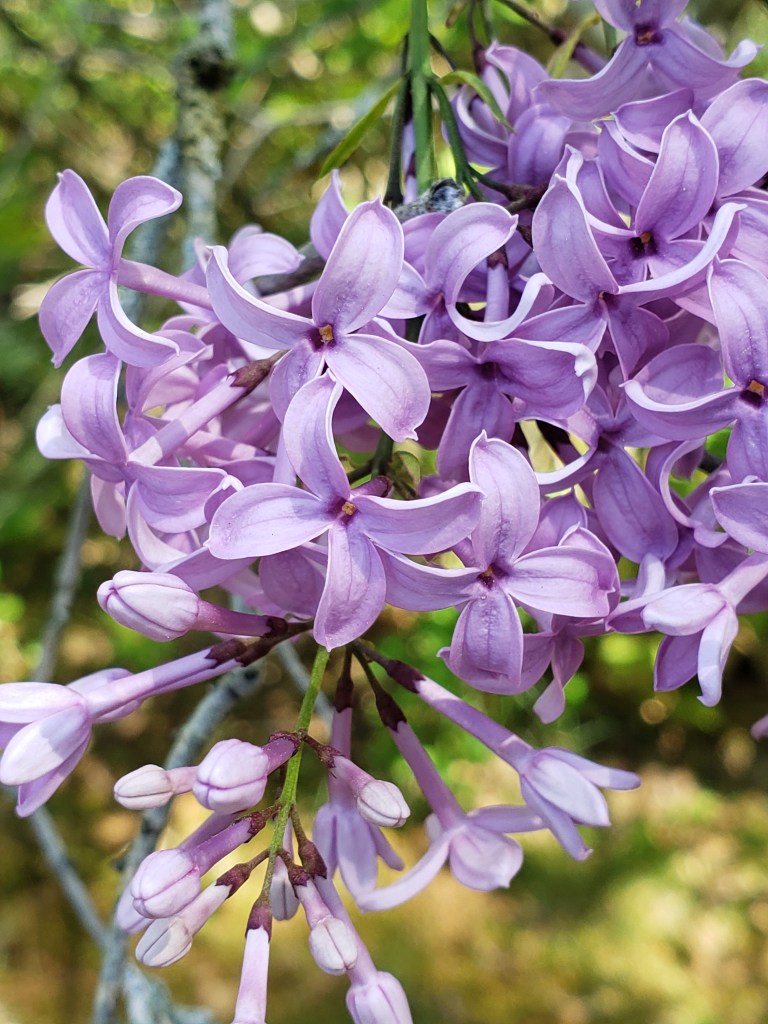
Lilacs. (c)2020

Patience and perseverance have a magical effect before which difficulties disappear and obstacles vanish.

John Quincy Adams

This pandemic has taken, but for those of us continuing to live through it, it has also given. More time with our families. More time to think of our priorities, our spirituality, our blessings, and our failings.

As President Adams said above, this pandemic has brought patience and perseverance to all of us in varying degrees of success. We all have both despite having different levels of both, and through it all, in whatever way we are and we can, we are moving through it and adapting.

It is ever with us.

Wear your mask.

Keep your distance.

We’re all in this together.

Be well.

Patience. Perseverance.