In my town, I’ve seen signs all over unmowed lawns, stating, “No Mow May.” This has proved very convenient for our family as our lawnmower is on the fritz, so I guess we’ve got one more month to get it repaired or replaced.
Sustainable Saratoga has some helpful tips on how not mowing benefits bees, which benefits all of us. Of course, check your local ordinances for property upkeep, but generally, you’re only required to mow your lawns in June, July, and August, but it varies by locality. Also, visit their link for Pollinators and Native Plants (Saratoga County and parts of Upstate New York.)
If coloring’s your thing, visit my new page: Coloring Sheet (link in the menu) and look for the World Bee Day sheet to download and color.
And if you like a snack while helping the bees, stop into your local Starbucks where they have the new Bumblebee Cake Pop, but I took photos of it from all angles, and all I see is a yellow cat. If someone could show me the bee, I would very seriously appreciate it!
“If we wish to live and to bequeath life to our offspring, if we believe that we are to pave the way to the future, then we must first of all not forget.”
Prof. Ben Zion Dinur, Yad Vashem, 1956
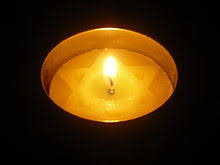
A few links to follow to learn about this day as well as reflect on it. In addtion to Holocaust Remembrance Day, which began at sundown last night, it is also 80 years since the Warsaw Ghetto Uprising. I have a well-worn book about the Uprising that I’ve kept since childhood.
Public Domain
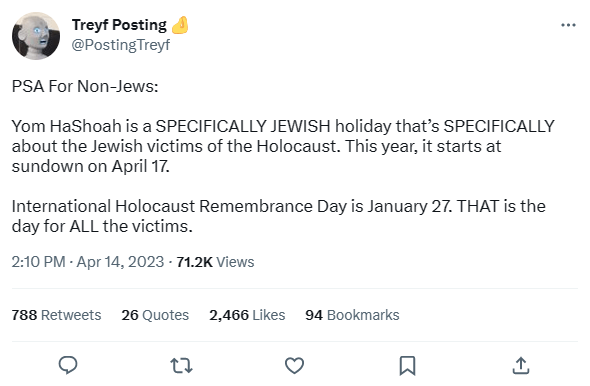
Yom Hashoah is specific to commemorating the Jewish people who perished in the Holocaust.
Click photo to be taken to the Twitter thread that explains this.
Passover, Easter, Spring Break, Prom Season. So much to do, including cooking. Holiday cooking plus the regular everyday cooking that we’re expected to do. These last few weeks had me teaching, my daughter working practically every day after school, my son trying to break the world’s record for most movies seen in a month (kidding), my husband’s job is one person short, and no one wants to cook dinner. They also don’t want to pay for take out or fast food, and frankly, I don’t blame them. I thought I would take this Friday Food to share some shortcuts and new things to try.
Everyone knows about cooking two meals on Sunday and then eating leftovers. I try to make one big meal a week, like a roast beef, a pork loin, or a whole chicken. They make a great meal, and then they make great leftovers. All of them can be eaten as sandwiches later in the week with a side of chips and cole slaw. If the first night is mashed potatoes, the next night can be rice. My daughter likes Minute Rice, but regular rice is very easy to make. I got the recipe from The Kitchen Survival Guide by Lora Brody and while I’ve changed some things, the gist of it is the same.
This is specific to a Texas school district, but challenges are happening across the country.
A federal judge has ruled that the books in question be returned to the library within twenty-four hours and left accessible while the case is ongoing. They are prohibited from removing any books while the case is in litigation.
According to this CNN article, while the Texas school said the books were removed as part of their normal weeding procedures it is clear that there were outside influences at play based on the subjects removed, including topics of race and LGBT+.
Disagreeing with the subject matter is not a reason to remove the books from the library. I also disagree with the comment in the article that pastors should be involved. Absolutely not. The separation of church and state is critically important both to the founding of this country and its ongoing evolution of welcoming all, despite the recent contradictions to that.
Part of the problem is the ignorance of those complaining about the books. They call many LGBT+ books pornographic when they are not sexual in nature and simply talk about feelings and gender as any adolescent character in a book would do. They are also trying to restrict CRT (critical race theory) which none of these books teach despite perhaps being written by a person of color or are about a person of color. As has been explained over and over again, CRT is not something that is taught in the schools, not even at a high school level. It is typically a subject in post-graduate and law schools.
As a writer, I understand that not all books are for everyone, and I agree that parents can determine the appropriateness of books for their children within reason (as I have done for my children without banning books for everyone), but I expect that we should trust in the schooling and expertise of librarians and teachers who have studied this field for a number of years.
I am also concerned about a random group of uneducated people coming in and removing books rather than letting individual parents and children make the determinations for their families on what is age-appropriate.
I hope the country steps back from the abyss; we are well beyond the slippery slope, and we need to offer modern books with timely subject matter while also encouraging the reading of classics while explaining the reasons that some of the material isn’t appropriate, and maybe never was.
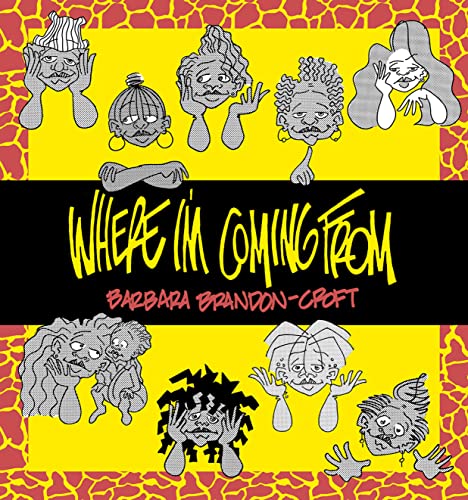
Barbara Brandon-Croft has a new book out, reflecting on her place as the first African American woman with a syndicated comic strip. Where I’m Coming From: Selected Strips, 1991-2005 hit shelves last month.
In this Washington Post article, author Michael Cavna tells us about Brandon-Croft’s beginnings, her social commentary through comics, and learning from one of the best and first African American comic strip writers, her father, Brumsic Brandon Jr. He told her three steps described the cartoonist’s job, and she repeats those words, almost as a mantra:
Yesterday was the 112th anniversary of the fire at the Triangle Shirtwaist Factory. This tragedy has become synonymous with workplace safety and ongoing regulations to protect workers. There were so many things wrong with the working conditions at Triangle Shirtwaist that it’s hard to believe that at the time none of it was illegal:
Stairwells and exits were locked.
There were no fire alarms to alert anyone to the fire.
There was a single fire escape.
In addition, fire department ladders, when they finally did arrive could only reach the seventh floor.
As a direct result of this fire, many changes, thanks to unions and current OSHA requirements have made things safer, but as we can see in today’s news, deregulation of trains and how chemicals are transported led directly to the Norfolk Southern train derailment and the new Governor of Arkansas, Sarah Huckabee Sanders, signed into law a roll back of child labor laws, allowing children, ages 14 and 15 to not fill out a form for work, commonly known as working papers. Other child labor laws remain in effect. In the case of Ohio, the governor took advice, not from the professionals but from the CEO of the train company to burn the chemicals in a controlled way. This led to people being evacuated and becoming ill. The CEO chose the most cost-effective option rather than the safest in many people’s opinions. Actions like these will likely lead to environmental disasters and workplace injuries that will affect these children for their lifetimes.
The Triangle Shirtwaist Company was situated in the Asch Building on the corner of Greene St. and Washington Place in Greenwich Village’s garment district. It resided on the 8th, 9th, and 10th floors and employed about 500 workers, mostly immigrants, mostly young Italian and Jewish women and girls who worked fifty-two hours a week including Saturday, earning between $7 and $12 a week.
Sketch of a Shirtwaist. (c)2023
The fire broke out around closing time. The only warning was someone on the 8th floor calling the 10th to warn of the fire on the 9th floor. The common practice of locking stairwells and exits was in effect and the person who held the stairway key had already escaped. Dozens escaped by going to the roof. A crowd escaped to a single fire escape which buckled from the heat and the weight and collapsed sending about twenty to their deaths on the ground below. 146 people died and 78 were injured.
Fire at the Triangle Shirtwaist Company, 1911. Public Doman
As for the fire, arson was not suspected despite four previous fires considered suspicious by companies owned by the same two co-owners.
The fire spurred a host of new labor laws including minimum wage and worker protections that included adequate bathroom facilities and a lessening of working hours for women and children. It also saw the burgeoning advancement of unions including the International Ladies Garment Workers Union, which had been established in 1900 and only expanded and diversified after the fire.
In Cemetery of the Evergreens in Brooklyn is a memorial to the six unidentified victims. They have recently been identified and their names were added to the list of victims known since 1911.
Today the building is the Brown Building and is part of the New York University campus and part of the National Historic Register.
For more information on this tragedy and its aftermath, check out the links below:
I’m including two links. One is the original article I read: How Cornrows Were Used by Slaves [sic] to Escape Slavery in South America, which details the idea that women braided escape maps into their hair as well as messages. The second article is from Snopes that doesn’t discredit this theory despite no tangible evidence. As been told, just because we don’t know if it happened, doesn’t mean that it didn’t happen. There are many ways that African Americans used to keep themselves safe in order to survive slavery and emancipation from slavery, including communicating with each other and traveling north to freedom. Whether mythology or history, it is important to know all aspects of the African American experience from their arrival on these shores, almost exclusively involuntarily.
An additional thing that I learned in regards to language is that in South America this type of hair braiding was known as “cane rows” as opposed to “corn rows” because the crop there was sugar cane.
St. Patrick’s Day has long been one of my favorite holidays. Long before I met and married my husband with Irish roots, and well before I set foot on the Emerald Isle. I have always been fascinated by the Celts, their people, their land, their culture, especially in relation to ancient and medieval culture. I have also been a questioner. Why? Why do we do this? Why don’t we do that? As a young child being told that I couldn’t write during Rosh Hashanah, I was devastated. But writing isn’t work; it’s writing, I whined to no avail. Becoming Catholic has not broken me of that – is it really a – failing.
And so, I question – why?
Why can’t we eat meat on Friday? Is it because Peter was a fisherman? Will there be a dispensation for today? It is a saint’s feast day after all. I waited for Pope Francis, and then was told that it’s up to the local bishops. I still couldn’t find it, so I texted my godmother and she okayed the corned beef which made my husband happy (as if he wasn’t going to indulge on his holiday).
But I still wondered: Why?
In googling and asking my questions of the internet, I discovered the controversy that is North Dakota. Apparently, they have three dioceses, and two have them have allowed meat today, and one has not. The idea that North Dakota has three dioceses makes little sense to me, but I found no less than twenty-five separate links about St. Patrick’s Day in North Dakota. Amazing.
Archbishop Nelson Perez of Philadelphia popped up as did Cardinal Dolan in New York City’s Diocese. I didn’t see Boston, but I came to the logical conclusion that there would be dispensation for Boston Catholics. What holy hell would be raised if even one of those cities banned meat on St. Patrick’s Day? I hope we never find out.
During Pope Nicholas I in 866 CE, Friday abstinence became a universal rule. Fasting also on Fridays was common by the twelfth century. It was expected for everyone, including those as young as twelve with very few exceptions.
It also used to be that you couldn’t eat any animal products on Fridays, not just during Lent, but ALL YEAR. I learned that Fat Tuesday began as a way to use up all of the animal products that you couldn’t eat – butter, cheese, eggs, lard, and of course, meat.
Pope Paul VI changed things in 1966 in his Paenitemini. His object wasn’t to end abstinence and fasting but for Catholics to choose to abstain and fast as part of their own penance practices; let their conscience be their guide.
With Sunday being a weekly Easter, shouldn’t every Friday be a Good Friday? This was asked by the US Bishops in 1966 and I tilt my head wondering the same thing.
Lent is an opportunity to lend mutual support on our spiritual and faith journey. We are in it together and have a shared experience through Christ’s death and resurrection.
So why the exception for St. Patrick’s Day?
Filled Soda. Randalstown, NI. (c)2023
I mean, look at this filled soda from Northern Ireland! Resistance is futile. This was a breakfast sandwich shared between my husband and myself (and after twenty-three years of marriage he still had to take it under consideration).
I can imagine that they might have thought they’d lose all the Irish American Catholics if they said no corned beef on Friday of St. Pat’s Day, although this quandary occurs once or twice a decade, so it isn’t exactly a pressing issue.
I would also note that the traditional St. Patrick’s Day celebration food in Ireland is different from the traditional food eaten in the US. In Ireland, sausage is usually eaten, and not your teeny-tiny frozen breakfast sausage, but a lovely, large, grilled bit of deliciousness. Bangers and mash. In the US, we serve corned beef and cabbage with mashed potatoes and carrots. Yesterday, I had cabbage with leeks, and it really boosted the flavor.
What are you to do?
It becomes a crisis of conscience.
Well, as I mentioned, dispensations are local, so check with your diocese.
Is it a pass? Not really. You’re expected to abstain from meat on a different day during the week.
Usually, you’re expected to give up meat on a day before the next Friday after St. Patrick’s Day and (or) perform acts of charity and good deeds to atone or call it even with the meat eating.
We’ll be having corned beef, cabbage, mashed potatoes (possibly champ), carrots, and Irish Soda bread with Kerrygold butter.
When I was in college, my friend was in England student teaching. When she invited me to fly over and meet her and travel the United Kingdom, I thought there was no way I could afford it. She told me we’d be staying in hostels.
I had never heard of hostels before. I had to join the association (for an annual membership) and then I could pay a small fee and spend the night in a safe, clean, dormitory. The Youth Hostel Association was for young adults, between the ages of 16 (without a parent) and 25. This is less common now. At the time, they also suggested that before you stay at a foreign hostel you should have a dry-run at a local, American run one. I did not do this, and it worked out fine for me. Of course, I haven’t gone hosteling in a couple of decades, so I can only imagine how much has changed. Part of that was because of my friend, who was the expert in my opinion, having been in England and traveled about quite a bit during her days off from teaching.
We are all bound up together in one great bundle of humanity, and society cannot trample on the weakest and feeblest of its members without receiving the curse in its own soul.
Frances Harper, We Are All Bound Up Together, 1866
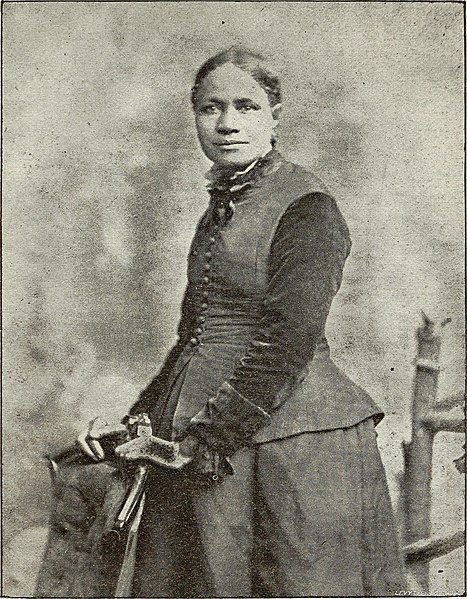
Frances Ellen Watkins Harper. Public Domain
Frances Ellen Watkins Harper was a voice of Black Suffragists. She was born in 1825 in Maryland to free African American parents. Her parents died when she was young, and she was raised by her aunt and uncle. By the age of 21, she had written her first small book of poetry, Forest Leaves and ultimately published 80 poems. More than a decade later she became the first African American woman to have published a short story, The Two Offers. She co-founded the National Association of Colored Women’s clubs.
While working as a teacher in Pennsylvania, a law was passed that free African Americans in the North were no longer allowed into Maryland, her home state. They would be imprisoned and enslaved.
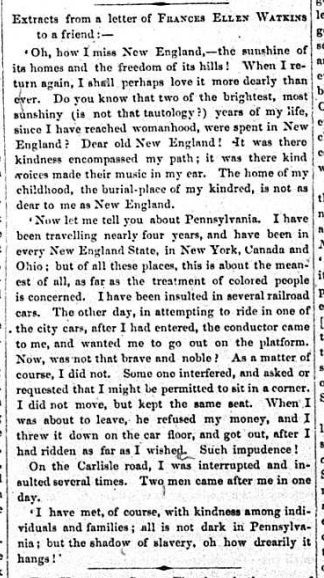
She refused to give up her seat on the trolley, and only got up when she reached her destination as chronicled in The Liberator, page 3 as seen below.
From The Liberator, Page 3 1858 Public Domain
Her famous speech, We Are All Bound Up Together, read in 1866 at the Eleventh Women’s Rights Convention held in New York City, can be read here.
She spoke at the National Woman’s Rights Convention in New York, held in 1866. The organization split over the suffrage of African American women and were opposed to supporting the fifteenth amendment. Harper left the group, and with Frederick Douglass and others supporting the amendment joined together to form the American Woman Suffrage Association. She was often the only Black woman at the women’s conferences. Through her life, she continued her advocacy for intersectionality (see- it’s not a new idea) in suffrage.
She spent the remainder of her life teaching and encouraging equal rights and education for African American women and founded and/or directed several clubs and organizations for African American women, including the National Association of Colored Women’s Clubs and the Pennsylvania Women’s Christian Temperance Union.
Some of her writings include:
Forest Leaves, poetry, 1845
Bury Me in a Free Land, poetry, 1858
Moses: A Story of the Nile, 1869
Light Beyond the Darkness, 1890
In Memoriam, Wm. McKinley, 1901
Trial and Triumph was one of three novels originally published between 1868-1888 as a serial.
Her first novel, Iola Leroy, or Shadows Uplifted was published in 1892. It was thought sentimental, but it also highlighted several serious social issues at the time, some of which remain today.
As a writer, I am always drawn to the writing lives of the people I choose to profile, and I was pleased to see that Harper was a mentor to other African American writers, including Mary Shadd Cary, Ida B. Wells, Victoria Earle Matthews, and Kate D. Chapman.











 Griffins and Ginger Snaps