Inspire. December. Chanukah.

Standard

I’ve been searching for the write inspiration for December, and this first night of Chanukah brought things into perspective. A little bit of perspective. While the internet and the news are filled with antisemitism and protests from people intent on gaslighting the Jewish experience and deny Jewish people the indigeneity of their homeland, I have been on a quest to celebrate Chanukah publicly. I’m a little wary about it. I live in a nice neighborhood, but I don’t put my head in the sand and think that it couldn’t happen here. I know it can.

Still….

I went out and bought blue and white lights for outside, something I’ve never done. I have an interactive menorah hanging on my front door, again, something I’ve never done. In fact, since I’ve been on my own (and with my own family) I have not put Chanukah lights in the window. That unfortunately will continue because I know that if I put candles on my windowsill, my mother would come back from the grave and blow them out with a raucous, and loud message of fire safety.

Most people don’t know the story of Chanukah; perhaps some teachers wanting to bring multiculturalism to their classrooms, and now the story of the Maccabees is being co-opted to match the narrative, anything to turn the words of Jews and their history against them. The Festival of Lights isn’t about war. It isn’t about victory. It is about faith. The miracle isn’t that the Maccabees won against their most recent oppressor. The miracle is the lights themselves. When we retook the temple, amid the destruction, they went to light the candelabra to rededicate the temple, the menorah – not the nine-branch one that most are familiar with, but the regular, ordinary menorah that is always lit in the temple. There was only enough oil to keep it lit for one night. There was no other oil. So, what did they do? They lit it anyway.

And it remained lit, not one night, not two, not three or four, not even five or six or seven, but it remained lit for eight days. One day’s oil lasted for eight days. That is the miracle. And that is why we light eight candles on a new type of menorah used just for this holiday: a hanukkiah.

Tonight, I will say the prayers (that I don’t normally say). I will fry the latkes in oil. I will fry the chicken in oil. I will light the first candle on the same menorah that I lit as a child; the one that I grew up watching the candles burn down on the dining room table that was my grandmother’s. It will be placed on that same dining room table in my own house. My kids will see the lights on the same menorah, the same table, and they will be able to see through my eyes, even amidst the clutter that seems to grow multi-generationally on this dining room table.

This year, however, this old menorah has a special, additional meaning. I saw this menorah in Toronto at the Royal Ontario Museum in their Judaica exhibit, in the Chanukah window. A copy/replica of MY Chanukah menorah sits in the largest museum in Canada. The exhibit label states that it is from Gdansk, Poland, brass, from the early 1900s.

Happy Chanukah.

My family menorah.
(c)2023
Royal Ontario Museum Judaica Exhibit.
Hanukkah menorah, “Danzig” type,
Gdansk, Poland, early 1900s.
(c)2023
Ready for sundown.
You can view it lit later tonight on Instagram (link in sidebar).
(c)2023
Friday Food – A Blending of Two Cultures

Standard

Food and cooking are universal. We all eat, we all need to get food on the table, and even if it’s not us directly, someone needs to cook. From small galley kitchens in apartments to large farmhouse kitchens looking out over lush, green backyards, whatever kitchens we are destined to be “stuck with” we adapt and we learn how to work with what we have. If we don’t have an ingredient, we try a different one. When my kids were little, in the summer we held taste tests. I would get things they’d never eaten and we’d try them. It was great fun, and the kids had an awesome time choosing what new food, mostly fruit they wanted to try. Some (donut peaches) did better than others (anchovies).

I had the privilege of working one of my first jobs out of college as a civilian for the US Navy’s child development program and through that job met people from all over the country and we shared food and recipes and cultural traditions, and it was wonderful.

One of my mentors, Sylvia was an African-American woman from New Orleans. She had a demeanor of floating on air, gliding through our lives, and expressing and encouraging our wonder in the world and in diversity. I learned so much from her. She was ethereal and offered her words and advice as a sage. From her, I learned to make her sweet potato pie for Thanksgiving.

I followed her recipe exactly for years and my family loved this new item in our Thanksgiving celebration. My mother could not reconcile that sweet potato pie was served cold and as a dessert. She just could not get used to it, and soon it became a side dish in our house. The only difference between Sylvia’s and my version was temperature and time to eat.

After a while, after three kids and depression, and “I don’t have time for this” I converted it to a casserole, but I still miss that original version that Sylvia introduced me to. At the bottom, I’ll share my recipe, which, while excellent is not what you’d find in New Orleans.

Combining Sylvia’s traditions with mine was one way I blended her African American heritage with my Jewish heritage and then further blending Jewish and Christian traditions for holidays, in classrooms as a teacher and in my husband’s Catholic family.

This has been a longwinded introduction to a Twitter friend of mine, someone I met on the social media site in the last few months.

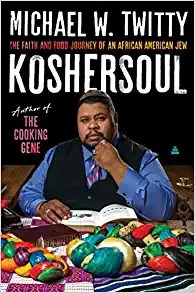
Michael W. Twitty is a proud African-American Jew who expresses himself through cooking and writing about food and culinary history. His Twitter handle is KosherSoul, which exemplifies his focus.

I’m going to quote from his website because this epitomizes how I think of my own cooking: Michael has introduced me to the term, “identity cooking.” “Identity cooking isn’t about fusion; rather its [sic] how we construct complex identities and then express them through how we eat.” This is a truism that if you follow me for any length of time and read my food posts, you’ll see that connecting different foods has always been my cooking style. Bringing together flavors that don’t necessarily go, but manage to surprise. None of us eats in a singular “culinary construct”. We often work with what we have and adapt. My mother-in-law was excellent at pulling things together from her cupboards and turning it into a gourmet meal. She had a rare talent.

As for Twitty, I could easily just copy and paste his website to describe how he blends the two diasporas of African-Americans and the Jewish people and their food, but I’ll let you visit him yourself as he explores their crossroads. He is a two time James Beard award-winning author and his recent book, KOSHERSOUL: The Faith and Food Journey of an African-American Jew was the winner of the 2023 National Jewish Book Council Award for Book of the Year.


Find all his socials below as well as his website and links to purchase his books.

Afroculinaria on WordPress

Twitter

Instagram

The Cooking Gene

KosherSoul

He also offers classes in the DC/Baltimore area. Information here.


As promised, my recipe for Sweet Potato Casserole

To make this as a pie, pour into a graham cracker pie crust, cover with mini marshmallows and bake for about 35 minutes at 350, until marshmallows are golden brown.

Ingredients & Directions:

1 large can of sweet potatoes (cook, drain, mash)
1 stick of butter
1/4 cup of brown sugar (whatever variety you prefer – I use dark, Sylvia used light)
I don’t measure the spices, but I add about:
1 TB cinnamon
1/2 tsp nutmeg
Incorporate everything together and pour into a small, any shaped casserole dish. Cover the top with mini marshmallows and bake for 35 minutes at 350 degrees.

Scoop and serve.
If pie, let cool, slice, and serve.

Friday Food. July. Dessert Cups.

Standard

I was eating a Dole fruit cup – cherry mixed fruit or something – and I was transported back to my childhood. We didn’t have the individual plastic cups like the one I was eating from. My mother would buy the cans of fruit cocktail, and we would most definitely fight over the cherries because there were never enough, and they really were the best part.

When we would have a special dinner – a holiday dinner – whether it was Thanksgiving or Rosh Hashanah or Passover, it didn’t matter which, there was always a multi-course meal with special dishes. Some meals like Rosh Hashanah would begin on the top plate with a piece of lettuce, a slice of tomato, and a scoop of chopped liver. There might also be a soup course – matzo ball – always a good choice, even on Thanksgiving. There also might be half a grapefruit with sprinkled sugar or a small dessert dish with fruit cocktail in it.

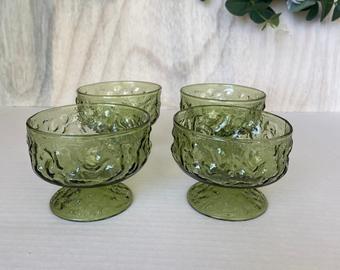
I loved those dessert dishes. They were small and squat and sat on little pedestals. They were perfect for fruit cocktail, jello, chocolate pudding (with whipped cream), and all sorts of interesting foods. The one problem I found as a kid was the texture of the dish. It wasn’t smooth so you could never scrape all the little bits of food left from the nooks and crannies, and they were annoying to wash, but I loved opening the cabinet just over the sink and seeing them, wondering what wondrous sweet treat they would next hold for us.

I still have them although they’re packed away in our basement. I wanted to find them last month for chocolate pudding, and then again to include a photo in this post, but our basement is a mess and in need of pruning. Finding them will be a goal for the next twelve months, but in the meantime I’ve included a photo I found of them from Ebay. We’ll see in the future if this photo that matches my memory will match the real ones when I find them.

Sometimes it’s not the food that’s nostalgic, but the containers we use.

Photo from Ebay. (c)2021