4th of July

Standard

I’ve been thinking a lot about July 4th lately, as in several years lately. I grew up with patriotic parents. I don’t remember displayed flags, but the way they lived their lives and taught their children was certainly patriotic. I remember two incidences specifically. One, we were at a professional sports game (could have been baseball or football) and the National Anthem played. I eas expected to stand, and stand still. The second was at a school assembly. I was young, elementary age probably, and we stood for the Pledge of Allegiance. Kids are lazy, and they hop on one foot, and lean on the seat in front of them, and they kind of sit on the top of those seats that close when you stand up, and that was me. Not disrespectful in my mind, but bored. My father leaned down and very quietly, all the important stuff was spoken quietly, expressed to me, in no uncertain terms that I would be standing up, and stand up I did.

My father was a veteran. He didn’t choose to join the Army, but he went when called and through that we saw the power of duty and real allegiance.

I’ve always been interested in history and genealogy, My grandfather was from Canada. I loved that we were from Canada. I once said that we were part Canadian. Goodness, you’d’ve thought that I had spilled tomato sauce on a white couch. We. Are. American. Period. End of Discussion.

When I got my own house I decorated for July 4th. We even marched in a parade with our son’s day care center (although that might have been the Uncle Sam Parade), but still. Nothing extravagant, but a couple of flags, flag shirts for the kids.

When the former guy became President, we didn’t decorate. It wasn’t a conscious decision. With my depression in full force in the mid-2000s, I didn’t do much of any decorating even though I tried for some minimal effort. Even after I got into a recovery groove, I didn’t put up anything patriotic. I didn’t want to go for the fifty cent ice cream cones at the local shop for wearing red, white, and blue. I saw that 90% of the American flags I saw were accompanied by T**mp flags or co-opted into Q flags. It was dispiriting. After the November election I noticed that many of the houses that had T**mp flags had changed them to the Good Ole Stars and Stripes. They are not the same.

This year, though, as Memorial Day was approaching, I was reminded of sacrifice, of bravery. I listened to marginalized voices and remembered what many of us believe – that the potential for this country is vast, and it is still accessible.

I bought a set of bunting. It looked unbalanced, so I bought a second set. That made it better. I fastened them in place with American flags and I left my Black Lives Matter sign and added a Choose Love in June. In a couple of weeks, I will take it all down, perhaps leave one flag in place because I am a proud American. I want my kids to feel that pride, to listen to all the voices, to accept the past, much of which is only now coming to light. Being proud doesn’t mean being blind to our faults. We all have them.

It may seem as though I’ve only decorated because Joe Biden became President. I’d agree, partially. We bought our house in 2006, and for the following July 4th we put up some flags and two buntings. It looked spiffy – very patriotic. I mention this because in 2007, President Bush was president, so this isn’t about only decorating for a Democratic President. I will say that President Biden’s concern and care for this country and especially for its people was an unconscious impetus to want to show off my colors. I have a place to store these buntings and flags safely, and I’ll know where they are so they can go up again next summer, just in time for the next 4th of July. Maybe they’ll go up for Flag Day and Juneteenth next year.

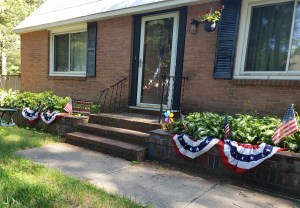
Front View. (c)2021
Close up View. (c)2021

Pandemic Artifacts – Part I (of III)

Standard

Sometimes, often, we need to look back at, as well as from the outside of circumstances to realize that there are themes that emerge, and the pandemic was no exception. The pandemic and subsequent lockdown gave us a unique opportunity (albeit at great cost) to look back at a year of new things and old ones, and to look inward.

We were inspired to do things but we were also inspired to slow down and do no things.

Recently, as lockdown, and at the same time, the school year came to a close, my daughter’s teacher gave the class a multi-dimensional project to look back on their pandemic and recognize some of the things that got them through the last year plus. The project and subsequent presentation included themes from memoir, historic timelines, artifacts, creative non-fiction, presentation, and art. Each component was unique and I was excited watching her accomplish each one and it gave me a perfect prompt for my next writing group. It went over very well with my friends, and as I wrote and read my submission, I began to notice themes.

Initially, I had chosen nine photos from across the year, and in laying them out to write about them, I saw that they unintentionally and neatly fell into three distinct sections:

  1. Keeping Safe: Hand-washing, lockdown, information, and isolation.
  2. Community: Neighbors, neighborhood, rainbows, household helpers, tools, the murder of George Floyd and ensuing protests.
  3. Looking Outward: spirituality, new things, and road trips.

The following three part series explores those themes and the significance of some of those pandemic artifacts for me, and hopefully you’ll think of the small or not-so-small things that got you through this unprecedented, uncharted pandemic year.

I created my own timeline (in retrospect) and divided it into three sections, beginning and ending with the first and third photo of each line of my original nine photos. The first third of the timeline and the original photo appear below. I would note that the sections are not evenly split; the first third has significantly more milestones than the other two in what seems like a much shorter time. In those beginning times, I think we were all so surprised by how quickly everything just stopped, even time it seemed.

Continue reading

Inspire. Surprise.

Standard

The only thing that should surprise us is that there are still some things that can surprise us.

Francois de La Rochefoucauld

The kids will be out of school soon. Things are winding down just as the world is winding back up. People are talking about the return of Broadway, In The Heights is in theatres, and I’m considering going…TO…A…THEATRE. (Practice for Black Widow, which I’ve been informed we WILL see in theatres in a few weeks.) Vacations are being planned, and we may actually see our cousins for Thanksgiving.

With all that taken into consideration, I decided to give myself a morning. Take a short drive and visit one of our local labyrinths. The temperature was a perfect seventy-six degrees.

The labyrinth itself is nestled in a quiet park on a quiet street in a sleepy Victorian former Methodist camp village. The roads are narrow and people drive a little too fast going from one end of town to the other. There is small parking area and the park is a field of grass with several trees that houses the birds and squirrels. It’s very Disney Princess-y.

My plan was to walk the labyrinth, pray parts of it, and sit on one of the benches for a few minutes in the quiet; give myself a little time and space before the summer heat makes that less possible.

When I arrived I could see from a distance that something was slightly different. Some of the rocks that form the labyrinth looked odd, larger, shinier; they really stood out from a distance. The closer I got, the more my eyes widened with surprise at what I found. Much of the labyrinth’s rocks had been replaced, repositioned, new soil beneath them, and some of the rocks making the path had been painted with a variety of things – a Scripture verse, a saying, a bumper sticker sounding Love Wins, all matter of animals and insects, Celtic knots, flowers, and symbols. One rock even had a photograph of two men attached to it. There was a pinwheel and new, bursting with color potted plants.

I walked through, marveling at the changes, at the brightness of the painted rocks, and I took several pictures. Once I reached the center of the labyrinth, I stepped out and spent ten minutes on the bench facing the labyrinth (even though my eyes were closed most of the time) letting myself attempt centering prayer with rocks for my mind’s focus.

There were still a few more left to rejuvenate and I look forward to returning in a couple of weeks to find what other surprises are in store.


The Labyrinth that is Full of Surprises. One.
(c)2021
The Labyrinth that is Full of Surprises. Two.
(c)2021
The Labyrinth that is Full of Surprises. Three.
(c)2021

Inspire. May.

Standard

Start where you are.

Use what you have.

Do what you can.

– Arthur Ashe

Bird. (c)2021

This wooden bird was bought on clearance at least two years ago. I wanted to say last year, but we really didn’t do a lot of shopping last year. Now, if I want to say last year, I just automatically add another year to it.

We’ve had it in the house, in the way, wondering where it should go. For the last dozen or so times that I’ve come across it (or moved it to get to something under it), I kind of regretted buying it since I had no place for it. The place it’s pictured is exactly where I didn’t want it.

But then months passed. And at least a year, probably just over two and I saw the bird in a new light. The green of the bird complimented the green of the kitchen walls. When I eyeballed it, it looked like it would fit perfectly in that space above the fan.

We cleaned the fan (and by we, I mean my husband), we put it up (and again, by we I mean my husband). Just below the fan, if you can picture it, is a wrought iron pot hanger. It makes a nice composition.

The bird reminds me that even if I’ve waited for what seems like too long, it’s never too late to embrace something new, to hang something up (or take something down), to change styles, to experiment. We’ve spent so much of the last pandemic year in our houses that for many of us, we grew to either love them or hate them. I like my house a lot better than I did a year ago, and this bird will tell me that whenever I glance over at.

How Fully Immunized Feels

Standard

It’s been an entire week (and one day) since I’ve been fully immunized. Two and Two. (That’s two doses followed by two weeks for maximum protection.) I know that we’re still waiting for a determination as to whether we’ll need a booster shot or if that potential booster shot would be yearly but that’s for Future Me to worry about.

The question for Present Me is: How do I feel?

After the initial bout of second dose side effects that went away after almost three days, I’m fine. No aches, no pains, no fevers; back to my normal.

More importantly, I’m relieved and that relief is palpable. I’m down to regular levels of stress and anxiety and that in itself is a relief.

There’s a lightness in the air that wasn’t there a few weeks ago. It’s like the weight of the world was lifted off of our collective shoulders. I see it wherever I look. More people in the stores, the restaurants, and on the roads. (Honestly, I didn’t miss the traffic. At all.) People are more apt to talk and smile behind their masks rather than be hesitant and step away. At least in the places I’ve been there’s a feeling of we’re all in this together.

My writing group is getting back together – still outdoors, but most of us are now fully vaccinated. My retreat house is doing hybrid retreats with some attending in-house and some over Zoom. I’ve done both, and while I love Zoom and will continue to attend over Zoom, I miss the atmosphere of the retreat house that I really can’t get at home with a house full of people (even when those people are being relatively cooperative). I go to church in person at least once a week and I’m thinking about returning on Sundays.

We’re talking about hugging friends again.

We’re talking about visiting family.

My husband went out Friday night for a work dinner and Sunday morning went for his first dose of the vaccine.

My son is planning on seeing Black Widow in the movie theatre. I’m still a little hesitant, but by July I may feel differently, and in five weeks he’ll be fully vaccinated.

I don’t know, however, how I feel about a return to what was considered “normal”. I don’t know if I want to go back to what was routine a little more than a year ago. While my calendar is filling up again, I’m thinking twice about what I want to spend my time on and I’m starting to say no to some things.

I also noticed that throughout the pandemic, my children’s principal (at the high school) emailed us (all parents) a minimum of once a week to keep us up to date and updated on what was going on at the high school with not only covid-related notices, but regular school information. This would have never happened without the pandemic. At the high school level, you don’t hear from the teachers or principal unless there’s a problem. I found this communication to be a positive and welcome practice, and I respect and appreciate the extra time that it takes for the principal to maintain this level of involvement with parents in addition to their regular duties.

I would never say that this has been a blessing – it hasn’t, and for the majority of the country, it hasn’t in tragic and profound ways – but we’ve been very blessed and I recognize the privilege we have with my husband working from home and my younger children being able to continue school at home with a minimum of change. We’ve spent more time together, watched streaming movies, went on drives, cooked more, and have been well overall.

As a first responder and frontline health care worker respectively, my oldest son and his girlfriend never stopped working and were the first in our family to receive the vaccine. For any parent, their children’s health and safety comes before their own, and I was relieved when they were one of the first in our state to be eligible.

What I want to do now is remember and not dismiss the tragedy of the past year but also take from it the positives that we’ve encountered and move forward with intention.

Soup’s On!

Standard

For the last six Wednesdays, beginning with Ash Wednesday, my parish has been delivering soup weekly during Lent. Typically during Lent, they would have a noon Mass and then have a community soup lunch in the parish center, but since covid arrived last spring, this was their reaction to the cancelling: a limited delivery service for the remaining weeks of last year. In 2021, they started delivering right at the beginning.

It’s been a wonderful idea and example of works put into action. Every week, my family looks forward to seeing which soup is that week’s, and tasting something that we normally would not have made ourselves.

Since the kids are learning remotely, they are home to run outside when we hear the car in the driveway and bring in four soup-bowl sized containers filled with the steaming hot soup of the day along with four soft pieces of (usually sourdough) bread for dipping or spreading with butter on the side.

Every slurp of broth, every bite of fresh vegetables is a reminder of the greater community of the church. There are gatherings in the parish kitchen (covid protocols always in place), chopping, cooking, ladling, packaging, and delivering our midday bounty. And for us at home there is a brief respite from our individual remote workings to come together even for a moment for each of us to collect our containers, talk a minute about what kind of soup, and appreciate the greater community around us.

Creamy Vegetable Chowder, Hamburger Barley, Cheesy Potato & Corn Chowder, Tuscan White Bean, Rye bread, Corned Beef & Cabbage, and Chicken Pot Pie, Pastry round.
(c)2021

It is a time when all of us at home can come together to enjoy the offering midday, mid-week, mid-Lent. We share the same meal, unlike most lunches during the work and school day, and we ooh and aah as our taste buds come alive. A couple of times I was able to enjoy lunch with my kids when their lunches coincided with the delivery.

We find out that our parish cooks like pepper and/or garlic depending on the soup. In mid-March one of the soups that contained corn had the most delicious, crunchy kernels of corn. It tasted like summer corn and I savored every tiny bite. Chunks of tomato in the bean soup surprising me (in good ways) with its red broth rather than white. They were all delicious and filling and made for a wonderful, satisfying lunch. There was rye bread with the corned beef and cabbage soup and a cracker sized pie crust round to go with the chicken pot pie soup, both wonderful change-ups and delicious.

On the last day we received a cheerful card from the students in youth ministry. I’m already looking forward to next Lent and hoping that they do this again. I’m not ready to give up my weekly soup so I even made matzo ball soup on the weekend for Passover.

Card received from youth ministry.
(c)2021

I don’t have any of their recipes, but I’m sure varieties of them can be googled, so I will include the names of the weekly selections: Creamy Vegetable Chowder, Hamburger Barley, Cheesy Potato & Corn Chowder, Tuscan White Bean, Corned Beef & Cabbage, and Chicken Pot Pie.

The Easter Fire

Standard

I didn’t know what to expect at my first Easter fire. It was nine years ago, and I still remember it as if it was this morning. I had decided on Tuesday of Holy Week to attend my first mass (thank you Tim for suggesting it), and then my second mass on Wednesday. I thought I was just getting into the groove of daily mass when I turned up on Thursday to what was a prayer service and not a mass. Holy Thursday Mass was at night. The same occurred Friday and Saturday mornings.

But Saturday morning was different. When I arrived there were already several people outside preparing the firewood, the kindling and the tall stone brazier for the lighting of the Easter fire. I didn’t know at the time that the fire is lit in the morning after the prayer service and tended to for the rest of the day by parishioners. This is done regardless to weather and I’ve seen some years in the rain, in the cold, in the wind; sometimes all three simultaneously.

At sundown, after burning all day, the fire is used to light the Paschal candle (this candle represents the light of Christ coming into the world), which is then carried into the church and is used to light all of the individual handheld tapered candles inside the church for the Easter Vigil. As an aside, the entire church is in darkness and as the candles are lit and the people in the pews are illuminated, it is a magnificent visual as well as spiritual to have the darkness overcome in the manifestation of the engulfing light, filling the entire church with the warm glow of hundreds of candles and the quiet singing (three times during the procession) of the light of Christ with the congregation responding, thanks be to G-d. After that, the Exsultet (the Easter Proclamation) is read or rather chanted.

Before any of that happens though, hours before, the priest lights the Easter fire in the presence of parishioners.

I was a few people back from the stone container that first year. I couldn’t see very well. I was wrapped up in a large scarf, trying to brace myself against the wind. It wasn’t strong enough to push anyone over, but it was just enough to be annoying to the priest and his assistants who were attempting to light the fire. It was also very, very cold. I still wasn’t sure if I belonged here.

I knew the moment the fire was lit. I felt something touch me inside. I couldn’t see it, and it was a split second or more before the exclamation of the crowd in the front let the rest of us all know it was lit. I heard the flint and stone, that sharp scraping that has to be done in just such a way to spark, and it took more than once or twice.

When the spark caught the paper and dry sticks I heard a whoosh sound, but it hadn’t come from the fire, and I felt that whoosh inside me. I was startled by it, I was chilled, and not by the cold. Something in me had changed or pulled me one metaphorical step forward. It wasn’t this moment that drew me to conversion, but this moment stands out as one of those unexplainable, miraculous openings to a wellspring of new emotions. Tears came involuntarily to my eyes.

It was deeply moving and as everyone moved back inside to the gathering space sharing coffee, bagels, and donuts, I was lost in my thoughts wondering what I had witnessed, what I was feeling emotionally, savoring the continuing shiver in my soul.

Gratitude by Mary Oliver

Standard

Mary Oliver’s Gratitude Poem came to my notice while I was searching for quotations on gratitude for another project. I am only familiar with Mary Oliver from one of her famous quotations that many religious people use in their meditations and artwork: “Tell me, what is it you plan to do with your one wild and precious life?” and a short book that I borrowed from the library (Upstream: Selected Essays).

As I read this poem, and then read through it again I was distracted how each of Oliver’s stanzas answered a question. It was thought-provoking and contemplative and I immediately thought this would make a great writing exercise; a way to stretch myself whether as poetry or prose. A push like the daffodils poking through the soil.

I still don’t know for sure if her poem should be read prior to the answering of the questions, but I would suggest doing whatever feels right for you at the moment. Obviously you can’t unread the poem so make your choice with care.

I suppose you could answer the questions and then read the poem and perhaps go back a few days later with the questions again. It may be a nice exercise on its own to see if the original answers changed in the ensuing days along with another reading.

For me, I will read the poem and savor it and then I will continue the writing exercise. I plan to come back to the questions next month from a different perspective, perhaps on an outing or after church services. There are many ways to approach something as profound as Mary Oliver’s writings.

Mary Oliver’s poem appears below the highlighted questions and my answers to the questions appear below that.

In doing this exercise, I sat in the quiet, in the stillness and let the questions speak to me. What do you hear them speaking to you?

What did you notice?
What did you hear?
When did you admire?
What astonished you?
What would you like to see again?
What was most tender?
What was most wonderful?
What did you think was happening?


Mary Oliver – Gratitude Poem

What did you notice?

The dew-snail;
the low-flying sparrow;
the bat, on the wind, in the dark;
big-chested geese, in the V of sleekest performance;
the soft toad, patient in the hot sand;
the sweet-hungry ants;
the uproar of mice in the empty house;
the tin music of the cricket’s body;
the blouse of the goldenrod.

What did you hear?

The thrush greeting the morning;
the little bluebirds in their hot box;
the salty talk of the wren,
then the deep cup of the hour of silence.

When did you admire?

The oaks, letting down their dark and hairy fruit;
the carrot, rising in its elongated waist;
the onion, sheet after sheet, curved inward to the pale green wand;
at the end of summer the brassy dust, the almost liquid beauty of the flowers;
then the ferns, scrawned black by the frost.

What astonished you?

The swallows making their dip and turn over the water.

What would you like to see again?

My dog: her energy and exuberance, her willingness,
her language beyond all nimbleness of tongue,
her recklessness, her loyalty, her sweetness,
her strong legs, her curled black lip, her snap.

What was most tender?

Queen Anne’s lace, with its parsnip root;
the everlasting in its bonnets of wool;
the kinks and turns of the tupelo’s body;
the tall, blank banks of sand;
the clam, clamped down.

What was most wonderful?

The sea, and its wide shoulders;
the sea and its triangles;
the sea lying back on its long athlete’s spine.

What did you think was happening?

The green beast of the hummingbird;
the eye of the pond;
the wet face of the lily;
the bright, puckered knee of the broken oak;
the red tulip of the fox’s mouth;
the up-swing, the down-pour, the frayed sleeve of the first snow—

so the gods shake us from our sleep.

[Gratitude is copyrighted to Mary Oliver and her Estate and Publisher. No money is made on the use of this poem.]


I sat for some time and thought about the words in the questions. I decided to go back about one year and contemplate the pandemic in all the ways that the questions made me think about it. Some things have changed – more people out and about, masks (we weren’t wearing them a year ago or we were just starting), vaccinations. It’s good to look back as we begin the real recovery in so many ways – economically, yes, health, yes, but also emotionally. It feels like coming out of a shell or a shelter after a storm.

What did you notice?
the quiet.
my heartbeat.
no cars, no people walking, no dogs.
at the grocery, head down, everyone getting in and getting out.
tension.

What did you hear?
on my excursions to my front yard hearing the breeze,
the birds,
the church bells,
a stray car,
and one kid in a stroller says hi

When did you admire?
my kids doing their schoolwork at home.
the school district keeping it all together.
the grocery store workers.
Zoom.

What astonished you?
the incompetence.
the kindness.
the quiet of all of us at home at the same time.
how frightened I became, especially of the unknown.

What would you like to see again?
the retreat house
Canada
the inside of a Starbucks
church family

What was most tender?
my kids still cuddling just a little.
seeing Onward – the last movie I saw in theatres.
cooperation.

What was most wonderful?
not running out of toilet paper!
livestream masses,
Zoom retreats,
weekly telephone rosary.
information.
Dr. Fauci.
podcasts,
Books.

What did you think was happening?
the end of the world – just a little bit…
a reset,
a chance to re-prioritize,
re-engagement,
reflection.
expect the unexpected.
too much time and not enough.

A Labyrinth for Your Thoughts

Standard

A little over two years ago I discovered labyrinths. I happened upon one at a local church and it immediately drew me in and down the proverbial rabbit hole. I was fascinated by it. It wasn’t just the shape, the circular path, but also in this case the courtyard it was in. There were windows set in stone walls with worn wooden benches separated by narrow walls giving it a medieval structured look. Opposite the entrance to the courtyard were a pair of French doors and around the boundary of the space were a variety of plants and flowers. The first time I was there was a bright sunny day, but on my second visit when I actually prayed with the labyrinth it was much colder and overcast. It didn’t dampen my enthusiasm for my hour in the labyrinth and meditating in the courtyard.

I started reading about them, and in an unexpected coincidence I met a woman in my writing group who used to teach a workshop about labyrinths. She loaned me a few of her books for my reading that semester.

The first thing I learned in my studies is that labyrinths and mazes, though the words are often used interchangeably, are not the same thing. Mazes are meant to be a little confusing, they dead end and may have more than one path to get to the center and the goal or treasure. Labyrinths usually have one path to the center and then either a second path out or a reversal of the original path and the treasure is in the journey through the labyrinth rather than a golden prize.

Continue reading

Inspire. March.

Standard

“Gratitude bestows reverence, allowing us to encounter everyday epiphanies, those transcendent moments of awe that change forever how we experience life and the world.”

— John Milton, English philosopher

Original. (c)2021
Inspired by the following art:
Ruth the Gleaner, Suzanne Moore, Copyright 2010, The Saint John’s Bible, Saint John’s University, Collegeville, Minnesota, USA. 

I was too sick last week to publish this month’s Inspire post. I didn’t have anything come to me for inspiration, which to be honest, is usually how it goes. Either a quotation or a picture – something starts the post off in my mind, but not this time.

As I kept staring at the continually postponed space in the planner, nothing came, and as I recovered a few days later, I spent time catching up on everything I’d missed.

And still, the idea of gratefulness kept returning to mind. Lent has a way of turning thoughts inward. More praying, more meditating, more contemplation, and yes, more gratitude. It is a quieter few weeks as we think on the journey to Easter and the Resurrection, and in the quiet, we are able to be with our thoughts and see the blessings and the gratitude that we often miss along the way in our cluttered minds.

Was it not doom-scrolling on Twitter, checking each morning that the world was still intact? I was certainly grateful for that.

Was it the covid relief money that our family received this weekend? I am very grateful for that. I paid all of my bills on Sunday. We’re even considering a home improvement, although that will take more discussion.

Was it teacher friends getting their vaccines?

Was it new Press Secretary, Jen Psaki, a brilliant, direct, honest representative of the Biden Admnistration? Watch her daily briefings and see what I mean.

Was it just the very idea of the Biden Administration being in charge? Waking up this morning to a quiet Twitter, the President visiting with his grandchildren at his family home and attending Sunday Mass? It’s certainly different.

This week, I’m filled with gratitude. For the researchers, the scientists, the doctors, the ongoing competence with the vaccine roll-out, and on a personal note for everyone I will encounter tomorrow at the vaccine site where I will be receiving my first dose!

With credit to the gratitude I feel to those who have gone before me, I will publish pictures and a listing of side effects (if any) that I encounter.

I feel very strongly that everyone who can get vaccinated should get vaccinated, and I also feel that everyone should have all of the information available to them. Side effects are individual and not everyone gets them. Knowing what you may expect before you go is the first step in moving past the pandemic year. It may sound cliche, but knowledge is power. I hope to add to your knowledge and I’d be grateful for your good thoughts and prayers.