I never miss an opportunity to celebrate the glorious nature of tea. Below is a selection of the variety of United Kingdom teas in my collection. Not pictured is a Scottish afternoon tea, Earl Grey, Lady Grey, and others that I’ve tried and liked.
One of my perennial go-to’s at Starbucks is a London Fog, which is made with classic Earl Grey with steamed milk and hints of lavender, vanilla, and Italian bergamot which lends a citrusy element.
There is no bad time to enjoy a cup of hot British tea.
A little over two years ago I discovered labyrinths. I happened upon one at a local church and it immediately drew me in and down the proverbial rabbit hole. I was fascinated by it. It wasn’t just the shape, the circular path, but also in this case the courtyard it was in. There were windows set in stone walls with worn wooden benches separated by narrow walls giving it a medieval structured look. Opposite the entrance to the courtyard were a pair of French doors and around the boundary of the space were a variety of plants and flowers. The first time I was there was a bright sunny day, but on my second visit when I actually prayed with the labyrinth it was much colder and overcast. It didn’t dampen my enthusiasm for my hour in the labyrinth and meditating in the courtyard.
I started reading about them, and in an unexpected coincidence I met a woman in my writing group who used to teach a workshop about labyrinths. She loaned me a few of her books for my reading that semester.
The first thing I learned in my studies is that labyrinths and mazes, though the words are often used interchangeably, are not the same thing. Mazes are meant to be a little confusing, they dead end and may have more than one path to get to the center and the goal or treasure. Labyrinths usually have one path to the center and then either a second path out or a reversal of the original path and the treasure is in the journey through the labyrinth rather than a golden prize.
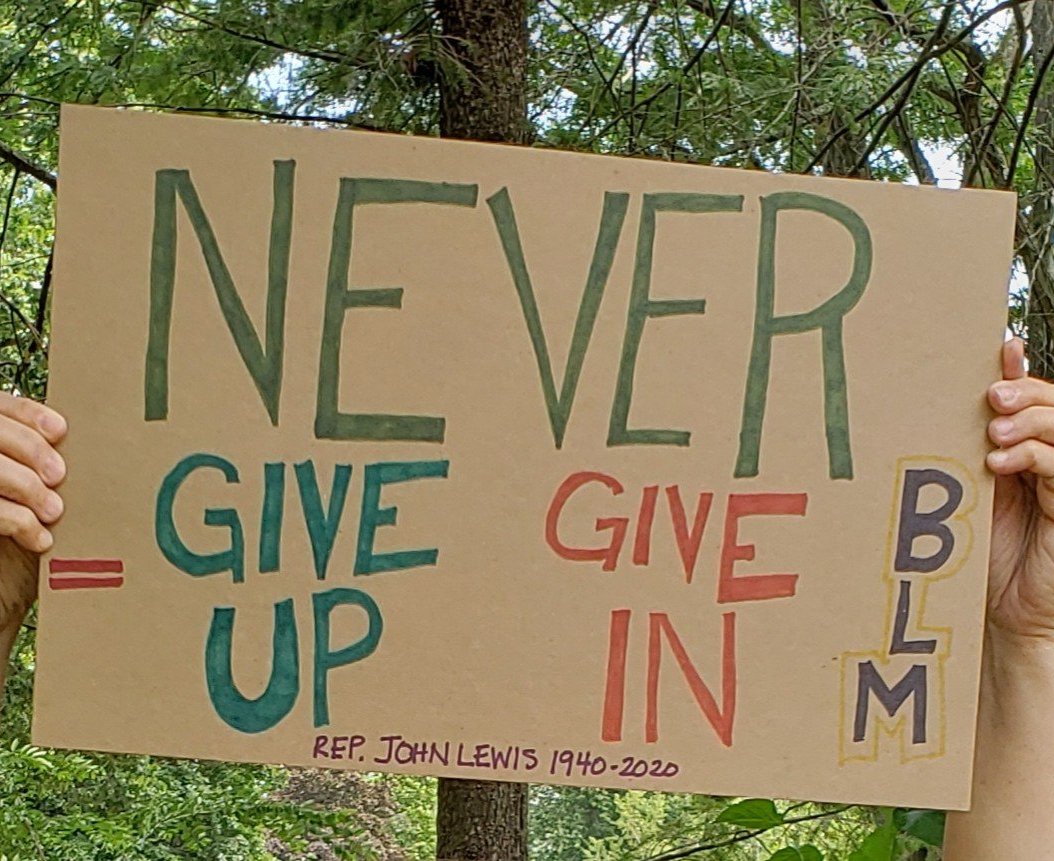
You must be bold, brave, and courageous and find a way… to get in the way.
– Congressman John Lewis, 1940-2020
A few years ago, I bought the book, The Children by David Halberstam, but I only read it recently. As an aside, David Halberstam was the commencement speaker when I graduated from college, so I always took a second look at his books.
I looked at this one often in my kindle library, but was never quite ready to sit down for such a serious book. In the last four years, I’ve been engulfed with politics, including racial justice, but I wasn’t ready for a history lesson.
I finally started it last summer, soon after George Floyd’s murder, and with all of Halberstam’s work, it did not disappoint.
I had misinterpreted the title to mean the literal children of the civil rights movement, the young people growing up in that time and after. What I discovered is that Halberstam’s implication that the civil rights movement was left to “the children” – the young adults who risked everything, including their lives to march, to sit at lunch counters, to register to vote, to do many of the things we take for granted, even today.
One of the very surprising things that stood out to me was the level of participation of John Lewis. John Lewis was a hero of mine, but more in an abstract way listening to his modern, inspirational speeches rather than his history, and I wondered why I hadn’t learned his name as readily as I learned about Martin Luther King, Jr. In school. I didn’t realize they were contemporaries, and met and worked together to build what they called the “beloved community.” As I thought about this missing piece in my childhood education, I realized that growing up in the seventies during busing, and my really formative years of middle and high school in the eighties, John Lewis wasn’t part of “history” as we think of it; for that matter, neither was MLK. Lewis’ beating on the Edmund Pettus Bridge was in 1965, one year before I was born, and King was assassinated in 1968 when I was a toddler. These events, and the bulk of the civil rights movement occurred a mere twenty years before I graduated high school; nineteen years to be more precise. In the time between Lewis and King’s assault and assassination, I hadn’t even reached adulthood. This book really brought that home to me. John Lewis would live in my kids’ history books, but for me, he was in my now.
I hadn’t even made it halfway through the book when John Lewis died, and I thought for several days of putting the book down and reading something else, but I didn’t. I finished the story, cringing and welling with tears, and sometimes gasping for air at the horror of it all and the idea that while we’ve come far, we have so much farther to go. When I finished The Children, I immediately read Jon Meacham‘s new book, His Truth is Marching On, and that bridged the short gap between Lewis’ civil rights activism and his congressional career all on that path to the beloved community.
One of the things that I found somewhat amazing, miraculous even, was the number of long-lasting activists all being in the same town at the same time. They didn’t travel to Nashville; they were already there from around the country attending school. John Lewis, Diane Nash, James Bevel, CT Vivian, James Lafayette, Kelly Miller Smith, Rev. James Lawson, who learned the non-violent method he taught them from his trip to India and learning from Gandhi, and of course as witness, David Halberstam, a local journalist with The Tenesseean in Nashville. Reverand Lawson described it as providential during his eulogy for John Lewis in 2020, and that just gave me chills.
If you do one thing, watch the Reverand James Lawson at the funeral of John Lewis in Atlanta, Georgia:
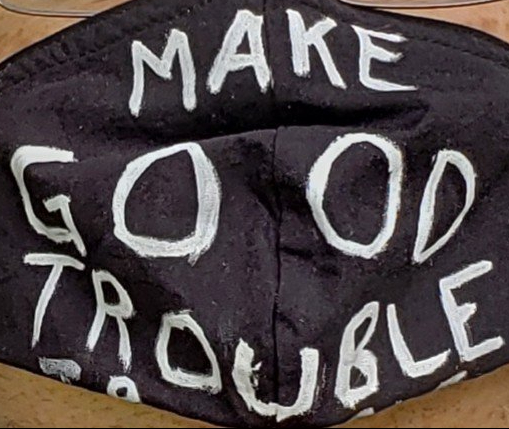
(c)2021Wearing a Mask is Good Trouble, Necessary Trouble. (c)2021
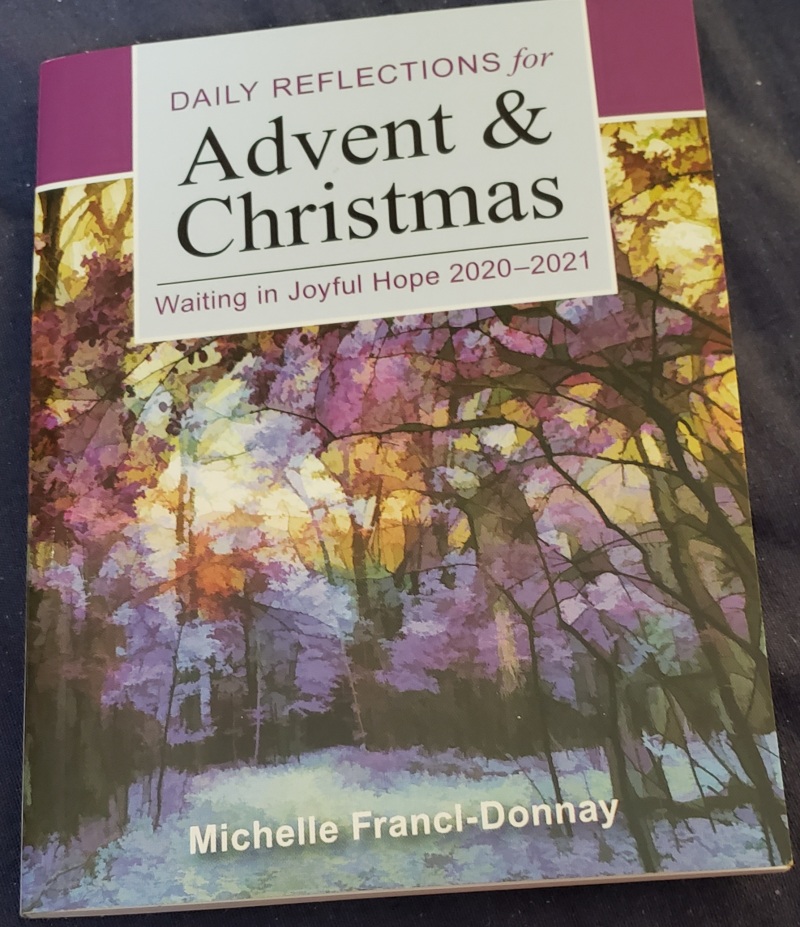
As we come to the last Sunday of Advent, I have finally decided to recommend an Advent book. The book itself begins with Advent but continues with daily readings throughout the Christmas season. What I have really come to share with you is the author, Michelle Frankl-Donnay.
I have been reading her reflections for a few years now, and she is by far my favorite person to read their reflections. They are a wonderful blend of spirituality and real life with the enormity of the universe for perspective. Professor Frankl-Donnay teaches chemistry at Bryn Mawr College and her science background gives an entire feeling with the mixing of the scientific and religious. Whenever I am reading her books durng the holiday seasons, I am wonderfully surprised at my reactions and how much I get emotionally from her reflections.
Patience and perseverance have a magical effect before which difficulties disappear and obstacles vanish.
John Quincy Adams
This pandemic has taken, but for those of us continuing to live through it, it has also given. More time with our families. More time to think of our priorities, our spirituality, our blessings, and our failings.
As President Adams said above, this pandemic has brought patience and perseverance to all of us in varying degrees of success. We all have both despite having different levels of both, and through it all, in whatever way we are and we can, we are moving through it and adapting.
Today Wednesday is was World Otter Day. Everyday should be World Otter Day!
Apparently, I had the wrong date in my planner and this makes me sad. My kids, my son especially have had an obsession with otters for several years now. There is a beaver near where we live, and for the longest time, my son called him an otter. When we explained that it was a beaver, he continued to call it an otter….or a skinny beaver. We see him throughout the spring, summer, and part of fall.
When my daughter and I went to Florida a couple of years ago for my aunt’s 95th birthday celebration we went to Flamingo Gardens where we saw real, live otters. We were so excited. They were enthralling.
Two years later, this past February, right before the pandemic, my son was able to go their with my husband and see the same otters. He was thrilled.
Statue of Mary, Journaling, Spring Blooms, Rosary, Mary by Tomie de Paola, Zen Garden. (c)2020
Mary our mother sustains us in moments of darkness, difficulty, and apparent defeat.
– Pope Francis
We’ve been slowly returning/adapting to a new normal. I don’t think we’ll go back to what we knew as normal for a long time, if at all.
I don’t think it’s helpful to be Pollyannas, but it is possible to find joy in our new circumstances.
Knowing that staying home and also wearing a mask when I go out for groceries and other supplies is my way of contributing to the mitigation and the time to search for a cure makes it a bit easier to accept my role in the effort. Each of us has a small part but all of us together can create a larger outcome.
Cooperation.
Unity.
Selflessness.
Compassion.
We all have our own struggles, but I would encourage you to find the silver lining in the cloud; the rainbow after the rain; the cliche in the trope.
Three Places Where I Find Joy
1. Cool breeze
2. Mary *more below
3. Kindle – FB with family/friends, books, podcasts, writing – encompasses much of my person in one place, not quite a talisman, but a path, a tunnel from one place to the next; from one world to the next.
May is also Mary’s month in the church. There’s Mother’s Day and Mary is all of our Mothers. Marian devotions. May Crowinings. Pope Francis provided two new prayers to add to our rosary prayers for the month of May.
I will have weekly Mary posts throughout May beginning below with links to the Vatican’s Rosary pages and the Pope’s letter and his two rosary prayers.
I have been praying them when I’ve prayed the rosary this week and it truly makes me feel as though I’m doing something tangible and positive during this pandemic. I may also begin a Mary meditation, but time will tell.








 Griffins and Ginger Snaps