I think when it comes to marginalized groups in this country, it is important to remember that even though we attempt to celebrate them and honor them, we can still do that on the other 364 days of the year, and not just on “their” day.
Native American Heritage Month officially ended on November 30th, and Native American Heritage Day was commemorated on November 29th.
In addition to the post last week with links to the American Indian Museum in Washington, DC, I’d like to share the following links and travel recommendations for you to consider over the next 361 days.
The Akwesasne Cultural Center is located on State Route 37 in Akwesasne, New York, near the Canadian Border. They are a museum, library, and cultural center focusing on the history and culture of the Mohawk people as well as protecting Mohawk culture and artifacts. The museum and gift shop are open T – F, 10-6, and Sat, 10-2. The library is open additionally on Monday, 9-5.
The Kanien’keha’:ka Onkwawen:na Raotitiohkwa Language and Cultural Center was established in 1978. Its mission is to preserve and enrich the language and culture of the Kanien’keha:ka (Mohawk) of Kahnawa:ke. They are located in the Mohawk Territory of Kahanwa:ke, south of Montreal, Canada.
You can also find the Welcome Center, the Kateri Interpretive Center, and the St. Francis-Xavier Mission Church (on this site since 1716) in the Mohawk Territory of Kahnawa:ke. I have toured all three of these sites and it is well worth the visit.
Bluesky Handle, Puff the Magic Hater has a thread of ways to support Native people, for everything from abortion care, defending voting rights, keeping Native families together, and more. Visit the thread here.
I’d like to close this post with the words of someone smarter than me. On Nov 29, 2024, historian Heather Cox Richardson wrote on Facebook:
There is still a long way to go in acknowledging what the governments of the United States and Canada have done to the Native American and First Nations peoples of North America. I’m being naive in thinking that Native American Heritage Month in November when Thanksgiving occurs is completely unrelated. However, it is what it is.
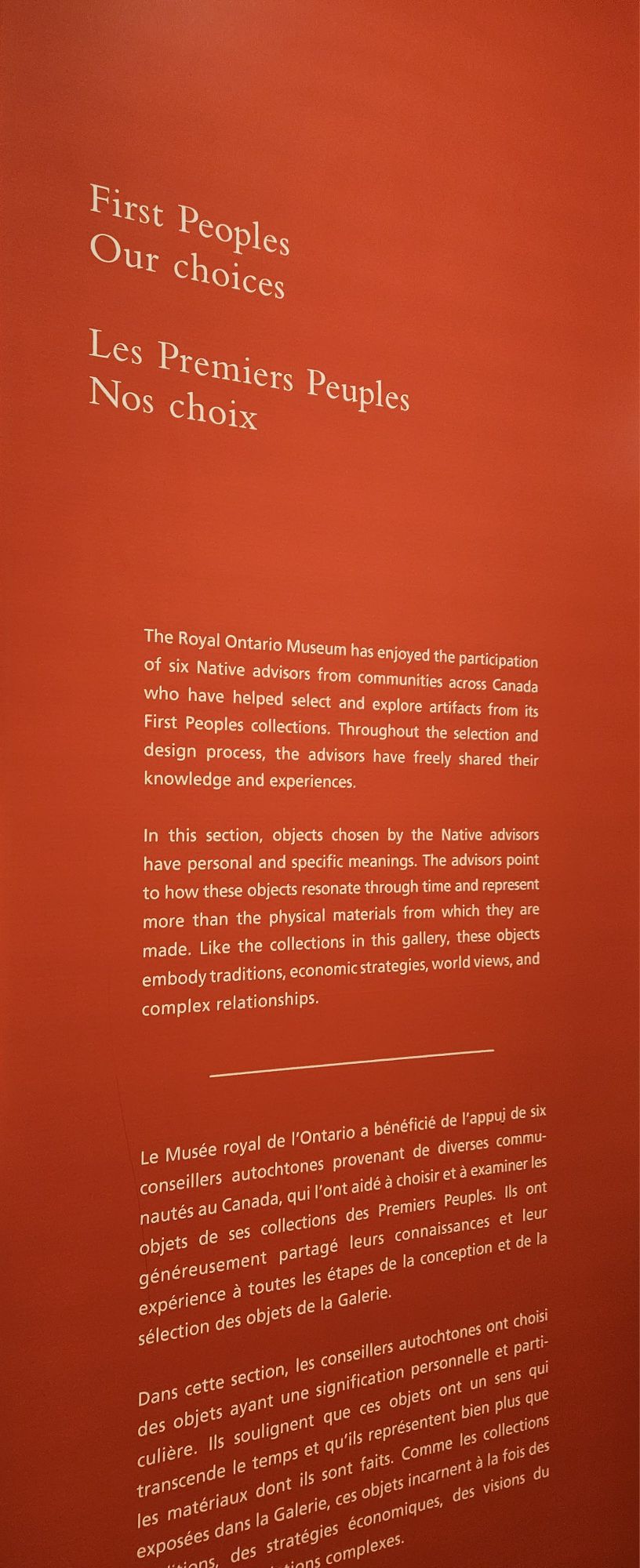
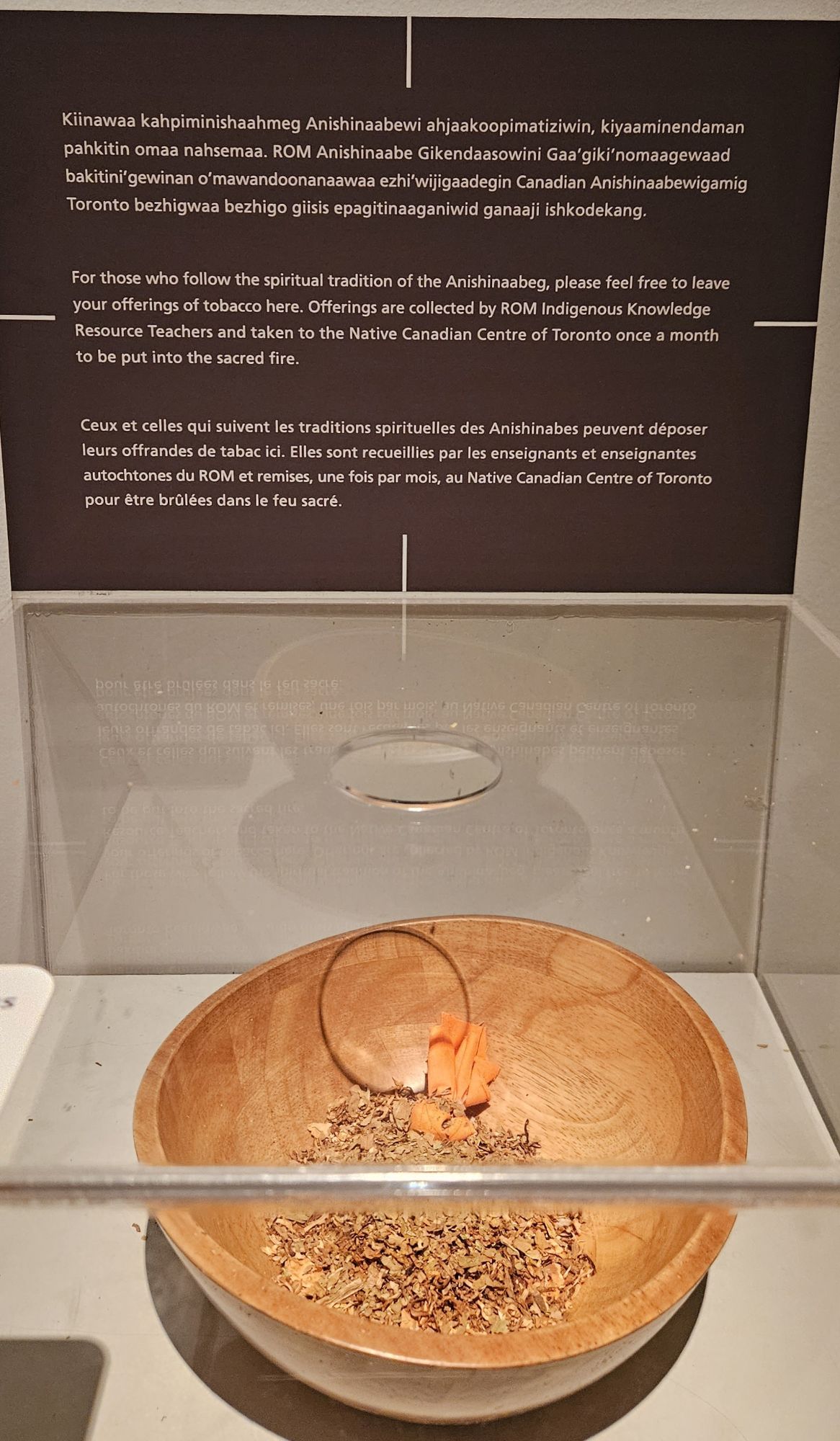
I thought I would share some of the things and signage that I noticed on our recent visits to Canada. The Royal Ontario Museum in Toronto has a large First Nations exhibit. I think it took nearly an hour to get through it and I could have probably stayed longer.
In addition to the following photos, when we visited the Canada Aviation and Space Museum in Ottawa, I noticed a sign at the entrance that said: Ingenium [Canada Aviation & Space Museum] offers free admission to all active Canadian military personnel, Canadian military veterans, Indigenous peoples, including First Nations, Inuit and Métis, and a support leader accompanying a person with disabilities. When available, presentation of an Identification Card is requested.
I noticed this in several museums including the ROM.
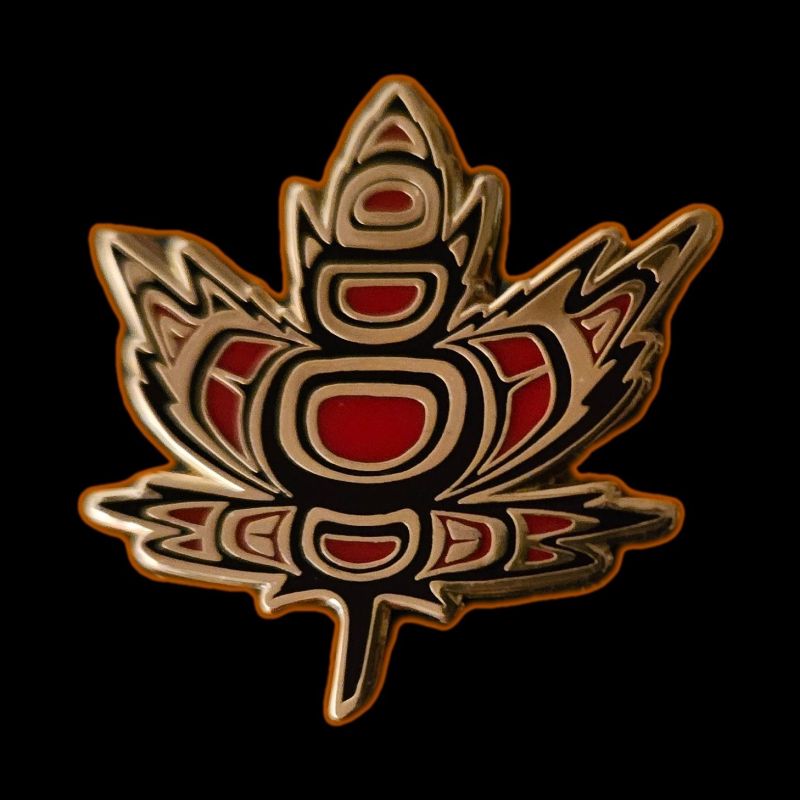
There was also a discount for the gift shop as well as Indigenous pins and souvenirs.
In the United States, it is on my bucket list to visit the American Indian Museum at the Smithsonian in Washington, D.C.. There is also a location in New York City. Check out the website for hours of operation. Admission to both locations are free.
With my ongoing research into St. Kateri’s life, I thought instead of a retelling of the first Thanksgiving today, I would set my table with the First People in mind, sharing with my family the Three Sisters as the Mohawk call these three plants that grow side by side: corn, beans, and squash.
My table setting. (c)2023
Sign about the Three Sisters at the St. Kateri Shrine in Fonda, NY. (c)2023
The Three Sisters. St. Kateri Shrine, Fonda, NY. (c)2023
The cake plate I used was a wedding gift from a friend who worked at the Jewish Museum in NYC. I like to blend our cultures in our interfaith family, and this was one way to join two ancient peoples and their symbols. (c)2023
The photo below represents both the start and the end of the day.
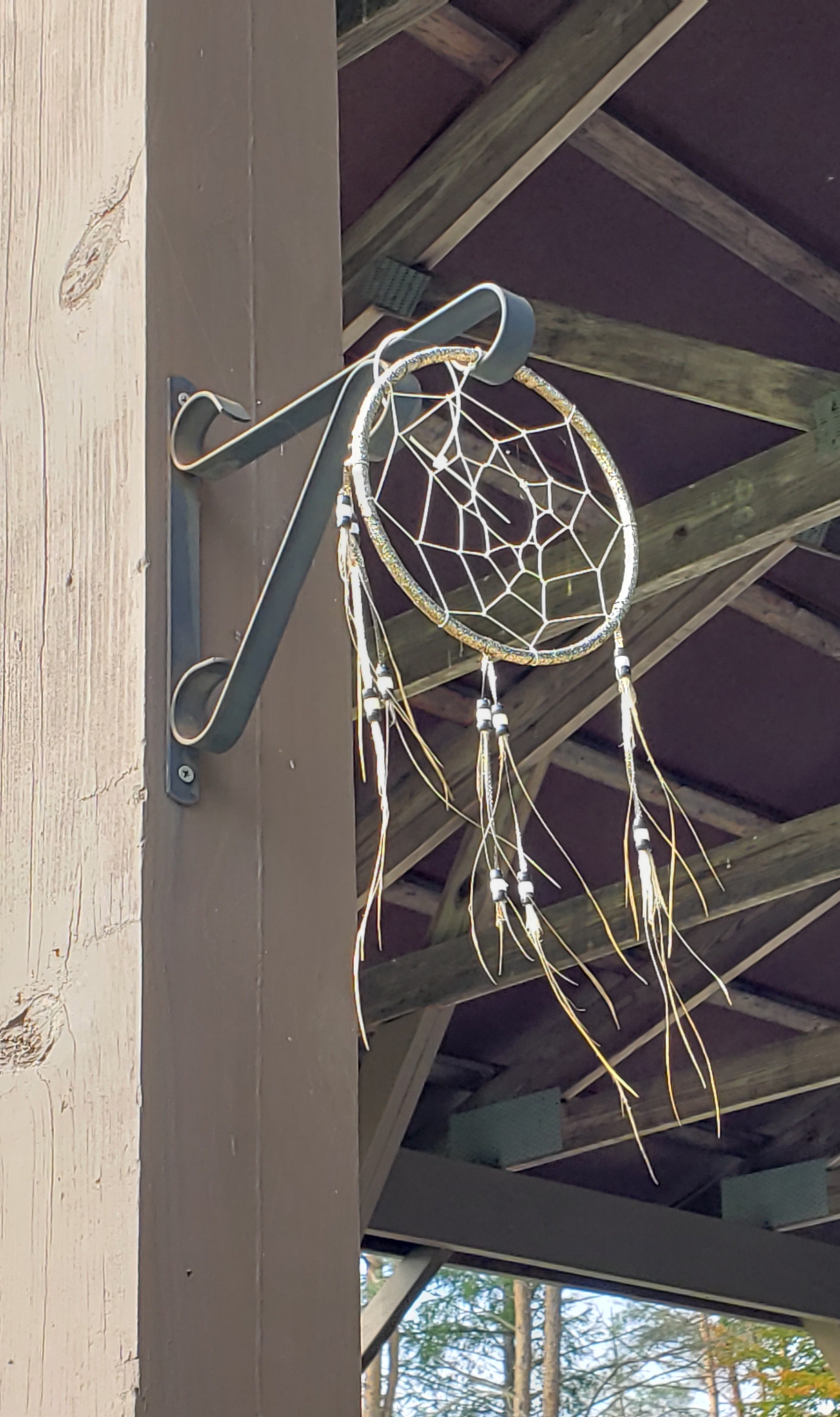
Beginning with the end, I have slept with a Dream Catcher for most of my life. I notice a change in my sleep when I don’t sleep with one. It creates a calm and peaceful rest as it catches the bad and lets the good continue through. This particular dream catcher is one I got in Niagara Falls, Canada. I was drawn to the colors of the beads that represent the four directions as well as the uniqueness of the center stone.
The booklet is something that I was more recently introduced to through Mohawk Elder Tom Porter of the Kanatsiohareke Community in New York. Since then, I’ve seen it in other Haudenosaunee writings and readings. It is called the Thanksgiving Address, but it has nothing to do with the Thanksgiving holiday, but in giving thanks for all that is around us in the natural world, all that we have, all that we see. It is said at the beginning of all important gatherings, ceremonial and/or governmental. The Haudenosaunee call them the Words Before All Else.
I recently used a form of this address for a meditation that I was tasked to share, and it was very well received. I read mine, but most are recited and because of that they are often never the same twice since the words change with the speaker and the timing of the gathering.
As I said at my own (non-Native) gathering, as a shared meditation, I acknowledged the land we were standing on (Mohawk), and reaffirmed that I am a non-Mohawk, non-Native, sharing their wise words.
When we visited the Royal Ontario Museum this past August, I knew that I could not visit every nook and cranny as much as I might have liked to. I also knew that with five of us having different interests that we were going to get very frustrated very quickly if we stuck together. Upon entering and deciding who wanted to pay extra for the special dinosaur exhibit, I announced the three places that I wanted to focus on and whoever came with would be welcome, but if they wanted to explore on their own and meet back through texts, that would be great.
As an aside, I do miss my little ones, but I really appreciate going on vacation with teenagers and older kids because of this freedom for all of us. I didn’t want to see the dinosaurs; more to the point, I didn’t want to PAY to see them, so I didn’t. My daughter was not a fan of medieval arms and armor and so she veered away from that. The technology of texting let us know where the others were when we were engrossed in our little worlds. It was fantastic! And I think we all benefited from the freedom to explore our interests and the freedom from each other for an hour or so.
My three focuses were in the areas of First Nations, Medieval History and Arms & Armor, and Judaica.
A few days ago, the honoring of Native American Heritage Month began. Like Indigenous Peoples Day, I think this is timed for us to remember that there were both sides to Columbus’ landing in the New World and how we perceive the Thanksgiving story. The Thanksgiving story in and of itself isn’t as problematic to my mind as other European centered celebrations. We know and should acknowledge that the English settlers could not have survived their first (and to be honest, many subsequent) year in a new land without the help of the Native Peoples they met and who helped them immensely. I have always been a history buff and drawn especially to people of my own heritage and Jewish ancestry as well as people I feel somewhat paralleled that history including African- and Native- Americans. One of my favorite books as a child is The Magic Tunnel by Caroline Emerson. It had everything a young me could want in a book: time travel, the NYC subway system, NY history, American Indians. The perspective is of about a fourth-grade child’s view of history, but it’s a fun adventure for the elementary school age and a great jumping off point to discovering what’s true in their depictions and what is not.
As I’ve grown and became more of an in-depth reader, I’ve been exposed to more and more books about Native history both by Native and non-Native scholars. Living in New York state my whole life, we have a rich history of the Iroquois, and every place I’ve lived has had several towns still using names found from and in the variety of Native American languages found in the state. Some examples include: Shinnecock, Massapequa, Copiague, Hauppauge, Schenectady, Oneonta, Oneida, the Mohawk Valley, Chautauqua, Ontario, Otsego, Tioga, Cheektowaga, Ticonderoga, and of course, Niagara and Manhattan.
Over the next few weeks and through the end of November, I hope to offer you some resources to expand your knowledge of Native American history and culture as well as books, movies, and photos that you can enjoy in your explorations.
About a week ago, I was asked to give a meditation for what’s called an Ultreya, a gathering of Catholic Cursillistas for community and fellowship. I elected to read a Haudenosaunee Thanksgiving Address. It is called Ohen:ton Karihwatehkwen, which are the Words Before All Else. This is recited before any gathering or ceremony. At the beginning, prior to starting the reading, I explained to them that this is often different each time it’s told as it depends on the speaker to choose their own words. I explained that I, however, would be reading it. Two important things I stated before I began were who the Haudenosaunee were; we knew them as the Iroquois, which is the French word assigned to them by Canadian and French missionaries, and that we were currently on their traditional lands, the lands of the Mohawk. I also stated that I am not Mohawk, nor am I of First Nations descent. I have included a statement on my FAQ page.
I think it’s important to acknowledge whose land we’re on, and if we’re speaking authoritatively or in entertainment or spiritually, that we acknowledge when we are not Native and/or Indigenous People. I will also use Native American, American Indian, Native Peoples, Indigenous Peoples, and First Nations interchangeably unless asked specifically not to.
As we celebrate what we view as the first thanksgiving, it’s important to remember that the English settlers didn’t “give this tradition” to the Native Wampanoag people they met. The Native people across the continent had harvest festivals and days of giving thanks for their harvests towards the end of the fall and the coming of winter. This is what they shared with the settlers.
For my own Thanksgiving, I am thankful for my family and spending time with them, but I also think back to the historical first thanksgiving and look back on what could have been and look towards that future.
In this opening for me of Native American Heritage Month, I give you a few places to visit and learn from:
Killers of the Flower Moon – the movie is in theatres now, and it was wonderful. Don’t be scared off by its length; I barely noticed and easily sat through the whole thing. I also read the book about a year ago. I highly recommend both: Book
Many people question why we need to focus on the diversity of our nation and celebrate heritage days and months; why can’t we simply celebrate our sameness as Americans.Also questioned is why we look back on the way we treated the indigenous peoples who were already here at our country’s very beginnings.
People want to forget the bad parts of our history.
The racist parts. The genocide. The meanness and the bigotry.
We can’t let those memories fade. They are a part of our history, and as we saw earlier in the year in British Columbia, Canada, it is part of the collective history of this continent.
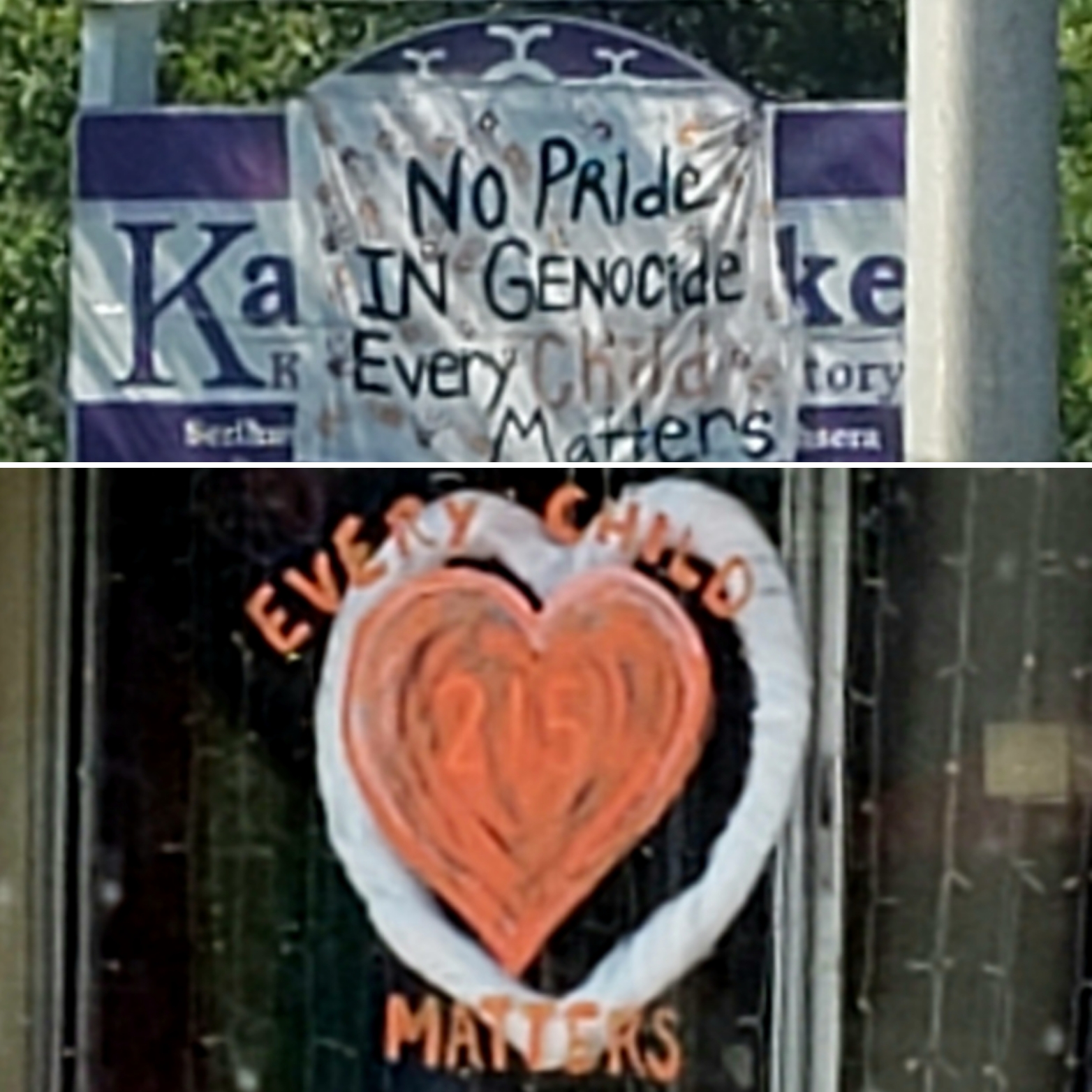
While we were on vacation in August, we couldn’t help but notice the signs, the memorials for the two hundred fifteen First Nations children found in unmarked graves in Kamloops, British Columbia.
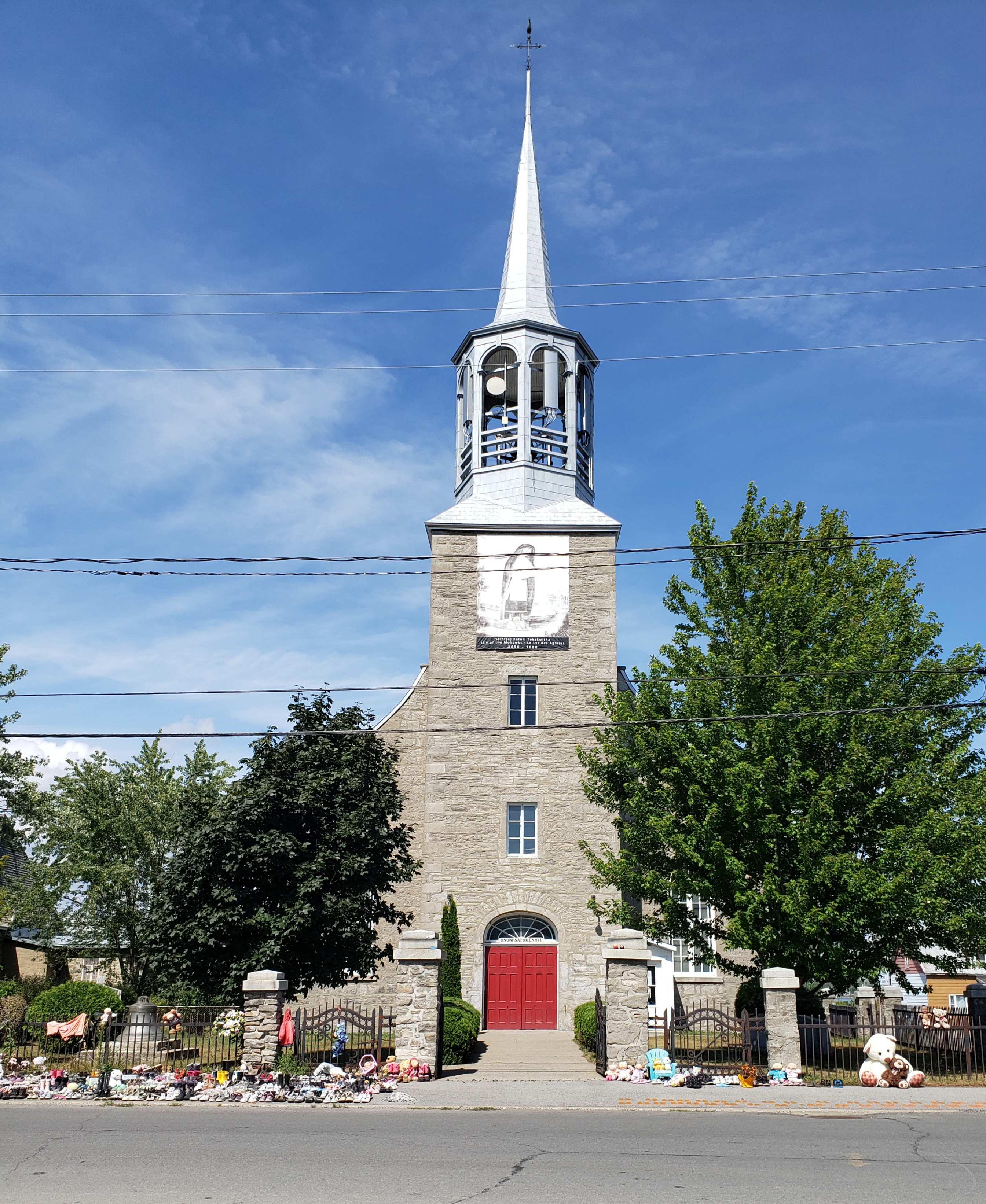
The articles read and linked below, as well as others were difficult enough to accept and they are still being processed emotionally by Native and non-Native peoples alike. However, happening upon one such memorial in Kanawake, the Mohawk tribal lands in southern Quebec tugged at emotions I was unaware of. The sight of the small shoes, representing the dead and unremembered 215 children, some as young as 3 was a lot to take in. It left me with a profound sadness, but also an emptiness that even the sadness couldn’t fill.
I leave you with links to read and photos to meditate on.
The emtpy shoes representing the 215 Indigenous children found in Kamloops. My presumption is that the ashes are from a First Nations religious ceremony in memory of the children. (c)2021
The above shoes can be seen at the St. Francis Xavier Mission in Kanawake, Quebec. This is also the site of the St. Kateri Tekakwitha Shrine where her body was brought. She is the first Native American Catholic saint. (c)2021
Signs we saw at various places across Quebec and Ontario, Canada. (c)2021
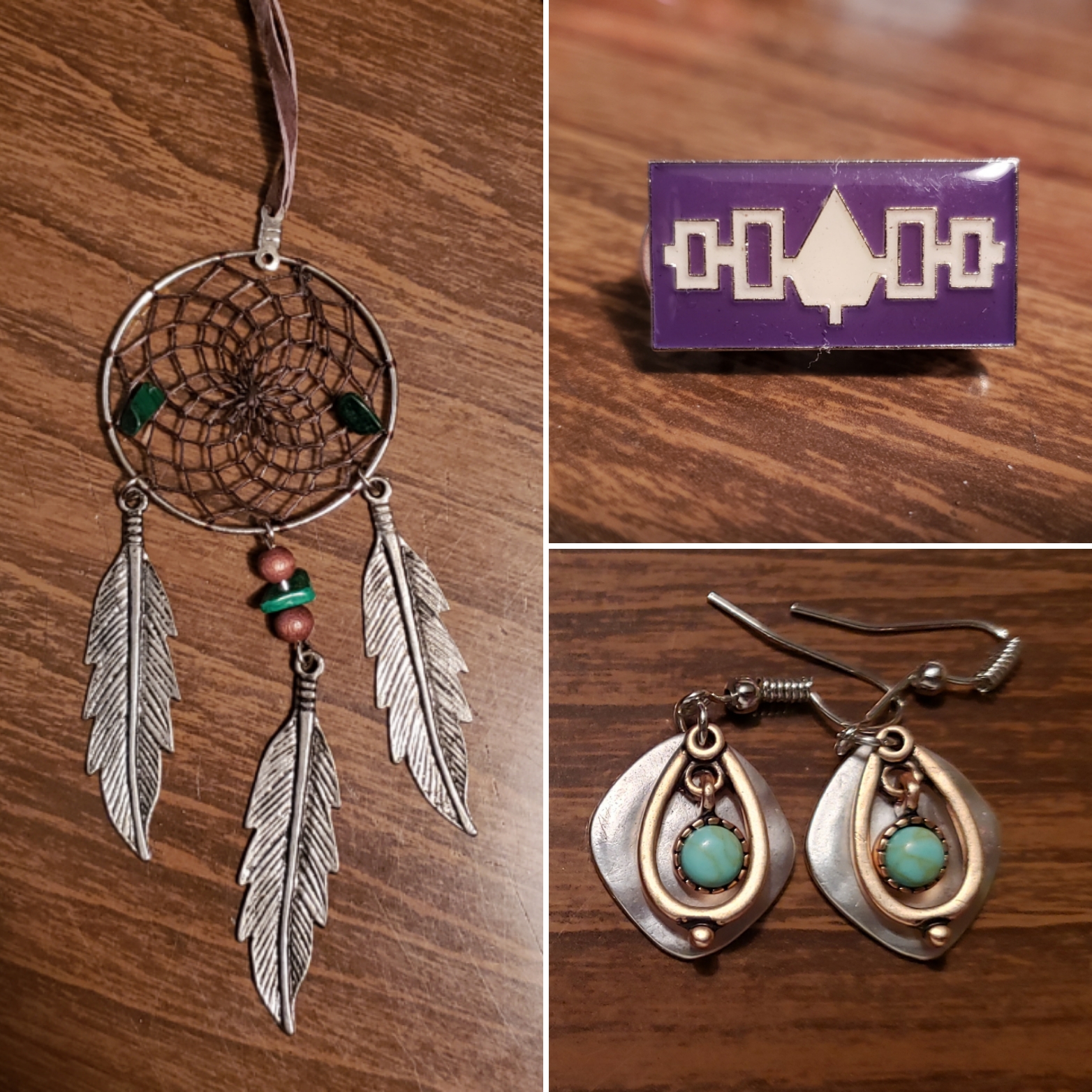
When we travel to places with Native American distinction and I plan to buy something to remember my visit, I look to see if the object is Native made. There are so many knock-offs and items appropriated out there that I feel that if I’m going to buy Native crafts, symbols, and jewelry, it should be genuinely made by Native peoples and the income should benefit them.
The picture below highlights my three most recent crafts:
(c)2021
The photo on the left is a dream catcher. I have had one in my bedroom for decades. I had received a small one but it has been mislaid. I chose this one while we were in Montreal. I didn’t realize it at first but it is a necklace. I have hung it over the lamp on my bedstand to keep away bad spirits and dreams.
The top right is a simple lapel pin that I purchased at the St. Kateri Shrine in Fonda, New York. It is the flag of the Iroquois Confederation. These flags can be seen flying in many places across New York State and lower Canada.
The bottom right picture is a pair of earrings I discovered in Niagara Falls, Ontario. I was drawn several times to the three colors – the silver, the bronze, and the turquoise. While this design could easily be Native American jewelry or ancient Egyptian, and I was so happy to find that they were indeed Native made. As my birthstone is turquoise, I am often drawn to the stone and color.
The Thanksgiving holiday is full of disharmony as we come to grips with our historic (and recent) treatment of the Native American peoples who were here before we arrived from Europe.
A few personal thoughts:
Growing up Jewish, this was always my favorite holiday. We didn’t need to explain our religious holidays and we weren’t excluded from the mainstream Christian holidays. This was an American holiday, one that everyone could participate in, both as a harvest holiday and as a day of gratitude. It brought our family together as well as allowing us to be a part of the greater family of our community.
This year comemorates the 400th anniversary of that traditional first Thanksgiving hosted by the Pilgrims who survived that first harsh winter. The basics of that first holiday, a gathering in gratitude brought two different communities together to share what each had. The helped each other and maintained a friendship against great odds. In modern days, we have much to be thankful for. I won’t list mine, but take a moment to reflect on your own blessings.
At mass this morning, we continued a tradition at my parish that I have always loved. Instead of a collection, we bring a bag of non-perishable food to the altar (for our food pantry and Christmas baskets), and at the end of mass, each family is given a small loaf of bread that has been blessed to share at our dinner table. We are called to pray and to break bread.
Give us this day, our daily bread…
(I apologize for the blurry picture) (c)2021
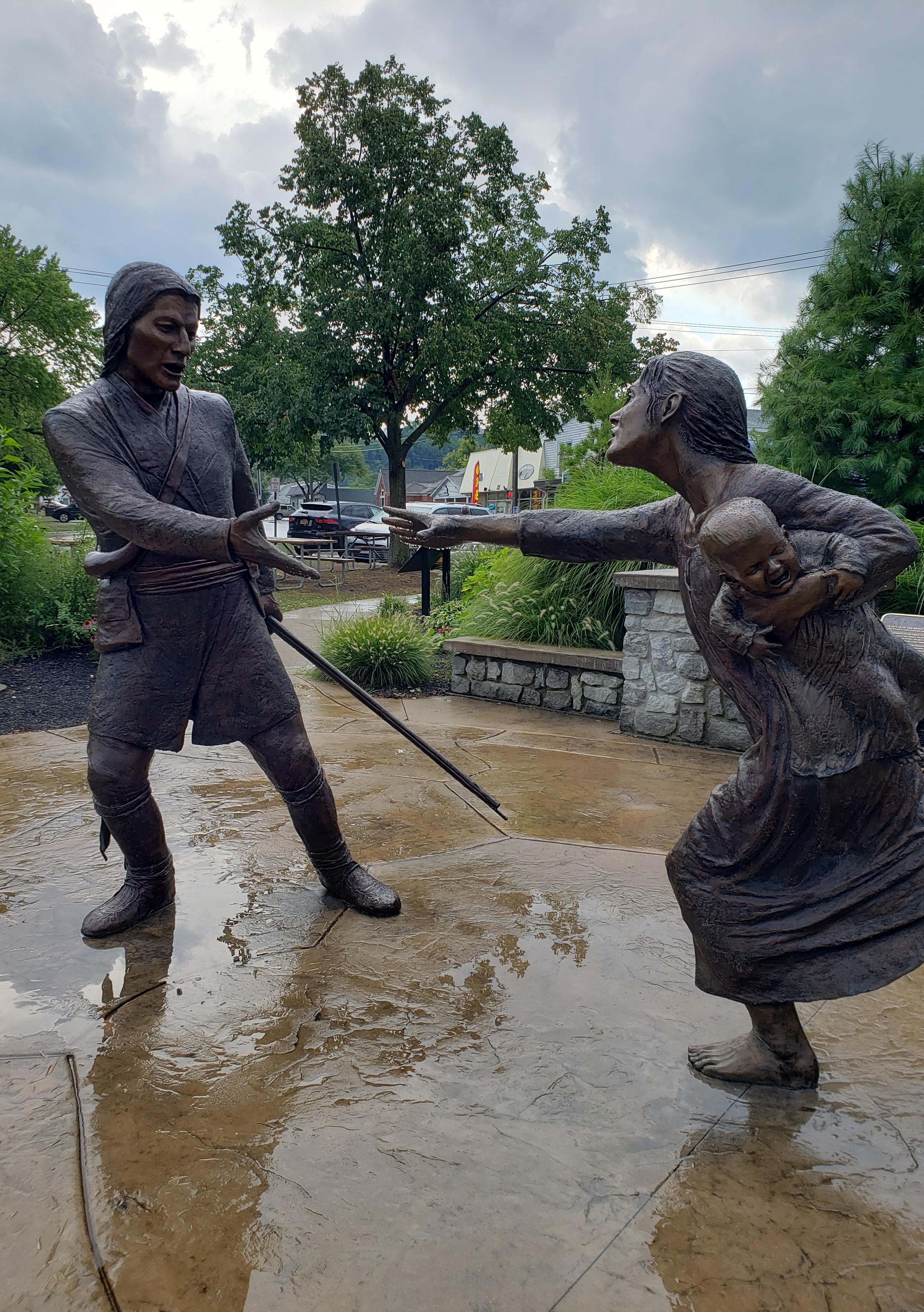
Last year while visiting Niagara Falls, New York, we learned of a nearby monument in Lewiston that commemorates the Tuscarora Indians coming to the rescue of American citizens during the War of 1812. The British invaded from Canada to the north and were mobilizing an attack on the village with their Indian allies. The Tuscarora, being outnumbered gave the appearance of greater numbers and were able to give the Lewiston families time to escape the inevitable horrors of death and watching their loved ones brutally murdered.
This monument is breathtaking in its emotion. The sculpted faces of both the mother and child fleeing and the Tuscarora helping them is so vivid, it tells the story in deeper and more profound ways than reading about it could ever do. I stood in awe of it for several minutes, even though it was pouring rain for much of the time.
Tuscarora Monument, Lewiston, NY. (c)2021
A closer look, Tuscarora Monument, Lewiston, NY. (c)2021
Enjoy the day with family and friends or alone, in peaceful quiet or boisterous noise, with turkey, stuffing, and cranberry sauce or whatever your family traditions call for.
I want to acknowledge that my family and I live on the traditional territory of the Haudenosaunee. I grew up knowing them as the Iroquois, which is the French name. Haudenosaunee means People of the Longhouse and they have a rich history in New York State. The map below shows the other tribes traditional to New York. The Haudenosaunee Confederacy is the oldest, participatory Democracy and our US Constitution is said to be modeled on theirs.
Credit: Aaron Carapella (c)2021
Some links to check out about Native American Heritage Month:
I’ve mentioned my affinity for our local saint, Saint Kateri Tekawitha (pronounced “gaderi dega-gwita”). She is the first Native American saint to be canonized. Her official elevation was in 2012 and her most recent miracle was in 2006. St. Kateri was Algonquin on her mother’s side and Mohawk on her father’s.
Since I was going to visit her shrine in Quebec, I wanted to have her chaplet to pray with while I was there. I wasn’t able to acquire it until after so I drew one and used that for my prayer. Here is a photo of both of them:










 Griffins and Ginger Snaps