
Be peace.
(c)2023
Continue reading


Indigenous Peoples’ Day was Monday, nearly a week ago, but that doesn’t mean that now we can forget about an entire culture, language, history, or a people. I usually will say that especially in the Northeast, where the Iroquois, more properly known as the Haudenosaunee lived, we should remember them. There are several things wrong with that sentiment though, and I am embarrassed to admit them. For one thing, the Haudenosaunee live, now, among us. They cover the six nations: Mohawk, Onondaga, Oneida, Cayuga, Seneca, and Tuscarora, across all of New York State and the international border with Canada. For another thing, Native tribes have lived on this continent from ocean to ocean, from the time when there were no borders at all. Just like our states, their nations had rivalries with others, they had distinctive cultures separate from one another. It’s important to remember that Native culture, whatever nations are represented, they are a living, breathing group of people, and it is well past time to recognize their contribution and their sacrifices. I’ve had several people (non-Native, I should note) that it was in the past, it’s history, there is nothing I can do, and that attitude disturbs me on many levels. I don’t know if it’s a connection I feel to the people whose land I live and work on. I don’t know if it’s from my childhood admiration and longing to be more involved in the limited Native culture around me as a child. I don’t know if it’s because of my Jewish background where people will say the same sentiment: it’s history, why are you still upset about…? I will call out some by saying that the same people who say that the Trail of Tears and stolen land in the 1880s and 1890s is “ancient history” and we “need to move on” are the same people who insist on the rest of the country worshipping a man who died over two thousand years ago. The continued hypocrisy is staggering in so many ways.
I have a few thoughts and photos that didn’t make it onto the website on Monday, and I hope to share them with you today and in the early part of next week.
I have been fortunate to have visited the village of Kahnawake in Quebec, Canada three times. Kahnawake piqued my interest through my studies and research of St. Kateri Tekakwitha who was born, lived, and was baptized very near to where I sit right now. Each visit was unique in that I saw new things and learned new things each time. The first time during covid was very limited to the outside world and was a superficial encounter. The second time had a decidedly Mohawk perspective, and the third time was more of a Catholic and Mohawk-Catholic perspective. Each visit gave me a new outlook, answering questions and thoughts, and offering insights that raised more questions and contemplations. I expect and look forward to returning next year to do some more research as well as visiting their language and cultural center that we were unable to see previously.
These photos are a little taste of the village. I will also share the one thing that really surprised me. The Mohawk in Kahnawake primarily speak English and Mohawk. Their street signs and stop signs are in those two languages. I thought the second language would be French. As I said, there is always something new to learn.
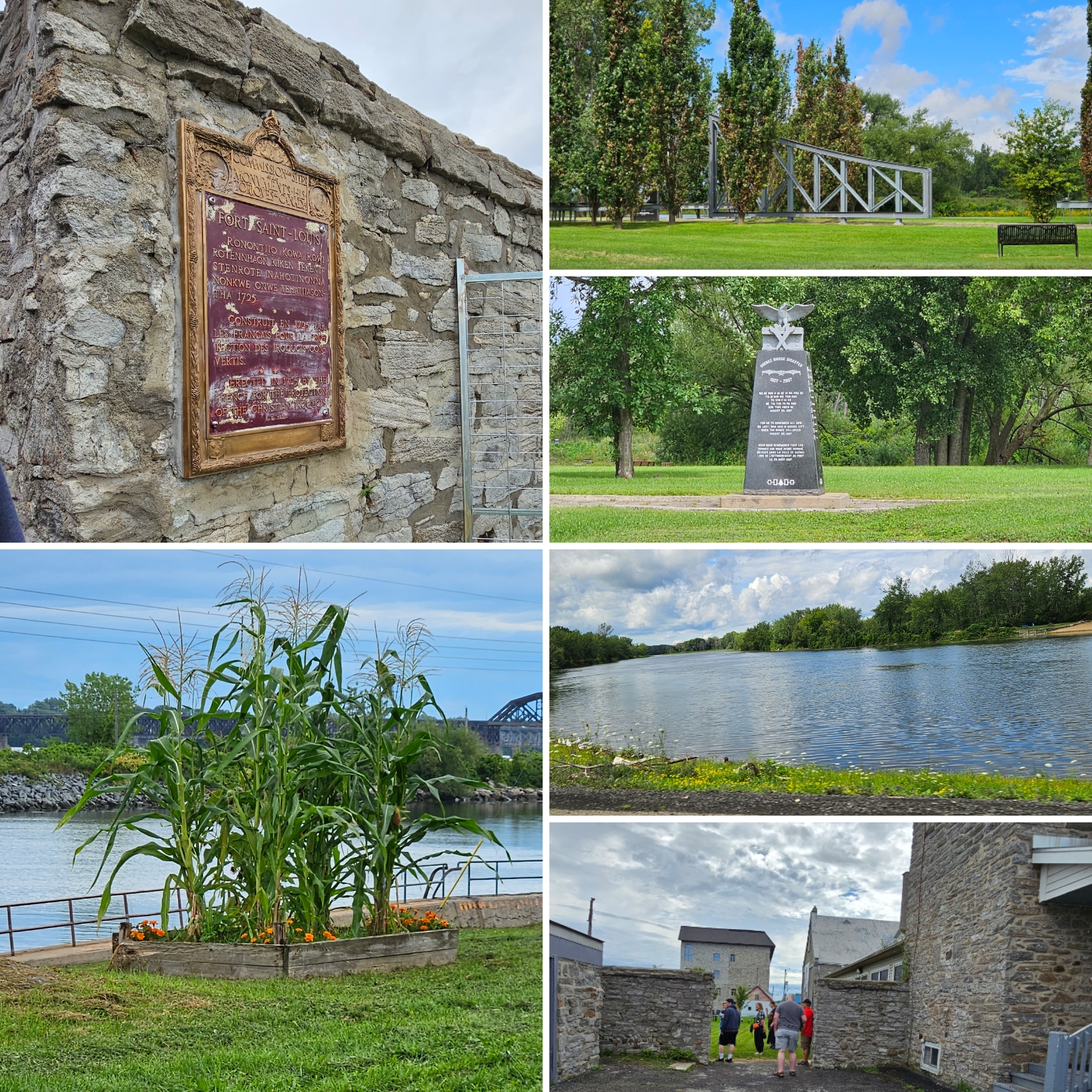
I just wanted to add one or two notes about the above photos:
The St. Francis Xavier Mission Church moved with the Mohawk. It moved four times,
I believe, before it settled permanently here and was built as a permanent structure in 1716. St. Kateri’s relics were moved here in 1973.
The Quebec Bridge Disaster killed 32 Mohawk ironworkers from Kahnawake. This left 25 widows and over fifty children fatherless. The compensation from the Canadian government was negligible. The Clan Mothers decided from then that so many members from one family could not work on such a dangerous job.
The Canadian government changed how the St. Lawrence River flowed, so it moved it away from Kahnawake and left the still St. Lawrence Seaway. The River was more profitable and was able to accommodate boats and fishermen as the Seaway was not. This is still an issue today.
The Three Sisters are known to the Haudenosaunee as the most important crops, sacred, and include corn, beans, and squash. They grow together in the same area and help each other thrive.

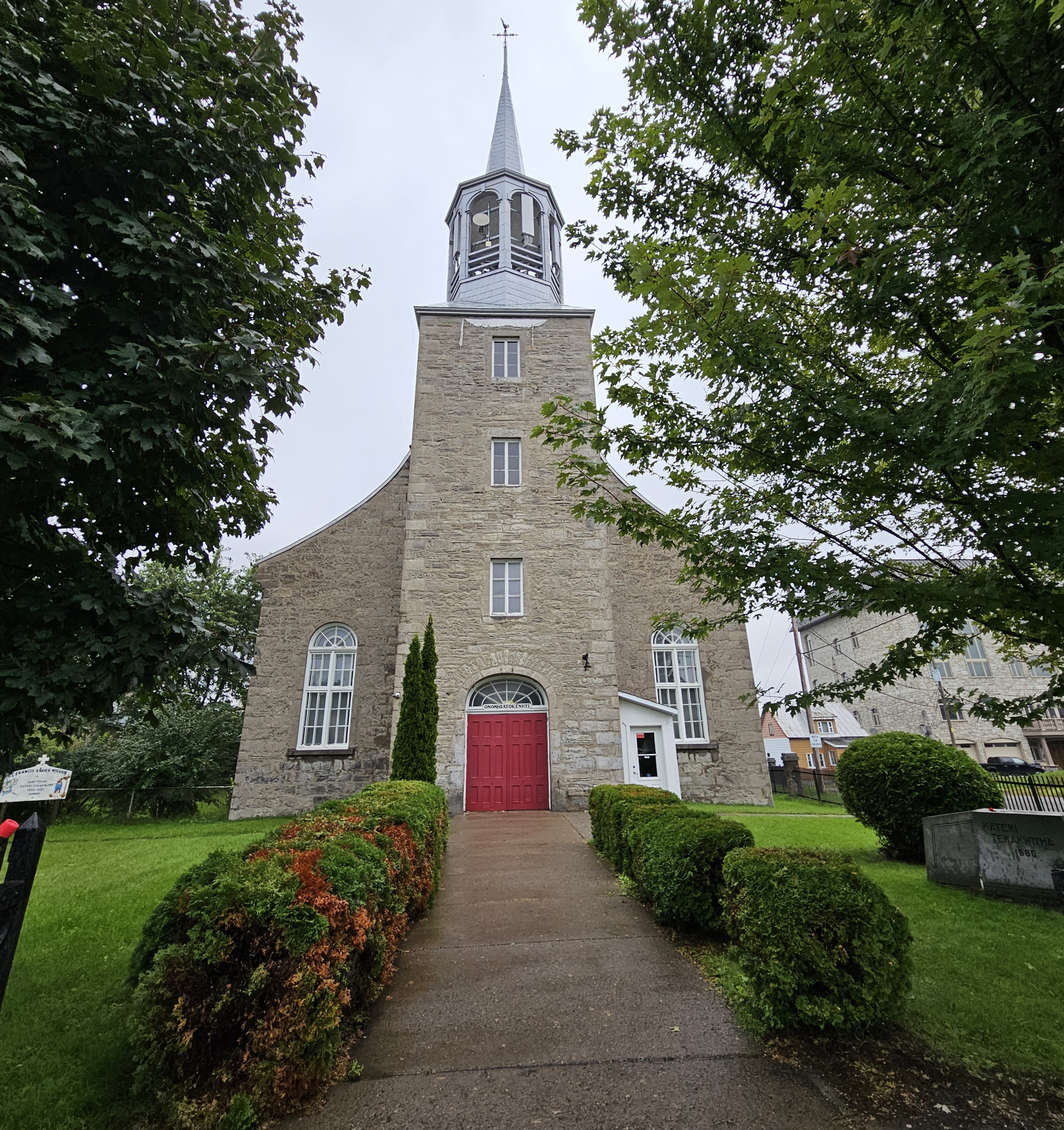
On the Coloring Sheets page, there is a new sheet for Indigenous Peoples’ Day which is today. Below I will explain what each square represents. I’m glad that we are beginning to acknowledge the people who were here long before the Europeans arrived and drastically changed things through their way of life, their diseases, their concepts of ownership, and of course, their biases, which for many remain today.
I am determined to remind myself and others that the land I live and work on once belonged to the world, and the Haudenosaunee (in my specific area) were the caretakers. They were willing to help the new settlers, and did. And I’m sure regretted it. The Europeans weren’t exactly grateful in the long run.
Wherever you live look at the names of the towns. Across this country (the US) and Canada you will find many towns and streets are named with Native American names. I like to look into some of those names and see what they mean in the various languages.
Continue readingI don’t even know where to begin with this bullshit.
The weakest Speaker of the House in US history has been ousted and the Speaker’s position is vacant for the first time in the House of Representative’s 243 years of existence.
Good riddance.
Kevin McCarthy is nothing more than a sycophantic, lying, piece of garbage scraped off the bottom of my shoe. Partisan hack and chaos agent doesn’t begin to cover the contempt I have for this phony.
I haven’t even gotten into his smarmy, self-satisfied, failing up brand, and contemptuous face.
But you may say, tell me how you really feel.
And judging by his recent tantrum, Interim Speaker, Patrick McHenry isn’t much better.
Let me actually begin by answering the media’s pressing question: Why are Democrats to blame for this debacle?
Well…they’re not.
At all.
The Democrats have a speaker. The Minority Leader. His name is Hakeem Jeffries. They voted for him at the same time Republicans voted for Kevin McCarthy. For the Democrats, nothing has changed. They support their speaker 100%.
It is not their job to bail out his weak ass.
It is not their job to create a safe space for the Republicans to continue their attack on the American people by their reverse Robin Hood of taking from the least of us and giving to the wealthiest. This isn’t politics as usual.
Except that for the Republicans, it is.
I am currently reading Wounded Knee: Party Politics and the Road to an American Massacre by historian, Heather Cox Richardson. It is more than the journey taken by the United States government that led directly to the Wounded Knee massacre, but it is the politics of the day that led to.
The greed.
The corruption.
Basically, the Republican way of life.
I don’t say this lightly.
Prior to this book, I finished reading Hear That Lonesome Whistle Blow: The Epic Story of the Transcontinental Railroads by Dee Brown about the building of the transcontinental railroad from the Atlantic to the Pacific, and it is full of the double-dealing, cheating, corrupt railroad tycoons who did everything in their power to steal the land from the Native Americans while committing genocide along the way. (As an aside, Dee Brown also wrote the seminal work, Bury My Heart at Wounded Knee: An Indian History of the American West – I highly recommend it.)
The railroad tycoons did not manage to do this alone. They had help, a lot of help from the US government and the military, all Republican run.
But I diverge from the focus of this writing which for our purposes only touches on the railroads and the Native Americans tangentially to the Republicans’ lying and cheating to win any election.
As I read Cox Richardson’s detailed descriptions of how things went down in the 1890s and beyond, the Republican representatives did everything in their power during the Harrison Administration to retain control of the Congress and the Presidency. They bought off election workers. They kept the Black vote suppressed. They refused to consider Native American citizenship because for some reason, having been born here wasn’t enough to be a voting citizen. Not to mention they weren’t land-owning, a prerequisite for the ability to vote.
They CREATED four new states, and only Montana surprised them by electing a Democratic governor, but other than that, they, as well as Wyoming, North and South Dakota were Republican in every other way. These four NEW REPUBLICAN states received at least four Congressmen and EIGHT senators. This heavily weighted the Electoral College to almost guarantee a Republican victory in 1892.
Which was exactly the point.
Our biggest mistake as a country is letting land vote.
And this was the least duplicitous thing they did to gain votes and money for their personal coffers.
They continually suggested that the land on the Great Plains was great for farming. It wasn’t. And it still isn’t without irrigation which hadn’t been discovered yet as a viable alternative to natural rain. They falsified weather reports, giving the opposite information than the Farmer’s Almanac predicted.
Reading this history, I was becoming incensed. I needed to stop often after I read a paragraph and then highlighted some other Republican misdeed. I was having flash-forwards to modern times and seeing this exact scenario playing out today.
Just look at the last few days of the Speaker vote. One Republican motioned for the speaker to vacate. Eight Republicans voted against Kevin McCarthy. REPUBLICANS. When the interim speaker took over, a small man who thinks smaller, slammed his temporary gavel so hard, he missed the block he’s supposed to hit. His first act as Interim Speaker wasn’t to speak to Democrats, to try to unite the parties or even to unite his own split, petty party, he used that first act to evict Speaker Emerita Pelosi and former Majority Leader Steny Hoyer out of their Capitol offices. Speaker Pelosi wasn’t even in Washington, D.C. She was attending her friend Dianne Feinstein’s funeral in California. Fortunately, her staff had help from Leader Jeffries’ staff to move her office. That’s all you need to know about the parties.
You may not agree with Democratic party policies, but most of the country does. And regardless of even that, when the Democrats are in power, they spend their time trying to make things better for ALL Americans. They’re not out there sabotaging each other and the rest of the country. They’re not holding the debt ceiling and the paychecks of the military hostage. They are working for the people. Always.
What have the Republicans gotten done for the American people?
Nothing.
They’re too busy whining, creating havoc, name-calling, lying, suppressing the vote and everything possible to stay in power.
But when they’re in power, what do they do?
Nothing.
Look back on the last few Republican Administrations. They screw us up so badly and put us deeper into debt, we elect a Democrat who fixes the mess, and then we get collective amnesia.
Remember this on Election Day.
Remember this on every Election Day.
Remember.

In our travels, I’ve been touched by how other countries have commemorated 9/11. We saw a tree that had been planted on the grounds of Belfast’s City Hall with an adjacent plaque that touched me deeply.
In our recent tour of the Mohawk village of Kahnawake in southern Quebec, we learned quite a bit about the Mohawk people of the area and their history, including their history of building many parts of New York City. One of the things our tour guide brought to our attention was the primary economy of Kahnawake; it’s easy to see once entering the village boundaries that cigarettes are one of the dominant businesses for the tribe. The second largest career for the Mohawk of Kahnawake is ironwork. This began long ago and continues to this day with many Mohawk men traveling each week to New York City to work as ironworkers, and then returning to their families on the weekend.
We were told about, and I subsequently read about a tribute that the ironworkers did for the 9/11 attacks on the World Trade Center, creating a replica that is kept in the chapel at the St. Francis Xavier Mission Church. With the WTC replica is a cross made from iron that came from the NYC site, and an artistic sketch showing the relationship of the traditional Mohawk with their older tools of their trade and the more modern Mohawk with their modern tools of the trade. There are also eagles and eagle feathers, both a symbol for the United State as well as an important symbol for First Nations/Native people, all set in front of the buildings rendered before the attacks on one side and the longhouse on the other, with both traditional and modern skylines reflected at the base. The visualization evokes many emotions and feelings for so many thoughts and for me, the pride depicted on the Mohawk faces supplants the sadness and creates a new somberness that dulls the pain and raises the heart.
Looking at the workmanship brings an emotion that welled in my chest: the work put into creating such a piece that is both simple and stunning while respecting the lives lost and the lives changed on that day.
When we returned to Quebec a couple of weeks later, we were able to tour the church itself and it was then that I took the pictures that I’m glad to share with you today on this twenty-second anniversary of 9/11.
Continue reading
Today is one of those days that needs some extra quiet.
I drove my son to work, and then sat in the car for over 30 minutes, discussing what I wanted to eat for breakfast with myself. Having not really decided, I just sat there. I knew what day it was, but it hadn’t imprinted on my mind yet. When it did, I at least understood my unexplainable melancholy.
In the interim between 2001 and today, I have met and befriended a few people who were there, in lower Manhattan when the World Trade Center fell, who were in one of the buildings when it was hit. We’ve heard stories of friends with near misses, where fate – or providence – kept them from being there that day, and others who found their way home, ghost-like.
I have pangs of guilt, feeling the strong feelings of Nine-Eleven when I wasn’t physically there, but in the ensuing years, I have come to accept and be at one with my own trauma. No, I wasn’t in attendance, but I had been affected more than a previous tourist, visiting once or twice. This was my home. Both of my parents were from the Bronx. I was born in the Bronx and grew up in Queens and on Long Island. At the time of the attacks, we had just returned from visiting my parents and my mother-in-law the day before, crossing the Throgs Neck Bridge, pointing out the New York City skyline to our four-year-old son. We viewed that sight not twenty-four hours before, the same perfect blue sky guiding our way north.
I resent out of state politicians using 9/11 as their fundraising, their inspo-porn, trauma-porn, and call to arms that they have no right to.
For more than a year after, when I traveled on our local highway to the state capital, I would shudder at the sight of a plane flying overhead, sinking lower and lower in the sky as it descended to the airport runway that I was passing. Our house is in the flight path of two small, local airports, and every time a plane flew low, I would have a visceral reaction. I felt that these reactions and feelings were not mine to have – I wasn’t there!
But in a way, I was.
This was my home. These were my people.
And I’ve decided to own my pain and my trauma of that day.
That’s my mental health Monday suggestion this week: don’t let others tell you how to feel. Only you know how you feel, and you should let yourself feel the things. It’s possible that the feelings can be too much, but if that’s the case, seek out a professional. Talking to someone who is a professional can do wonders for your mental health, not only today, but any day.
Have a peaceful, blessed, quiet, tea-filled day.
❤
I didn’t want to let this one day go by without sharing some of my photographs from our Canada holiday. When we travel, we may have different objectives. Each trip is different, and it is only in looking back at journals and photos that a theme sometimes emerges. Sometimes it’s just family time, tourist time, foodie fun, and relaxation, and other times it fleshes out into something a little different.
In looking for photos to share as part of National Photography Day, I saw a theme of history; not only a historical perspective, but a focus on First Nations, ancient land, and my own personal history. I hope that the captions will tell a story.
[Picture heavy]
I’ve been really immersed in Native American spirituality and history. I have always been intrigued and felt kinship with Native American/First Nation people, being drawn to their stories, their history, and their lives since I was a child. It’s been something that has ebbed and flowed throughout my life, even with the insensitive and appropriated costumes of my childhood. I know better now, and I hope that in my past teaching in early childhood, I’ve lessened some of those stereotypical ideas as those children grow up and remember their experiences of the culture as best offered by an outsider and non-Native person.
I’ve recently mentioned attending a weekend retreat with Terry and Darlene Wildman and learning about the First Nations Version of the New Testament. It was enlightening and eye-opening, and I enjoyed the ceremonies we were invited to participate in. I’ve been a visitor and participant at the nearby St. Kateri Shrine when they’ve had those ceremonies open to the public.
I spent all of June reading the Daily Readings from the FNV New Testament; it really highlighted the beauty of Native American storytelling, and I felt that I was hearing some of these Scriptures for the first time and in a completely new way.
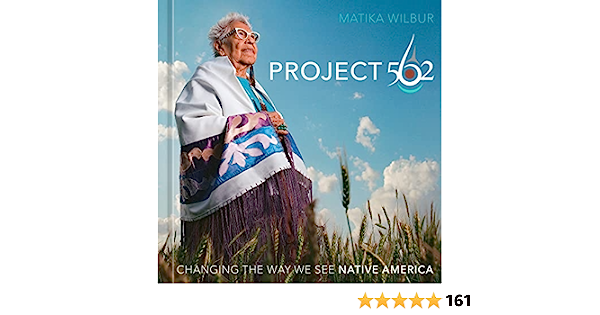
Which brings me to the most recent book that I’ve been reading: Project 562: Changing the Way We See Native America by Matika Wilbur. I must say that I started the book in a naive headspace. I was looking forward to her interviews with modern Native people across Turtle Island (North America), hearing about how they keep their culture and religious rituals alive, and while I’m aware (more than the average person) of the history of the US’s forced removal, forced assimilation, and truly what can only be called genocide of the Native Americans, I was still surprised by so many things in this book that took me by surprise.

 Griffins and Ginger Snaps