I’d also encourage you to familarize yourself with the First Amendment of the United States Constitution, which holds the freedom of the press as one of the most important tenets of our democratic beliefs.
I thought on November 3rd that this series would be retired.
And then Republicans in Congress went off the rails. They took every conspiracy theory, every half-baked piece of nonsense, and tried to overturn the legal election.
How do people who coined themselves the Tea Party after the original throw-British-tea-in-the-river protesters and become the seditionists and treasonous anti-democratic rioters?
After that, their supporters marched to the Capitol and breached security, injuring over 140 police officers, killing one, directly causing the suicide of two other officers. Four other rioters died in the process. The FBI is still investigating, arresting, and jailing those seditionists.
Meanwhile in Georgia, state Republicans are attempting to pass laws to suppress voters going forward in the future.
We will need to remain engaged in order to keep the fragile democracy we have. We need a larger majority in both Houses if we want to continue to help the American people.
What follows is a starting place for following people who know what they’re doing and what they’re talking about. Please add your own suggestions in the comments.
This information was originally shared here a little more than a year ago. The compiler of the information at the links has continued to update and maintained it so all of us can learn more about Black History throughout the year.
Author and activist, Charles A. Preston maintains this Google doc on his own. I discovered him from a random Twitter post last year, and feel fortunate that I did.
The multi-folder Google doc is chock full of information about many aspects of Black History from Afro-Futurism to Zora Neale Hurston and many others in between. I believe he is continuing to update it. When using his folders, remember to give him credit as well as linking to his Twitter or website (linked below).
Mural on a building of WWI hero Henry Johnson and other WWI service members, on Henry Johnson Blvd. in Albany, NY. (c)2021
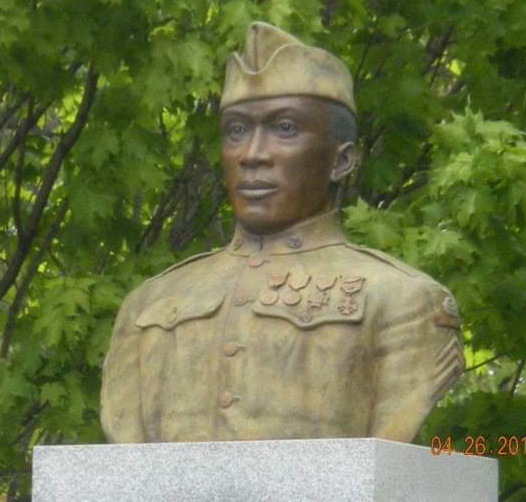
Henry Johnson was born in Virginia, but lived in Albany, the capital of New York, since his teens. He worked as a redcap (porter) at the Albany Union Station. He was also a sergeant in an all African American unit (the 369th Infantry Regiment, formerly the 15th Infantry Regiment of the National Guard during World War I and was awarded the Croix de Guerre with star and the Gold Palm from the French govenment for his heroism in fighting off a 20 person raiding party of Germans.
He was the first American to receive these awards, and yet there was no recognition from his own country.
Finally in 1996, he was awarded the long overdue Purple Heart and in 2003, the Distinguished Service Cross. In 2015, President Barack Obama awarded him the Presidential Medal of Honor, accepted by Command Sergeant Louis Wilson of the New York National Guard.
By the time you read this, the second impeachment trial of former President Donald Trump will have begun. You can read about how the trial will proceed in this resolution, however beware that clicking the link will begin an automatic download of the pdf from the Senate website.
If you’re not able to watch the trial live or choose not to, Elie Honig’s daily (approximately ten minute) podcast, Third Degree, is the way to go. His Twitter is here.
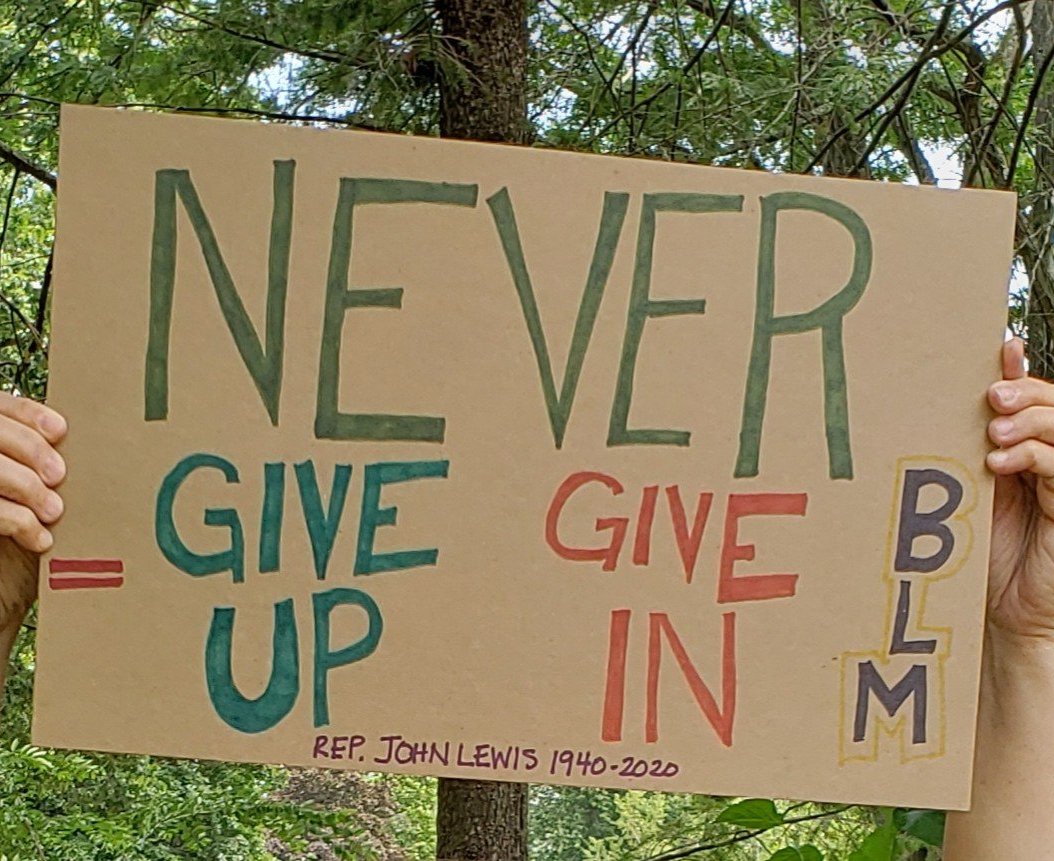
You must be bold, brave, and courageous and find a way… to get in the way.
– Congressman John Lewis, 1940-2020
A few years ago, I bought the book, The Children by David Halberstam, but I only read it recently. As an aside, David Halberstam was the commencement speaker when I graduated from college, so I always took a second look at his books.
I looked at this one often in my kindle library, but was never quite ready to sit down for such a serious book. In the last four years, I’ve been engulfed with politics, including racial justice, but I wasn’t ready for a history lesson.
I finally started it last summer, soon after George Floyd’s murder, and with all of Halberstam’s work, it did not disappoint.
I had misinterpreted the title to mean the literal children of the civil rights movement, the young people growing up in that time and after. What I discovered is that Halberstam’s implication that the civil rights movement was left to “the children” – the young adults who risked everything, including their lives to march, to sit at lunch counters, to register to vote, to do many of the things we take for granted, even today.
One of the very surprising things that stood out to me was the level of participation of John Lewis. John Lewis was a hero of mine, but more in an abstract way listening to his modern, inspirational speeches rather than his history, and I wondered why I hadn’t learned his name as readily as I learned about Martin Luther King, Jr. In school. I didn’t realize they were contemporaries, and met and worked together to build what they called the “beloved community.” As I thought about this missing piece in my childhood education, I realized that growing up in the seventies during busing, and my really formative years of middle and high school in the eighties, John Lewis wasn’t part of “history” as we think of it; for that matter, neither was MLK. Lewis’ beating on the Edmund Pettus Bridge was in 1965, one year before I was born, and King was assassinated in 1968 when I was a toddler. These events, and the bulk of the civil rights movement occurred a mere twenty years before I graduated high school; nineteen years to be more precise. In the time between Lewis and King’s assault and assassination, I hadn’t even reached adulthood. This book really brought that home to me. John Lewis would live in my kids’ history books, but for me, he was in my now.
I hadn’t even made it halfway through the book when John Lewis died, and I thought for several days of putting the book down and reading something else, but I didn’t. I finished the story, cringing and welling with tears, and sometimes gasping for air at the horror of it all and the idea that while we’ve come far, we have so much farther to go. When I finished The Children, I immediately read Jon Meacham‘s new book, His Truth is Marching On, and that bridged the short gap between Lewis’ civil rights activism and his congressional career all on that path to the beloved community.
One of the things that I found somewhat amazing, miraculous even, was the number of long-lasting activists all being in the same town at the same time. They didn’t travel to Nashville; they were already there from around the country attending school. John Lewis, Diane Nash, James Bevel, CT Vivian, James Lafayette, Kelly Miller Smith, Rev. James Lawson, who learned the non-violent method he taught them from his trip to India and learning from Gandhi, and of course as witness, David Halberstam, a local journalist with The Tenesseean in Nashville. Reverand Lawson described it as providential during his eulogy for John Lewis in 2020, and that just gave me chills.
If you do one thing, watch the Reverand James Lawson at the funeral of John Lewis in Atlanta, Georgia:
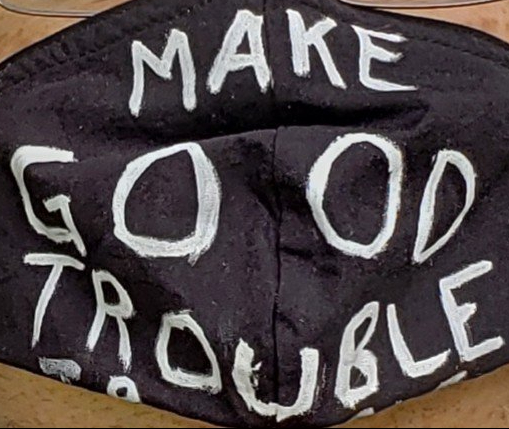
(c)2021Wearing a Mask is Good Trouble, Necessary Trouble. (c)2021
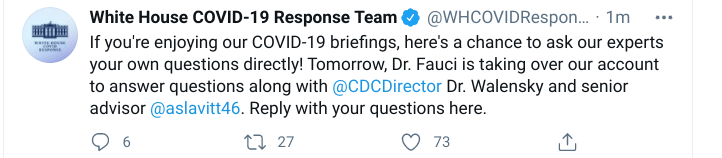
Click here or on the above picture to be taken to the Tweet to ask your questions of Dr. Fauci when he takes over the White House COVID-19 Response Team’s Twitter to answer questions tomorrow!
The Election Connection series will be a bit more sporadic, posted on a need-to-know basis now that we have an Administration that cares about its citizens in all the important and even in the most mundane ways. I still feel waves of PTSD at moments and then I see Press Secretary Jen Psaki swatting stupid questions, not arguing with White House correspondents, and offering experts to give briefings and answer questions, and I remember that it’s all going to be okay. It’s like the last four years were a dream, and I’m Pamela Ewing.
Unfortunately, the last four years weren’t a dream, and as nightmarish as it was to live through, it wasn’t a nightmare either. It was very real.
We need to take that same energy from the last years, the same energy brought to the Georgia Senate race, the same energy brought by the summer protests, and we need to focus it unrelentingly on the next two years, and then the two after that, and then the two after. We can never get complacent again.
Complacent = Complicit
We came very close to losing our republic. As it was, we witnessed a coup attempt, an insurrection that struck at the heart of our democracy. Five people died, including a Capitol police officer, but hundreds of others were injured. Two members of law enforcement have committed suicide. And still, there are Republicans who refuse to comply with law enforcement requirements to go through a magnetometer before entering the House floor. I mean, let’s be realistic and honest here, they’re also refusing to wear masks despite common sense and Executive Order, putting their colleagues and staff at risk (four members of Congress plus one spouse became covid infected because of Republican negligence on January 6th, and that was without their obvious complicity in the attack on the Capitol).
So, it’s time for a Civics lesson, and I will go extra slow as if I were speaking to the newly elected Senator from Alabama (this one) who doesn’t know the three branches of government (see below*) or a Supreme Court justice (this one) who doesn’t know the five rights guaranteed in the First Amendment (see below*).
Some things are etched in stone – the Constitution including the Bill of Rights is one of those things. The Constitution may be amended, and there are procedures in place to do that. In fact, we have amended the Constitution twenty-seven times, most recently in 1992.
Some things are not – Number of Supreme Court justices, the use of the filibuster. Supreme Court justices were based on the number of circuit courts, which have increased to thirteen. This is why many experts feel that the Supreme Court should be expanded to cover each circuit court with its own justice (as established in 1869 with what is known as the Circuit Judges Act).
The filibuster is not part of the Constitution, which makes it easier to change than amending the Constitution would be.
A couple of points:
Unity does not mean to continue to allow ourselves be abused or gaslit.
Unity does not mean giving in to bullies.
Unity does not mean power sharing when Democrats have a clear mandate.
Below the cut are Twitter follows of the Biden Administration, the House Managers of the Impeachment Trial, a selection of podcasts, and other accounts that I follow regularly and find are very informative and honest. Add your own in the comments and I can include them in the next Election Connection.
*Branches of Government | | | Legislative Executive Judicial
*5 Rights Enumerated in the First Amendment: 1. Freedom of Speech 2. Freedom of Religion 3. Freedom of the Press 4. Freedom to Assemble 5. Freedom to Protest the Government
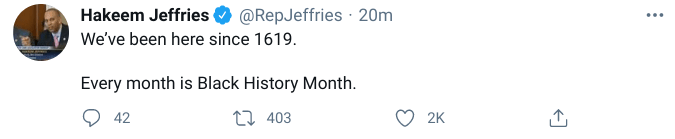
Today is February 1st, the traditional start of Black History Month. It would be good to remember, as Congressional Representative Hakeem Jeffries of NY’s 8th District tweeted this morning: “We’ve been here since 1619. Every month is Black History Month.”
I grew up in NYC in the 70s, at what seemed to be the height of bussing as well as a prominent Back to Africa movement. I didn’t understand why my Black friends didn’t live near me. One of them, Robert, moved with his family to Africa, although I don’t know if that was related to his father’s job or if they decided to “return” (I don’t know the proper term and I apologize for that).
In school, we learned about Harriet Tubman, Booker T. Washington, George Washington Carver, and of course Rosa Parks and Martin Luther King, Jr, but not nearly enough. No Medgar Evers, no Emmett Till; at least not that I remember. Thurgood Marshall, of course; he was currently on the Supreme Court at that time. As historic as their lives were, many were left out.
Malcolm X, for example was deemed too militant. It wasn’t until last year when I read his autobiography that I saw how little difference there was between him and the mainstream civil rights movement. Of course, no one agrees with anyone one hundred percent of the time, but students in school should be given all the information and use critical thinking skills to form their own opinions.
I can’t possibly make up for the lack of Black history within American history. As a country we can absolutely begin to try, and I do try in my small space of the internet. Since I am not part of the Black community, I try to draw on Black voices and offer links and some information to get you started.
What I had planned for today was postponed by another tweet I saw this morning; that of March for Our Lives activist, David Hogg who asked if anyone had the link to W.E.B. Du Bois PhD thesis on the history of slavery and abolition in the US, and so with the assistance of David Hogg and Carl Fonticella (who provided the link), I am sharing that to get us started.
Relatedly, the 1619 Project would be important reading as well. The pdf is provided through this link from The Pulitzer Center and begins with an introduction from New York Times journalist, Nikole Hannah-Jones, who provided the idea for the project.
Beginning today and hopefully continuing throughout the year, I will be curating music playlists. I enjoyed doing the Supernatural one so much last year that I thought it would make an exciting new series.
This month’s curated list is based on President Joe Biden’s inauguration.
It includes artists, songs, and themes from the 2021 Inauguration of Joe Biden and Kamala Harris.




 Griffins and Ginger Snaps