Everything is Fodder for Writing

Standard

Including arguing about whether the writiing is relevant to the non-writing and whether the argument about whether the writing is relevant to the non-writing is relevant fodder for a third party’s writing. Or none of those things.. 

This, posted at 6:17pm EST on the 15th of February, 2019 was the tweet heard ’round the world. At least the world of food blogs everywhere. Before historian Kevin M. Kruse tweeted this, innocence had hung over the Twitter world, that global place for the polite exchange of ideas, but after… after, the cacophony that some wanted to laugh at while others were weeping shook even the most innocent of bystanders.

I don’t know who I’m making fun of, although I include myself in that. Never have I felt the both sides of an issue as I did with this tweet and the responses that followed.

Having “enjoyed” Twitter since 2009, I laughed at the original tweet. Not a haha good one laugh, but a what have you done FTLOG laugh. I could see what was next a mile away and it didn’t take long for my foreknowledge to be realized.

I’m paraphrasing here, but the gist of it was mostly how fucking dare you?!?!

I saw this storm form quickly as the clouds darkened and the winds gathered. As I said, I can see both sides because I am both sides.

I’m a writer. I want people to read my writing and with most writing, every word has its place, its function. I want it all read.

I also blog about food, share recipes, and post food pics here and on Instagram. It’s one of my, let’s call it niches. 

I also search for recipes online.

There are days, like last week. In the middle of cooking dinner, our oven broke. I needed to finish baking the cornbread. I searched online and when I found a microwave recipe, I skipped over everything to get to the very end of the directions for how long to microwave it. It took a little longer than stated because our microwave is older and smaller than the average microwave available today.

Other times I read the narrative to get clues as to taste and texture; what needs to be followed perfectly; what can be tweaked.

And there are times when I post a recipe that I post a narrative alongside it. Some kind of how I discovered this or my daughter came up with this or some other family story or anecdote that I find relevant.

For Christmas, in fact, I wrote a ten recipe cookbook for my church’s food pantry/Christmas basket program. One of the most often compliments that I’ve received about the booklets was about the accompanying narrative that I included for some of the recipes. These included origins, where some were adapted from, links. Next time, I’ll add photos, but the narrative was received just as well as the recipe itself. In fact, one of the gentlemen who I’ve always thought of as dour, smiled, thanked me, and informed me that he sent copies to his two daughters. This was high praise indeed.

So while it would have been easy to be pulled into a Twitter fight between (favorite) historian and a band of incensed food bloggers, I stayed far away, but still checking in to see how both sides held up and where the argument would end. I mean, it is Twitter after all. I did leave one tweet, and I’m sure that I didn’t help anyone on either side.

Are Libraries Still Essential?

Standard

Libraries are the thin red line between civilization and barbarism. – Neil Gaiman


I originally saved the Vox link, thinking that this was a fluff piece; a ridiculous headline that they easily debunked in the article. I hadn’t realized that someone had actually written in favor of getting rid of libraries in favor of Amazon bookstores/coffee shops.

I need to preface this by saying that I happen to love bookstore-slash-coffee shops. Whenever my family goes to Barnes & Noble, I find a comfortable space in the cafe and read or write. I frequently (before Howard Schultz began running for President) went to Starbucks with the specific intention to get something to eat and drink and to write. There is a comic book store that is also a coffee shop in Philadelphia, Pennsylvania that is on my list of places to visit. I love bookstores and coffee shops, together or apart.

However, I don’t confuse them with libraries. Libraries have a whole different feel to them. They also have a different necessity to them. In fact, I’ve just come from my local library. I meet a group of people there once a month for a writing group. We’ve been getting together for about seven years, although they had been meeting prior to my joining them. I woujldn’t have met them if not for the memoir workshop that I began to attend, which not only gave me a wonderful learning environment but was also one of the important things that led me out of the darkness of my depression.

I returned two of my daughter’s books that she had finished reading, and I collected the forms to file my taxes.

In summer, I bring my kids for special programs as well as their summer reading program that includes prizes and a special celebration at the end of the summer. My older son attended a Harry Potter evening in costume and my younger kids met therapy dogs and learned some cooking techniques during two separate events. We’ve attended Olympics activities and Halloween parades. All of these activities were either free or for a nominal activity – one or two dollars.

I almost always see people using the computers, checking their email, searching for jobs, and whatever else they’re doing that they can’t do at home, either because they don’t have access to the internet or because it isn’t safe to (domestic abuse victims and the homeless).

There are several daily newspapers and hundreds of magazine subscriptions.

On my Kindle, I will often have the maximum loan of four library books. I am currently reading Timothy Egan’s The Immortal Irishman. I can hold books and sign up for programs through my Kindle.

Libraries often have local art exhibits, both from local artists working in several different mediums and school kids showing off their artistic talents from art class in school in all grade levels.

I’ve attended concerts and lectures, and will be attending a storytelling event on the first of March.

Last year, one local library had a comic book convention with activities, free items, and displays both to see and/or for sale.

I remember being a kid growing up in NYC and having the bookmobile come. What a special day that always was.

Every community needs a library.

If you don’t believe me, listen to Neil Gaiman; or to librarians.]

What was your favorite thing to do at your local library?

What was your favorite book?​

Susan B. Anthony: Suffrage and Equality, and How Far We Still Need To Go

Standard

​One hundred ninety-nine years ago today, Susan B. Anthony was born into a Quaker family in Adams, Massachusetts. Her activism began early at her family’s hearth as the entire clan was involved in the anti-slavery movement as well as temperance movements all throughout their lives.

Her birth year of 1820 was coincidentally one hundred years before the 19th Amendment, giving women the right to vote, was ratified.

In 1868, she, and her longtime close friend and women’s rights collaborator Elizabeth Cady Stanton published a weekly newspaper called The Revolution, focusing on women’s rights and calling for women’s suffrage as well as highlighting other opinion and discussion pieces in relation to suffrage as well as politics and finance. It’s motto was: “Men, their rights and nothing more: women, their rights and nothing less.”

I think we’re seeing a resurgence of this attitude if not the outright message. Coming to a head in 2017 with the #metoo movement, women are finding their voices and speaking out when they feel ignored or condescended to, which happens in all walks of personal and professional life.

When the 15th Amendment was proposed and ratified (giving former male slaves the right to vote), Anthony was firmly against it, feeling that African Americans and women should receive voting rights simultaneously rather than continue to give men, regardless of race more rights than women.

In 1872, she brought her Declaration of Rights for Women to the nation’s centennial in Philadelphia, wanting to share it at the official celebrations. Permission was denied, but Susan B. Anthony, leading a group of five women interrupted the speaker and handed the Declaration to the him. Leaving, she handed out copies to the crowd, and then found a public space nearby and read it to the crowd that had formed around her.

1872 was also the year in which Susan B. Anthony cast her vote. In doing so, she was arrested and brought to trial. Prior to the trial, she went around the county doing speaking engagements. Her speech was titled, “Is it a crime for a US citizen to vote?” At her trial, she was found guilty and ordered to pay a fine. She refused. Instead of the judge holding her in contempt, he declined any further action, and the fine has never been paid.

‘Failure is impossible’ quickly became the watchword for the women’s movement” according to her Wikipedia article. Those three words were taken from comments made by Susan B. Anthony at her eighty-sixth birthday celebration a few weeks before her death:

“There have been others also just as true and devoted to the cause — I wish I could name every one — but with such women consecrating their lives, failure is impossible!”

She and Stanton were the first to lead the National American Woman Suffrage Association (NAWSA), and after the ratification of the 19th Amendment, the organization’s name was changed to the League of Women Voters, still a formidable voice for voting rights.

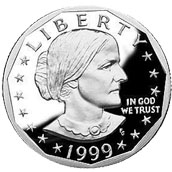
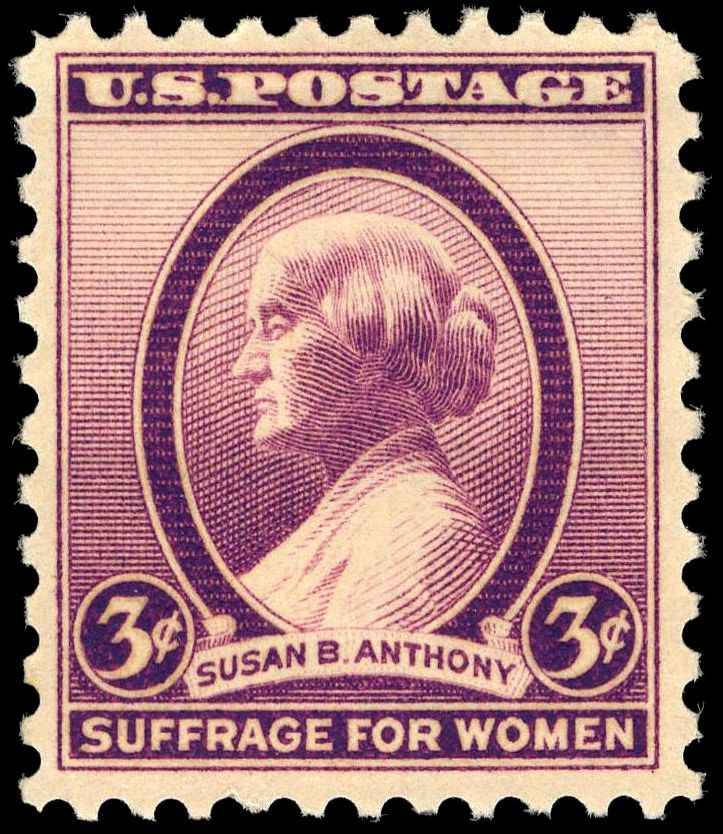
In addition to her house in Rochester, NY named as an historic landmark and her gravesite visited on many Election Days, most especially in 2016 when Democrat Hillary Clinton ran as the first woman nominated by a major party, she was also commemorated on a US postal stamp in 1936 and is the first woman to have her likeness on a US coin when her image was depicted on the dollar coin, first minted and released in 1979.
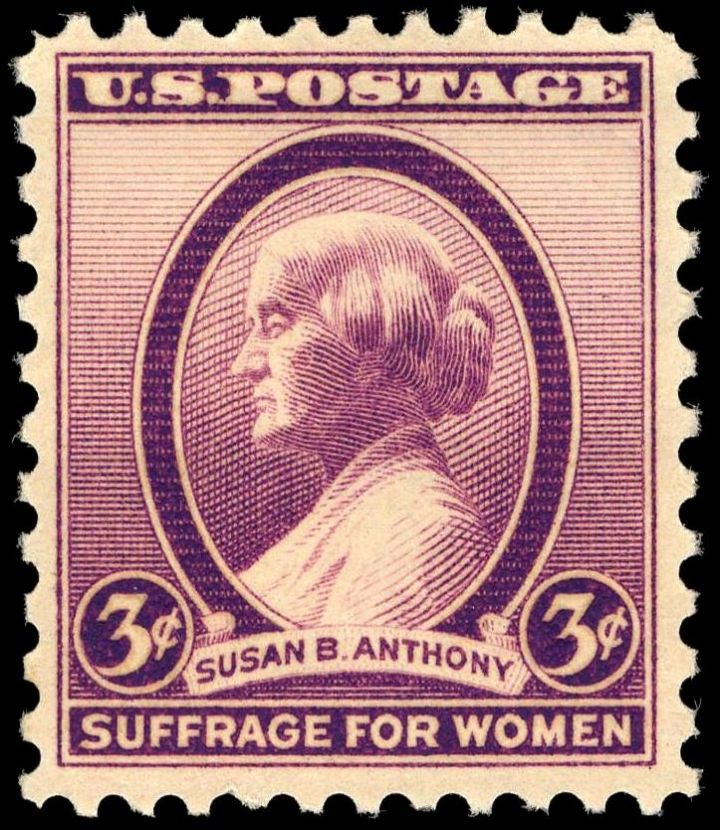
Commemorative Stamp 1936, US Postal Service. Public Domain. (c)2019

Susan B. Anthony Dollar Coin, 1979. Public Domain. (c)2019

In reading the title of her speech: Is it a crime for a US citizen to vote? it made me realize that as far as we’ve come, we still haven’t come all that far. We saw in 2016, an amount of voter suppression that many didn’t recognize in prior years. Some of it was so obvious as to be racist and sexist that it boggles my mind that it was allowed by officials and ignored by the media. The questions asked of Secretary Clinton, and the ridiculously higher expectations and almost impossible to meet standards expected of her in relation to her male opponents was embarrassing. 

Even more embarrassing is the way the media is currently treating the four women candidates for the Democratic nomination. I hear about Sherrod Brown’s ties to working class families, and reflection on Joe Biden’s status as elder statesman, and they haven’t even decided if they are running for 2020. However, Kamala Harris, Kirsten Gillibrand, Elizabeth Warren, and Amy Klobucher are being lambasted for listening to rap music, eating fried chicken, mocked for family lore, and treatment of her subordinates instead of where they stand on the issues. Is the idea that Amy Klobucher expects her staff to live up to her expectations more problematic than a President who lies constantly about everything, even the insignificant? Bill Clinton played the saxophone on television, Mitt Romney has a car elevator in one of his houses, former Speaker of the House Dennis Hastert is in jail for sexual misconduct, but no, let’s find out if Amy raises her voice trying to get things done. Journalism is in a tailspin, and I thought we were, if not past this sexism then at least pretending to be fair in public.

Also standing out significantly is the Georgia governor’s race in 2018, the Voter ID laws that disproportionately affected the Native American population in North Dakota, also in 2018, closing polling places, shortening voting times, which thereby increased lines and eliminated the working class who can’t afford to leave work early or go in late. Deciding that polling places didn’t meet accessibility requirements for the general election even though there were no problems during the primaries, and those polling places that didn’t meet the requirements were in primarily African-American districts (in Georgia, where the Secretary of State who is in charge of those things was also running for governor. He won. Big surprise there.) There is still a congressional seat in North Carolina that has not been certified because of blatant fraud.

So, how do we combat this?

Should Election Day be a national holiday so more people can vote without losing time and money from work? Why do certain segments of political partisanship want less people to vote, not more despite their being eligible and wanting to vote?

Should we have a standard set of questions to address to each office-seeker when they’re being introduced as a presidential candidate?

Why do we continue to allow the Senate Majority Leader to lie about what the American people want (as shown in poll after poll), and allow him to not bring bills to the floor that have passed the House?

Why do we allow the White House and the President’s enablers in Congress to block investigations into the Russian interference in the 2016 and 2018 elections? I would hope that no one wants a foreign power controlling our votes and who is elected to our national offices, but it seems that some of those politicians blocking access and investigatory avenues are dominated by their monetary reliance on that same foreign power. This is wrong. When will they come to their senses? When will their patriotism extend to real American sovereignty and equal rights instead of their false flag patriotism?

How do we also encourage voting participation?

Why do some from one side think it should be harder to vote, whether because of economics or transportation or accessibility?

This needs to be addressed before the 2020 election. 2020 will celebrate the centennial of the ratification of the 19th Amendment. We should come together for a comprehensive overhaul of the registration and voting process to make it accessible to all eligible voters. If we wait much longer, we won’t have anything worth voting for.

National Tea Month (Jan) – Masala Chai

Standard

​Masala Chai is a black tea brewed with a variety of spices, and varies depending on the person making and drinking the chai. The word chai is simply the Chinese word for tea, although Western tea drinkers will often refer to this drink as Chai Tea or Chai Tea Latte, which is more than a little redundant.

Masala chai is originally from India and its surrounding environs.

There is no standard recipe for masala chai although all have four basic ingredients:

  • milk
  • sugar
  • cardamom
  • ginger

The recipe I used was adapted from this DIY Chai Spice Mix recipe and in addition to milk, sugar, cardamom, and ginger listed above, I also included allspice, cinnamon, cloves, nutmeg, and black pepper.

I put all of the fresh, whole spices into a blender and once they were blended and mixed, I added any powdered spices that I had. I followed the ratios of the recipe above.

My brewing recipe was as follows:

2 cups of milk, 2 teaspoons of sugar, 1 1/2 teaspoons of the masala chai mix, 3 black tea tea bags (you can also use loose tea, whatever your preference). I set the saucepan to medium and brought it slowly to a boil, stirring occasionally. One word of advice would be to cut off the strings from the tea bag. This may let the tea loose, but I found some bits of string slightly caramelized with the sugar, so I would avoid that next time.

Once the tea was boiling, I poured it into a Pyrex measuring cup and poured it through a tea strainer into a mug. There was a lot of sediment between the spices and the loose tea, but the strainer did its job and it was a delicious, warm cup of spicy tea for a cold, winter morning.

Masala Chai: Top, L-R: 1. Homemade chai spice mixture, 2. Putting all the ingredients in the saucepan on medium, 3. Just after boiling; Bottom, L-R: 4. Pouring into the Pyrex, 5. Pouring through tea strainer into the mug, 6. The final look in the mug. Mmm, delicious. (c)2019


– – –

A second method of brewing would be to make your tea as usual. Steep your tea bag, and add 1/2 tsp (or your preferred amount) of chai masala powder with any sweetener you like (or leave out the sweetener). Stir well and I would still pour through a strainer.

Tea Time Tuesday – Travel Tea Tin

Standard

My travel tea tin with the tea items I travel with. (c)2019

I bring tea (in bags) with me.

Everywhere.

I bring it on retreat (where they have a wide variety of tea to choose from).

I bring it to church breakfasts (where they have tea selections).

I bring it to school functions.

I bring it to use with the McDonald’s hot water in the drive thru.

I bring it when I travel.

I bring it everywhere.

The only place I didn’t bring my travel tea was when my family visited the United Kingdom and Ireland because, well, it’s the UK and Ireland.

In the photo, there are various sugar substitutes. I don’t normally carry those with me, but I’m trying out different ones to see what I like best since being told I need to stop adding sugar (since being diagnosed with diabetes). I haven’t found one I like yet, so I’ve simply cut back on the amount of sugar that I add.

The container I use for my travel tea is a small square https://www.lushusa.com container. My daughter wanted to visit a Lush store, and while we were browsing (great customer service there by the way), I saw this container and immediately knew it would be perfect for my traveling tea.

St. Brigid of Ireland

Standard

St. Brigid in stained glass from the St. Joseph Catholic Church in Macon, Georgia. Image in the public domain. (c)2019

May Brigid bless the house wherein you dwell
Bless every fireside every wall and door
Bless every heart that beats beneath its roof
Bless every hand that toils to bring it joy
Bless every foot that walks its portals through
May Brigid bless the house that shelters you.

St. Brigid’s Cross. My collection. (c)2017-2019


National Tea Month – PG Tips

Standard

​PG Tips was started in 1869 (this year is its bicentennial) by Arthur Brooke in Manchester, England. It was named for its pre-digestion properties as a digestive aid until after World War II when regulators ruled that tea did not help in digestion. The tips in the name referred to the part of the tea leaf used.

Tea in stringed bags were launched in 1985 and the current triangle/pyramid shaped bag (no strings attached) were offered in 1996.

Knowing the importance of adverts, Brooke’s slogan was released early in the history of PG Tips: 

“Good tea unites good company, exhilarates the spirits, banishes restraint from conversation and promotes the happiest purposes of social intercourse.”

Today was the first time I’ve read that slogan, and it very nicely sums up the experience of tea and sharing a cuppa.

While I was in Wales, I drank tea every morning, sometimes several times during the day. At home, I normally prepare my tea in a mug, but what I discovered in Britain was that it was so much better steeped in a pot and then poured into a warm cup. Glorious. Decadent even. I was fortunate to find a wonderful tea cottage in Llanrwst. It was set on the other side of the bridge alongside the Conwy River. It was beautiful, homey, and very tea cottage-y. I ordered white tea with scones and jam.

Tu Hwnt i’r Bont, Llanrwst. (c)2009-2019

I re-created that wonderful repast this week for my breakfast, using my last bag of PG Tips. Drinking it I realized how perfect it tasted and I’ll be going out to get some more!

Scones: Blueberry (Starbucks), Strawberry Yogurt (Starbucks), Cranberry Orange (Archer Farms) with butter, jam, marscapone, and the perfect color of PG Tips tea I have ever seen or tasted! (c)2019

I’d like to share an anecdote from when I was visiting a friend of mine. He is originally from Wales (which is relevant), but now lives in the US. I was visiting him and his roommates. He and his wife had gone to sleep, and a few of us stayed up for tea. Friend #2 set the water to boil in the kettle on the stove. We were talking and when the kettle began to whistle we ignored it, finishing up the thoughts we were making. Out of the bedroom comes British friend, says nothing to us, turns off the kettle, pours the boiling water into the waiting cups and goes back to bed. The rest of us watch this with mouths open. He did not remember doing this in the morning. The tea is strong in the British.

Every morning, he made me a cup of PG Tips with milk and sugar and I’d discover it on my bedside table. It is still one of my warmest memories.

National Tea Month – Adagio’s Fandom Tea Blend

Standard

Today’s Tea:

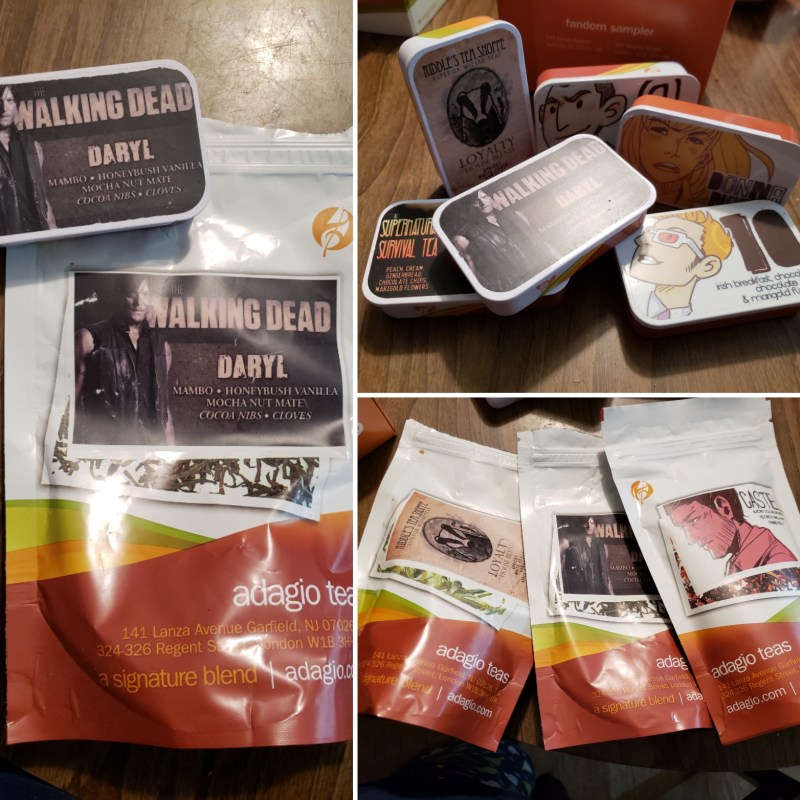
The Walking Dead Daryl

This tea consists of mambo, honeybush vanilla, mocha nut mate, cocoa nibs, and cloves. This blend is perfect both for a morning, get ready for work drink or a late afternoon treat. It’s a dark blend that works with and without milk. (I prefer without.) The cocoa nibs give it a bit of sweetness, but adding sugar perfects the flavor in my opinion.

This was a gift from a close friend. It came in a sampler box with four other teas from four other fandoms. Also included in this custom made set were Loyalty House Blend (Harry Potter/Hufflepuff), Supernatural Survival Tea (Supernatural), Donna Noble (Doctor Who), and Civil War Remedy Tea (Captain America). What was so very funny about the Civil War one was the box was a light sepia color and had a picture of an old-fashioned medicine bottle. When I didn’t look very closely at it, it took me until I actually tried it to realize that it wasn’t tea in retrospect of the American Civil War, but of the Captain America movie subtitled Civil War.

Each tea has its own unique flavor that is ver reminiscent of the fandom and characters it is made to represent. These are all loose teas, but for those new to loose tea, there are make your own tea bags, tea balls, tea strainers, and other methods for brewing loose tea.

Fandom teas is something of a specialty of Adagio, although they also offer all of the regular teas and tea blends that you might be looking for as well as accessories and teaware. Their teas are reasonably priced as is shipping and they run sales throughout the year. It’s definitely worth a visit to their website to see what interests you.

Sampler size tin, tea strainer, mug. (c)2019

National Tea Month

Standard

Drinking a daily cup of tea will surely starve the apothecary.

 – Chinese Proverb

I don’t know who decides these things, but rules are rules. January is National Tea Month, not to be confused with National Hot Tea Day (this coming Saturday, January 12) or National Iced Tea Month (June) or the United Kingdom’s National Tea Day (April 21). I’m certain there are more if you choose to look for them. (I don’t.)
Tea has been around forever, longer in fact than Christianity, by about sixty years. Officially discovered in 59 B.C., but more than likely around prior to that, tea has developed into a cross-cultural, multi-faceted sensation, sometimes a curiosity that has its own rituals, not only ethnically but also individually.

It’s been used for medicinal purposes. Still is.

It is offered monthly by my therapist, something to do with my hands, I suppose, although I usually settle on cold water.

It is the morning beverage of choice by a plethora of people, writers at keyboards, spiritual directors at retreats, teachers awaiting their classroom full of eager faces, business people scarfing down toast or filling travel mugs to take with. Many cups of tea grow cold during the daily work of their drinkers. I have the dregs of tea leaves and sugar granules at the bottom of my morning cup right now.

There are formal tea ceremonies, welcoming honored guests or memorializing those who have gone.

There is High Tea and Cream Tea, hot and cold bubble tea, and tea as an afternoon meal.

There are teas that aren’t teas – herbals and infusions, also called tisane that are easier to offer as tea than explain the difference between tea plants and other plants. Actor Benedict Cumberbatch recently went on a rant about chamomile not being tea at all (see my reference to tisane above; chamomile is a flower). On a related note, my friend Tom never removes his tea bag letting it continue to steep as well as teaching me long ago not to squeeze my tea bag (it makes the tea acidic), a practice that I now cringe at when I see others do it.

Tea has been used as protest, albeit a waste of perfectly good tea from Boston to Washington DC to Manchester, England (April, 2018), although in Manchester, he didn’t get rid of it, but serve it in protest to war (make tea, not war).

From its initial popularity in the Chinese Tang Dynasty to the drinking of tea that spread across Asia through Portuguese priests into Europe during the 16th century and soon after becoming part of UK culture beginning in the 17th century continuing through the present day.

It is India’s most popular hot beverage, and Ireland drinks by far the most tea in Britain at four cups per person per day, some as much as six cups a day.

Many people have their own recipe for the perfect cup of tea. I prefer to follow Douglas Adams’ specifications. I did this for a few years and it really was better; perfect, in fact.

Since getting our electric kettle, I drink tea nearly on a daily, sometimes multi-daily basis, and like to try new teas depending on my mood, although overall I prefer black tea as the base. When we went to Ireland and Wales for a family function, my kids brought back bags and bags of British candy; I brought back tea and Welsh cakes, and it still wasn’t enough.

For Christmas gifts this year, I blended my own Masala chai, which was a lot of fun, and I really enjoyed doing it, deciding how much of what to put in. I did have a base recipe (that I will share in a future week).

For the next three Wednesdays, I will share a different type of tea that I’ll have drunk during the week past. I’ll share something of a review, a photo perhaps, and links to find those teas plus at then end, possibly the first Wednesday in February, all the tea links I have. Even the grocery shelves have plenty to select from.

In addition to those four Wednesdays (including today), I will also share a few of my other tea posts from years past. If you can’t wait, just check the search box on the left and find some on your own schedule.

Onward to today’s tea: 

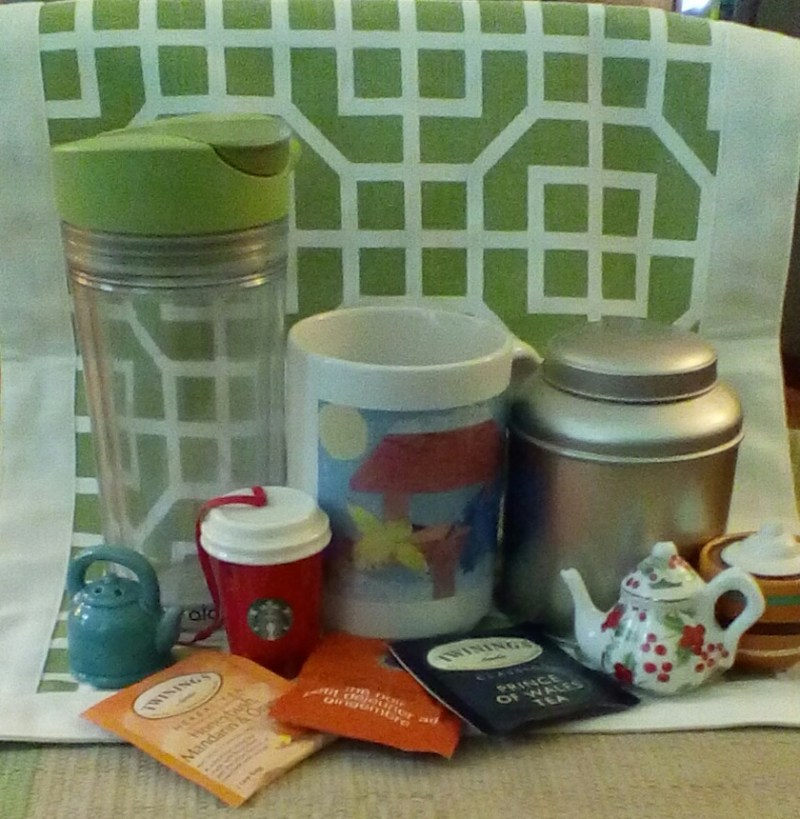
Twinings Prince of Wales tea. Twinings has been manufacturing tea for over three hundred years, so I’m going to guess that they’ve gotten the hang of it.
The Prince of Wales tea is a bit less strong than the English breakfast tea from the same company that I often drink. It is also less strong (by a mile) than the Welsh tea I brought home from Wales. Part of the strength of the tea I brought home, which I should have read on the box is that it’s made specifically for the Welsh water. When I was there I didn’t notice a strength difference, but when I got home it was more than I’d expected. I’ve adjusted to it, but it took a few tries.

The Prince of Wales tea is a lovely black tea that is mild and a bit woody. It is blended from several provinces in China and was originally created in 1921 for THE Prince of Wales at the time who went on to be crowned King Edward VIII. I like it both with and without milk and always with a bit of sugar. It’s my primary choice for the mornings to go along with eggs and toast, a bagel, or the ever more common for me, healthier oatmeal with craisins and granola. I can drink several cups of this a day and it’s also my go-to for a late afternoon cup. It’s good during the autumn and winter, but I have no prejudice – I’m a hot tea drinker year round.