Graham Greene has been a favorite of mine for a very long time. It may hit a bit harder today because of my research into St. Kateri Tekakwitha, a fellow member of the Haudenosaunee Confederacy, although she was Mohawk (and Algonquin) and he was Oneida.
This post will have several pages, which will be linked. This is so that when you click on the “read more” you won’t be bombarded with a wall of text and you can read the information in bite sized chunks.
Below, you will find:
Jack Smith’s Final Report (clicking the link below will automatically download it to your device)
Statement from the US & Canada regarding the Haudenosaunee’s independent participation in the Olympics.
The language of the 28th Amendment
Statements from both the President and the Vice-President on the new amendment to the Constitution.
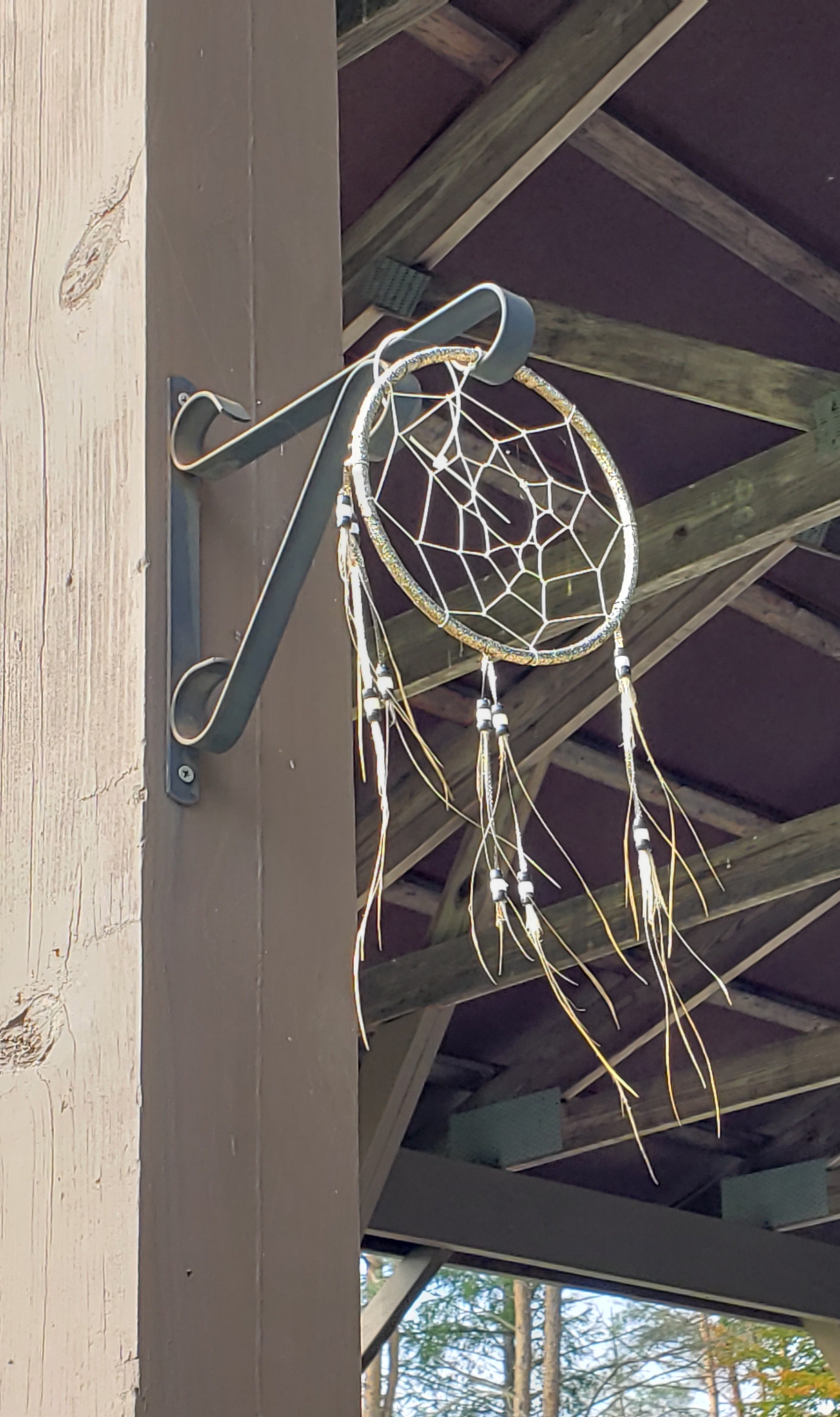
The photo below represents both the start and the end of the day.
Beginning with the end, I have slept with a Dream Catcher for most of my life. I notice a change in my sleep when I don’t sleep with one. It creates a calm and peaceful rest as it catches the bad and lets the good continue through. This particular dream catcher is one I got in Niagara Falls, Canada. I was drawn to the colors of the beads that represent the four directions as well as the uniqueness of the center stone.
The booklet is something that I was more recently introduced to through Mohawk Elder Tom Porter of the Kanatsiohareke Community in New York. Since then, I’ve seen it in other Haudenosaunee writings and readings. It is called the Thanksgiving Address, but it has nothing to do with the Thanksgiving holiday, but in giving thanks for all that is around us in the natural world, all that we have, all that we see. It is said at the beginning of all important gatherings, ceremonial and/or governmental. The Haudenosaunee call them the Words Before All Else.
I recently used a form of this address for a meditation that I was tasked to share, and it was very well received. I read mine, but most are recited and because of that they are often never the same twice since the words change with the speaker and the timing of the gathering.
As I said at my own (non-Native) gathering, as a shared meditation, I acknowledged the land we were standing on (Mohawk), and reaffirmed that I am a non-Mohawk, non-Native, sharing their wise words.
When we visited the Royal Ontario Museum this past August, I knew that I could not visit every nook and cranny as much as I might have liked to. I also knew that with five of us having different interests that we were going to get very frustrated very quickly if we stuck together. Upon entering and deciding who wanted to pay extra for the special dinosaur exhibit, I announced the three places that I wanted to focus on and whoever came with would be welcome, but if they wanted to explore on their own and meet back through texts, that would be great.
As an aside, I do miss my little ones, but I really appreciate going on vacation with teenagers and older kids because of this freedom for all of us. I didn’t want to see the dinosaurs; more to the point, I didn’t want to PAY to see them, so I didn’t. My daughter was not a fan of medieval arms and armor and so she veered away from that. The technology of texting let us know where the others were when we were engrossed in our little worlds. It was fantastic! And I think we all benefited from the freedom to explore our interests and the freedom from each other for an hour or so.
My three focuses were in the areas of First Nations, Medieval History and Arms & Armor, and Judaica.
A few days ago, the honoring of Native American Heritage Month began. Like Indigenous Peoples Day, I think this is timed for us to remember that there were both sides to Columbus’ landing in the New World and how we perceive the Thanksgiving story. The Thanksgiving story in and of itself isn’t as problematic to my mind as other European centered celebrations. We know and should acknowledge that the English settlers could not have survived their first (and to be honest, many subsequent) year in a new land without the help of the Native Peoples they met and who helped them immensely. I have always been a history buff and drawn especially to people of my own heritage and Jewish ancestry as well as people I feel somewhat paralleled that history including African- and Native- Americans. One of my favorite books as a child is The Magic Tunnel by Caroline Emerson. It had everything a young me could want in a book: time travel, the NYC subway system, NY history, American Indians. The perspective is of about a fourth-grade child’s view of history, but it’s a fun adventure for the elementary school age and a great jumping off point to discovering what’s true in their depictions and what is not.
As I’ve grown and became more of an in-depth reader, I’ve been exposed to more and more books about Native history both by Native and non-Native scholars. Living in New York state my whole life, we have a rich history of the Iroquois, and every place I’ve lived has had several towns still using names found from and in the variety of Native American languages found in the state. Some examples include: Shinnecock, Massapequa, Copiague, Hauppauge, Schenectady, Oneonta, Oneida, the Mohawk Valley, Chautauqua, Ontario, Otsego, Tioga, Cheektowaga, Ticonderoga, and of course, Niagara and Manhattan.
Over the next few weeks and through the end of November, I hope to offer you some resources to expand your knowledge of Native American history and culture as well as books, movies, and photos that you can enjoy in your explorations.
About a week ago, I was asked to give a meditation for what’s called an Ultreya, a gathering of Catholic Cursillistas for community and fellowship. I elected to read a Haudenosaunee Thanksgiving Address. It is called Ohen:ton Karihwatehkwen, which are the Words Before All Else. This is recited before any gathering or ceremony. At the beginning, prior to starting the reading, I explained to them that this is often different each time it’s told as it depends on the speaker to choose their own words. I explained that I, however, would be reading it. Two important things I stated before I began were who the Haudenosaunee were; we knew them as the Iroquois, which is the French word assigned to them by Canadian and French missionaries, and that we were currently on their traditional lands, the lands of the Mohawk. I also stated that I am not Mohawk, nor am I of First Nations descent. I have included a statement on my FAQ page.
I think it’s important to acknowledge whose land we’re on, and if we’re speaking authoritatively or in entertainment or spiritually, that we acknowledge when we are not Native and/or Indigenous People. I will also use Native American, American Indian, Native Peoples, Indigenous Peoples, and First Nations interchangeably unless asked specifically not to.
As we celebrate what we view as the first thanksgiving, it’s important to remember that the English settlers didn’t “give this tradition” to the Native Wampanoag people they met. The Native people across the continent had harvest festivals and days of giving thanks for their harvests towards the end of the fall and the coming of winter. This is what they shared with the settlers.
For my own Thanksgiving, I am thankful for my family and spending time with them, but I also think back to the historical first thanksgiving and look back on what could have been and look towards that future.
In this opening for me of Native American Heritage Month, I give you a few places to visit and learn from:
Killers of the Flower Moon – the movie is in theatres now, and it was wonderful. Don’t be scared off by its length; I barely noticed and easily sat through the whole thing. I also read the book about a year ago. I highly recommend both: Book
Indigenous Peoples’ Day was Monday, nearly a week ago, but that doesn’t mean that now we can forget about an entire culture, language, history, or a people. I usually will say that especially in the Northeast, where the Iroquois, more properly known as the Haudenosaunee lived, we should remember them. There are several things wrong with that sentiment though, and I am embarrassed to admit them. For one thing, the Haudenosaunee live, now, among us. They cover the six nations: Mohawk, Onondaga, Oneida, Cayuga, Seneca, and Tuscarora, across all of New York State and the international border with Canada. For another thing, Native tribes have lived on this continent from ocean to ocean, from the time when there were no borders at all. Just like our states, their nations had rivalries with others, they had distinctive cultures separate from one another. It’s important to remember that Native culture, whatever nations are represented, they are a living, breathing group of people, and it is well past time to recognize their contribution and their sacrifices. I’ve had several people (non-Native, I should note) that it was in the past, it’s history, there is nothing I can do, and that attitude disturbs me on many levels. I don’t know if it’s a connection I feel to the people whose land I live and work on. I don’t know if it’s from my childhood admiration and longing to be more involved in the limited Native culture around me as a child. I don’t know if it’s because of my Jewish background where people will say the same sentiment: it’s history, why are you still upset about…? I will call out some by saying that the same people who say that the Trail of Tears and stolen land in the 1880s and 1890s is “ancient history” and we “need to move on” are the same people who insist on the rest of the country worshipping a man who died over two thousand years ago. The continued hypocrisy is staggering in so many ways.
I have a few thoughts and photos that didn’t make it onto the website on Monday, and I hope to share them with you today and in the early part of next week.
I have been fortunate to have visited the village of Kahnawake in Quebec, Canada three times. Kahnawake piqued my interest through my studies and research of St. Kateri Tekakwitha who was born, lived, and was baptized very near to where I sit right now. Each visit was unique in that I saw new things and learned new things each time. The first time during covid was very limited to the outside world and was a superficial encounter. The second time had a decidedly Mohawk perspective, and the third time was more of a Catholic and Mohawk-Catholic perspective. Each visit gave me a new outlook, answering questions and thoughts, and offering insights that raised more questions and contemplations. I expect and look forward to returning next year to do some more research as well as visiting their language and cultural center that we were unable to see previously.
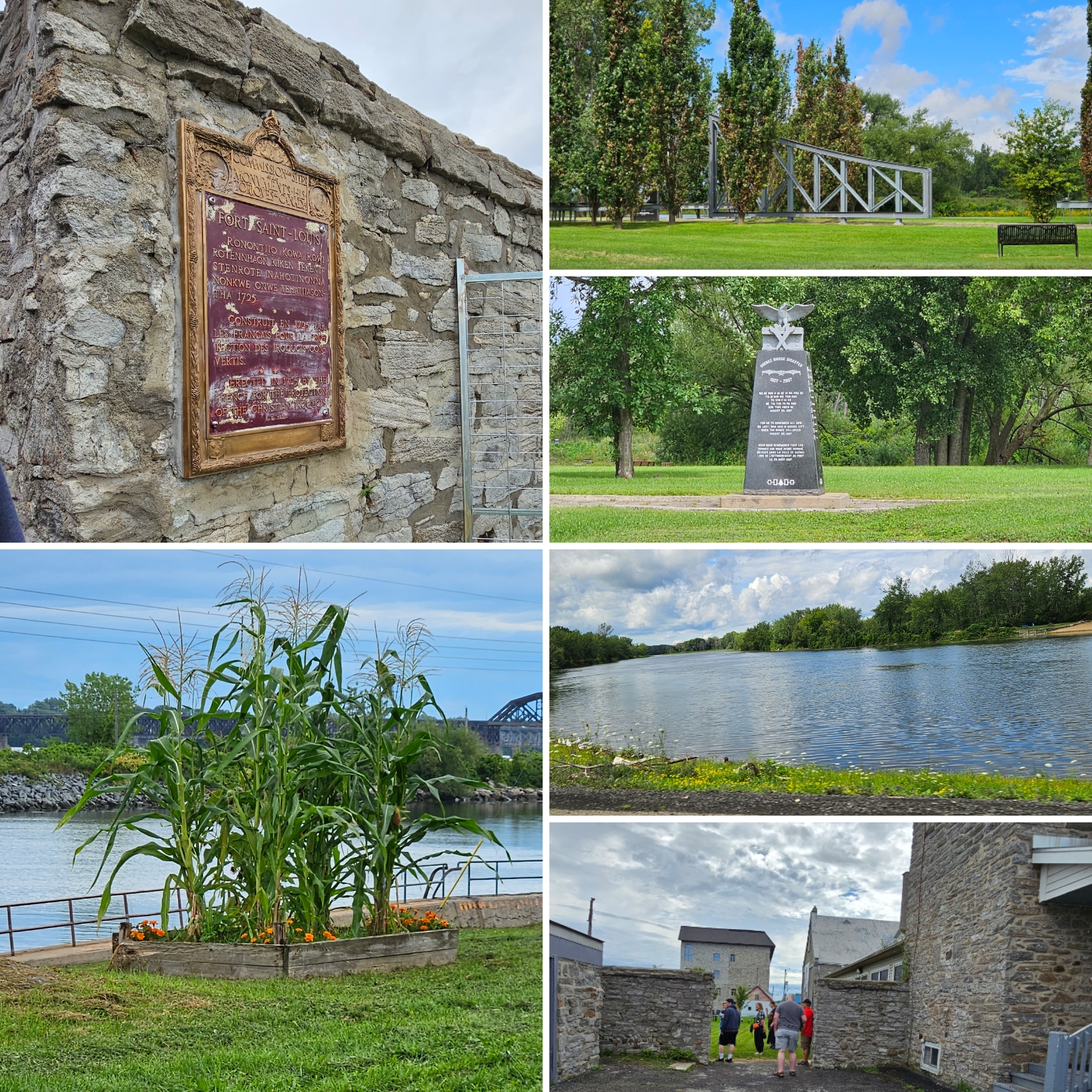
These photos are a little taste of the village. I will also share the one thing that really surprised me. The Mohawk in Kahnawake primarily speak English and Mohawk. Their street signs and stop signs are in those two languages. I thought the second language would be French. As I said, there is always something new to learn.
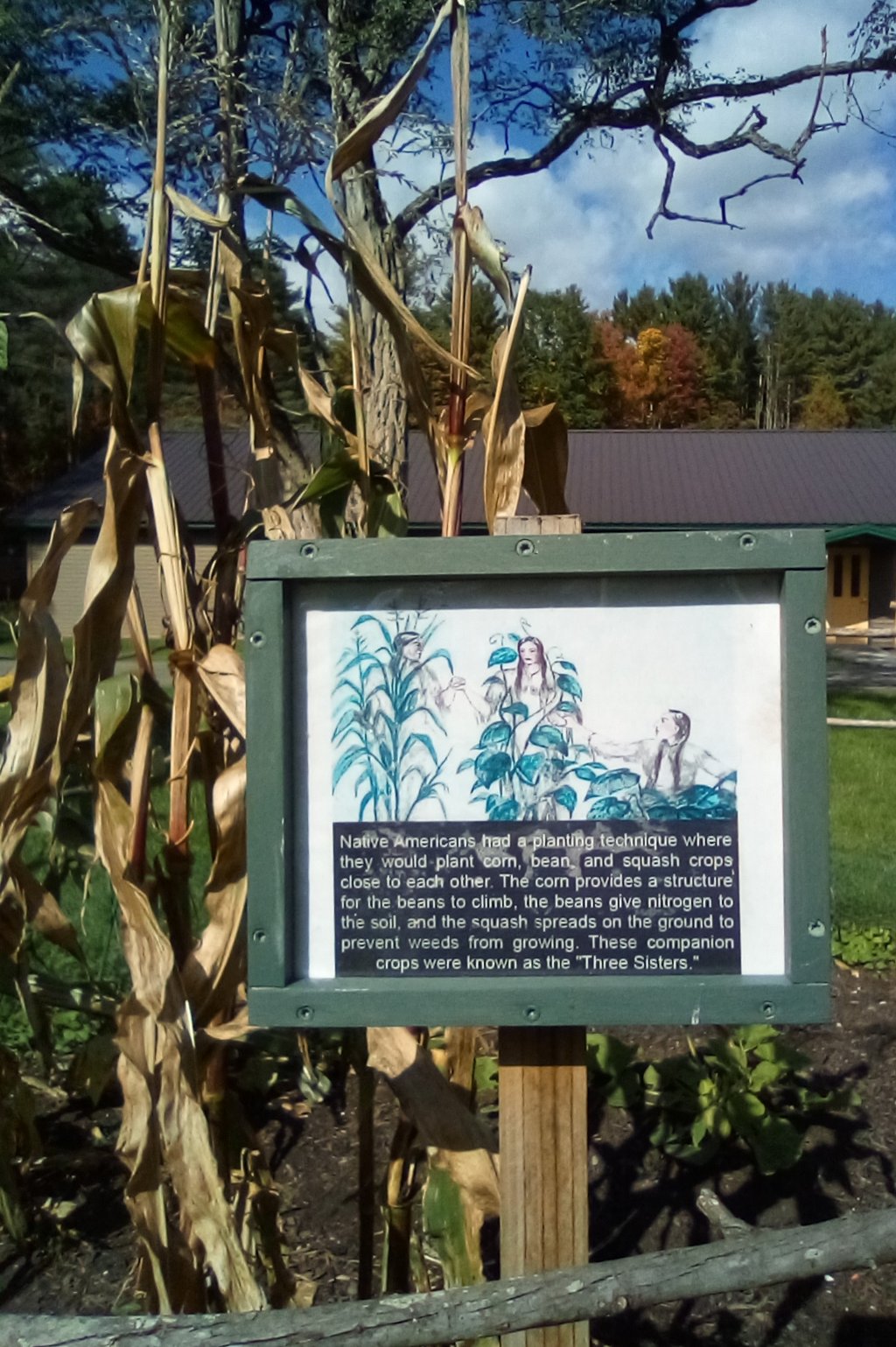
From the top, clockwise: Original wall of the Fort Saint Louis, Replica of the Quebec Bridge, Memorial to those who perished in the Quebec Bridge Disaster, part of the St. Lawrence Seaway, the back of the St. Francis Xavier Mission Church, what I presume are the Three Sisters, which are grown on Mohawk land. Kahnawake, Quebec. (c)2023
I just wanted to add one or two notes about the above photos:
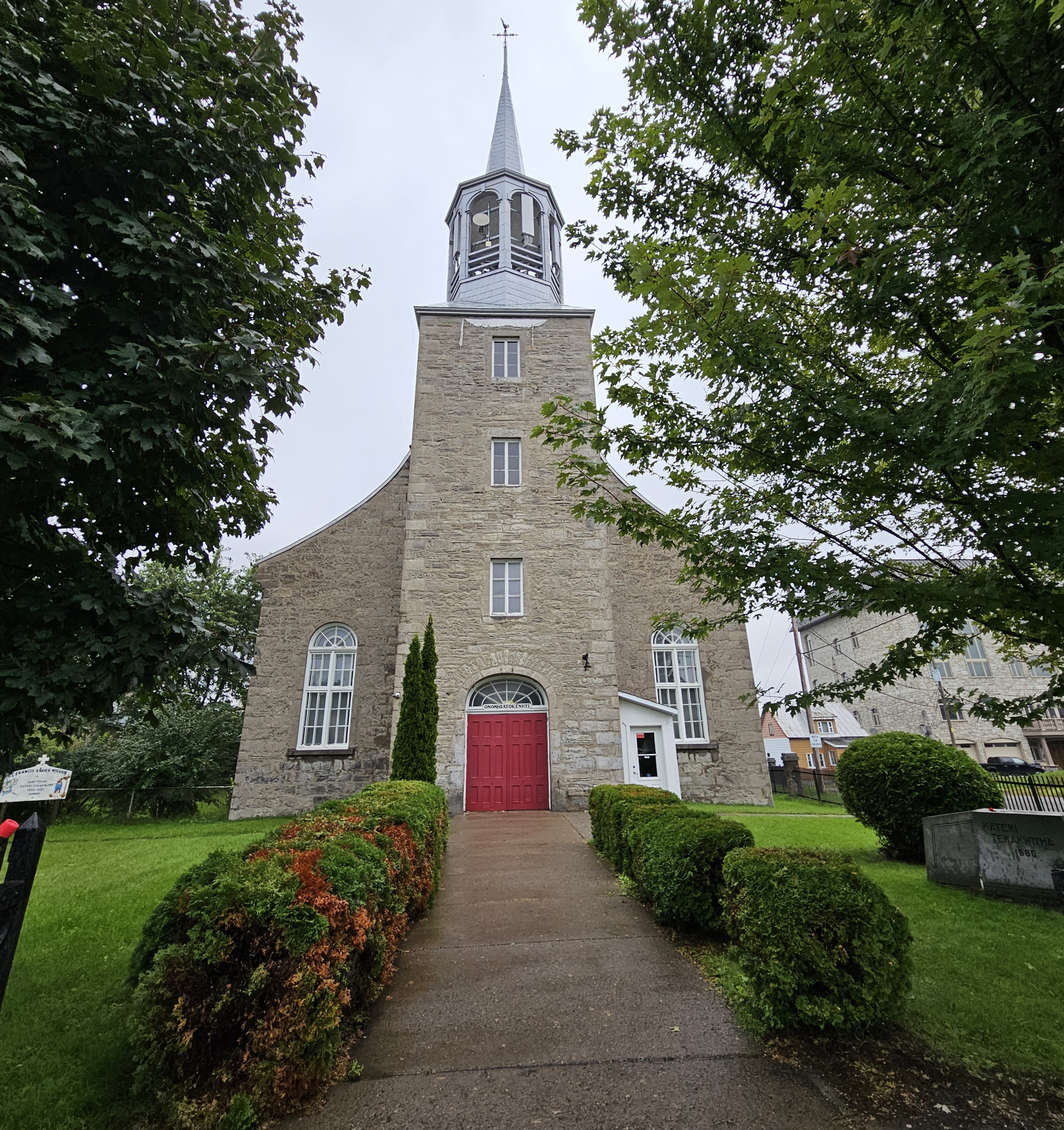
The St. Francis Xavier Mission Church moved with the Mohawk. It moved four times, I believe, before it settled permanently here and was built as a permanent structure in 1716. St. Kateri’s relics were moved here in 1973.
The Quebec Bridge Disaster killed 32 Mohawk ironworkers from Kahnawake. This left 25 widows and over fifty children fatherless. The compensation from the Canadian government was negligible. The Clan Mothers decided from then that so many members from one family could not work on such a dangerous job.
The Canadian government changed how the St. Lawrence River flowed, so it moved it away from Kahnawake and left the still St. Lawrence Seaway. The River was more profitable and was able to accommodate boats and fishermen as the Seaway was not. This is still an issue today.
The Three Sisters are known to the Haudenosaunee as the most important crops, sacred, and include corn, beans, and squash. They grow together in the same area and help each other thrive.
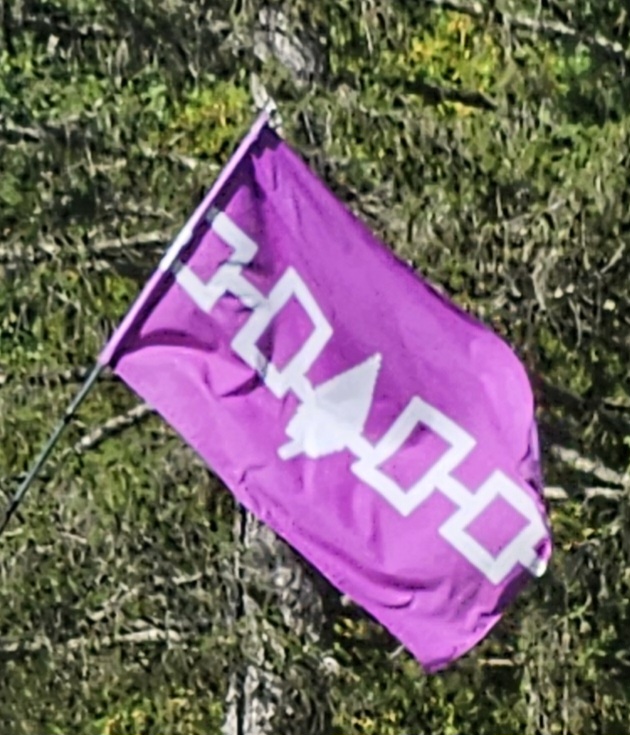
Haudenosaunee Confederacy Flag, which is a depiction of the Hiawatha wampum belt. (c)2023
Front of the St. Francis Xavier Mission Church. Kahnawake, Quebec. (c)2023
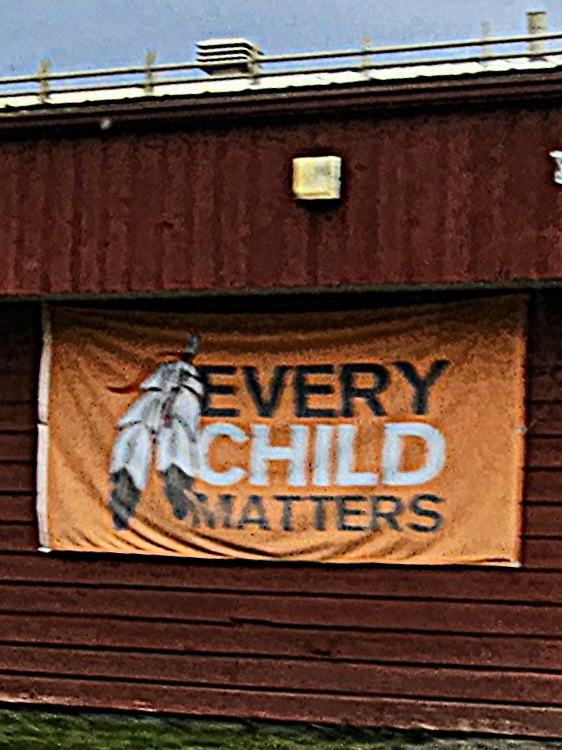
Signs and flags of Every Child Matters on orange are seen in many places. Despite Canada’s Truth and Reconciliation Committee, there is still much to be answered for. (c)2023
On the Coloring Sheets page, there is a new sheet for Indigenous Peoples’ Day which is today. Below I will explain what each square represents. I’m glad that we are beginning to acknowledge the people who were here long before the Europeans arrived and drastically changed things through their way of life, their diseases, their concepts of ownership, and of course, their biases, which for many remain today.
I am determined to remind myself and others that the land I live and work on once belonged to the world, and the Haudenosaunee (in my specific area) were the caretakers. They were willing to help the new settlers, and did. And I’m sure regretted it. The Europeans weren’t exactly grateful in the long run.
Wherever you live look at the names of the towns. Across this country (the US) and Canada you will find many towns and streets are named with Native American names. I like to look into some of those names and see what they mean in the various languages.
I hadn’t intended for this series on travel to wholly encompass shrines, but I was asked yesterday about visiting these two later in the summer and thought it would be a good opportunity to share their information with you.
The sites are spiritually connected by both St. Kateri Tekakwitha and the Jesuits. The site in Auriesville has a coliseum, one of the first circular churches built in the US. It holds about 6000 people. Across their 600 acres of land is a museum, one or two chapels, a grotto dedicated to Our Lady of Fatima, and Theresa’s Rosary, a rosary made of rocks embedded in the ground. I have walked and prayed this rosary on one of my visits.
There is also the ravine where Rene Goupil’s body was found. In visiting there, I found it very spiritual and a place of holiness. The way to the ravine is quite steep. On the way there are several statues and grottos to pray at as well as signs that tell the story of the Martyrs.
Prior to his martyrdom, Isaac Jogues had been held in captivity and tortured by the Mohawk (a different group) for over a year. With help he escaped in New Netherland or Albany, NY. He returned to France, where he visited his mother in Orleans (where Joan of Arc led France’s army 219 years before) and was considered a “living martyr” by Pope Urban VIII, but soon again returned to this area, longing for and meeting his martyrdom in what is now Auriesville. It had been the Mohawk village of Ossernenon. He, Jean de Lalande, and Rene Goupil were tortured and killed here. Jogues weighted Goupil’s body and placed it in the water of the ravine in order to return and bury him properly. He did return, but he was gone. He later found some of his body parts, and reverently buried them. I’ve heard others say that the ravine itself is a reliquary. As I said, the spirituality felt here is palpable.
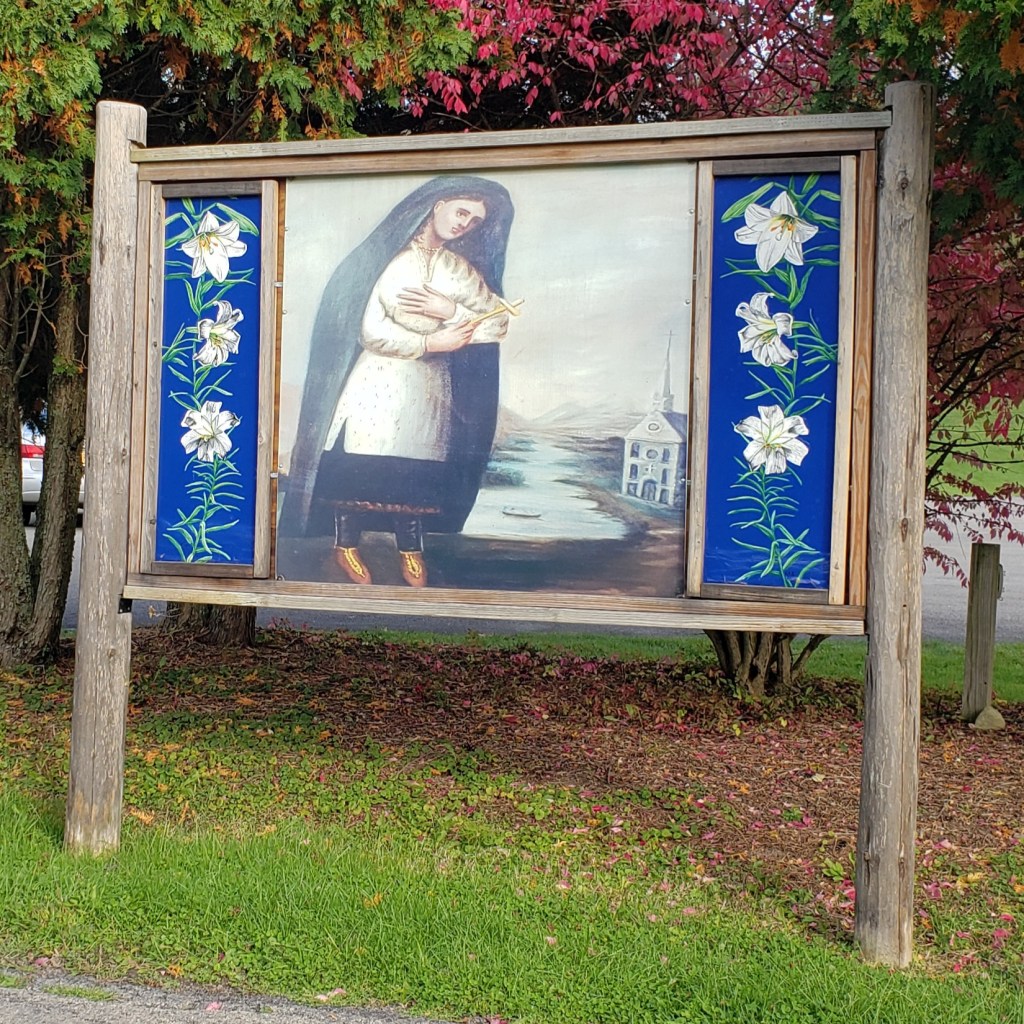
At this same village, ten years after their deaths, Kateri Tekakwitha was born. She became ill with smallpox and both of her parents died. She was scarred, and it was difficult for her to see, needing to put her hands out and feel her way. Her name Tekakwitha translates into she who bumps into things. Her mother had been baptized Catholic and educated by the e missionaries. Her village moved from Ossernenon across the Mohawk River and rebuilt their village, named Caughnawaga, which means place of the rapids. She was bullied for practicing her Catholic faith. She refused to be married, and that did not make her popular within her adoptive family and aunts. She also practiced mortification, praying for the conversion of her family and for forgiveness.
Her name Kateri is for her baptismal name of Catherine, which she received after her baptism at the age of 19. It took me several years, but I was able to walk to the spring (it’s a bit of a steep incline) from the village footprint that archeologists uncovered. Her Native people still felt that the Catholic religious rituals and items were sorcery and opposed her conversion. At some point after her conversion, she was helped to leave and went north to the new Mohawk village where other Native converts had gone. This village was also named Kahnawake (this is the Mohawk spelling), just south of Montreal. She died in 1680.
When I visited her empty tomb (where she was first laid to rest until her relics were removed to the St. Francis Xavier Mission Church on the Mohawk land), the sound of the rushing water nearby was nearly deafening. I have had so many spiritual experiences in visiting the sites of Kateri and her people that it only makes me more in awe of the Holy Spirit.
For those who are not religious, but want to visit a pastoral, serene, place of comfort, both shrines offer that in the beautiful Mohawk valley. The sights and sounds are lovely, and it is easy to get lost in your own thoughts. Of course, that’s until the train comes roaring by, but that is in its own way an affirmation of the space we are in.
National Shrine of the North American Martyrs Auriesville, NY
Open May 1 – October 19, 2023 Hours: Grounds: Open daily 9-7 Museum: Open daily 11-3:30 Gift Shop/Visitor Center: Open daily 10-3 There is no fee for admission or parking. If you are interested in attending mass or other events, visit their website.
National Shrine of the North American Martyrs. (c)2023
St Kateri Tekakwitha, National Shrine & Historic Site Fonda, NY
Summer Season: May 1st to October 31st Hours: Grounds are open sunrise to sunset daily. Saint Peter’s Chapel and Native American Museum open daily, 9-5 Gift shop open: Sat, 10-6, Sun – Wed, 9-5, Thurs – Fri, 10-4 Office open daily 9-4 Candle Chapel, Caughnawaga Village Site, Kateri Spring and grotto, outdoor sanctuary, and hiking trails are open sunrise to sunset year-round. If you are interested in attending mass (scroll down at the link) or other events, visit their website.
St. Kateri Tekakwitha statue with a sign of her last words: Jesus, I love you! (c)2023
Two weeks ago, I was privileged to attend Mass at the St. Kateri Shrine in Fonda, New York. It was a dual celebration: today is ten years since the canonization of St. Kateri Tekakwitha, the first Native American saint. The celebration on October 9th was held on Indigenous Peoples Weekend, acknowledging the history and legacy of the Native peoples who were already living and thriving in the Americas at the time of Columbus’ landing in what is now the Bahamas.
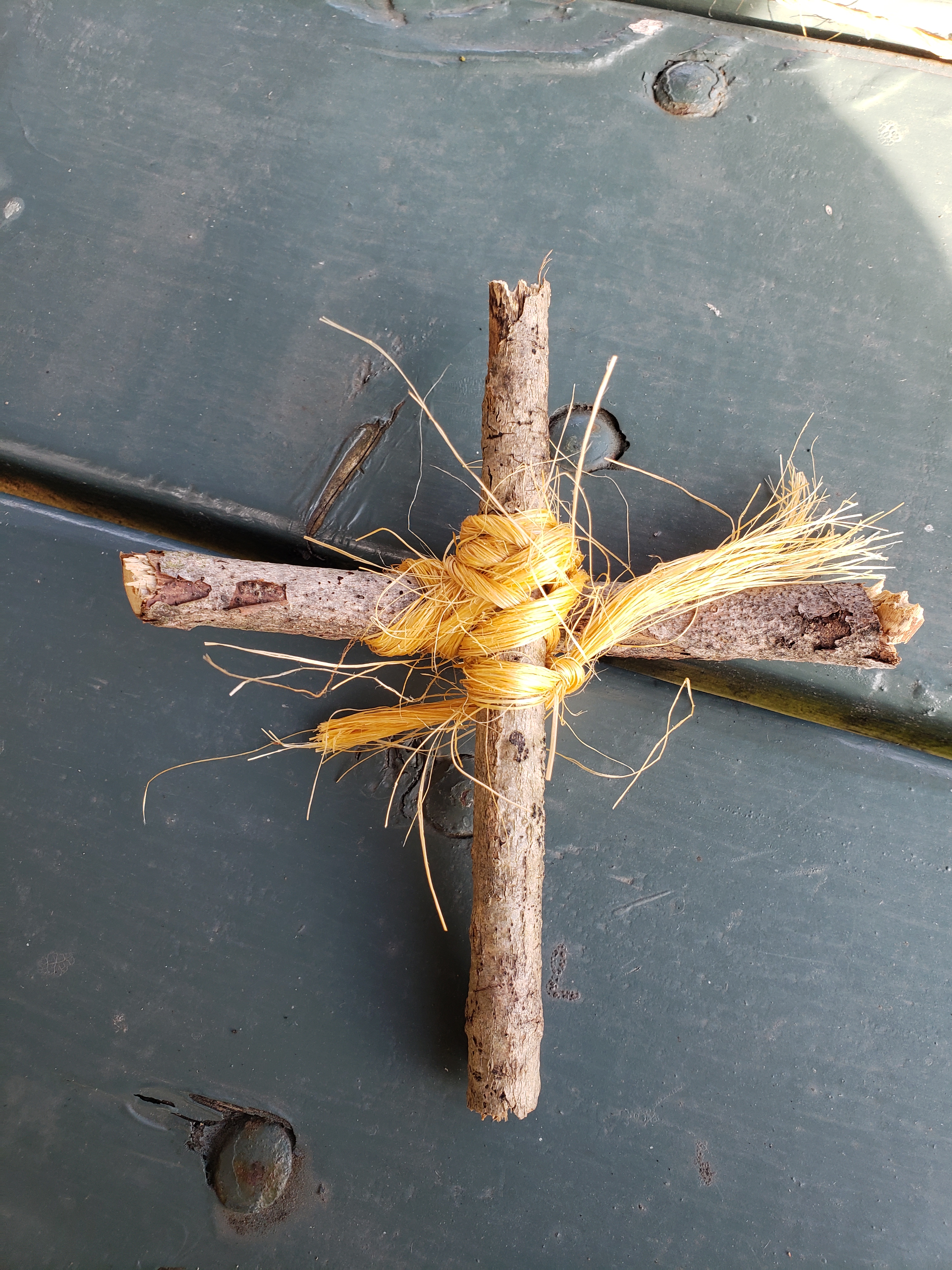
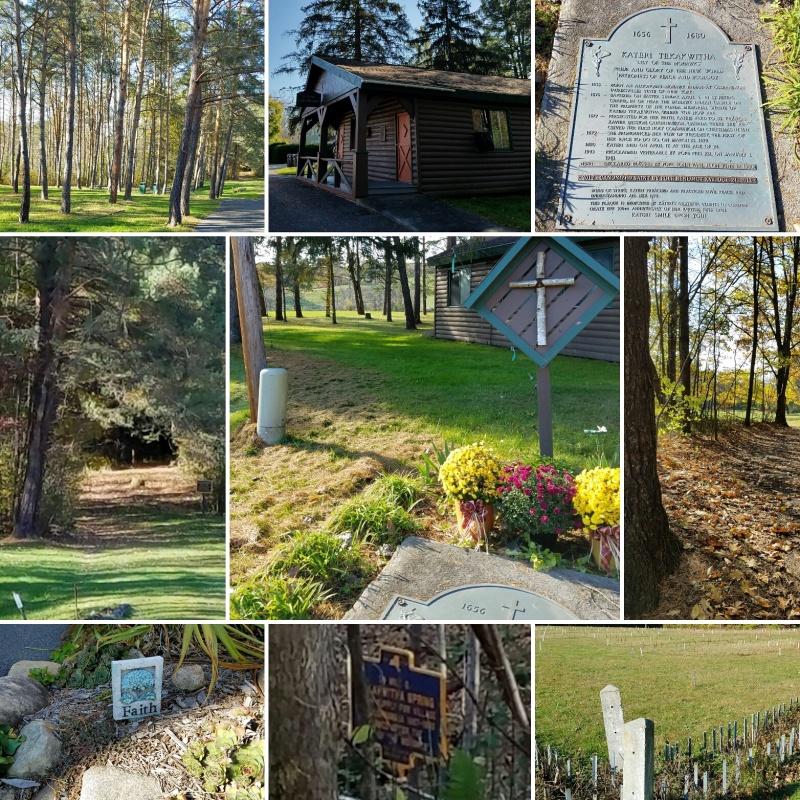
It was a chilly, fall day with bright blue skies and vibrant, colorful leaves, mostly still waving from their branches. Mass was held outdoors in the pavilion, a roof the only cover from the elements. As mass is celebrated, an occasional breeze flutters in, and really reminds you of Creation and the Creator. I had time before the mass and so I wandered the grounds a bit, spent some quiet time in the candle chapel, contemplated the words of Handsome Lake, an Iroquois Prophet whose words appear in the Peace Grove; I made a small cross from sticks and twine, reminiscent of St. Kateri’s own according to the sign on the table.
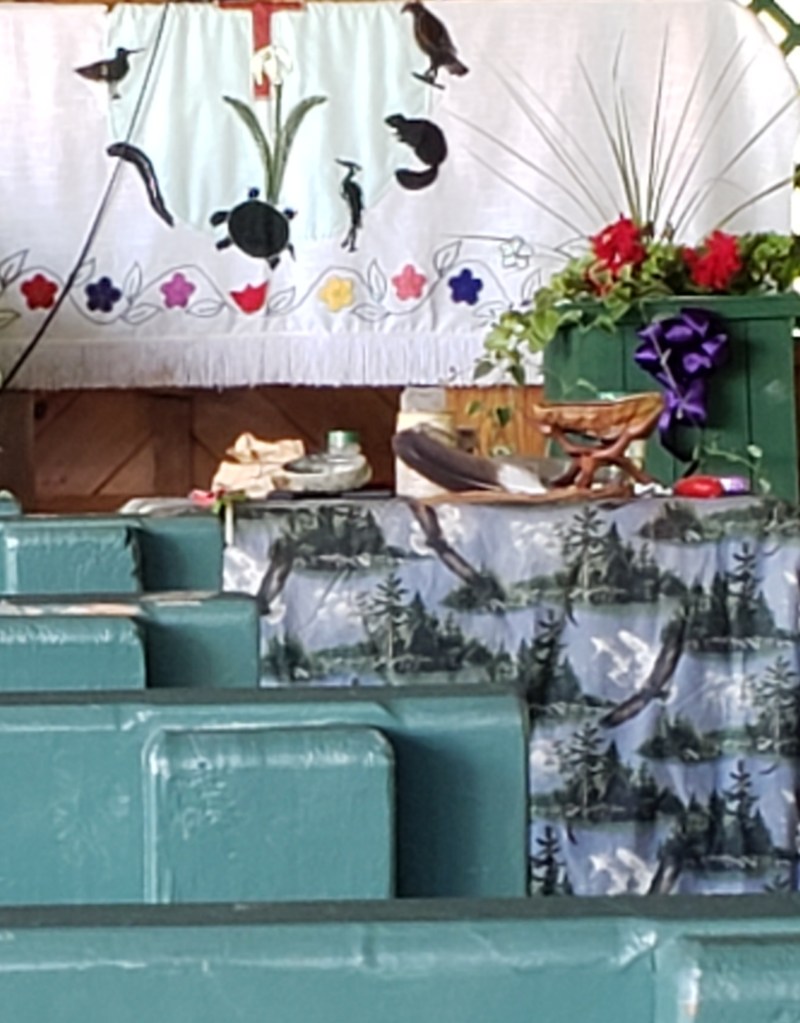
But mostly, I simply settled in with a subdued awe in the anticipation of the mass, the quiet celebration of Kateri’s canonization and difficult life that she never shunned from nor complained about. My eyes were drawn constantly to the bright colors of the Native dress, the feathers adorning and the large eagle feathers carried and used for the Mohawk rituals.
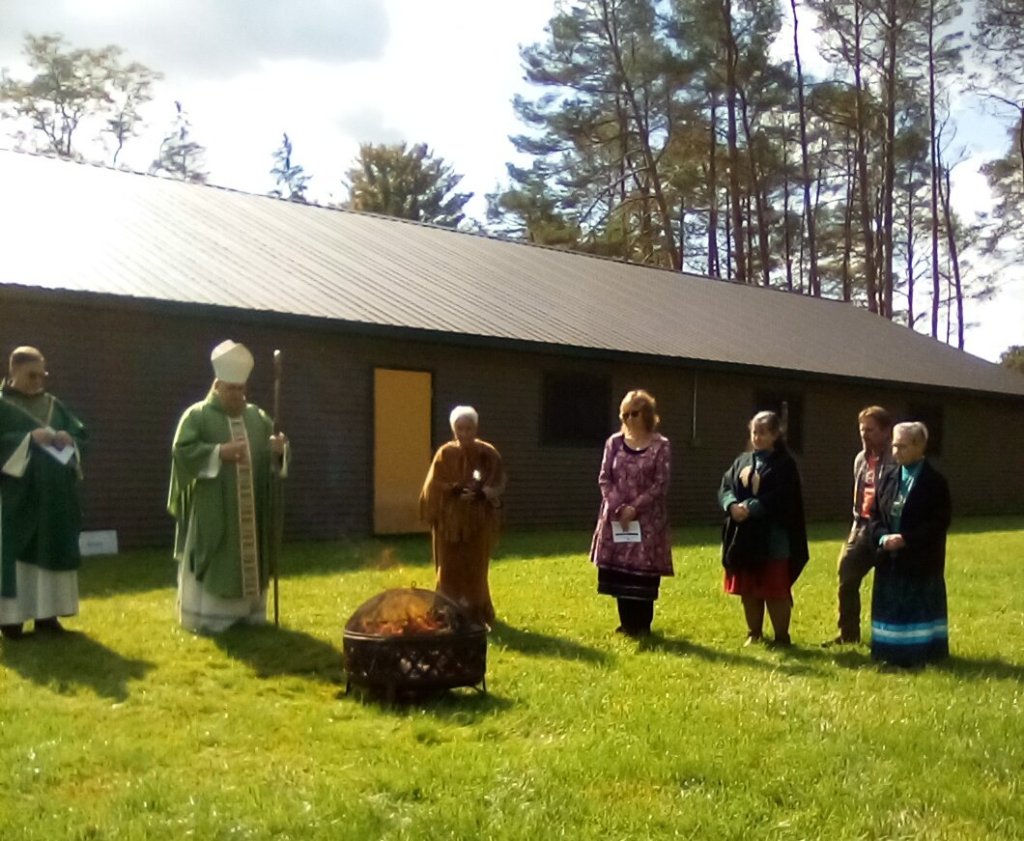
Between the Greeting and the Liturgy of the Word was the Sweetgrass Blessing, the burning of plants and herbs, assisted in its smoking by the motion of the eagle feather. We were invited to proceed up, as if for communion to receive the smoke. I felt as though I was part of something bigger, something ancient, and of course, I was, and I felt honored and humbled to be there. The four sacred plants used in Mohawk ceremonies are cedar, tobacco, sweetgrass, and sage.
Throughout the mass whenever hymns or songs were presented they were by the Mohawk Choir of Akwesasne. I couldn’t understand the words but the meaning was clear. Their voices carried on the wind and through the chapel and transported me far away and very near.
Sister Kateri Mitchell, who played a part in the 2006 miracle for St. Kateri Tekakwitha’s elevation to sainthood was there to share the prayer of the faithful and to talk about the miracles associated with the saint. I have met her before and was happy to see her and talk to her briefly on this day.
Following the mass, there was the annual burning of the prayer petitions. The Bishop said the prayer over them and that concluded this remarkable day.
I have found that attending mass in other cultures deepens my own faith and commitment to my own prayer and meditations. I have included some links throughout this post in the hopes that you will read more about St. Kateri Tekakwitha and her people and their journeys.
Takwaién:a karonhiá:ke tehsí:teronTakwaién:a karonhiá:ke tehsí:teron Aiesahsén:naien Aiesawenniióhstake Aiesawennaráhkhwake nonhwentsiá:ke Tsi ní:ioht né karoniá:ke tiesawennaráhkhwa Takwá:nont né kenwénte Niationnhéhkwen, nia'tewenhniserá:ke Sasa'nikónr:hen né ionkwarihwané:ren Tsi ní:ioht ní:'i tsonkwa'nikór:henhs Bothé:nen ionkhi'nikonhrasksá:tha nón:kwe. Nok tóhsa aionkwa'shén:ni né karihwané:ren Akwé:kon é:ren shá:wiht né io'taksens Asekenh í:se sáwenhk né io'taksens Asekenh í:se sáwenhk né kanakeráhsera' Ka'shatstenhsera, kaia'tanehrakwáhtshera Tsi nienhén:we e'thó naiá:wen
I would like to acknowledge the land where I live is the traditional and historic land of the Haudenosaunee, specifically the Mohican [Eng.] or Lenape and the Mohawk, known as Kanienʼkehá꞉ka in the Mohawk language.
The Haudenosaunee have been known in New York as the Iroquois and the Mohawk are the Keepers of the Eastern Door, traditionally guarding the Iroquois Confederation from eastern invasions.
In acknowledging the land I am on, it is an attempt to come to terms with the violent history of the European settlers and immigrants who did not understand the way the Native peoples viewed the land and in many cases simply did not care.
We, and they are the caretakers, not the owners of the land, and it is important to recognize that and move towards the future with respect and compassion while acknowledging our collective past.
I spent today praying at the St. Kateri Shrine. There was Catholic Mass and a celebration of miracles attributed to St. Kateri. This was also in recognition of Indigeneous Peoples Weekend as well as commemorating the tenth anniversary of the canonization of St. Kateri Tekakwitha.
Tomorrow, I will share some photos from that beautiful time. It was full of Mohawk tradition, language, music, and spirituality and grace. It left me in a better place.









 Griffins and Ginger Snaps