Inspire. December. Chanukah.

Standard

I’ve been searching for the write inspiration for December, and this first night of Chanukah brought things into perspective. A little bit of perspective. While the internet and the news are filled with antisemitism and protests from people intent on gaslighting the Jewish experience and deny Jewish people the indigeneity of their homeland, I have been on a quest to celebrate Chanukah publicly. I’m a little wary about it. I live in a nice neighborhood, but I don’t put my head in the sand and think that it couldn’t happen here. I know it can.

Still….

I went out and bought blue and white lights for outside, something I’ve never done. I have an interactive menorah hanging on my front door, again, something I’ve never done. In fact, since I’ve been on my own (and with my own family) I have not put Chanukah lights in the window. That unfortunately will continue because I know that if I put candles on my windowsill, my mother would come back from the grave and blow them out with a raucous, and loud message of fire safety.

Most people don’t know the story of Chanukah; perhaps some teachers wanting to bring multiculturalism to their classrooms, and now the story of the Maccabees is being co-opted to match the narrative, anything to turn the words of Jews and their history against them. The Festival of Lights isn’t about war. It isn’t about victory. It is about faith. The miracle isn’t that the Maccabees won against their most recent oppressor. The miracle is the lights themselves. When we retook the temple, amid the destruction, they went to light the candelabra to rededicate the temple, the menorah – not the nine-branch one that most are familiar with, but the regular, ordinary menorah that is always lit in the temple. There was only enough oil to keep it lit for one night. There was no other oil. So, what did they do? They lit it anyway.

And it remained lit, not one night, not two, not three or four, not even five or six or seven, but it remained lit for eight days. One day’s oil lasted for eight days. That is the miracle. And that is why we light eight candles on a new type of menorah used just for this holiday: a hanukkiah.

Tonight, I will say the prayers (that I don’t normally say). I will fry the latkes in oil. I will fry the chicken in oil. I will light the first candle on the same menorah that I lit as a child; the one that I grew up watching the candles burn down on the dining room table that was my grandmother’s. It will be placed on that same dining room table in my own house. My kids will see the lights on the same menorah, the same table, and they will be able to see through my eyes, even amidst the clutter that seems to grow multi-generationally on this dining room table.

This year, however, this old menorah has a special, additional meaning. I saw this menorah in Toronto at the Royal Ontario Museum in their Judaica exhibit, in the Chanukah window. A copy/replica of MY Chanukah menorah sits in the largest museum in Canada. The exhibit label states that it is from Gdansk, Poland, brass, from the early 1900s.

Happy Chanukah.

My family menorah.
(c)2023
Royal Ontario Museum Judaica Exhibit.
Hanukkah menorah, “Danzig” type,
Gdansk, Poland, early 1900s.
(c)2023
Ready for sundown.
You can view it lit later tonight on Instagram (link in sidebar).
(c)2023

St. Francis Xavier Mission Church in Kahnawake, Quebec

Standard

When I was studying Catholicism and becoming Catholic, I wanted to know which saint shared my birthday. As it turned out, when I discovered that “my birthday saint” was St. Francis Xavier, I was a little underwhelmed. Every time I said his name I thought of Rufus Xavier Sarsaparilla, and I thought couldn’t I have had a better saint.

I bemoaned and ignored him, later discovering him as a follower of St. Ignatius of Loyola, who’s Spiritual Exercises and Daily Examen I was also looking into. Still, I was unsatisfied. I think I wanted someone like Joan of Arc or Mary Magdalene.

When I became interested in and devotional to St. Kateri Tekakwitha, a very local saint and the first Native American canonized saint, I wanted to visit her homes and her shrines. I’ve often been to Fonda, where she lived for most of her life, and tried to visit her tomb in Quebec. However, it was during covid, and they weren’t allowing non-parishioners or pilgrims to visit the shrine.

Where exactly is her shrine in Canada?

Kahnawake, Mohawk Territory at the, wait for it, St. Francis Xavier Mission Church.

Really. Her earthly bones, her relics are laid to rest in the church dedicated to “my birthday saint”. A truly remarkable and at the same time ordinary coincidence.

I’ve been to Kahnawake three times. The first was during that covid time when we could only explore the outside. And then this past summer, I was able to visit Kahnawake twice. The first time we visited, we knew the church would be closed on the only day we had available, but we did attend a tour of the village through the Kahnawake Tourism Center. We received a very detailed and informational tour about the area, the Mohawks past and present, St. Kateri, and a bit about the mission church. On our next visit at the end of August, we were able to not only visit and see the inside of the church, we were also able to attend mass, see the original and earliest painting of Kateri by Father Claude Chauchetiere (one of the Jesuit missionaries at the time) as well as her relic that was removed from the vault for us to observe and venerate (if we chose to).

This mission church is a permanent building and was erected in 1716. Before that it was a moveable mission that traveled with the Mohawks beginning in La-Prairie-de-la-Madeleine. They moved a total of five times each time their mission church was constructed the same as the other Mohawk buildings until this last time in its permanent location. St. Kateri’s remains were entombed here in 1972.

Inside the church, in addition to St. Kateri’s tomb, are two memorials: the first is to the Mohawk men lost in the Quebec Bridge disaster in 1907, and the second is an ironwork replica of the World Trade Center’s Twin Towers in honor of 9/11. Both are on the main altar. It should be noted that the Mohawk are known for their ironworking skills, and were large parts of crews building not only the World Trade Center, but the Empire State Building as well in addition to many other high-rise buildings and skyscrapers across the area.

[Photos below cut]

Continue reading

Happy Thanksgiving.

Standard

With my ongoing research into St. Kateri’s life, I thought instead of a retelling of the first Thanksgiving today, I would set my table with the First People in mind, sharing with my family the Three Sisters as the Mohawk call these three plants that grow side by side: corn, beans, and squash.

My table setting.
(c)2023
Sign about the Three Sisters at the St. Kateri Shrine in Fonda, NY.
(c)2023
The Three Sisters.
St. Kateri Shrine, Fonda, NY.
(c)2023
The cake plate I used was a wedding gift from a friend who worked at the Jewish Museum in NYC. I like to blend our cultures in our interfaith family, and this was one way to join two ancient peoples and their symbols.
(c)2023

Native American Heritage Month – Beginnings & Endings

Standard

The photo below represents both the start and the end of the day.

Beginning with the end, I have slept with a Dream Catcher for most of my life. I notice a change in my sleep when I don’t sleep with one. It creates a calm and peaceful rest as it catches the bad and lets the good continue through. This particular dream catcher is one I got in Niagara Falls, Canada. I was drawn to the colors of the beads that represent the four directions as well as the uniqueness of the center stone.

The booklet is something that I was more recently introduced to through Mohawk Elder Tom Porter of the Kanatsiohareke Community in New York. Since then, I’ve seen it in other Haudenosaunee writings and readings. It is called the Thanksgiving Address, but it has nothing to do with the Thanksgiving holiday, but in giving thanks for all that is around us in the natural world, all that we have, all that we see. It is said at the beginning of all important gatherings, ceremonial and/or governmental. The Haudenosaunee call them the Words Before All Else.

I recently used a form of this address for a meditation that I was tasked to share, and it was very well received. I read mine, but most are recited and because of that they are often never the same twice since the words change with the speaker and the timing of the gathering.

As I said at my own (non-Native) gathering, as a shared meditation, I acknowledged the land we were standing on (Mohawk), and reaffirmed that I am a non-Mohawk, non-Native, sharing their wise words.

All Saints Day

Standard

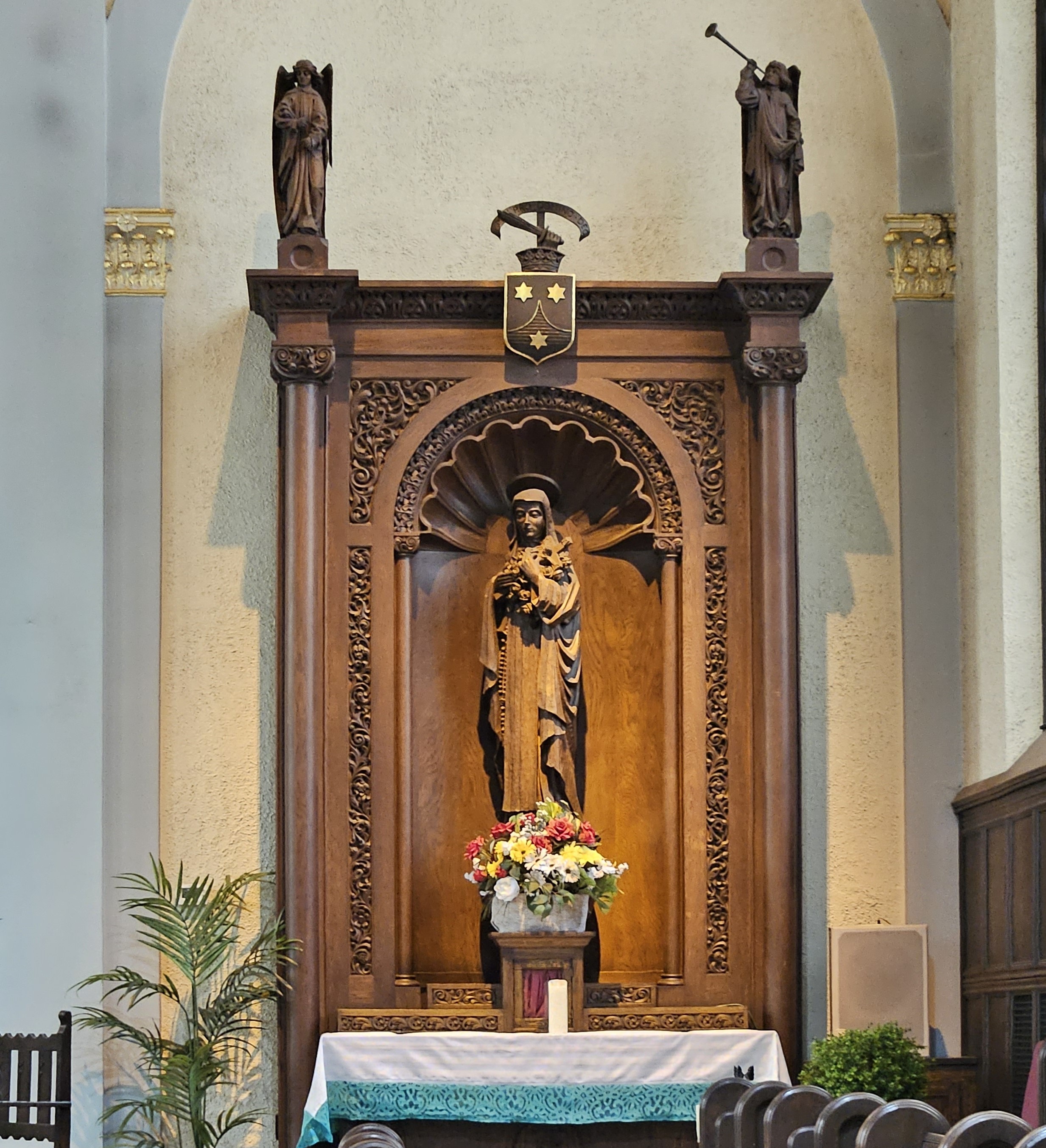
I’ve written before about the saints in my spiritual life. The photo below shows the three I considered for my confirmation saint (next Easter it will be ten years!): Joan of Arc, Kateri Tekakwitha, and Elen of Caernarfon as well as a fourth devotion, Mary, Untier of Knots. I had hoped to have a new prayer for the St. Elen card I sketched, but it wasn’t ready for today. I hope to share it in the next week.

Who are the saints you ask to intercede for you in prayer?

(c)2023

Terry and Darlene Wildman and Rain Song

Standard
From their website.
(c)2023

I’ve mentioned earlier in the year about a retreat I went on in June, which had stayed with me for weeks, and now, for many months. It still reverberates in me. I was privileged to be in attendance as it was guided by Terry and Darlene Wildman. Terry and Darlene are known for their music, which ironically, I did not know until they arrived and began playing and singing.

The retreat was primarily centered around the First Nations Version of the New Testament, and the weekend was filled with music, Scripture, prayer, Native American spirituality and ceremony, and really good, deep conversation.

When I awoke on the first morning, I knew that there was something special about this weekend retreat. I was awake early; not drowsy, and ready to start my day. I was reinvigorated. This is very unusual for me. While I’m very comfortable at this retreat house, I can never quiet my mind down enough to sleep at a reasonable time. On this weekend, this retreat gave me the exact opposite experience. I went to sleep every night before midnight (sometimes long before) and woke up refreshed at around seven in the morning, without an alarm, and with the sunrise shining out of my window.

The evening before and again on that first morning, we went into the warm courtyard where a sacred fire was burning. Darlene held an abalone shell with burning sage, smoke rising, guided by a large feather. We prayed in the seven directions, and then each of us had the opportunity to purify ourselves with the smoke, using our hands to bring it in, while the feather helped the smoke. I think we also had the opportunity to add a pinch of tobacco to the fire.

This table held the sacred plants for smudging and purifying: braided sweetgrass, sage, cedar, and tobacco as well as a large feather, traditionally an eagle feather along with an abalone shell to hold the smoking sage.
(c)2023

It was a very profound experience, and it enhanced the rest of the prayers that we each would do that day. I found it very natural and complementary to my own rituals. It was a wonderful experience.

In the months since, I’ve immersed myself in local Native American history. I haven’t changed my religion or coopted anyone else’s, but I have found a place in my daily readings for the First Nations version. I read from this Bible every day in June and continue to do so during my weekly prayer time. While I was on vacation, I recorded the daily readings in my notebook, and took photos of those pages to bring with me for my daily prayers.

I spent time with other experiences of Native American spirituality and storytelling, reading a book by Mohawk Elder Tom Porter, and completing a historical account of Wounded Knee. I’ve also spent time in the museum at the St. Kateri Shrine in Fonda, examining the Caughnawaga archaeological site, and touring the Mohawk village of Kahnawake in Quebec. Next year, I plan on attending the Strawberry Festival in Kanatsiohareke, just west of Fonda, New York.

All of this was a direct result of that holy weekend.

I’ve spent weeks listening to the music of RainSong, the music of Terry and Darlene whenever I get into the car. I sing along and it brings me back to that weekend and the feelings of being closer to G-d, and of being uplifted spiritually. My favorite CD so far is Hoop of Life, which has many of the songs that Terry and Darlene shared with us on our weekend.

Use the links throughout this post to meet Terry and Darlene and find your own way to their wonderful sounds.

Indigenous Peoples’ Day

Standard

On the Coloring Sheets page, there is a new sheet for Indigenous Peoples’ Day which is today. Below I will explain what each square represents. I’m glad that we are beginning to acknowledge the people who were here long before the Europeans arrived and drastically changed things through their way of life, their diseases, their concepts of ownership, and of course, their biases, which for many remain today.

I am determined to remind myself and others that the land I live and work on once belonged to the world, and the Haudenosaunee (in my specific area) were the caretakers. They were willing to help the new settlers, and did. And I’m sure regretted it. The Europeans weren’t exactly grateful in the long run.

Wherever you live look at the names of the towns. Across this country (the US) and Canada you will find many towns and streets are named with Native American names. I like to look into some of those names and see what they mean in the various languages.

Continue reading

St. Therese of Lisieux

Standard

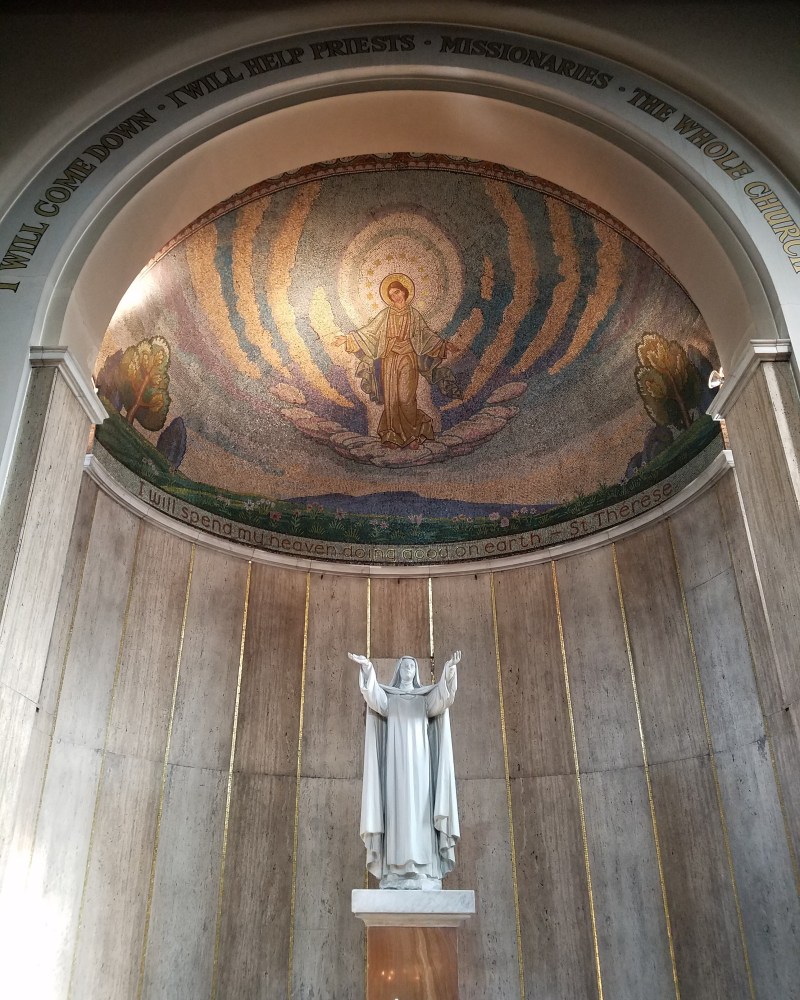
Shrine of St. Therese of Lisieux.
Niagara Falls, Ontario, Canada.
(c)2023

Next weekend marks the second anniversary of the death of my priest. In some ways it feels like yesterday and in others it feels like decades since he’s gone. I don’t know if it’s been a disadvantage or an advantage coming into the church so late in life that I’ve only had one priest up until recently. He was a guiding force in my welcome and acceptance in the parish and the Catholic faith, borne from his being Christ in the world through love, care, and guidance.

This weekend holds two saints’ feast days that I strongly relate to Father Jerry. Yesterday marked Saint Jerome’s feast and today is Saint Therese of Lisieux. Jerome was Father’s given name, so there is the obvious connection, and he held a strong devotion to St. Therese, also known as the little flower. When we visited Northern Ireland for the burial of my mother-in-law’s ashes, we stopped in Dublin, where I had the fortune to visit and pray at a shrine of St. Therese. I brought home a postcard for him, knowing that he was devoted to her. At the time, I hadn’t known that she has a much closer shrine, northwest of here in Niagara Falls, Ontario, just over the border. From that shrine at the Monastery of Mount Carmel, the roaring Falls could be heard and if you could get high enough even see the Horseshoe Falls.

The Monastery of Mount Carmel has two shrines; one inside the chapel where I attended mass, and one outside. The outside one was at the end of a path guided by plaques with many of the things that St. Therese is known for having said, culminating in a round clearing bordered by flowers, several park benches and centered with a statue of St. Therese in white marble, holding a cross and an armful of roses.

Those plaques are shared below. I hope they can be read on their own, or prayed with as you like.

Take some inspiration from her words and life.

Continue reading

Feast Day of St. Jerome (of Stridon)

Standard

St. Jerome was known for his writing. He translated the Hebrew Scriptures from Hebrew to Latin, which was unusual at the time since most people translated it from a controversial text called the Septuagint, also called The Greek Old Testament. He is the second most prolific writer of in ancient Latin Christianity. The first is Augustine of Hippo, who actually had no problem with the original Septuagint.

As a result, perhaps, he is the patron of translators, librarians, and encyclopedists as well as archaeologists, students, Biblical Scholars, and against anger, the latter of which I believe stems from his widely known bad temper.

As a student in Rome, he indulged his hedonistic side, but also attended the catacombs of Rome to visit the martyrs and Apostles there. There were early inscriptions and wall art that I imagine he studied, although he referred to the place as giving the feeling of the terrors of hell.

To put it simply, Jerome was a person of contradictions, some of which can be sourced as his being a student, a constant learner, and a voracious reader and writer. He had a group of women who surrounded him that read his scholarly works, and several were turned towards a life of consecrated virginity and the ascetic monastic life. This had a negative impact on these wealthy women’s donations, and he became at odds with the Roman clergy.

He is considered a saint in the Catholic Church (and a Doctor of the Church there), Eastern Orthodox, Lutheran, and Anglican.

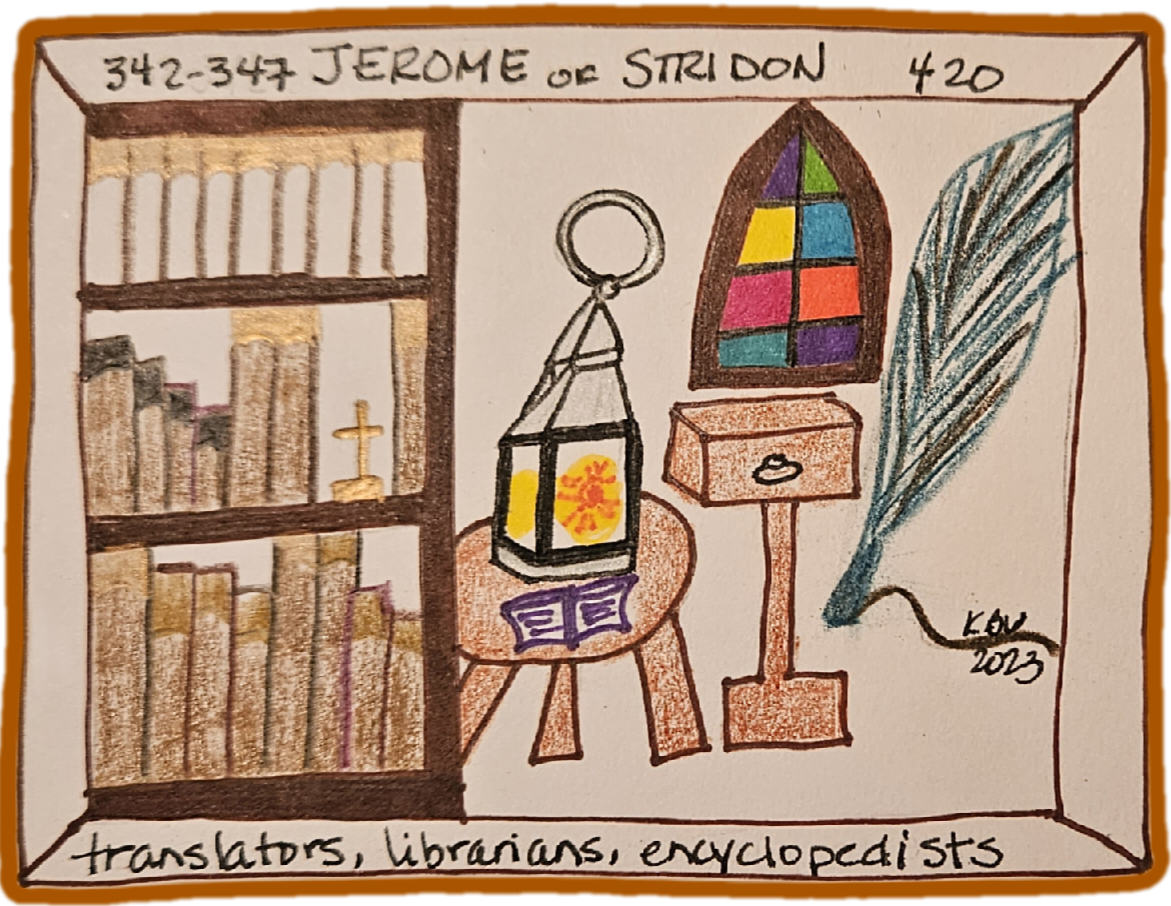
His iconography is often depicted in libraries and/or scriptoriums surrounded by books, parchment, vellum, and writing implements. He sits at a desk, holding a quill. He is also depicted with a lion having apocryphally removed a thorn from one’s paw.

In my sketch below, I have chosen to leave the lion and the saint outside the view as we look into his small cell of scholarly works.