I’m including two links. One is the original article I read: How Cornrows Were Used by Slaves [sic] to Escape Slavery in South America, which details the idea that women braided escape maps into their hair as well as messages. The second article is from Snopes that doesn’t discredit this theory despite no tangible evidence. As been told, just because we don’t know if it happened, doesn’t mean that it didn’t happen. There are many ways that African Americans used to keep themselves safe in order to survive slavery and emancipation from slavery, including communicating with each other and traveling north to freedom. Whether mythology or history, it is important to know all aspects of the African American experience from their arrival on these shores, almost exclusively involuntarily.
An additional thing that I learned in regards to language is that in South America this type of hair braiding was known as “cane rows” as opposed to “corn rows” because the crop there was sugar cane.
We are all bound up together in one great bundle of humanity, and society cannot trample on the weakest and feeblest of its members without receiving the curse in its own soul.
Frances Harper, We Are All Bound Up Together, 1866
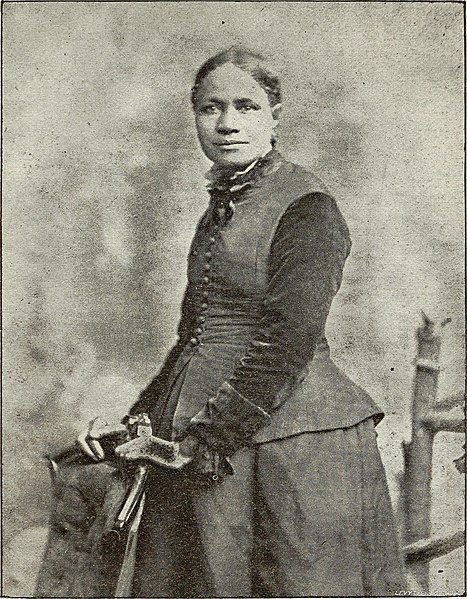
Frances Ellen Watkins Harper. Public Domain
Frances Ellen Watkins Harper was a voice of Black Suffragists. She was born in 1825 in Maryland to free African American parents. Her parents died when she was young, and she was raised by her aunt and uncle. By the age of 21, she had written her first small book of poetry, Forest Leaves and ultimately published 80 poems. More than a decade later she became the first African American woman to have published a short story, The Two Offers. She co-founded the National Association of Colored Women’s clubs.
While working as a teacher in Pennsylvania, a law was passed that free African Americans in the North were no longer allowed into Maryland, her home state. They would be imprisoned and enslaved.
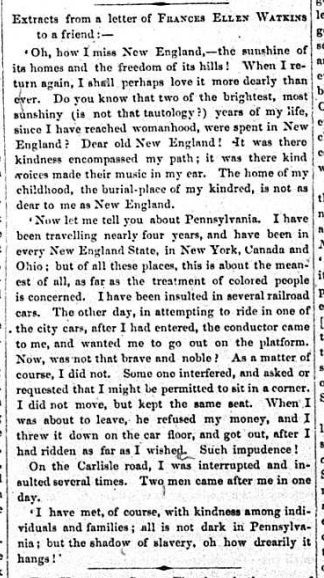
She refused to give up her seat on the trolley, and only got up when she reached her destination as chronicled in The Liberator, page 3 as seen below.
From The Liberator, Page 3 1858 Public Domain
Her famous speech, We Are All Bound Up Together, read in 1866 at the Eleventh Women’s Rights Convention held in New York City, can be read here.
She spoke at the National Woman’s Rights Convention in New York, held in 1866. The organization split over the suffrage of African American women and were opposed to supporting the fifteenth amendment. Harper left the group, and with Frederick Douglass and others supporting the amendment joined together to form the American Woman Suffrage Association. She was often the only Black woman at the women’s conferences. Through her life, she continued her advocacy for intersectionality (see- it’s not a new idea) in suffrage.
She spent the remainder of her life teaching and encouraging equal rights and education for African American women and founded and/or directed several clubs and organizations for African American women, including the National Association of Colored Women’s Clubs and the Pennsylvania Women’s Christian Temperance Union.
Some of her writings include:
Forest Leaves, poetry, 1845
Bury Me in a Free Land, poetry, 1858
Moses: A Story of the Nile, 1869
Light Beyond the Darkness, 1890
In Memoriam, Wm. McKinley, 1901
Trial and Triumph was one of three novels originally published between 1868-1888 as a serial.
Her first novel, Iola Leroy, or Shadows Uplifted was published in 1892. It was thought sentimental, but it also highlighted several serious social issues at the time, some of which remain today.
As a writer, I am always drawn to the writing lives of the people I choose to profile, and I was pleased to see that Harper was a mentor to other African American writers, including Mary Shadd Cary, Ida B. Wells, Victoria Earle Matthews, and Kate D. Chapman.
Stagecoach Mary (Mary Fields of Cascade, Montana) Public Domain
Stagecoach Mary was a mail carrier on a star route between Cascade, Montana to St. Peter’s Mission. She held two four year contracts with the United States Postal Service beginning in 1895, and received her stagecoach that she drove to deliver the mail from her friend, the Mother Superior of an Ursuline Convent, originally in Ohio, but now missioning in Montana.
I should also mention that she was the first African American woman to carry the mail (only the second woman to do so) and in her time she became a Wild West legend.
Sounds intriguing, doesn’t it?
Mary Fields was born in 1832, most likely in Tennessee, into slavery.
As times change, so does language. Since I’ve been in school and up until recently, we’ve referred to the “slaves” in the South (or elsewhere in the world). This denies the people their humanity. It tells the reader/listener that their only value was as a slave; that they are slaves at the heart of their being. But of course, that’s not true. They are people first. Men, women, and children who were kidnapped and enslaved and their children born into slavery and enslaved. These two links should help with the explanation:
She was freed with other enslaved people after the Civil War. From that time, she worked as a servant and laundrywoman on riverboats up and down the Mississippi River. She worked for the Dunne family until the wife died. John Dunne sent her to live with his sister, a nun and Mother Superior of a convent, where Mary lived and worked. She became very close with Mother Mary Amadeus Dunne and after Mother moved to Montana to mission with the Jesuits, Mary eventually followed her and helped nurse her back to health.
As if that wasn’t enough, Mary Fields wore men’s clothing, drank, smoked cigars, shot guns. She was tough and intimidating, two traits needed to be an independent contractor working alone on the frontier.
At some point, the bishop barred her from the convent after an altercation with a co-worker/colleague involving guns. To be fair, I can’t imagine that it would have been palatable for a man to be answering to a woman, an African-American woman and that may have played into some of the friction between them. Of course, it can be hard for any two headstrong people to work together.
It was then that she contracted with the Postal Service to become a star route carrier. She drove her stagecoach on the route with horses and a mule named Moses.
Star Routes were named such after their motto/mission of Celerity, Certainty, and Security in delivering the mail. They were denoted on paper with three asterisks: * * *, thereby becoming “star” routes. This name was renamed Highway Contract Routes in 1970.
She retired from her role as a mail carrier when she was 71 and lived on in town becoming one of the more popular figures of Cascade. She was praised for her generosity and kindness, especially to children. When she died in 1914 at 82, her funeral was one of the largest ever seen in the town.
She was very popular – schools closed on her birthday. When an ordinance was passed disallowing women from enjoying the saloons, the mayor exempted her. When her house burned down, volunteers rebuilt it.
Born a slave somewhere in Tennessee, Mary lived to become one of the freest souls ever to draw a breath, or a .38.
Gary Cooper, Montana native, writing for Ebony in 1959
In a companion to my recent post Black History in Film, I’m sharing the NAACPLegal Defense Fund‘s link on Black Media & Black Culture. The NAACP LDF has put together a list of over 50 works recommended by the staff of the Legal Defense Fund. It showcases their mission to “defend, educate, empower.”
This single link offers links to their recommendations with how to view, read, or listen to them.
Included in the list are books, both non-fiction and fiction as well as for younger readers, television shows, movies and films, podcasts, and of course, music, which, as a white person, I say where would we be without Black music and its influences across every genre.
Visit your local library or e-library and see what’s available.
If you’d rather buy, this link will take you to a list of 149 Black-Owned Independent Book Stores.
In addition, Haymarket Books is offering three FREE e-books:
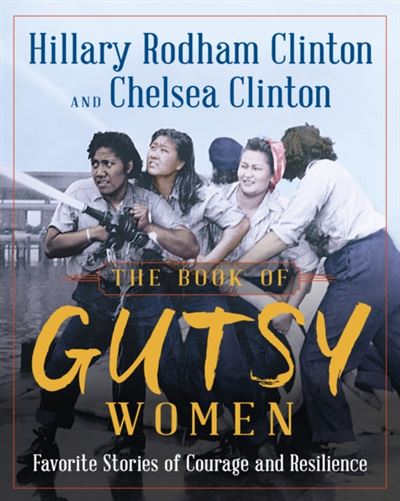
Secretary Clinton and Dr. Clinton are the perfect choices to co-author a book on women’s courage and resilience with over 100 examplesof other courageous and resilient women throughout their lives. Each profile is given respect and admiration and both Clintons strive to express how these women influenced and affected their lives. It is such an important book for young girls to see and read about those who have come before and led the way to our present. One day, some of us will be in a similar book recounting how we changed the world for the better.
I have a daughter who I would describe as courageous and resilient. She’s as kind and generous as she is self-absorbed (as all teenagers are wont to do), but while being kind, she is also someone who stands up for herself, and will not hesitate to give you her opinion. She is the best of me. I hope to be her when I grow up.
The Book of Gutsy Women can be found for purchase in any bookstore, online retailer, and as an e-book as well as borrowing it from the library. However you can get the book, you should read it. I read about five profiles a day, sometimes more.
It’s a great way to start off Women’s History Month.
It’s important to remember that one of the things left out of the abortion access discussion is that it is a freedom of religion issue. Banning abortion violates the tenets of some religions. It is also important to remind people that despite declarations of the opposite, this is not a Christian nation. It is not founded as a Christian nation, and many of us need to be reminded of that. More often it seems.
In fact, in the Treaty of Tripoli, signed in 1796 and ratified by the United States Senate in 1797, UNANIMOUSLY and without debate under the Presidency of John Adams stated that explicitly:
“…the Government of the United States of America is not, in any sense, founded on the Christian religion.”
Article 11, Treaty of Tripoli, rat. 1797
The below article was posted in USA Today on February 13, 2023. It is written by Christine Fernando and can be read here:
I’ve spent a couple of days looking at Florida’s list of banned books, and it is disproportionately authors of color. There are many with authors and references to LGBT+ issues and information, but diversity seems to be the “problem” for Florida’s governor, from banning books about Jackie Robinson and Roberto Clemente to calling the AP African-American course “contrary to Florida law” and states that it “significantly lacks educational value.”
There is a list of 176 books from one county alone. I’ve chosen a few to highlight the ridiculousness of this ban. I will say that some of the books on the list are not for all ages, but almost no book is. That is where parenting comes into play. I help my own kids choose books, and when I have a question (which I have had in the past) I speak to the teacher, and we sort it out. I try not to censor my kids, but I do if I need to base on age-appropriateness.
I will also say, in all fairness, that many of the books on the list will be returned to the school libraries after they are examined and approved. I wonder what is the point of having a professional educator and librarian who spend years becoming experts in their field only to have a parent, who has a bias against certain kinds of books make the decision for all the parents in the school system. It makes no sense. And yes, I will stand by my characterization of a biased parent. Look at some of these books (these are in no particular order, and you may google them for descriptions, but some are obvious).
Wilma’s Way Home: The Life of Wilma Mankiller by Doreen Rappaport and Linda Kukuk
Two Roads by Joseph Bruchac
Time to Pray by Maha Addasi, Ned Gannon, and Nuha Albitar [If this book was about Christian prayer, do you think it would have been questioned?]
Thank You, Jackie Robinson by Barbara Cohen & Richard Cuffari
My Mother’s Sari by Sandhya Raot and Nina Sabnami
Memphis, Martin, and the Mountaintop: The Sanitation Strike of 1968 by Alice Faye Duncan and R. Gregory Christie
The Legend of the Bluebonnet by Tomie de Paola
Knots on a Counting Rope by Bill Martin, Jr., John Archambault, and Ted Rand [These are the same authors of Here Are My Hands, and Brown Bear, Brown Bear, What Do You See?, preschool aged books that I used when I taught early-childhood.]
Dim Sum for Everyone by Grace Lin [What could this book be about?]
Celia Cruz: Queen of Salsa by Veronica Chambers and Julie Maren [In 2011, she appeared on a US postage stamp]
Brother Eagle, Sister Sky by Chief Seattle and Susan Jeffers [This is a book I used in early childhood programs often.]
Barbed Wire Baseball: How One Man Brought Hope to the Japanese Internment Camps of WWII by Marissa Moss and Yuko Marissa Shimizu
Black Frontiers: A History of African American Heroes in the Old West by Lillian Schlissel
The #1 banned book is George Orwell’s 1984. Also banned are The Dictionary, The Bible, and Anne Frank: Diary of a Young Girl.
Profiles of banned books from Carnegie Mellon can be found here.
Banned Books Week will be the week of October 1 through 7 in 2023. In 2015, according to the Banned Books Week website, nine out of ten books banned contained diverse content. What does that tell you?
If you are having trouble finding a banned book in your area, and you are between the ages of 13 and 21, you can go online to the Brooklyn Library and get their e-card that lets you take out books online, so you can read the books. Email them at: booksunbanned@bklynlibrary.org
If you are a New York State resident and teenager, you can apply for BPL’s free e-card here.
Another place to get information on banned books (and other books) is the American Library Association. They are the oldest and largest library association in the world.
Read banned books. Read all books. Speak up against this authoritarianism. We are on the slippery slope.
On February 1st, a new social media site opened for business: Spoutible.
I’ve been using it since then and it has been smooth sailing, more or less. It’s still in beta and it can be a bit slower than you might be used to on Twitter, and it glitches a little, but the team behind the scenes keeps us in the loop as things progress. The soft opening let people really find their pods, their like-minded people. I’ve found some of the political accounts I followed elsewhere, but my most positive experience thus far has been getting to know the writing community there.
I’d recommend giving it a try, kicking the tires and take a deep breath because the whale puns abound.
The biggest difference that I see on Spoutible is my timeline is filled with the people I actually follow as opposed to Twitter which has been giving me Jim Jordan, Ted Cruz, Lauren Boebert and others whose drivel I really don’t need in my life. I would understand if what I’m seeing was newsworthy, but it’s trolling by our Congresspeople. It’s sad and depressing.
Do I expect Spoutible to be perfect? No, of course not, but I kind of like the Nazi- and conspiracy theory-free zone.
I’d also recommend Post, which has been going along for a couple of months (I think) now. It’s more newsie and political, although I expect Spoutible to pick up on those topics as more new voices join up. I can be found at Post under the same handle, kbwriting.
Follow the links.
I do believe I’m done looking for more microblogging sites though.
Do what you can, with what you have, where you are.
– Theodore Roosevelt
This is a picture I took in the hotel my daughter and I stayed at right before Covid. Her brother and father were visiting friends in Florida and we stayed in New York, so I took her for one night to a hotel for her to go swimming. It was a fun time. Little did we know how much would change in the next couple of weeks. I’m sharing this photo now because I came across it and it’s been in my phone as a photo that I want to draw and sketch, so I’m including it now to give them the push to try and get it done before the next inspiring post. Wish me luck. (c)2023
January almost always starts off with a bang. I’m organized, I’ve got my calendar, I’ve planned my blog and my classes up to a point, and then around now, not quite halfway through February, it flounders.
But…
It hasn’t floundered. Not really.
I think I may have found a routine, sort of, some motivation, kind of, and even though it’s not perfect, well, nothing is, it seems to be working (for the most part).
I’m still trying to find the perfect storm of organizing while not being overly fastidious and ridiculously detailed.
I’m sitting at my desk (read: dining room table that was actually cleaned last night for dinner, but is currently not even remotely close), surrounded by folders, papers, planner, notebooks, car keys (which actually have a home, but are not there at the moment), and my cell phone.
I have a meeting in ten minutes, and I’m still trying to get this post halfway done so I can put it up tomorrow (Wednesday). It would only be two days late (in my mind) so that’s okay, and that’s what I wanted to talk about.
Since the beginning of the new year, I’ve been on top of things. Not only on top of my website writing, but the site housekeeping is coming up this week (ch-ch-ch-changes), and I’ve been getting ready for my two new classes in March, and working on organizing my two books on Scrivener, my storyboard program.
And, the list goes on and on. Not sure if that’s such a good thing.
Since my success in November with NaNoWriMo, I’ve been really excited about writing. I’ve tried to keep track of my writing time, word counts, ideas for future items, and writing every day. Almost every day. This has been coupled with moving all of my computer folders onto an external hard drive to better organize my writing and be able to see what I have and what I can do with those old workshop pieces. Next up is transcribing those workshop notebooks that go back about a decade.
Things seem to be coming together, and I’m hoping that by writing about it, I won’t jinx it.
I had my final therapy appointment (until I find another therapist) last week. I’ve decided to take a month off and see how I’m feeling. It’s been ten years and therapy has been a lifeline as well as a mental comfort. I’m not sure how I’ll be, but I’m hyperaware of how I feel, and I have my coping. There have been so many changes recently and a lot of the positives began about ten years ago when I found therapy; my faith; my writing. It’s been a lot in ten years and the changes take some getting used to. Including deciding on a new therapist.
I had a funeral last week for a wonderful woman in my writing group. At her funeral (and unrelated to my friend), I believe that I was given inspiration for a short story.
Inspiration is everywhere.
I’ve been on a new social media site, Spoutible. It opens to the public on Thursday and despite its glitches and slowness, it’s amazing. The atmosphere is truly the anti-Twitter. Everyone is so nice and friendly and we’re all following each other. We’re helping each other figure things out and having conversations, and I think I’m going to really like it there.
It’s still in beta (and will continue to be on Thursday) but it’s a million times better than a week-old site should be. I feel safe, I feel lighter, something I didn’t feel on Twitter. I can feel my blood pressure remaining steady. And when I open it, I don’t see Jim Jordan, Ted Cruz, or Lauren Boebert like I do on Twitter at the top of my feed even though I don’t follow any of them. It’s kind of annoying. I mean, I can’t mute everyone, can I?
I will have a Spoutible account attached to this site, something I did not do with Twitter. I’m not sure how I’ll use it but come along for the ride.
That’s it for now. I have an exciting Friday Food coming up at the end of the week. Come back for that!
I’ve been seeing and hearing quite a bit about a new proposal from House GOP members about abolishing the IRS and implementing a 30% sales tax*. On its face it is an absurd prospect filled with scare tactics talking points and falsehoods, or as we like to call them: LIES.
I’m including three links as well as a great video that explains exactly what’s in the bill at the end. First, I’m glad to give you my opinion on this as someone who pays the bills for my household and is soon-to-be preparing our taxes and who spent the weekend shopping with my family for our household needs.
A 30% tax increase is CRAZY. It’s as simple as that. We’re an average family of five, one of whom lives on his own (but who often comes to dinner). We are still materially supporting two other children (regardless of their ages), feeding, clothing, entertaining. We live paycheck to paycheck, and some months we don’t have anything at all until the next paycheck. It varies.
This weekend we went to several places and took our daughter to breakfast on Sunday. I’m going to round up what we spent:
Breakfast out: $63
Department Store: $68 (this included groceries, medicine, and clothing)
Walmart: $6 (groceries)
McDonald’s: $3 ($1 drinks)
Sally’s Beauty Supply: $24 (school supplies)
Target: $164 (personal care/hygiene, toilet paper, school supplies, groceries, toy on clearance)
All of these purchases include state and county sales tax, which in (our part of) New York is 8%.
New totals based on an additional 30% federal sales tax (on goods and services):
Breakfast: $81.90
Dept. Store: $88.40
Walmart: $7.80
McDonald’s: $3.90
Sally’s: $31.20
Target: $213.20
For a grand total increase of: $98.40 for one day’s shopping. ONE DAY.
Republican House Members claim that this will abolish the IRS and eliminate 87,000 “weaponized” IRS agents who were increased in a recent bill that President Biden signed last year. This is a falsity that they’ve continued to lie about. Those 87,000 IRS agents will not be armed (as they’ve claimed) and they will not be coming to your house, but increasing the assistance the IRS gives to its clients every day. I’ve been on the phone with them previously and have always felt helped. They’re also supposed to help reduce the backlog to avoid situations like we experienced in 2021 when we filed in May and didn’t receive our refund until the end of December.
This National sales tax will be on goods AND services, where the current state formula is on primarily good with only a few services paying sales tax. This tax on services would include babysitters, which is explained in the video. This will also be on top of the state and local taxes paid on goods currently.
One of the things they claim is that 40% of households pay no form of income tax, and for those family’s eligible, there will be a monthly rebate based on a formula in relation to the poverty line and family size, but you would still have to pay it upfront at the time of purchase. If you’re eligible for the rebate, that is.
This creates an enormous burden on the poor and middle-class working families. The rich will always find ways to get around this tax, simply by leaving the country to do their shopping. Plus the fact that they can afford the increased pay out.
If it wasn’t obvious yet, I am definitely against this bill, and will be contacting my Congressman’s office to let him know he has my support to vote NO when this comes to the floor.
*Republicans claim that it isn’t a 30% increase, that it’s a 23% increase. That is because of how they are doing the math: $30 out of $100 is 23%. The video does an excellent job of explaining this.




 Griffins and Ginger Snaps