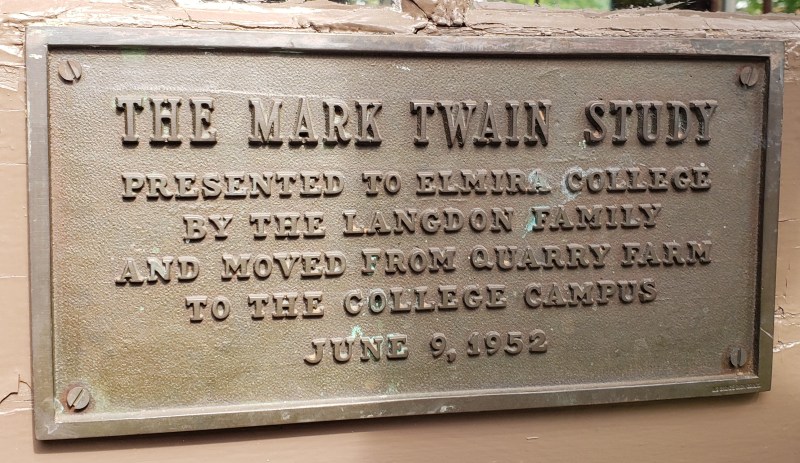
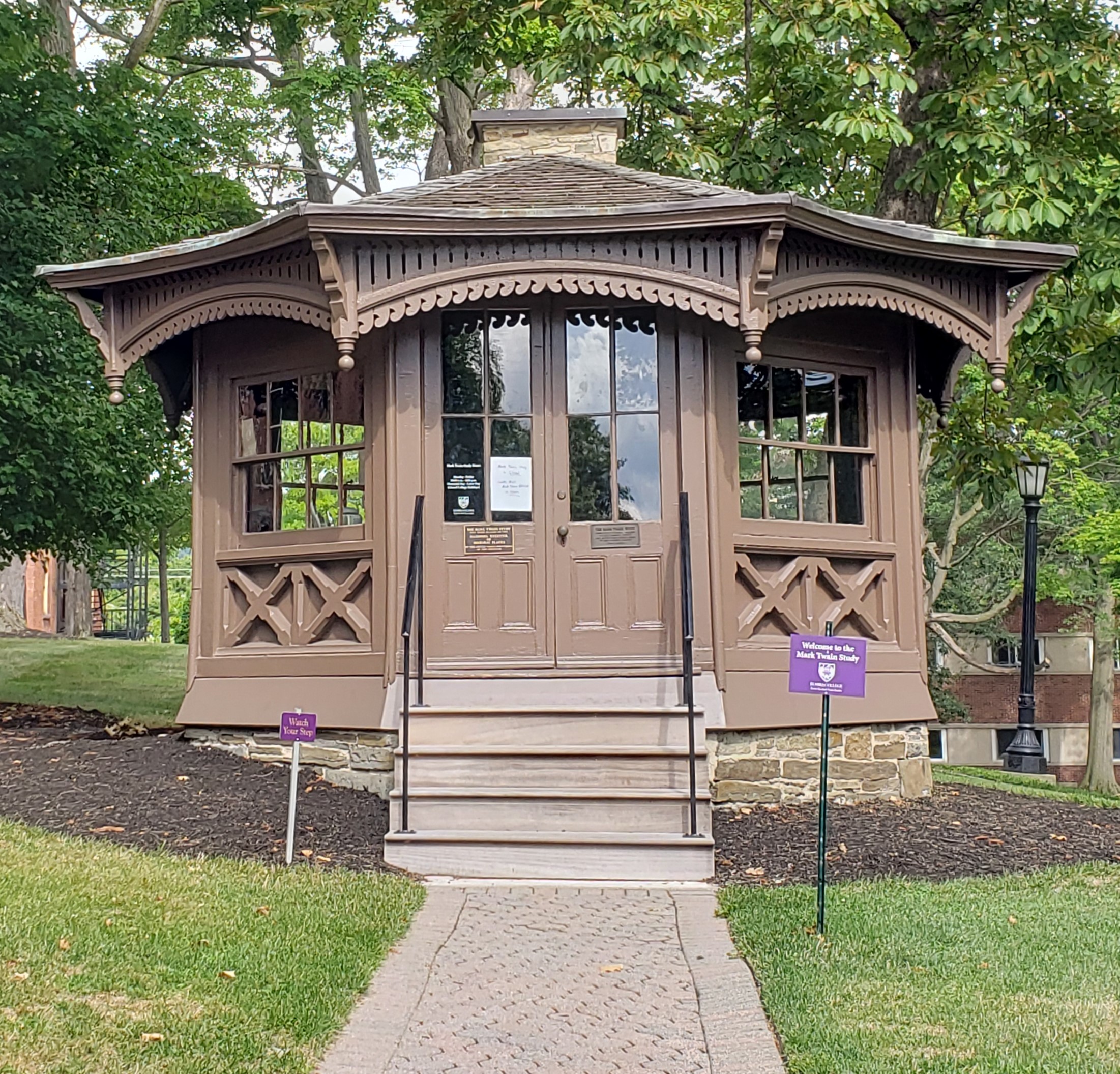
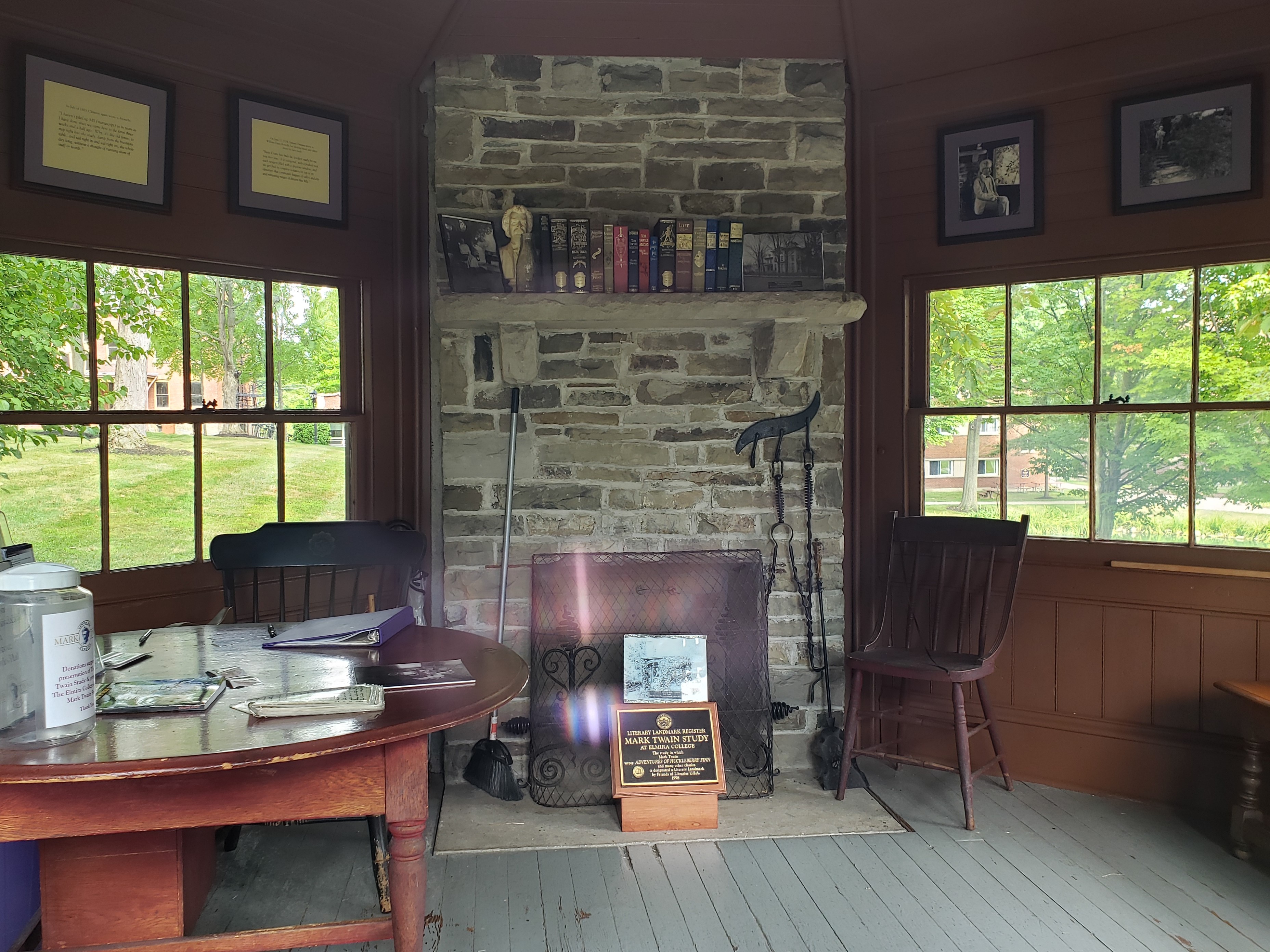
On Mark Twain’s birthday, I wanted to share some of the photos we took when we traveled to his study’s current location at Elmira College in Elmira, New York. The study was originally on the Langdon land where he did his writing in this small building. He wrote many of his classic stories here. I’ve included an information sign from the site.
These are a few of the things that have inspired me in the last several months and that keep inspiring me.
The duality of Niagara Falls, Ontario, Canada. Bright and flashy by night; beautiful and awe-inspiring by day (and by night also). (c)2023
This is the Louis Roy Press, the oldest wooden printing press, and one of two remaining in working order; the second of which is in the US at the Smithsonian Institution. This press was used to print the 1793 Act to Prevent the further introduction of Slaves and to limit the Term of Contracts for Servitude within this Province [Ontario]. (c)2023
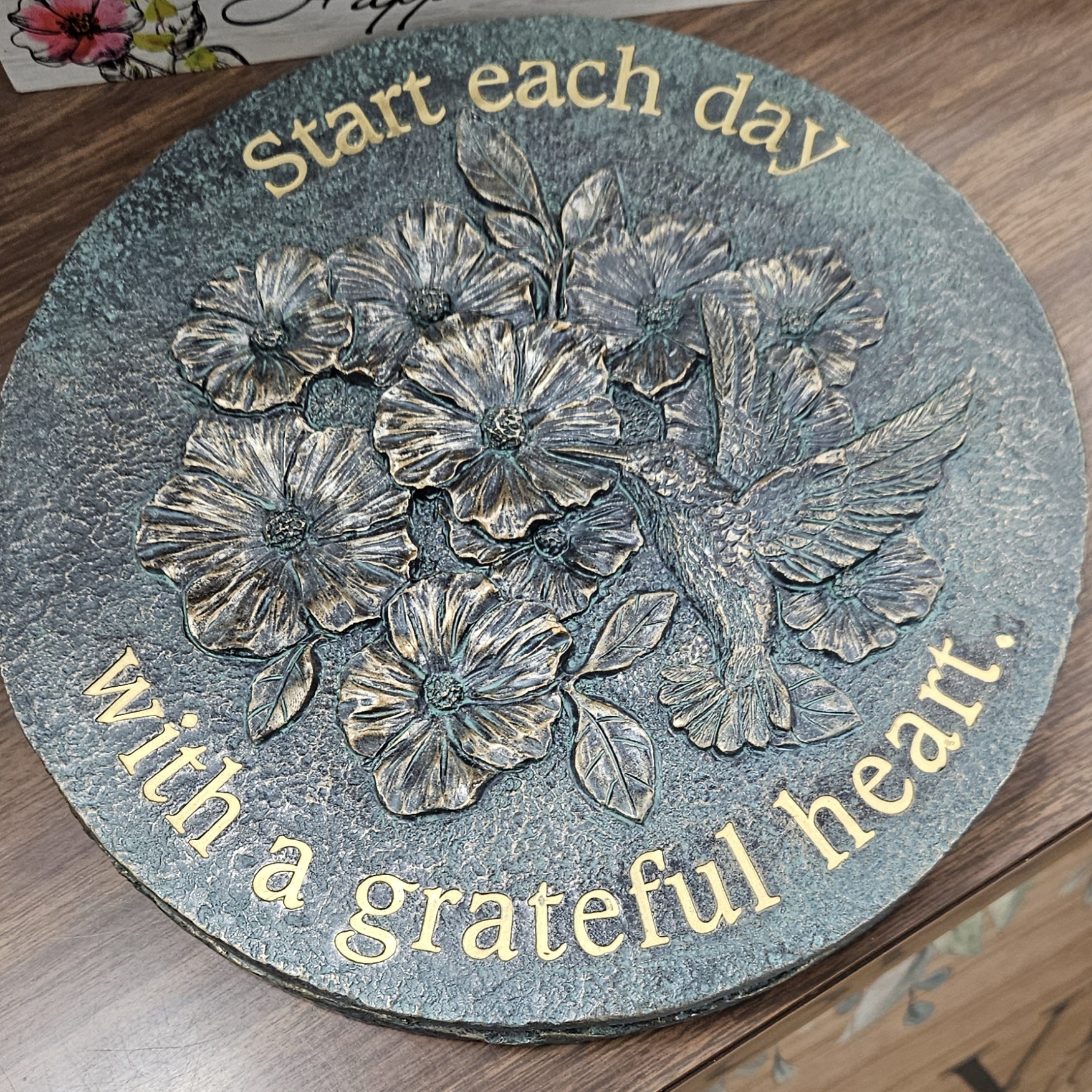
A good motto to follow. Begin the day with thanks, and the rest of the day will follow. (c)2023
St. Jerome was known for his writing. He translated the Hebrew Scriptures from Hebrew to Latin, which was unusual at the time since most people translated it from a controversial text called the Septuagint, also called The Greek Old Testament. He is the second most prolific writer of in ancient Latin Christianity. The first is Augustine of Hippo, who actually had no problem with the original Septuagint.
As a result, perhaps, he is the patron of translators, librarians, and encyclopedists as well as archaeologists, students, Biblical Scholars, and against anger, the latter of which I believe stems from his widely known bad temper.
As a student in Rome, he indulged his hedonistic side, but also attended the catacombs of Rome to visit the martyrs and Apostles there. There were early inscriptions and wall art that I imagine he studied, although he referred to the place as giving the feeling of the terrors of hell.
To put it simply, Jerome was a person of contradictions, some of which can be sourced as his being a student, a constant learner, and a voracious reader and writer. He had a group of women who surrounded him that read his scholarly works, and several were turned towards a life of consecrated virginity and the ascetic monastic life. This had a negative impact on these wealthy women’s donations, and he became at odds with the Roman clergy.
He is considered a saint in the Catholic Church (and a Doctor of the Church there), Eastern Orthodox, Lutheran, and Anglican.
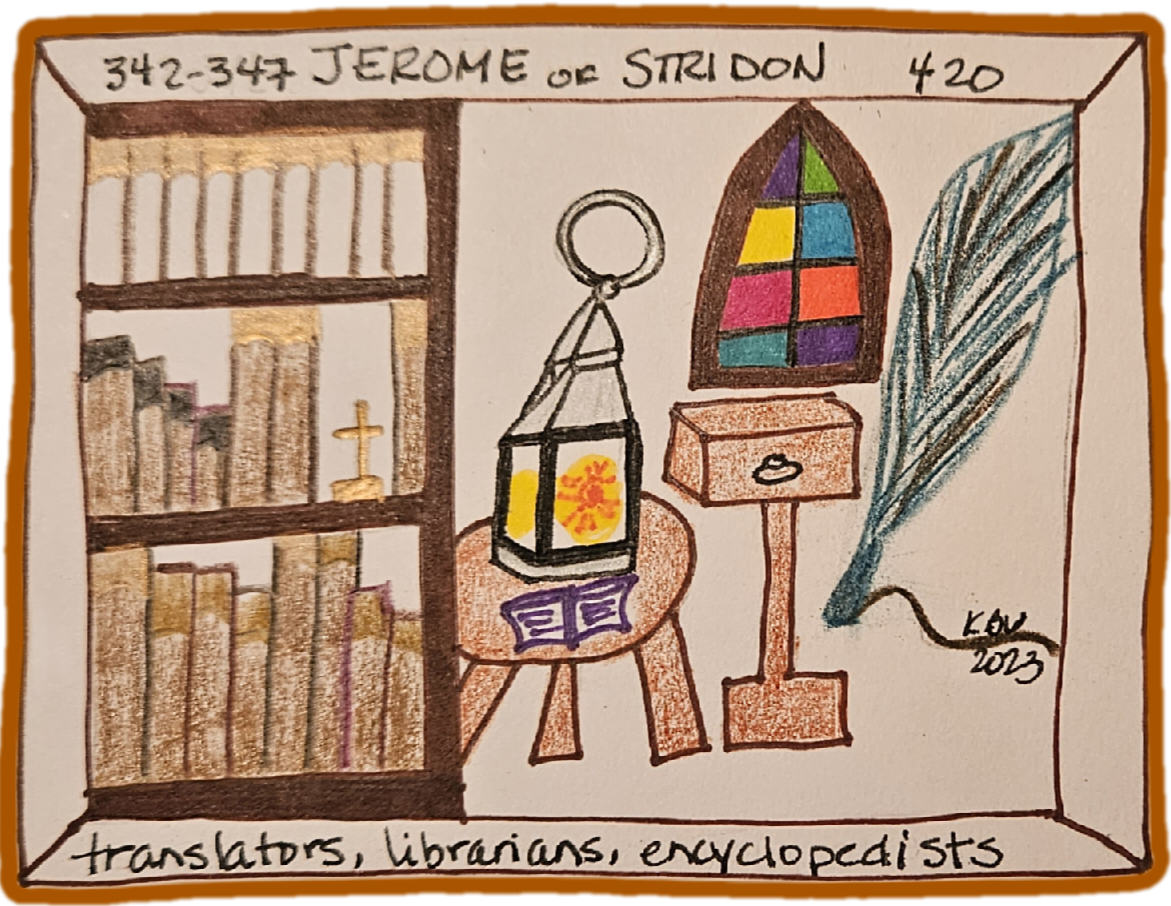
His iconography is often depicted in libraries and/or scriptoriums surrounded by books, parchment, vellum, and writing implements. He sits at a desk, holding a quill. He is also depicted with a lion having apocryphally removed a thorn from one’s paw.
In my sketch below, I have chosen to leave the lion and the saint outside the view as we look into his small cell of scholarly works.
I was watching The Shuttlepod Show, hosted by Star Trek alums, Connor Trineer and Dominic Keating. It’s a conversational show where they invite and talk to a guest for an hour or so, usually also a Star Trek alum. I’ve seen several, and enjoyed them. There is insight into the actors, behind the scenes, and the world of Star Trek, past, present, and future. Recently, they had on Star Trek: Voyager’s Garrett Wang, and in a segment I had never seen before, Connor Trineer asked him a desert/deserted island question about what he’d bring with him.
There were six categories, although for books, you’re already given the religious text of your choice and the complete works of Shakespeare. I thought this was a great thought experiment as well as a terrific writing prompt, and so I share it with you, with credit and thanks given to Connor for the inspiration.
What one ____(1-6)______ would you bring with you on the desert island to occupy your time, for all time?
1. Book 2. Food 3. Author 4. Composer/Musician 5. Dessert 6. Plus a bonus item
As I mentioned in the June Inspire last week, I’ve been awed by the number of inspiring events I’ve been privileged to have participated in since the very beginning of the month. Since I was unable to choose one or two to write about, I thought I’d write about most of them, and include some photos and links so you can explore on your own in your own timeframe and let them capture your imagination and inspire you as well.
One warning before I really get into it: this will be picture heavy (as well as, from my estimate, word heavy).
June began with a weekend retreat that I’m still feeling. June is also the end of the school year, and so during finals and Regent’s exams, my youngest often doesn’t have to go to school, and since the whole crew at home took a day off to see The Flash movie (no spoilers ahead), we decided to take a road trip to Connecticut. And then finally, a field trip to a college outside of Albany to tour a set of books (a Bible actually) of Biblical calligraphy and illuminations. And in between all of that it’s been busy with driving my kids, funeral for a colleague and friend, interfaith doings, Red Hats lunch, a broken hearing aid, weekly rosary, and Father’s Day, an interfaith prayer service, and a fellowship luncheon.
June has been a lot more than usual, and it’s still got a few days left; Indiana Jones will be inspiring in its own way. I don’t want it to sound as though I’m complaining; I’m really not, although once I get started it’s hard to turn off the listing; it’s like a waterfall. However, I can’t say it’s been dull or uninspiring; it’s definitely been the opposite of both of those.
Felicia Day, taken from her book jacket. (c)2019-2023
Felicia Day is Human Extraordinaire. She’s talented, cute as a button, and has the perfect color red/ginger hair that I strive for. I had known her in geek and fandom circles, and then she appeared in my favorite television show of the moment, Supernatural. Her character was the epitome of geek, nerd, D&D master that I grew up with and grew up as. In honor of her birthday, I am recommending one of her books that I am currently reading.
I borrowed her book, Embrace Your Weird: Face Your Fears and Unleash Creativity from the e-library at the end of 2019. I read about two chapters in, and knew that a borrowed book, an e-book would not do. I was expected to write in this book – something both foreign to me and impossible to do with an e-book. I broke down and ordered a hard copy in paperback with my Christmas Amazon money and waited until the perfect moment to start.
One word of advice: there is no perfect moment.
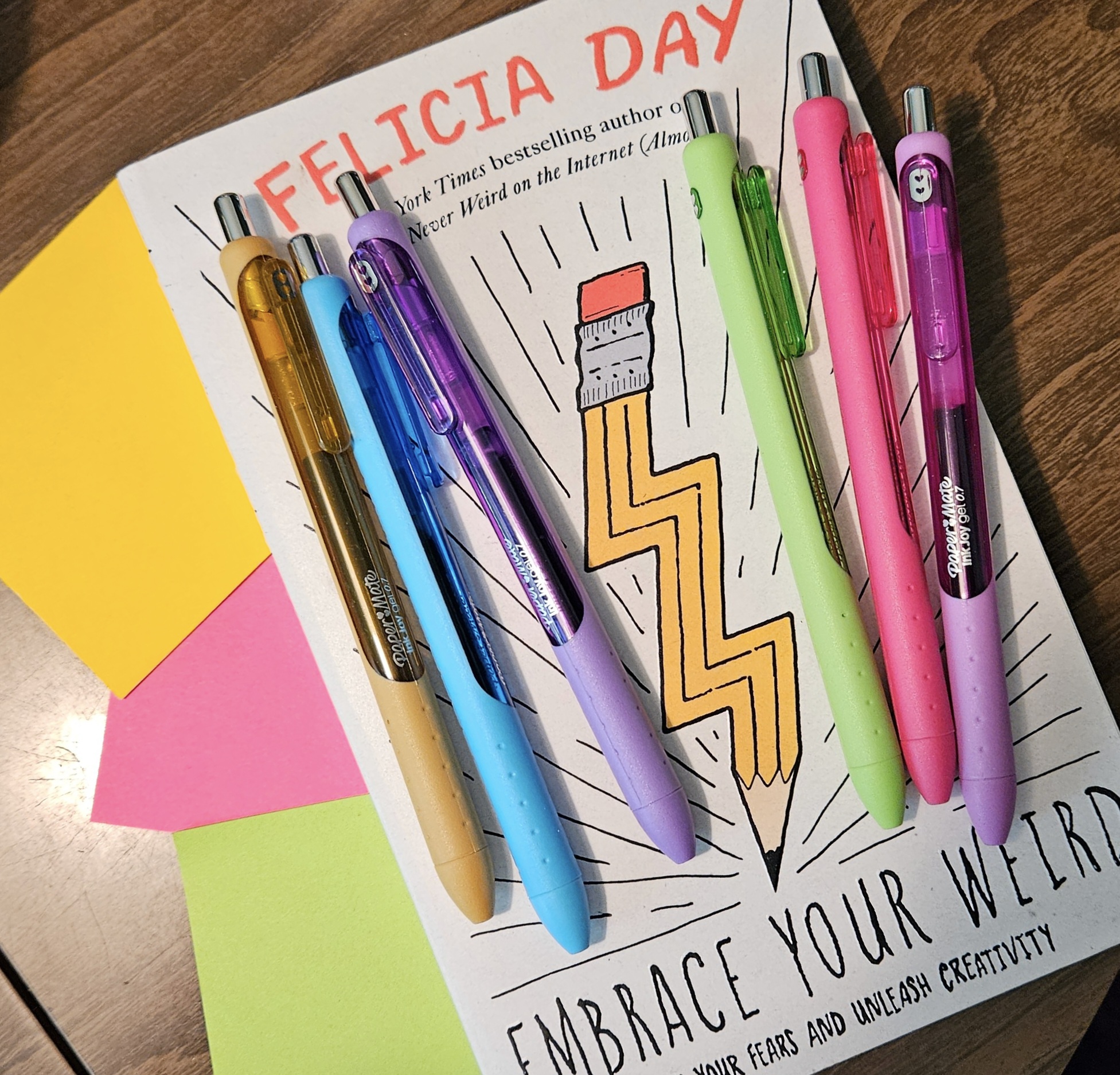
Embrace Your Weird book with my go-to post-it notes and the pens I bought especially for working in this book. (c)2023
Some of the tasks are really thought-provoking, and some were emotionally draining, but also exhilarating. I was proud of getting through the tasks thus far. I am not even halfway done with the book. I did put it aside for a time for other (creative) projects, and I’ve picked it up again, and in picking it up, I wanted to share it with you.
There are seven chapters with several parts in each chapter. Each chapter lets you look into yourself and learn what might be holding you back from busting out the creativity and finding your jam. That sentence channels Felicia in all the best ways. Don’t be afraid to try. A lot of the hesitation for me (and for Felicia, as it turns out) is anxiety. Name the monster and it can’t hurt you, or something like that.
The book is go at your own pace, which is why I’ve been able to start it, put it down, and continue it. Notice that I said “continue;” not “start again.” The book, like your creativity, is a never-ending journey that pauses when the need arises and continues when you’re ready. I was ready last week, actually, but the book’s been missing. It was a victim of cleaning for guests, and shoved in a large green tote bag, which I only remembered yesterday morning.
This book breaks two of my rules:
Read and follow the directions as closely as possible.
Write in the book.
Despite my guilty childhood of scribbling in books, writing in books is anathema to me, but I’ve adapted with this special book.
In honor of today’s roll out of the limited edition Big Mac Sauce, I thought I’d share a recent writing I did for my memoir workshop class. Following the ode, there are two links to some news articles about the Big Mac sauce debut. As I understand it, the sauce will be free with chicken nuggets, and there will be a limit on how many one person can get as well as only being able to order it through the app. May the odds be ever in your favor.
I sit at my computer, sipping a large Diet Coke from McDonald’s and I wonder why we love fast food so much. I have no doubt there is something in the composition of fast food that keeps us coming back for more, dare I say, something that makes it addicting, and I think that’s a chemical reason, and not so much a psychological one. There have been times that I’ve gone quite some time without a McDonald’s cheeseburger (or in my case the quarter pound with cheese burger), but once I return, it is like a valve on a water hose that just won’t shut off. I want it morning, noon, and night. Of course, I don’t indulge that much, but the want is there.
I just found out that McDonald’s will be coming out with a limited-edition packet of Big Mac sauce. I found this hilarious. A couple of weeks ago, I stopped in the drive-thru for some free fries and I actually asked for a cup of Big Mac sauce. They put it in a small chicken nugget box. It was great on the fries. I have always wondered why they’d never done this before, but I know where I’ll be in seven days [seven when this was originally written] when they are released. Expect it to be Instagrammed and blogged about.
I told my husband the monumental news, and he said he doesn’t like the Big Mac. Really? Who doesn’t like the Big Mac? He must be a heathen. Or a Communist.
“Writing a book is an adventure. To begin with it is a toy and an amusement. Then it becomes a mistress, then it becomes a master, then it becomes a tyrant. The last phase is that just as you are about to be reconciled to your servitude, you kill the monster and fling him to the public.”
Winston Churchill
Let’s try that again. The entire essay is gone. No recovering it, and we’re off to the races again. It won’t be as witty or a breathtaking example of fine writing, but it is what it is.
I woke up this morning with a ton of stuff on my mind, and in my mind, and my mind would not settle down. I thought of a great story to write about the holidays, but it would also make a great blog post, and it might be a good memoir essay for the prompt of “details, details” that I’ve been struggling with, but it was also a good piece of family history, and it was probably prompted by a conversation I had with a friend about the balancing of Passover and Easter. As an aside, I happened to look at a calendar, and next year Easter is March 31, and Passover is near the end of April, so that should cause less balancing and juggling and stress, but of course, we’ll see how it goes. The best laid plans and all.
The thoughts and memories were coming fast and furious, one thing after the other, and I tried to filter out other unrelated memories that happened in the same space I was writing about. I had twenty minutes before I had to leave, and I could use that time to get it down before it was gone forever. I’ll remember it, I told myself. No, you won’t. You never do. And to make matters worse in my head, I knew that NO ONE in the history of writing remembers when they say they’ll remember and will jot the thought down later. No. One.
We are all bound up together in one great bundle of humanity, and society cannot trample on the weakest and feeblest of its members without receiving the curse in its own soul.
Frances Harper, We Are All Bound Up Together, 1866
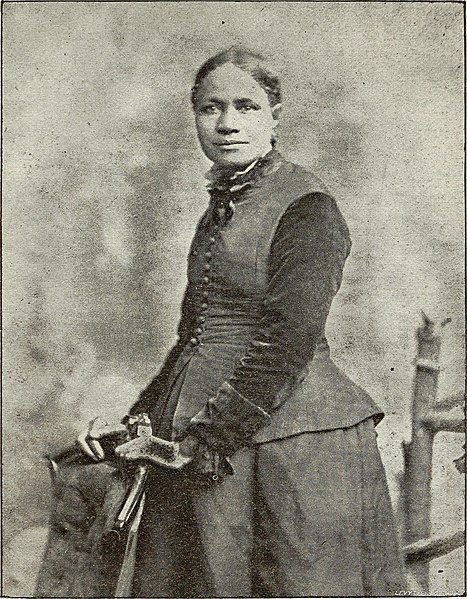
Frances Ellen Watkins Harper. Public Domain
Frances Ellen Watkins Harper was a voice of Black Suffragists. She was born in 1825 in Maryland to free African American parents. Her parents died when she was young, and she was raised by her aunt and uncle. By the age of 21, she had written her first small book of poetry, Forest Leaves and ultimately published 80 poems. More than a decade later she became the first African American woman to have published a short story, The Two Offers. She co-founded the National Association of Colored Women’s clubs.
While working as a teacher in Pennsylvania, a law was passed that free African Americans in the North were no longer allowed into Maryland, her home state. They would be imprisoned and enslaved.
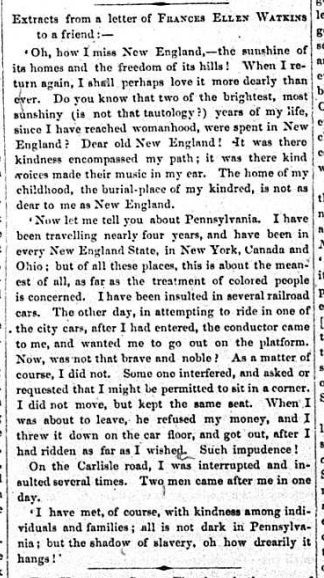
She refused to give up her seat on the trolley, and only got up when she reached her destination as chronicled in The Liberator, page 3 as seen below.
From The Liberator, Page 3 1858 Public Domain
Her famous speech, We Are All Bound Up Together, read in 1866 at the Eleventh Women’s Rights Convention held in New York City, can be read here.
She spoke at the National Woman’s Rights Convention in New York, held in 1866. The organization split over the suffrage of African American women and were opposed to supporting the fifteenth amendment. Harper left the group, and with Frederick Douglass and others supporting the amendment joined together to form the American Woman Suffrage Association. She was often the only Black woman at the women’s conferences. Through her life, she continued her advocacy for intersectionality (see- it’s not a new idea) in suffrage.
She spent the remainder of her life teaching and encouraging equal rights and education for African American women and founded and/or directed several clubs and organizations for African American women, including the National Association of Colored Women’s Clubs and the Pennsylvania Women’s Christian Temperance Union.
Some of her writings include:
Forest Leaves, poetry, 1845
Bury Me in a Free Land, poetry, 1858
Moses: A Story of the Nile, 1869
Light Beyond the Darkness, 1890
In Memoriam, Wm. McKinley, 1901
Trial and Triumph was one of three novels originally published between 1868-1888 as a serial.
Her first novel, Iola Leroy, or Shadows Uplifted was published in 1892. It was thought sentimental, but it also highlighted several serious social issues at the time, some of which remain today.
As a writer, I am always drawn to the writing lives of the people I choose to profile, and I was pleased to see that Harper was a mentor to other African American writers, including Mary Shadd Cary, Ida B. Wells, Victoria Earle Matthews, and Kate D. Chapman.









 Griffins and Ginger Snaps