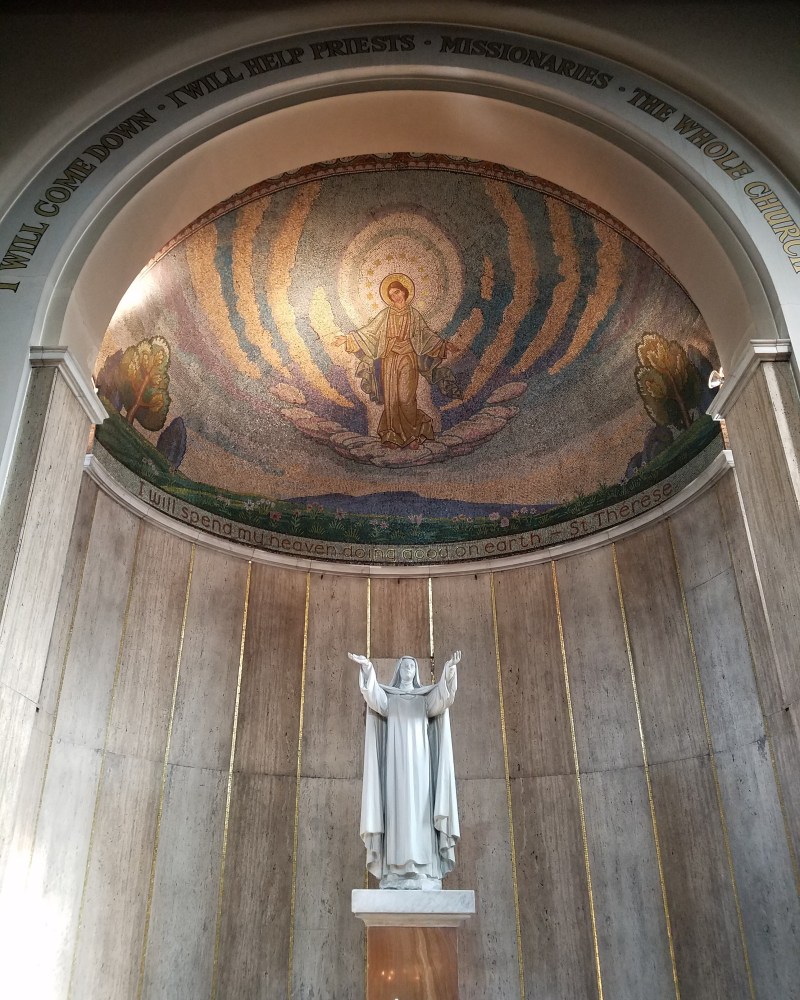
Shrine of St. Therese of Lisieux. Niagara Falls, Ontario, Canada. (c)2023
Next weekend marks the second anniversary of the death of my priest. In some ways it feels like yesterday and in others it feels like decades since he’s gone. I don’t know if it’s been a disadvantage or an advantage coming into the church so late in life that I’ve only had one priest up until recently. He was a guiding force in my welcome and acceptance in the parish and the Catholic faith, borne from his being Christ in the world through love, care, and guidance.
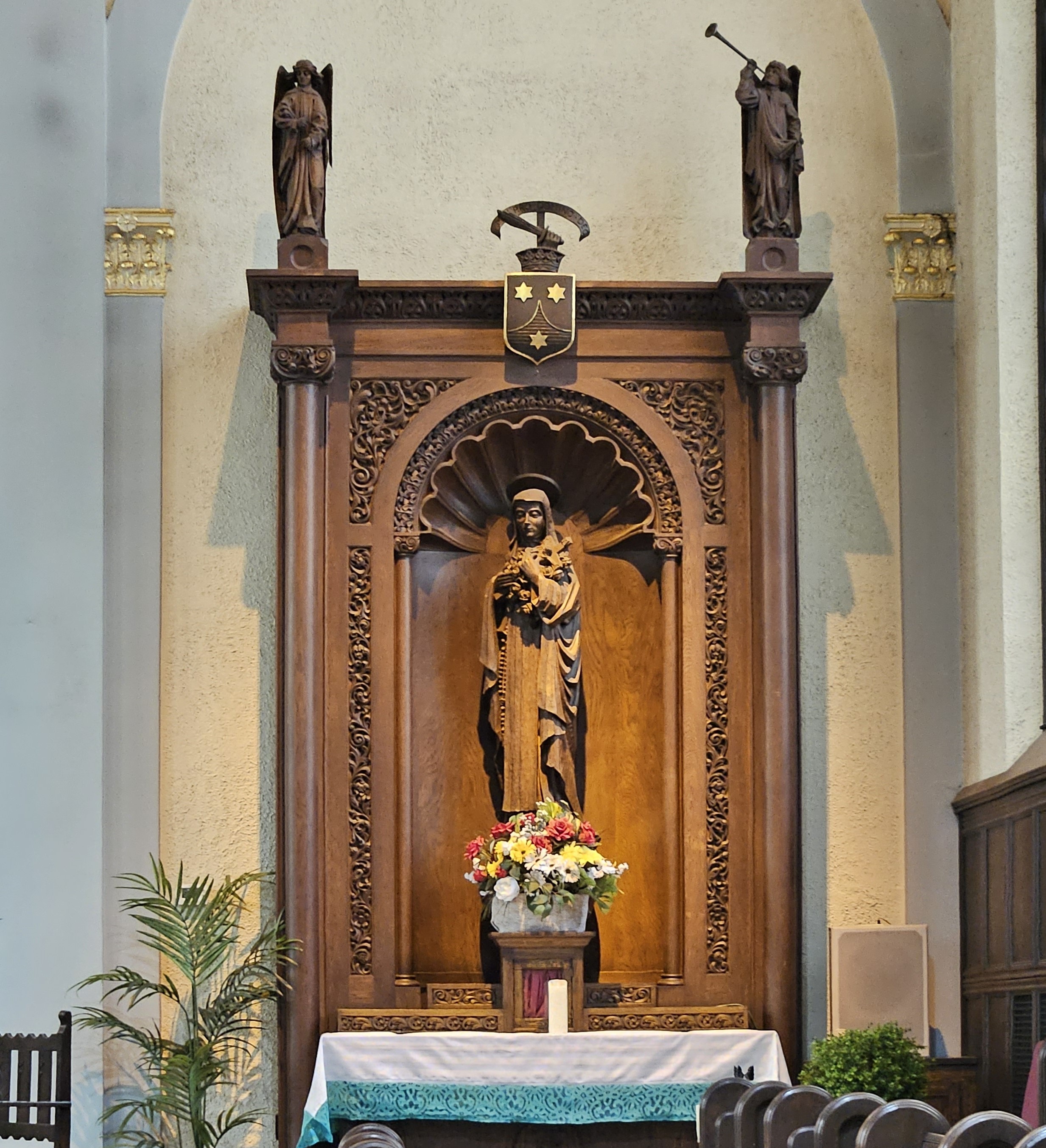
This weekend holds two saints’ feast days that I strongly relate to Father Jerry. Yesterday marked Saint Jerome’s feast and today is Saint Therese of Lisieux. Jerome was Father’s given name, so there is the obvious connection, and he held a strong devotion to St. Therese, also known as the little flower. When we visited Northern Ireland for the burial of my mother-in-law’s ashes, we stopped in Dublin, where I had the fortune to visit and pray at a shrine of St. Therese. I brought home a postcard for him, knowing that he was devoted to her. At the time, I hadn’t known that she has a much closer shrine, northwest of here in Niagara Falls, Ontario, just over the border. From that shrine at the Monastery of Mount Carmel, the roaring Falls could be heard and if you could get high enough even see the Horseshoe Falls.
The Monastery of Mount Carmel has two shrines; one inside the chapel where I attended mass, and one outside. The outside one was at the end of a path guided by plaques with many of the things that St. Therese is known for having said, culminating in a round clearing bordered by flowers, several park benches and centered with a statue of St. Therese in white marble, holding a cross and an armful of roses.
Those plaques are shared below. I hope they can be read on their own, or prayed with as you like.
I hadn’t intended for this series on travel to wholly encompass shrines, but I was asked yesterday about visiting these two later in the summer and thought it would be a good opportunity to share their information with you.
The sites are spiritually connected by both St. Kateri Tekakwitha and the Jesuits. The site in Auriesville has a coliseum, one of the first circular churches built in the US. It holds about 6000 people. Across their 600 acres of land is a museum, one or two chapels, a grotto dedicated to Our Lady of Fatima, and Theresa’s Rosary, a rosary made of rocks embedded in the ground. I have walked and prayed this rosary on one of my visits.
There is also the ravine where Rene Goupil’s body was found. In visiting there, I found it very spiritual and a place of holiness. The way to the ravine is quite steep. On the way there are several statues and grottos to pray at as well as signs that tell the story of the Martyrs.
Prior to his martyrdom, Isaac Jogues had been held in captivity and tortured by the Mohawk (a different group) for over a year. With help he escaped in New Netherland or Albany, NY. He returned to France, where he visited his mother in Orleans (where Joan of Arc led France’s army 219 years before) and was considered a “living martyr” by Pope Urban VIII, but soon again returned to this area, longing for and meeting his martyrdom in what is now Auriesville. It had been the Mohawk village of Ossernenon. He, Jean de Lalande, and Rene Goupil were tortured and killed here. Jogues weighted Goupil’s body and placed it in the water of the ravine in order to return and bury him properly. He did return, but he was gone. He later found some of his body parts, and reverently buried them. I’ve heard others say that the ravine itself is a reliquary. As I said, the spirituality felt here is palpable.
At this same village, ten years after their deaths, Kateri Tekakwitha was born. She became ill with smallpox and both of her parents died. She was scarred, and it was difficult for her to see, needing to put her hands out and feel her way. Her name Tekakwitha translates into she who bumps into things. Her mother had been baptized Catholic and educated by the e missionaries. Her village moved from Ossernenon across the Mohawk River and rebuilt their village, named Caughnawaga, which means place of the rapids. She was bullied for practicing her Catholic faith. She refused to be married, and that did not make her popular within her adoptive family and aunts. She also practiced mortification, praying for the conversion of her family and for forgiveness.
Her name Kateri is for her baptismal name of Catherine, which she received after her baptism at the age of 19. It took me several years, but I was able to walk to the spring (it’s a bit of a steep incline) from the village footprint that archeologists uncovered. Her Native people still felt that the Catholic religious rituals and items were sorcery and opposed her conversion. At some point after her conversion, she was helped to leave and went north to the new Mohawk village where other Native converts had gone. This village was also named Kahnawake (this is the Mohawk spelling), just south of Montreal. She died in 1680.
When I visited her empty tomb (where she was first laid to rest until her relics were removed to the St. Francis Xavier Mission Church on the Mohawk land), the sound of the rushing water nearby was nearly deafening. I have had so many spiritual experiences in visiting the sites of Kateri and her people that it only makes me more in awe of the Holy Spirit.
For those who are not religious, but want to visit a pastoral, serene, place of comfort, both shrines offer that in the beautiful Mohawk valley. The sights and sounds are lovely, and it is easy to get lost in your own thoughts. Of course, that’s until the train comes roaring by, but that is in its own way an affirmation of the space we are in.
National Shrine of the North American Martyrs Auriesville, NY
Open May 1 – October 19, 2023 Hours: Grounds: Open daily 9-7 Museum: Open daily 11-3:30 Gift Shop/Visitor Center: Open daily 10-3 There is no fee for admission or parking. If you are interested in attending mass or other events, visit their website.
National Shrine of the North American Martyrs. (c)2023
St Kateri Tekakwitha, National Shrine & Historic Site Fonda, NY
Summer Season: May 1st to October 31st Hours: Grounds are open sunrise to sunset daily. Saint Peter’s Chapel and Native American Museum open daily, 9-5 Gift shop open: Sat, 10-6, Sun – Wed, 9-5, Thurs – Fri, 10-4 Office open daily 9-4 Candle Chapel, Caughnawaga Village Site, Kateri Spring and grotto, outdoor sanctuary, and hiking trails are open sunrise to sunset year-round. If you are interested in attending mass (scroll down at the link) or other events, visit their website.
St. Kateri Tekakwitha statue with a sign of her last words: Jesus, I love you! (c)2023
St. Kateri Tekakwitha was the first Native American woman to be canonized. This was in 2012, the same year I joined the church with my ongoing attendance. It would be another two years before I came into full communion and participation.
There were many reasons that I was attracted to St. Kateri as I considered her among others while I discerned a confirmation name (ultimately choosing St. Elen of Caernarfon as many of you know).
I have always felt a connection to the Native American people and interested in their culture and spiritual practices. As kids our parents took us to the pow-wow out on Long Island with the Shinnecock Indians. It’s hard to live anywhere in New York State and not find nearby towns with Native names.
A gift from my friend in South Dakota. It is a dream catcher and it has helped me at times when I’ve had trouble sleeping. It is Native made near the sacred Black Hills. (c)2021
Kateri was from nearby; just west of the Capital District. She was born in the village of Ossernenon, now known as Auriesville. The village is mapped out at the Martyrs Shrine. After a small pox epidemic killed her family and left her scarred, the remaining Mohawk burned the village and moved (as was done when a disease ran rampant through their homes).
They moved further west and to the other side of the river to what is now Fonda, above where the current Kateri Shrine is located in the village called Caughnawaga. The footprint of the village can be seen and can be reached either by car or by walking the trails to the village and the spring.
Whitefriar Street Church, also known as the Church of Our Lady of Mount Carmel in Dublin, Ireland was one of those places on the map that i expected to see from the outside, take a few pictures of, and move on down the street. We were on a very limited time clock, one of the only ones on this trip. The map wasn’t even a real map; it was a tourist map – not every street and not to scale. The boys were going to search out the comic stores of Dublin, and my daughter and I were going to St. Patrick’s Cathedral, the Dublin item n my bucket list.
I had done no research and so while I rushed to the Cathedral, I had no idea that we couldn’t get in without a ticket and we didn’t have the time to wait in line for one, having arranged to meet back at Starbucks and then drive north and back to Belfast.
In hindsight I would have skipped the Dublin cathedral and spent some actual time in Downpatrick in the north. I had dismissed it, clinging to my childhood stereotype that St. Patrick was of the south. I seem to always make the mistake of lack of research despite mounds of research.
Before heading to St. Patrick’s, we, my daughter and I, stood on the corner adjacent to the Starbucks which was adjacent to our hostel to get our bearings and plan our foray through the streets of Dublin. It was then that we heard the bong of a church bell.
We quickly realized that on the corner directly across the little alley where the hostel was, was a church, and upon further investigation discovered that it was the very church I had wanted to see.
Right place, right time were both on my side as we entered to gape at the first of sixteen shrines, a life size depiction of Calvary. It was beautiful and sad, thrilling and literally breathtaking and haunting and everything all at once. We stepped around and into the small alcove that was St. Albert’s Shrine and holy well dedicated to him, and as I contemplated taking a cupful of water from the shrine in my hand I was made aware that mass was about to begin.
Mass. In Dublin. Among sixteen shrines. I couldn’t pass this opportunity by.
For today’s pilgrimage I’m going to show you what I saw. They have a beautiful church with a guide to each of the shrines as well as a 360° virtual tour.
I found the mass fulfilling, the shrines inspiring, lighting the candle prayerful. I love that technology allows me to share this with you.
Finding Mary on my UK trip: Mary, Untier of Knots medal. Ballintoy, NI. Our Lady of Lourdes replica, Dublin. Mary, Mother of G-d, Dublin. Our Lady of Dublin, Dublin. Praying the rosary at Ballintoy, NI. Tiny Saints, Mary, the Blessed Mother. Mary statue at Cranfield Church, NI. Mary, Untier of Knots color charm. (c)2017-2018
What I call my “relics”. These are not historical or sacred in any way except to me. 1. (Top left): Dried flowers and rock along with holy water from St. Elen’s Well in Wales. 2. (Bottom left): The top and bottom of a rock from what is still standing of my mother-in-law’s uncle’s house in Northern Ireland. 3. (Top right): A shell and a rock (or a fossilized rock) from Ballintoy. 4. Middle right): Holy water and pebble from St. Olcan’s Holy Well and a rock from the Cranfield Church ruins as well as the top and bottom of the rocks from the site. 5. (Bottom right): The dried flowers and rock from St. Elen’s Well without the holy water pictured. (c)2017
These grounds are a reliquary to the North American Martyrs, St. Isaac Jogues and his Companions, St. Rene Goupil and St. John LaLande. In 1642, the same year Rene Goupil was martyred, the first known recitation of the Rosary was prayed here. This was also the birthplace ten years later after St. Jogues and St. Lalande’s martyrdoms, of St. Kateri Tekakwitha.
The view of the Mohawk Valley and River from the Shrine Grounds
Three Crosses bearing the names of the North American Martyrs at the Entrance, at the edge of what was the Mohawk village.
Unfortunately, I’ve been ill all morning so I wasn’t able to post what I intended today; the reflection from my visit to the Shrine of Our Lady of Martyrs. I am hoping to push my usual dailies down by a day, and start my week tomorrow.





 Griffins and Ginger Snaps