Blessed are the Peacemakers

Standard

I was out this weekend for some breakfast and holiday shopping, and I saw a man wearing a dark hoodie with an American flag on it, although it was black and white with a blue stripe for the middle stripe. I recognize this as a call out in support of law enforcement. I don’t disagree with supporting law enforcement when it’s called for, however there is a lot to be done to improve their strategies, especially when it comes to working with people of color and the mentally ill and people not necessarily mentally ill but in crisis in the moment they meet up with LEOs.

I am certainly not going to solve this problem in one blog post.

On the back of this hoodie, above and below the black, white, and blue flag was the phrase:

Blessed are the peacemakers,

For they will be called the children of G-d.

Matthew 5:9

I was drawn to it in a negative way. It bothered me. It bothered me enough to start writing about it here. Part of that is some of the study I’ve been doing this Advent season through readings and a couple of faith enrichment and scripture classes throughout the month of December.

I recognized that phrase as from Scripture, although my initial thoughts were incorrect in assigning it to Isaiah (his readings are quite prominent during Advent) rather than where it actually comes from: Matthew 5:9; the Beatitudes.

The entirety of the Beatitudes is contained in Matthew 5:3-11

Blessed are the poor in spirit, for theirs is the kingdom of heaven.

Blessed are those who mourn, for they shall be comforted.

Blessed are the meek, for they shall inherit the earth.

I won’t relay them here. You can google or open any Bible and read all of them. There is also an addition that Pope Francis expressed on an Ecumenical trip to Sweden in 2016 that can be read here.

Reading through this part of Chapter 5 of Matthew and getting to verse 9, it is clear to me that this Scripture is entirely misinterpreted by the people who created (and wear) that hoodie. The implication that law enforcement and military are the peacemakers is inconsistent and contradictory.

I also found it ironic that I saw this on the hoodie during Advent when we are reading the Book of Isaiah who prophesizes an unlikely peace among foes: the wolf and the lamb, the leopard and the kid, calf and lion, cow and bear, children and snakes (reversing Adam and Eve’s punishment in the Garden of Eden). (Isaiah 11:6-8)

When I see these types of scriptures on hoodies that promote law enforcement and military soldiers as peacemakers it just fills me with exasperation and even a touch of anger. The misinterpretation that soldiers are peacemakers and not warriors first is simply wishful thinking. This isn’t to say that all soldiers are bad; I don’t believe that, and I understand the need for a military. I understand that when the UN sends its soldiers they are called peacekeepers, and I get that too. Peace is the goal. The UN tries to be neutral despite arguments of its futility and the presence of its flaws. I think that neutral isn’t the objective though as much as fairness and the desired overall good of society.

Are the peacemakers the ones with guns? Or are they the ones with food? With books? With pens and clothes and shelter? The pen is mightier than the sword is it not? That aphorism (as wella s many others) credited to author Edward Bulwer-Lytton has been known similarly as far back as before Biblical sources including an Assyrian sage in 7th century BCE and Greek playwright Euripides using different words in place of pen: word, tongue. Talmudic and Islamic sources also reference words, both oral and written, a means of knowledge and peace as being stronger than the strength of the sword, a means of war. The implication being that with the pen/word being mightier, peace is also mightier than war.

It’s important that we call out these misuses of words and reclaim our Scriptures that have been corrupted and used in opposition to what they actually say.

War is sometimes necessary, but it shouldn’t be considered inevitable, nor should it be considered the path to the kingdom of heaven and to the discipleship of G-d.

Blessed are the poor in spirit; blessed are those who mourn; blessed are the meek; blessed are those who hunger and thirst for righteousness; the merciful; the pure in heart; those who are persecuted; those who are reviled and persecuted falsely on the account of Jesus.

And blessed are the peacemakers; those who make peace. They don’t force something they call peace on others; they create a lasting peace, an eternal peace.

Those are the peacemakers; they are the children of G-d.

Advent: First Sunday

Standard

The theme and, I suppose the objective also, of Advent is waiting in joyful hope. This is often the titles of books marketed to Catholics for their Advent reading. And that is really what it is. Becoming Catholic taught me that the Christmas season begins on Christmas Day, and the season of Advent is a special time in its own right. Last year, I was given a set of four candles for my Advent wreath and this year I have coupled those candles with my daily reflection book, my daily readings, and beginning on Tuesday, the Novena of the Immaculate Conception. However, this Advent, while I am in joyful hope and I am waiting for the birth of Christ, I am also struggling with parts of my faith and parts of my life.

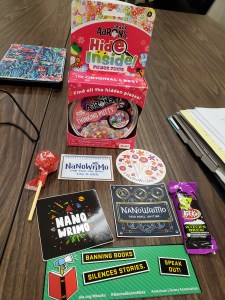
I’ve spent this entire month writing for Nanowrimo, just stream of consciousing my way through my book about my travels to Wales, and I’ve made great progress. I am very pleased. I have almost reached the 50,000 word goal and I anticipate that I will complete it before the 30th.

Nanowrimo Kick-Off at the Library.
(c)2022

My personal update on the Home page explained my accident, and I believe I am in the must get worse before it gets better stage of recovery. My ankle is much better, and I am driving a little, but not far, staying in our small town when I am able. My husband has been doing everything. While I can cook, I can’t do any lifting and standing for a long period of time is difficult. Thanksgiving actually was the least stressful I have ever had. I gave a lot of directions and stirred one dish and added marshmallows to another on my own, but I had to rely on everyone else to do the heavy lifting. There were hardly any of the usual arguments, we put the turkey in the oven around 10:30am, and then everyone was free until about 4:30 when the sides would need to be prepared. I couldn’t believe how well it went.

I was even able to go to church for Thanksgiving mass. I wasn’t sure how it would go; it’s been just over a year since we lost our priest, and while our new priest is a joy, I do not like change. I wondered if we’d keep the traditions that we’ve had, that I’ve gotten used to over the last few years, and I was happy to see that most traditions held.

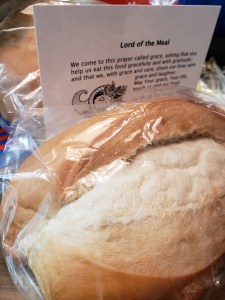
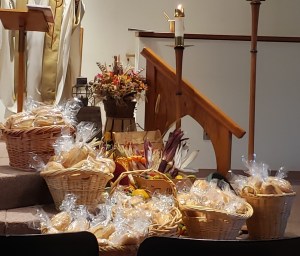
Our church gives all the parishioners a loaf of bread and a short prayer for our Thanksgiving table. It is one of the things I love about our church – those seemingly little things that are so personal.

Right before Thanksgiving, my husband was driving my daughter home from work when they were rear-ended. Hard. No one was hurt, PBTG, but because of the holiday we won’t know about the car until tomorrow or Tuesday. It needed to be towed from the accident. This is a struggle, and a sadness, and it is hard to get past the awfulness of possibly losing the car, something that was so important to our family. Of course, we are so relieved and grateful that no one was hurt, and it was only materials that may be lost.

Last weekend, I returned from my annual retreat. The theme was Change. And I have gone through so many changes, and many more continue to happen, whether I like it or not. I had to laugh when I found out the theme. I discovered it soon after my first reconciliation with our new priest, and after giving him the litany of things that are bothering me, and frustrating me, he commented, “Boy, you’re going through a lot of changes.” Yes. Yes, I am! In addition to the new priest, my therapist is retiring (soon!) among other things.

And I shouldn’t forget the good changes. I taught for the first time in a long time. This was for adults and it was a writing class. Next semester, I’m teaching two, so that is both exciting and terrifying. This one went well (I think), and I hope the next ones go as well and better (crosses fingers). As with all teachers, I spent more than I made, but such is the life of the classroom. I’ll hope to downsize my affinity (obsession) with handouts and maybe lower my overhead.

I’m hoping that with this Advent, I can slow down. I can focus. I can focus on my faith, and also on how I’m approaching the things in my life. It is a good time to reevaluate and reassess and wonder about the changes that will inevitably be coming, whether I like it or not.

Through it all, I’m trying to keep my perspective and my faith. This is the first day of the Advent journey which will ultimately end with the Birth of Christ. But of course, that is only the beginning, isn’t it?

Some photos that I wanted to share: The first two are works-in-progress sketches on I did on my retreat from things that I saw around me in the dining and the conference rooms. The third photo is the statue of Harriet Tubman and William Seward outside the library where the Nanowrimo Kick-Off was held on November 1st. I was also there when they dedicated the statue. I love history.

Statue of Harriet Tubman and William Seward.
(c)2022

Celebration of St. Kateri Tekakwitha

Standard

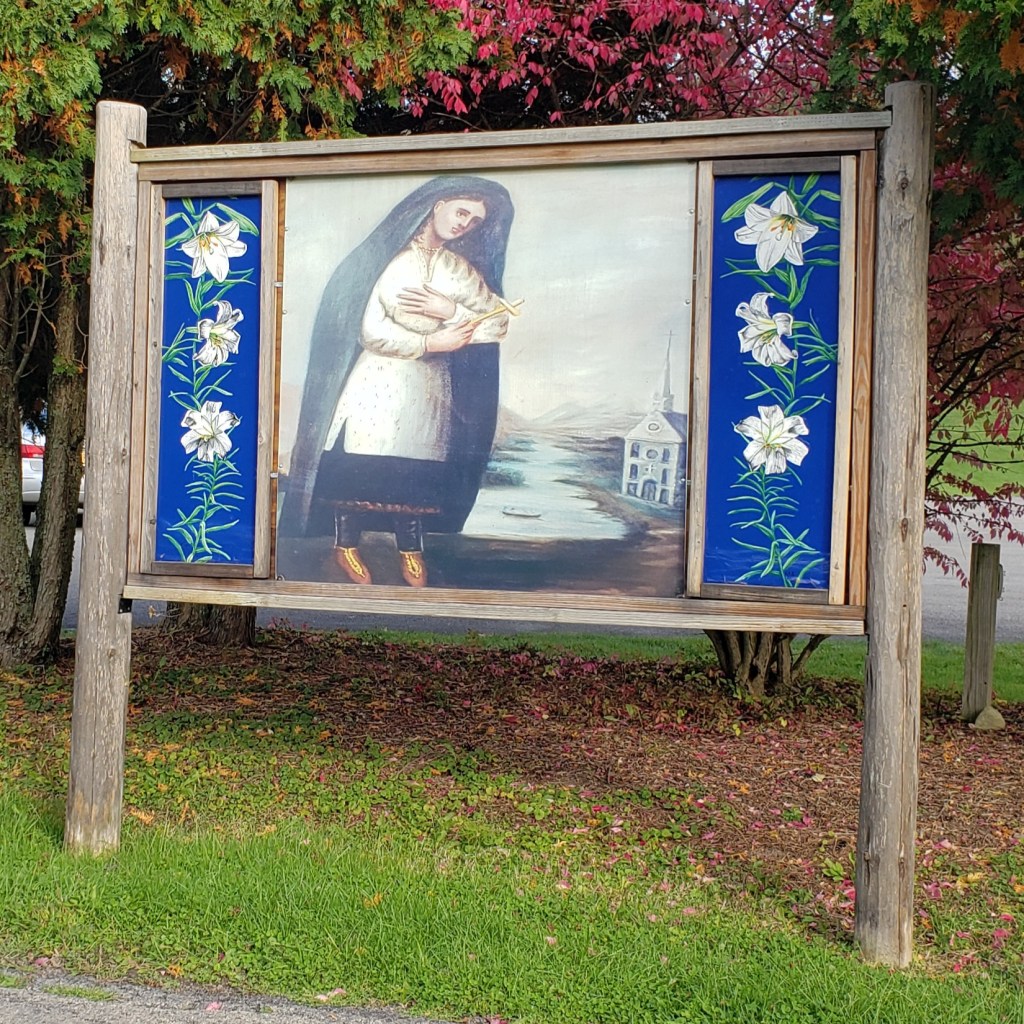
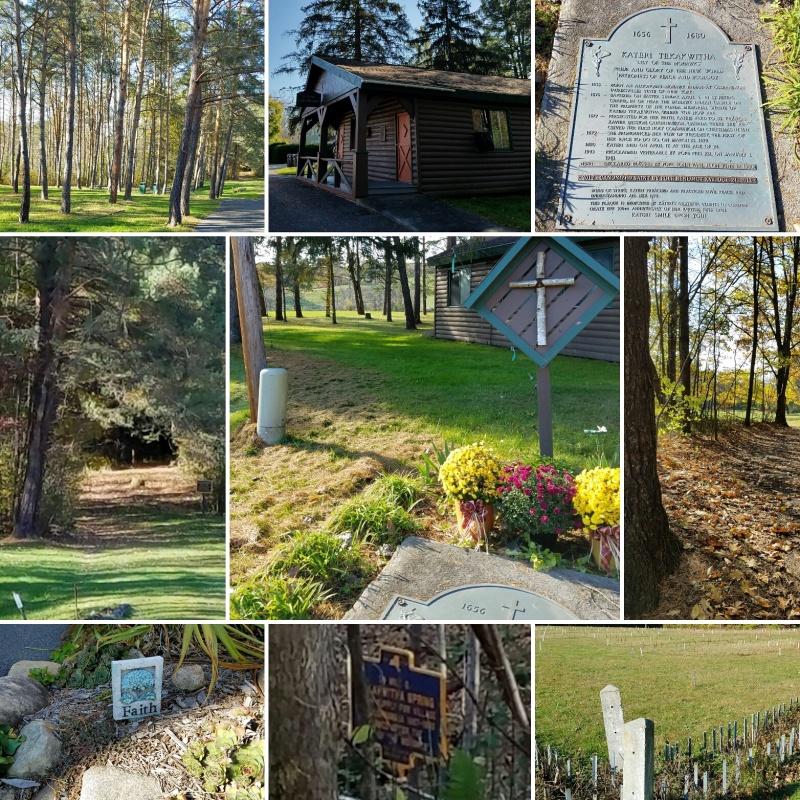
Two weeks ago, I was privileged to attend Mass at the St. Kateri Shrine in Fonda, New York. It was a dual celebration: today is ten years since the canonization of St. Kateri Tekakwitha, the first Native American saint. The celebration on October 9th was held on Indigenous Peoples Weekend, acknowledging the history and legacy of the Native peoples who were already living and thriving in the Americas at the time of Columbus’ landing in what is now the Bahamas.

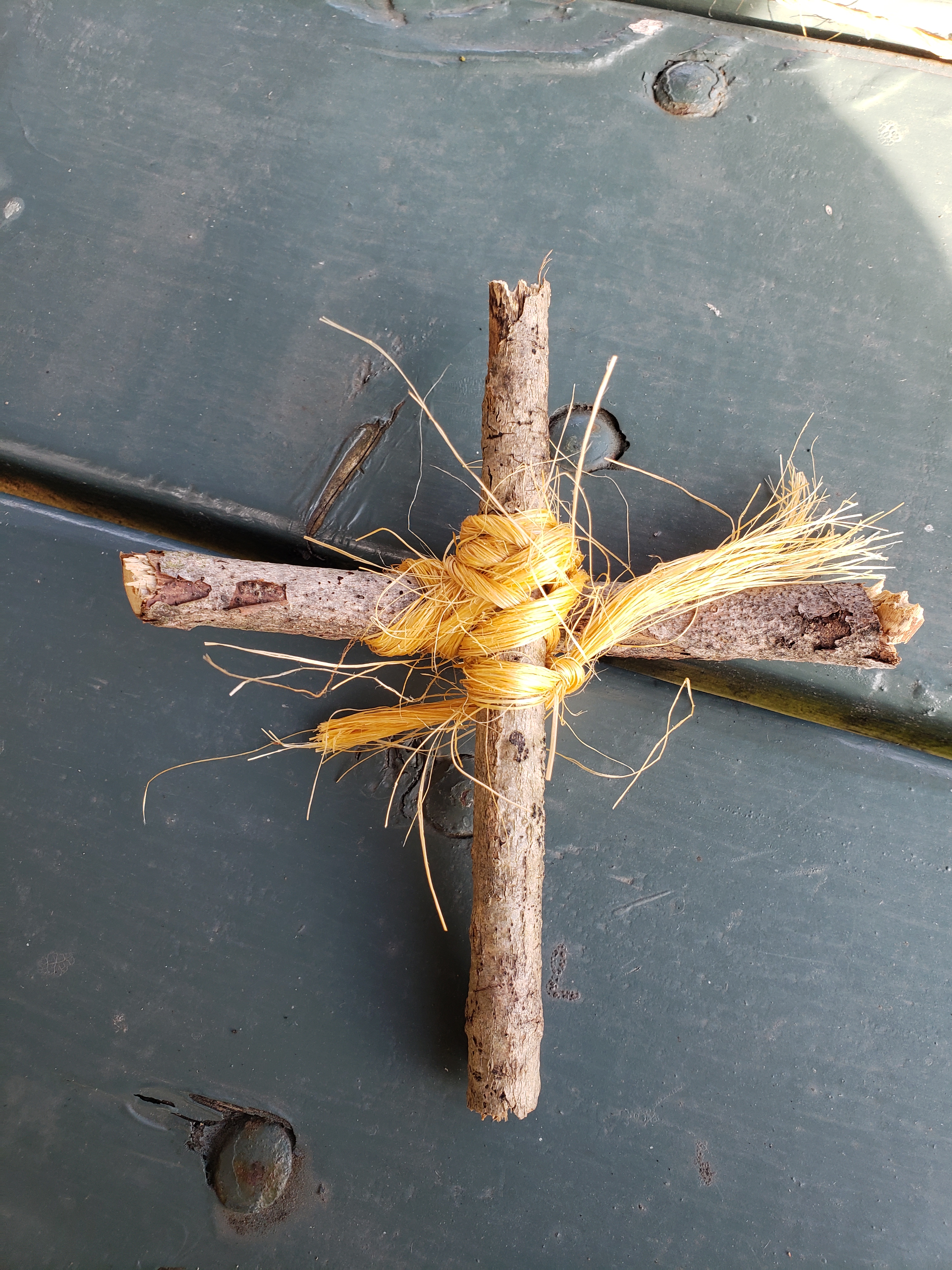
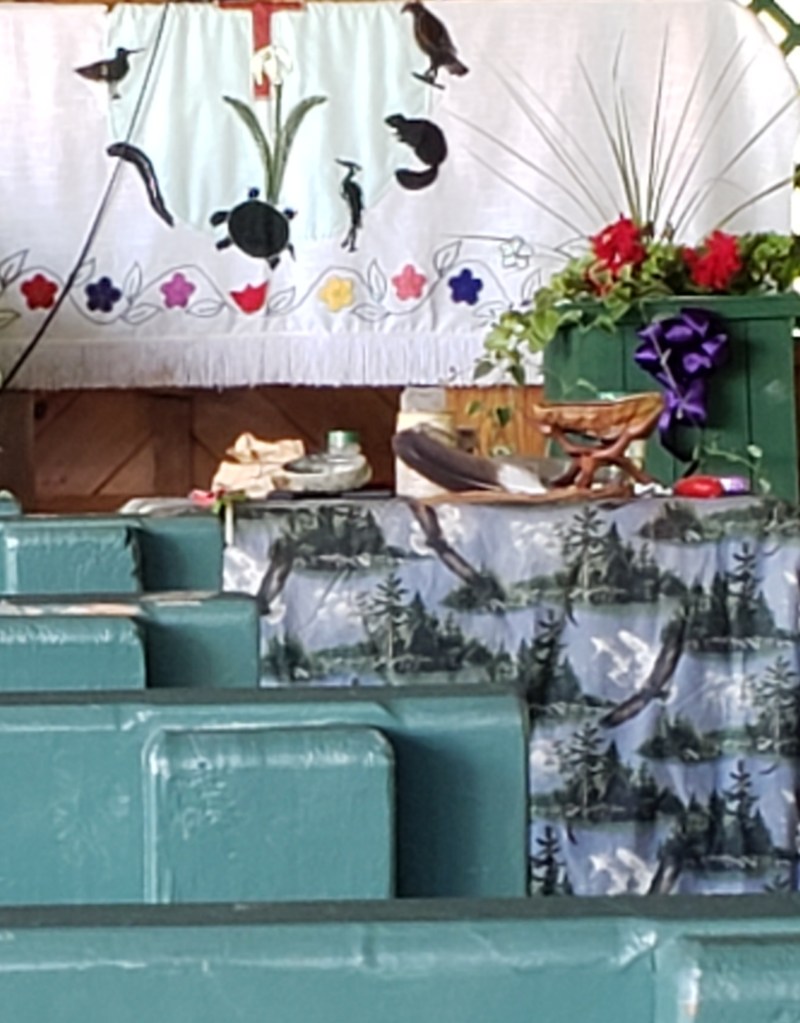
It was a chilly, fall day with bright blue skies and vibrant, colorful leaves, mostly still waving from their branches. Mass was held outdoors in the pavilion, a roof the only cover from the elements. As mass is celebrated, an occasional breeze flutters in, and really reminds you of Creation and the Creator. I had time before the mass and so I wandered the grounds a bit, spent some quiet time in the candle chapel, contemplated the words of Handsome Lake, an Iroquois Prophet whose words appear in the Peace Grove; I made a small cross from sticks and twine, reminiscent of St. Kateri’s own according to the sign on the table.

But mostly, I simply settled in with a subdued awe in the anticipation of the mass, the quiet celebration of Kateri’s canonization and difficult life that she never shunned from nor complained about. My eyes were drawn constantly to the bright colors of the Native dress, the feathers adorning and the large eagle feathers carried and used for the Mohawk rituals.

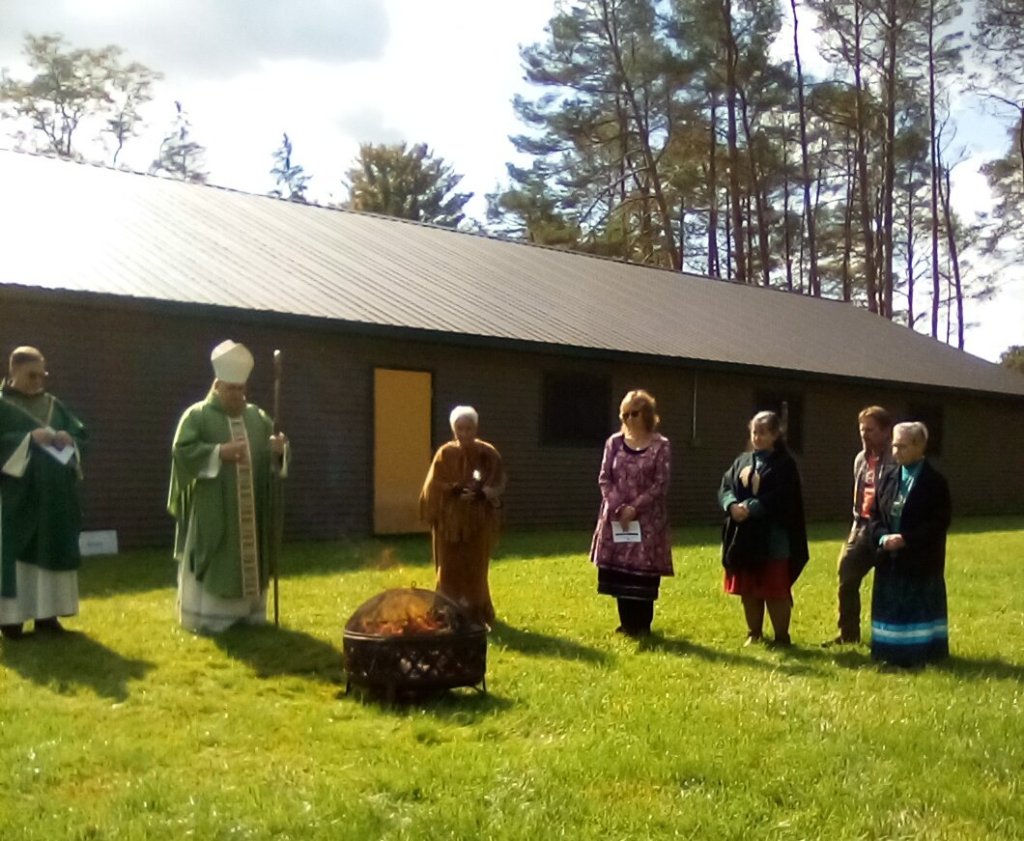
Between the Greeting and the Liturgy of the Word was the Sweetgrass Blessing, the burning of plants and herbs, assisted in its smoking by the motion of the eagle feather. We were invited to proceed up, as if for communion to receive the smoke. I felt as though I was part of something bigger, something ancient, and of course, I was, and I felt honored and humbled to be there. The four sacred plants used in Mohawk ceremonies are cedar, tobacco, sweetgrass, and sage.

Throughout the mass whenever hymns or songs were presented they were by the Mohawk Choir of Akwesasne. I couldn’t understand the words but the meaning was clear. Their voices carried on the wind and through the chapel and transported me far away and very near.

Sister Kateri Mitchell, who played a part in the 2006 miracle for St. Kateri Tekakwitha’s elevation to sainthood was there to share the prayer of the faithful and to talk about the miracles associated with the saint. I have met her before and was happy to see her and talk to her briefly on this day.

Following the mass, there was the annual burning of the prayer petitions. The Bishop said the prayer over them and that concluded this remarkable day.

I have found that attending mass in other cultures deepens my own faith and commitment to my own prayer and meditations. I have included some links throughout this post in the hopes that you will read more about St. Kateri Tekakwitha and her people and their journeys.


The Lord's Prayer in the Mohawk Language

Takwaién:a karonhiá:ke tehsí:teronTakwaién:a karonhiá:ke tehsí:teron
Aiesahsén:naien
Aiesawenniióhstake
Aiesawennaráhkhwake nonhwentsiá:ke
Tsi ní:ioht né karoniá:ke tiesawennaráhkhwa
Takwá:nont né kenwénte
Niationnhéhkwen, nia'tewenhniserá:ke
Sasa'nikónr:hen né ionkwarihwané:ren
Tsi ní:ioht ní:'i tsonkwa'nikór:henhs
Bothé:nen ionkhi'nikonhrasksá:tha nón:kwe.
Nok tóhsa aionkwa'shén:ni né karihwané:ren
Akwé:kon é:ren shá:wiht né io'taksens
Asekenh í:se sáwenhk né io'taksens
Asekenh í:se sáwenhk né kanakeráhsera'
Ka'shatstenhsera, kaia'tanehrakwáhtshera
Tsi nienhén:we e'thó naiá:wen

One Year

Standard
(c)2022

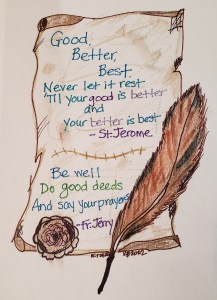
I read this quote attributed to St. Jerome awhile ago, and since my priest was also a Jerome, I recognized him in this quote. Do your best. Be your best. I always wanted to do my best for Father Jerry; not to impress him or for accolades but because he made you want to be a better person. There is no perfection , but I am definitely a better person because of my friendship and faith journey with Father Jerry.

Last week was the first anniversary of his unexpected death. So many who were close to him are still mourning; I miss him every day. That’s not to say our new pastor isn’t wonderful and special in his own ways, but I’ve said many times in the past year, and I’ll continue to say it, but I would not be here today if not for Father Jerry. He guided me, not only through my faith, but also showing me a different focus, a different way of being, a gentler, more compassionate, more giving way of being.

He was a gentle soul, gently guiding you, not always where you wanted to be, not even where he wanted you to be, but to where you needed to be.

He accepted my silly questions and loved my family even though they didn’t come to church. The last time I saw him he had just celebrated mass and was rushing from one thing to the next – the busyness was written on his face, and still he took time for me, he sat me in the sacristy and heard my confession. I didn’t want to leave on vacation without reconciliation.

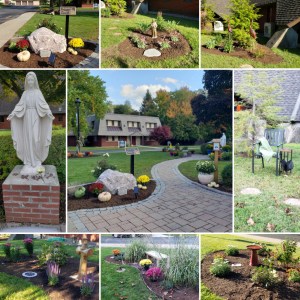
His memorial garden is complete and it was blessed and dedicated on his anniversary. It was moving and the day was beautiful. The design of the garden is extraordinary in my opinion. It was put in an area where Mary was already standing. I often sit by Mary’s statue and pray and look to her for guidance, so the space is a familiar one. The garden designer laid out five separate gardens so that when you walk it, beginning at Mary and following the stepping stones you can pray the rosary; one decade in each garden space.

Father Jerry had a secret garden in the back of the rectory. A place where he could sit with his dog, Grace, and spend time with the Master Gardener. He shared it with us during the pandemic through videos and a newspaper story. I think the idea of a memorial garden was a natural one, and a way to share his secret garden more permanently with those of us who loved him, and miss him, as well as those who will come later to worship at our parish.

Earlier in the week, I had seen the new sign, and then I sat in my car for a bit, reading through a paper on moving forward in grief. As I was reading, out of the corner of my eye, I could see a shadow moving just in and out of my peripheral vision around my car, but every time I looked directly at where I thought I saw the figure, there was no one there. This went on for a few minutes, until I finally just rolled my eyes, and thought, Father Jerry?

It was gone after that moment.

The Garden of Grace.
(c)2022

Inspire. October.

Standard

There are so many things happening in the last 24-48 hours and I’d love to write about them and share them here, but putting them all in one post feels as though it would diminish each of them and not give them the attention and love that they deserve.

I decided to give a little piece of each, a tease if you will, and then write more in depth with the feelings that are rising within me.

Continue reading

On This Indigenous Peoples Weekend

Standard

I would like to acknowledge the land where I live is the traditional and historic land of the Haudenosaunee, specifically the Mohican [Eng.] or Lenape and the Mohawk, known as Kanienʼkehá꞉ka in the Mohawk language.

The Haudenosaunee have been known in New York as the Iroquois and the Mohawk are the Keepers of the Eastern Door, traditionally guarding the Iroquois Confederation from eastern invasions.

In acknowledging the land I am on, it is an attempt to come to terms with the violent history of the European settlers and immigrants who did not understand the way the Native peoples viewed the land and in many cases simply did not care.

We, and they are the caretakers, not the owners of the land, and it is important to recognize that and move towards the future with respect and compassion while acknowledging our collective past.

I spent today praying at the St. Kateri Shrine. There was Catholic Mass and a celebration of miracles attributed to St. Kateri. This was also in recognition of Indigeneous Peoples Weekend as well as commemorating the tenth anniversary of the canonization of St. Kateri Tekakwitha.

Tomorrow, I will share some photos from that beautiful time. It was full of Mohawk tradition, language, music, and spirituality and grace. It left me in a better place.

Inspire. August.

Standard

I’ve often talked and written about how profoundly life-altering it was when I returned from my first (and at the time I thought only) trip to Wales. It was barely forty-eight hours and yet it left an indelible mark on my soul. It led me down new paths that branched off and created new adventures and journeys within these past thirty-five years. If I recall correctly, that first summer was spent working at (the now defunct) Waldenbook’s bookstore, where as an employee I received a 33% discount, and folks wonder why I had less money at the end of the summer than I started with. I was straightening and dusting books, and performing an additional wide plethora of mindless tasks when I noticed a small mass market paperback book high on a shelf. It was the title that drew my attention: Here Be Dragons. I thought it would be fantastical and in line with my hobby of playing Dungeons & Dragons, but I was to be disappointed in that, and extremely gratified to discover that it was a novel based in medieval Wales centering on the life and world of the Prince of Wales, Llywelyn Fawr.

I was drawn into this story quickly. This is the only book that I’ve owned three copies of: one that I read several times and gave to someone to read, a new copy to replace that one, and a digital copy for my Kindle. There were two subsequent novels, Falls the Shadow and The Reckoning, now know more or less as The Welsh Trilogy. I was all in.

The author, Sharon Kay Penman had a way of bringing me into the medieval age, and I read the rest of her books – all of them – voraciously. Not one was a disappointment. One of the things that drew me so deep was Penman’s Author’s Notes, where she discussed and explained her researching process and she defined some of the things that seemed implausible but that had in fact actually happened.

  1. Lady Joanna’s affair, the burning of the prince’s bed, and the execution of her lover. True.
  2. Gruffydd ap Llywelyn, the prince’s son was held hostage by King John and the terms of his release were detailed in the Magna Carta; yes, THE Magna Carta. True.
  3. Eleanor de Montfort kidnapped by pirates. True.

And much more.

Earlier this week, I discovered that Ms. Penman died in early 2021. I am heartbroken, but I’ve discovered her last published book, The Land Beyond the Sea, which I began this afternoon. The memories of reading her well-researched and well-developed books will continue to inspire me as I continue to gain insight into the process of writing and the joy of reading.


“We’d become aliens in our own land,” he’d warned, “denied our own laws, our own language, even our yesterdays, for a conquered people are not allowed a prideful past. Worst of all, we’d be leaving our children and grandchildren a legacy of misery and loss, a future bereft of hope.”
― Sharon Kay Penman, The Reckoning

“But in all honesty, I do not find it so peculiar a notion, that a Welshman should rule Wales.”
― Sharon Kay Penman, Falls the Shadow

“Poor Wales. So far from Heaven, so close to England.”
― Sharon Kay Penman, Here Be Dragons

“Fretting about time’s passing will not slow it down one whit.”
― Sharon Kay Penman, Here be Dragons

“for each age interprets the past in the light of its own biases.”
― Sharon Kay Penman, Falls the Shadow

Dolwyddelan Castle, built by Llywelyn Fawr (the Great) in or around the 13th century. Dolwyddelan, Gwynedd, North Wales. (I don’t imagine it looked much different in his time, especially from this angle.)
(c)2022

Be Well – Word Art

Standard

Today is my priest’s first birthday anniversary after his recent death in the fall. This combination of phrases is something he always signed at the end of his weekly parish bulletin letter. I have been wanting to do an art piece related to it for awhile. This simple one came to me as I was thinking about my friend and praying for his intercession. He is still dearly missed.

Continue reading

My Patron, St. Elen

Standard

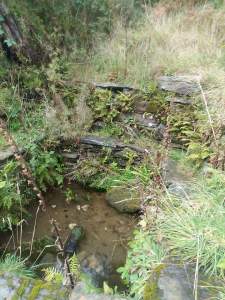
Today is the feast day of my personal saint, the one I chose for my confirmation, St. Elen of Caernarfon. She and her homeland has touched me in many ways, and I was privileged a few years ago to pilgrimage to one of her holy wells in the small town of Dolwyddelan in North Wales. She is the patron of traveling and travelers and ironically, when I visited the town of Dolwyddelan and the Castle there, I was walking distance (even for me) from my future saint’s holy well. There are so many connections that I shouldn’t be surprised anymore.

St. Elen’s Well. Dolwyddelan. (c)2022
Continue reading

Inspire. May.

Standard

I know we’re a little late with our inspiration, but May has been both inspiriing and challenging. When I decided to share my inspiration received from St. Hildegard of Bingen, I needed some quotes. Then I went to a workshop about her. Then I thought I’d add a picture, and here we are.

Friday Food will continue to be delayed but I expect it to be published within the next seven days, despite the end of May creeping upon us.

“To sense each creature singing the hymn of existence is to live joyfully in God’s love and hope.”

Pope Francis, Laudato Si

“Humanity: take a good look at yourself. Inside, you have heaven and earth and all of creation. You are a world. Everything is hidden within.”

St. Hildegard of Bingen

Last week I had the privilege of attending the first of three explorations of Catholic mystics, Hildegard of Bingen; the other two are St. Catherine D’Ricci and St. Julian of Norwich. I have long been intrigued by St. Hildegard, both because of her strong personality at a time when that was frowned upon in women as well as her body of work in a plethora of fields.

“We cannot live in a world that is not our own, in a world that is interpreted for us by others. An interpreted world is not a home. Part of the terror is to take back our own listening, to use our own voice, to see our own light.”

St. Hildegard

Her words from the 16th century are equally true today for us as they were then; perhaps moreso. Her words of advice remain a strong reminder that we remain brave and strong, and in control.

“Even in a world that’s being shipwrecked, remain brave and strong.”

St. Hildegard
Continue reading