Halloween and Political Statement

Standard

​As Walter Cronkite said, “Freedom of the press is not just important to democracy, it is democracy.”

My Halloween costume this year is a political statement. I’ve been shocked and appalled by the number of attacks, both verbally and physically on journalists in the past year and throughout this election cycle, mainly from one side in particular.

There is a reason that freedom of the press is in the first amendment; it is that important.

We can’t let serious presidential candidates mock journalists for their disabilities.

We can’t let candidates refuse press credentials to mainstream, reliable, longstanding investigative journalistic newspapers like The Washington Post, the paper that broke the Watergate scandal.

At the same time, we can’t let them issue credentials to their friends.

We can’t let campaign employees (Lewandowski) assault journalists (from Breitbart no less).

We can’t let journalists (like Amy Goodman) be arrested for inciting and disorderly conduct when she is working as a journalist (and has been for more than 20 years) and covering an important news story that you just don’t like (ND pipeline).

I’m certain that I’ve left out at least half a dozen incidents that I can’t recall at this moment.

This is for every journalist kidnapped while doing their job. At the most recent White House Correspondents’ Dinner, President Obama honored Jason Rezaian, journalist released from an Iranian prison. He stated, in part, “This year, we see that courage [Jason Rezaian] in the flesh and it’s a living testament to the very idea of a free press, and a reminder of the rising level of danger, and political intimidation, and physical threats faced by reporters overseas.” [And I would add, here at home as well.]

This is for David Bloom who died doing his job.

This is for Daniel Pearl who was murdered for his religion.

This is for Bob Woodruff who got a traumatic brain injury doing his job.
This is for Spotlight, the Academy Award’s Best Picture for 2016.

This is for every journalist who went to jail for protecting a source.

This is for the First Amendment and the freedom of the press.

50-31 – The Magic Tunnel

Standard

The Magic Tunnel by Caroline D. Emerson was one of my favorite books as a child, and it still resides on my bookshelf. I will take it out on occasion and thumb through it, reading bits and pieces and remembering what I loved about it.

It was multi-genre, taking on adventure, history and historical fiction, and time travel, and it probably influenced the direction of my interests more than I would have thought at the time. It had everything a voracious reader in elementary school could ask for.

I spent my elementary years in NYC – Queens with grandparents in both Queens and the Bronx. The brother and sister in The Magic Tunnel also lived in New York City, and in taking the subway, something I did with my uncle and on class trips, they found adventure in the past before NYC became New York. It was originally New Amsterdam, and in their travels, they met the original Dutch colonialists, the Native Americans already living in the area, and Peter Stuyvesant.

They explored the Dutch settlement and saw other aspects of Dutch colonial life and recognized much as what they had been learning in school as well as straightening out some misconceptions from that time period.

In the years after reading this, I immersed myself into history and science-fiction, still two of my loves. I also continue to have an unfinished novel from college in the same multi-genre way, combining time travel, adventure, and history. Without realizing it, I’m certain that The Magic Tunnel was a strong influence to begin and continue that story. Even today, I still come back to it and try to tweak and add elements, thinking maybe the story is relevant and can still go somewhere.

After college, I joined a re-enactment group to study and fully immerse myself in The Middle Ages.

I still love train travel, and am thinking of how to take a train trip for a writing excursion, although I’m not sure that I want to travel to another dimension or plane.

Published in 1964, it may certainly be dated and somewhat stereotypical, but it is still worth a look to see how our past was perceived and may have been perceived by two elementary age siblings just trying to get home.

50-30 – The Post Office

Standard

I grew up in the post office. Sort of. Both of my parents worked for the post office, and I’d visit them often from when I was young, in elementary school right up to college and after.

I knew where the employee only door was to visit my mother, and I’d walk on through even though it said, No Admittance, Employees Only. This was also my way of bypassing the line and I would give my mother my mail and she’d dump it into the sorting tray.

I used to send a lot of letters and cards to friends and pen pals. I didn’t realize that stamps had to be paid for; that thyey cost money. My parents never asked me for money for stamps.I thought they were a benefit of working for the post office.

I’d leave my mail sticking out of the medicine cabinet mirror in the bathroom at night, and the next morning they’d be gone and on their way to the addressee.

I sat at Gloria’s desk, twirling in her chair, pushing around the cigarette butts in the ashtray with a pencil. I’d use the stampers on blank pieces of routing paper: First Class, Air Mail, Fragile.

On ocassion, I’d sort the mail into the carrier’s trays by zip code.

I would address letters to my grandmother by simply writing Grandma and her address.

I knew the importance of the return address and using a zip code. I rebelled against the zip plus four.

For a long time, I could identify a state by its zip code, and I was one of the only kids in class who knew all the postal abbreviations for all of the states.

Even today, two hundred fifty miles away from those childhood post offices, I still feel at home sending out my letters and packages. I sneak behind the second counter to build my boxes, pack them, address them and tape them closed. This isn’t an official counter where the stamps and money are kept. It is alongside the retail section. It might have had a cash register a long time ago for just the retail items, but it’s just a great space to pack up and get my Christmas presents ready for mailing. I do get asked a lot of questions, though because everyone thinks I work there. I can almost always answer the questions, which makes me feel good too.

As a kid, I knew not to put any mail in the blue neighborhood boxes. I still don’t although the problems that happened in the 70s don’t really happen too much anymore – fireworks in July, eggs at Halloween.I do hand my already stamped mail to the clerk about ninety-nine percent of the time.

Fragile, liquid, perishable, or potentially hazardous? My clerk knows I know it, and he has to say it anyway, so I just smile and wait patiently to answer him. Usually it’s the first three, especially around the holiday season.

I automatically hand over my credit card, knowing the clerk needs it for the credit transaction.

I’ve asked for tape and markers and staplers.

I almost always use priority mail. I remember when priority mail was guaranteed like express mail is.

The price of stamps almost always goes up right after Mother’s Day, at least it did two or three times in a row.

I remember when computers came into the station, and at my parents’ first station together, we could walk to the pizza place and back. Joe’s Pizza.

As an adult they kind of frown on you spinning the chairs around, but there was not a chair that I didn’t spin when I was a kid.

50-25 – Charm Bracelets

Standard

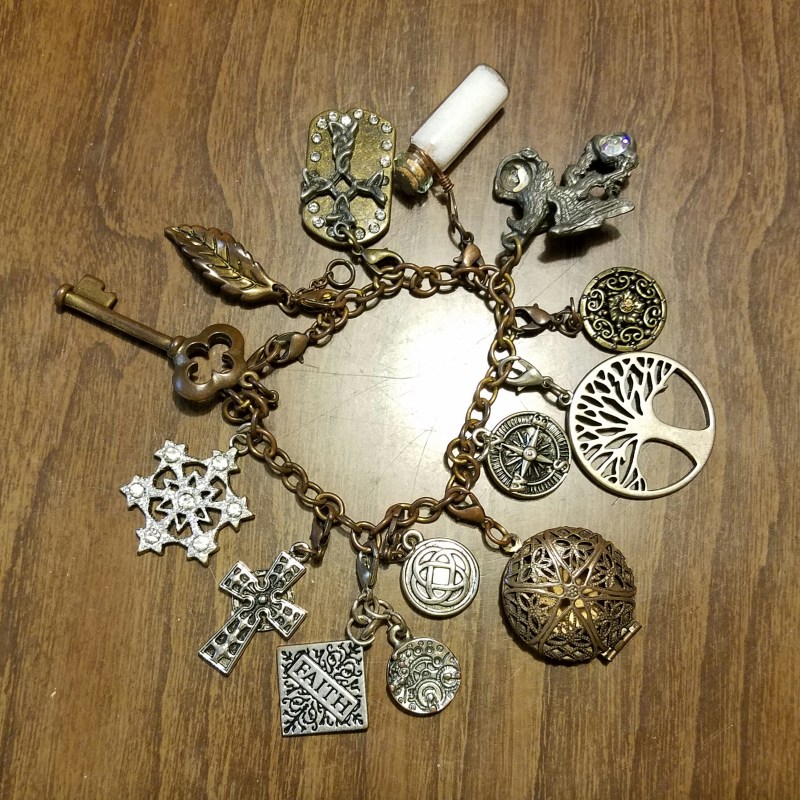
Did you ever collect charm bracelets? Collect might be a bit strong of a description for mine. I’d get them at a variety of tourist spots on vacation, and then promptly lose them upon coming home. I remember looking at them in the gift shop, twirling them around my fingers, examing each charm. I’d wear it for a little while and then it would disappear into the netherworld of lost socks and board game pieces, never to be seen again.

I have vague memories of tricorn hats, moccasins, cactus, oranges, palm trees, revolvers, horses and buggies, Amish hats and other like trinkets in fake silver and gold.

After college, I made myself a charm necklace with pendant charms that I liked but no longer wore, strung onto a shoelace or a thick piece of twine, each separated by beads. It became too heavy to wear.

In recent years, I began collecting charms again; this time on a chain bracelet. I picked things out that were meaningful to my life now. I did lose one of a bow and arrow that I’d had since the SCA and archery practice in the ’90s, and that made me sad, but I substituted a bow and arrow that I found on a keychain of The Hunger Games.

Each one means something different and symbolizes some aspect of my life now.

The charm bracelet was the first place that I put a cross after I’d begun my RCIA studies.

The compass symbolizes the constant journey I’m on, and keeps me on the path and going in the right direction.

The salt vial keeps the demons away. Actually, it’s a symbol of Supernatural, a television show that is one of my coping mechanisms for depression (along with others). It reminds me that I’m part of the Supernatural familly and to always keep fighting.

The Tree of Life is nature, and life, and something that is bigger than me.

My griffin is from my original charm necklace. It is my favorite animal. Part lion and part eagle, they are both majestic and confident, and their golden feathers are gorgeous.

The feather is in place of a quill for all my writing.

Each one is special in its own way. It is like my secular rosary.

A newer charm bracelet that my family got me for Mother’s Day. It has only a few charms that werre important to me. (c)2016

50-24 – Green Candy Dish

Standard

Top of the dish, closed. (c)2016


That candy dish came to our house when my grandmother moved in with us. I thought it was the most hideous thing ever. There was a mosaic tiled tray that didn’t go with it but managed to fit into the hideous theme that apparently my mother was going for. The green on it was the same color as my grandmother’s green velvet couch, two pieces that separated. When she moved in one half of it went into the basement where I wouold lie down on it, legs over the arm watching baseball and eventually the US hockey team beat the Russians.
Looking at the dish now, I don’t know what it was that I didn’t like. I love the shine of the green even under the specks of dust. The colored tiles seem like painted slate. Someone worked very hard on that art. When I pulled it out of the bookkshelf, I started thnking about where I might put it in my office instead of keeping it safe behind glass. Perhaps put it in my mother’s curio with her rabbi and upside down ashtray that makes him taller.

I also wonder how my grandmother came to have this piece. Was it a wedding gift? It’s proably not old enough for that. I don’t recall her ever going to Israel like other family members did on my mother’s side. 

Maybe it was her new authority in our house that I transferred to her stuff. She lived with us now. She became mean, like a third parent, telling us when to be home, to wash our hands before dinner, you know, usual kid complaining stuff. I could have been better.

Maybe it’s true that we mature as we age, and despite not liking this candy dish as a kid, now that I’m older, I appreciate the fine work that went into it; the distance it traveled to come into my household, and wanting and asking for it when my mother died.

Dish, open. (c)2016


Detail of bottom. Made in Israel. (c)2016

My kids have a better appreciation for their grandparents’ things. They appreciate where they came from and the lives that they lived as kids and young adults. They’ve each had the opportunity to interview my mother-in-law for biographical reports for school and so they talk about her and her experirences often. I wish I was more like them when I was a kid.

50-21 – Miracle on Ice

Standard

​1980. US Olympic Men’s Hockey Team. The Miracle on Ice. Jim Craig wrapped in the American flag, looking for his father in the crowd, tears falling on his cheeks. Al Michaels screaming, “Do you believe in miracles?! Yes!”

The late ’70s, early 1980s were the heights of the Cold War. In 1969, we’d won the space race with the first men landing on the moon. Nuclear armament was at its pinnacle until START treaties and talk of Star Wars, which while mocked was a real defense initiative against the Soviet Union.

Today they are Russia, and a half dozen or so other republics, but in the 1980s they were the USSR – the United Socialist Soviet Republic. The Iron Curtain was firmly in place.

Defections from communist countries was happening so often it became a TV trope playing itself out on television from Murder, She Wrote to Mission: Impossible, MacGuyver, The Hardy Boys/Nancy Drew Mysteries, and The West Wing. Russian spies were everywhere too, including our televisions on Scarecrow and Mrs. King, Remington Steele, Murder, She Wrote, and of course, Get Smart. It was all around us and television and pop culture reflected that.

In school, we continued to have drills in case the Russians sent their missiles to bomb us. I’m still not sure how lining up in the hallway or crowding under our desks in the classrooms were supposed to keep us from spontaneously combusting if it did happen.

We couldn’t travel to Soviet bloc countries, including Cuba, a mere 90 miles away from our border. Cubans climbed aboard dangerous boats and attempted to find a new life here. If you could reach the beach of southern Florida, you could be an American, but instead often ended up drowned or sent back.

Not to forget that at the time of the Winter Olympics, President Jimmy Carter was considering a boycott of the Summer Olympics that was to be held in Moscow later in the year. The Soviet Union had invaded Afghanistan, and they were not happy with our threat of a boycott. [We did end up boycotting, and our teams could not go to the Summer Olympics in Moscow, including one of my high school teachers who had been training for competition.]

This was the world we lived in when the world came to the village of Lake Placid, New York for the 1980 Winter Olympic Games.

The Russian Olympians were a powerhouse. They were amateurs in the sense that they didn’t get paid in the traditional sense, but they lived better than most Russians and several were full time military. They didn’t work apart from training and they trained with state of the art  equipment and in arenas, and on the world stage they were the best. At pretty much everything.

Our hockey team was a ragtag bunch of scrappy college students and true amateurs (average age 22, the youngest team up until that point) mostly led by the plain-spoken, dour looking Herb Brooks, but Herb Brooks had something else. He had sayings, motivationals that were sometimes cliche, and sometimes corny, and for a long time after 1980, I compiled a list of them that is long since lost. Luckily, Wikipedia kept track:

Brooksisms

Brooks’ original expressions were known by his players as “Brooksisms.” According to Olympians John Harrington, Dave Silk, and Mike Eruzione, these are a few. [Herb Brooks]

“You’re playing worse and worse every day and right now you’re playing like it’s next month.”

“You can’t be common, the common man goes nowhere; you have to be uncommon.”

“Boys, I’m asking you to go to the well again.”

“You look like you have a five pound fart on your head.”

“You guys are getting bent over and they’re not using Vaseline.”

“You look like a monkey tryin’ to hump a football!”

“You’re looking for players whose name on the front of the sweater is more important than the one on the back. I look for these players to play hard, to play smart, and to represent their country.”

“Great moments are born from great opportunity.”

“You know, Willy Wonka said it best: we are the music makers, and we are the dreamers of dreams.”

“This team isn’t talented enough to win on talent alone.”

“If you lose this game you’ll take it to your grave … your fucking grave.”

“You were born to be a player. You were meant to be here. This moment is yours.”[14]

“Write your own book instead of reading someone else’s book about success.”[5]

“Boys, in the front of the net it’s a bloody nose alley.”

“Don’t dump the puck in. That went out with short pants.”

“Throw the puck back and weave, weave, weave. But don’t just weave for the sake of weaving.”

“Let’s be idealistic, but let’s also be practical.”

“You guys don’t want to work during the game?”

“The legs feed the wolf.”

“We walked up to the tiger, looked him straight in his eye, and spat in it.”

“Tonight.”

“Again.”

He pushed this team, and while they weren’t expected to do great, they were still our team.

We watched them beat one team, and then another. When they were matched up against the Soviet team, we knew it was over. We skated a good fight, but we were done. The Soviets had beaten them in exhibition a few weeks earlier by a score of 10-3.

I was huddled around my basement television, lying down on my grandmother’s half green velvet sofa, my legs hung over the single armrest, just like I’d watched baseball the summers before and after.

I know I drifted off to sleep, but woke for the final moments of the game.

Do you believe in miracles?

After this moment, we all did.

We beat the Russians! We beat the Russians!

Not they; WE.

The college trained, Herb Brooks led, no names who became household names had beat what the world called a professional amateur team, the Soviets, who lost at nothing. They had won the gold medal in hockey for six of the seven most recent Olympics. We won.

Most people forget that this game wasn’t for the gold medal. The US Hockey Team still had to go on to beat Finland in the finals, which they did, to win the Gold. But somehow, this was better than the Gold.

This….was amazing.

50-20 – Temple

Standard

I recently found myself in Temple for my friends’ daughter’s Bat Mitzvah.It is at once familiar and strange to me. As a child, I went to shul or school twice a week, but there were no services with them. It was the learning of the language, the history, the tradition, and I loved it. I went with my cousins who were my best friends and neighbors. When we all moved, they to Florida, we to Long Island, I went to a more religious center that I did not like, but was lucky enough to find my old teacher, Mr. Baran and went back to the traditional school that I loved so much.

This recent time in Temple was more enriched by my attending Catholic Mass than any other thing I can think of. I suddenly understood some of the ritual that was never explained to me as a child.

When the Cantor sang, Oh-ya-say-Shalom-bin-romav, I began to sing along. I was amazed to discover that I knew every word, and wished that the song would go on forever because it brought me to a childhood place that I thought was lost.

It reminded me of the High Holidays in Queens. The High Holiday services required tickets. All of us children were left in the parking lot while our parents went in to pray at the multi-hour service. I was one of the older kids at seven or eight.

We stayed on the warm asphalt, playing jump rope and hopscotch in our Saturday best. For a long time I thought  I made up this memory, but in talking to my cousins recently they remember it exactly the way that I do, so it must have happened. We were left to our own devices and on occasion someone would come out from the temple and shush us. We had the foresight to look chagrined, but as soon as the doors closed again, we went right back to our playing, eventually getting loud enough for someone else to come out and chastise us.

It was like that every year until we moved.

50-19 – Ghost Stories

Standard

​As skeptical and full of cynicism as I am, I still believe things. While it’s still in the mainstream, I don’t need to see G-d to know He exists, but I also believe in other spirits. I’ve seen them and felt them, and unexplained things are unexplained for a reason. Sometimes, it just is.

One of the reasons I never watched The X-Files or came so late to Supernatural and hated The Twilight Zone is how much of it I believe can be reality. The supernatural and unexplained aspects of shows like that, of seeing things in the corner of your eyes, of hearing things that others don’t – I could never accept it as fiction because I’m a believer in those spirits and happenings. Some of those types of stories are just too real. For me, there is no suspension of disbelief; my disbelief is already suspended and I clutch one hand to my armrest, and one over my eyes with barely separated fingers.

The first experience that I can recall was as a child visiting the Jenny Wade house in Gettysburg. Jenny Wade was the only civilian casualty of the Battle of Gettysburg. A bullet propelled through her street facing closed door and hit her, killing her instantly while she was kneading bread. As a child, there was a mannequin of a soldier in the kitchen that told her story. They projected a talking face onto the mannequin that creeped me the fuck out. Even as a kid, I knew it wasn’t a ghost or ghostly figure, but it was still scary for me. The promotion of the house was that the walls could talk as the only eyewitness to the death.

I visited there again with my husband and later on with my kids when they were younger, and I remember a distinct feeling of not being alone in the cold cellar of the house. The simple act of opening the doors tilted and facing outside, and descending down the stone steps left a profound feeling.

Gettysburg is full of spirits, though. Out of all my encounters, three have taken place in Gettysburg or areas of the Civil War battles. I distinctly remember waking up to find a soldier in a Civil War era uniform standing at the edge of my hotel room bed. I still get shivers when I picture him; like now.

The third time, my husband took my son exploring some of the gravestones on the Battlefield while I stayed in the car with the two younger kids, and I could feel it all around me – the unrest.

I think of all the battles we’ve experienced as a country, the Civil War has the most unrest, the most restless, the most tragic spirits still roaming about.

Once, after college, I was driving my car and was stopped at a red light. I think I drifted off to sleep. My foot stayed on the brake and there was no one behind me to honk, but when the light turned green or just after, I felt a hand on my shoulder. It just nudged me and I was awake. I’m not sure, but it felt like my grandmother. She had recently died, and of course, no one was in the car with me.

In 2010, I kept a dream journal on post-it notes. I had been having odd dreams, and so I kept track of them at that time. I didn’t discover it until several years later, but one of those dreams was of my friend getting shot. When I looked at the date, it was exactly one year before he was actually shot by a mutual friend’s ex. That definitely gave me pause.

That mutual friend was murdered, and a few of us, some who knew her and some who didn’t, drank a variety of teas and wrote or journaled about them and/or our friend, B. There were five different varieties of tea that we were all sharing at different times and in different places, and I could definitely feel her presence during those tea drinking moments, and while journaling about them. She was very present for about a year after she died; maybe a bit longer than a year, but it was palpable, almost a tangible feeling of her spirit, encouraging me to taste the tea with all my senses and keep writing about the feelings. Her spiritual presence was one of the many influences on this blog coming together more consistently.

There have been others, including the moment that my belief in Jesus Christ came upon me in cliched and literal glowing white light and sudden understanding, but other than that the other moments were much less, just there nudging me forward, sometimes a comfort and sometimes a question, but my mind and my heart are both open to these and other encounters.

50-16 – Grandma’s Basement

Standard

Nancy Drew Mysteries, The Mystery of the 99 Steps, 1966


My grandmother’s basement was perfect for reading Nancy Drew mysteries. It was the kind of basement you’d expect to find a body buried in. It was scary and exciting, and inviting all at the same time. There was a window that you couldn’t see out of because of all the overgrowth in the yard just above the window line.

It was a finished basement with a floor and paneled walls. Between the brush shadows and the paneling, it made for a very dim space. Dampness hung in the air, but that didn’t dimish its charm to a preteen girl reading mystery stories.

There were built in shelves filled with dusty books for all age ranges. I remember a lot of different blue hued books. Blue seemed to be a popular color for a book cover. None of them had book jackets that I recall.

There was a couch and a round coffee table in the center of the seating area.

There was another side to the basement that I don’t remember as well. I don’t think we went on that side or if we did it was rare. That is probably where the washing machine was and the furnace – those important things that keep the house going, but remain invisible to visitors.

There was also a door leading to the garage. It was a one car garage at the bottom of a steep driveway. It smelled of oil and gasoline, and every time we drove into the dreiveway, I thought for sure we were going to slide right through the closed garage door.

But the other side, with the books and shelves and seats, that was where we played and read and pretended. Nancy Drew, the Hardy Boys and whatever else came to mind.

When I think of my grandmother’s house, this is invariably what I picture in my mind.

Google Image, 2016. This is the outside of my grandmother’s house. It is a little different than when I visited her there in the ’70s.