June Inspired

Standard

When we were in Montreal last August, we were driving down one of the city’s streets on our way to Notre Dame Cathedral. It was our first time visiting the cathedral – it had been closed the year before when we tried. I was looking out the window – I’m always on the lookout for an unusual picture, and I saw a giant bird. Was that a bird? I asked my family. I think that was a dodo bird. I don’t know how I knew it was a dodo bird, but they thought I was seeing things. One google search showed that I wasn’t. It was really there. When we went last week, I made sure to put the dodo bird on my list of things to take a picture of.

It did not disappoint.

Most of the trip was to do research for the book I’m writing about St. Kateri Tekakwitha, and while I wasn’t able to look at documents, I did speak to some people, attended two masses, and received a wealth of information – all of it inspiring. The second mass was a surprise, and the priests were two traveling priests who said mass for the four of us in the church at the time. The homily was about Mary at the crucifixion, and I was moved to tears by not only this man’s words, his sermon, his preaching, but his excitement. He was just thrilled to be talking to us about our mother, Mary. It was a beautiful thing.

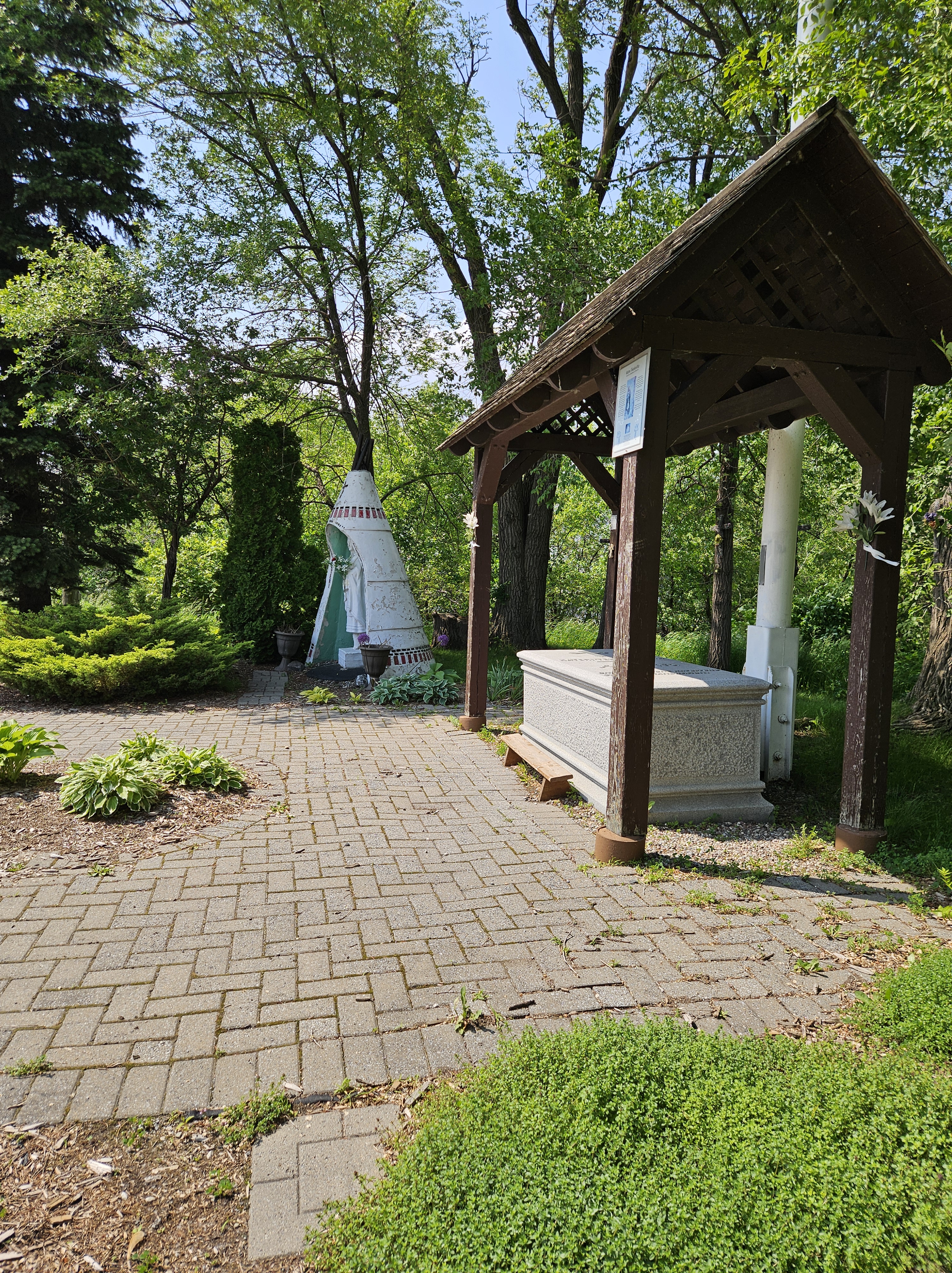
On our last day, we went to see the original burial place of St. Kateri, which is marked by an empty tomb (cenotaph) in Sainte-Catherine. I had been there before; this was the first Kateri place in Canada that I had been to initially, but I wanted some photos closer to the water that flowed behind the shrine. Water is important in the story of Kateri’s people and where they located their villages. I got there, and I stood for a moment, just looking around. I was overcome with the scent of flowers. It was so strong, like lilies or hyacinth. Hyacinth has that very strong, powerful, flowery aroma.

I looked around to find where the strong smell was coming from, but there was nothing. There were flowers, pines, grass, and a shrub or two. I even put my face into some of the colorful flowers that were budding there, but none of them gave off that smell. Nothing there could explain the scent. As one of my writing colleagues said the other night maybe St. Kateri was communicating something to me. She was called the Lily of the Mohawk, so maybe they were right. Whatever caused that remarkable moment I may never know, but it remains inspiring and wonderful all the same.


Dodo Bird. Montreal, Canada.
(c)2025
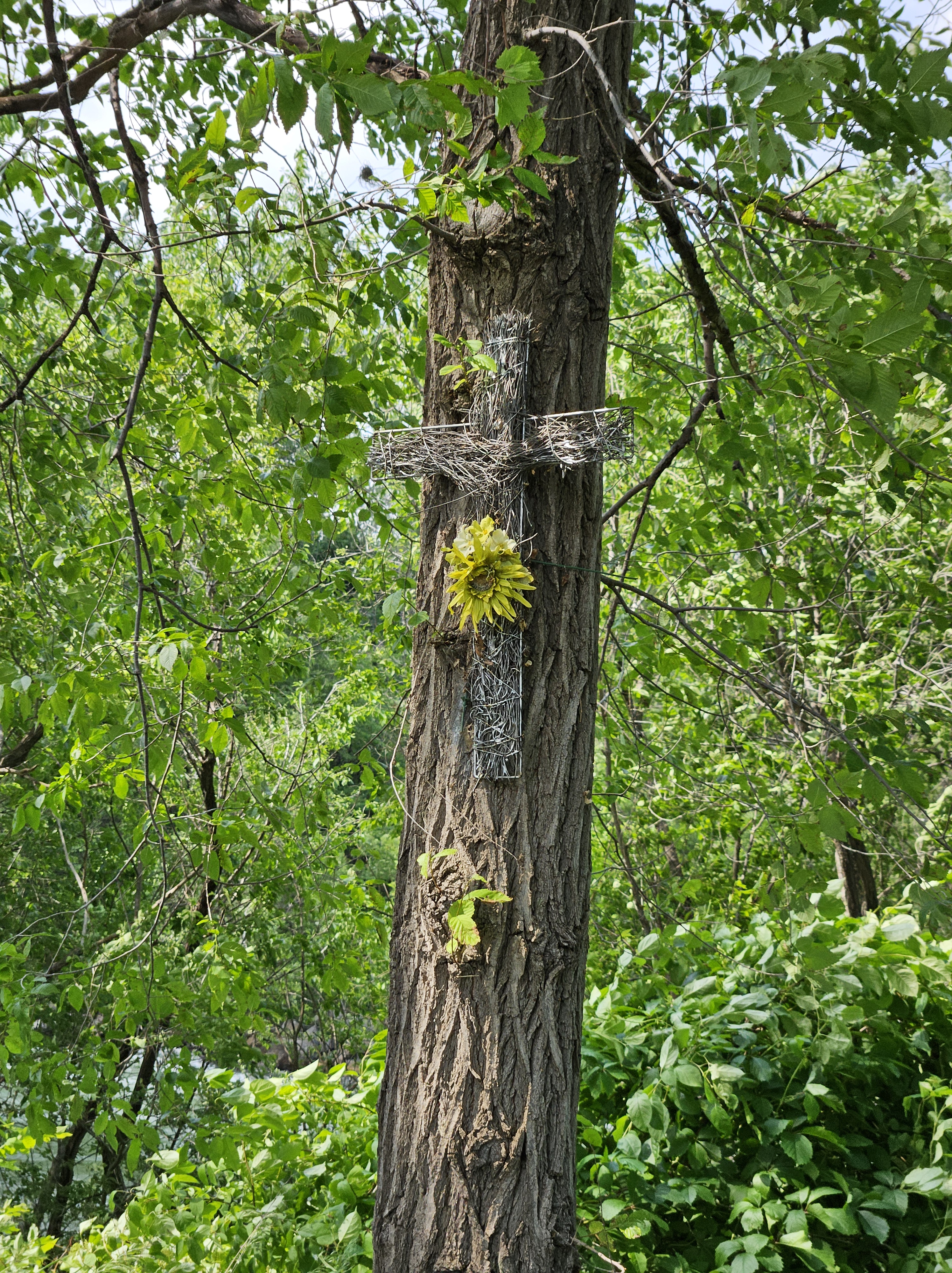
Cross on tree at the Tomb of St. Kateri Tekakwitha in Sainte-Catherine, Quebec. (c)2025
Tomb of
St. Kateri Tekakwitha in Sainte-Catherine, Quebec.
(c)2025

Research and Rabbit Holes

Standard

For my May inspired I thought I would indulge a little. As many know I have been doing a lot of research for my book on St. Kateri, and as I was reminded of in a recent writing class I took, with research you will learn much more than you will actually include in your book, whether that book is fiction or non-fiction, and I have discovered the truth in that. The research that I’ve been doing for this book includes not only St. Kateri’s life before sainthood, but also Mohawk history, the Jesuits in New France, and various aspects of both Catholicism and the longhouse religion as well as many other details that help to inform the writing and the context, something that I’m learning the Jesuits at the time lacked when they spoke of the Native American ways.

I went down one rabbit hole recently that led me to three separate web pages regarding President Ulysses S. Grant’s “Indian Policy,” which was both informative and disheartening. I spent two hours reading, and it will only result in one or two sentences in the entire book.

In discussing 19th century treaties with one of my writing groups, I was sent a recent article on a court case from 2005 that referenced a treaty from 1794. There was also a recent Supreme Court case whose decision was based on a treaty from the 1800s regarding water rights. Another disheartening read as while the Supreme Court agreed that the Native tribe had rights to water, they did not however have the right to have the US government provide said water. Whew! What an acrobatic backflip!

One thing that surprised me in reading about the Jesuit way of converting the Natives to Catholicism was how they dismissed the Haudenosaunee’s spirituality and religious ceremonies when they were already so close to Christianity: a monotheistic society with one Creator, virgin births, miracles, and several other instances of commonalities.

I’ve read five books, two of which had nothing to do with St. Kateri but was wholly about Haudenosaunee Creation and the creation of their confederation and countless journal articles including one comparing the Jesuits’ use of incense to the Native American’s use of sacred fire and smudging. In reading Tom Porter’s book, And Grandma Said…, I have confirmed that we are more alike than we are different. In fact, when he was discussing how he prayed (by talking to his Creator), but was told that was the wrong way to pray by Christians, I was aggravated; that was exactly the way I prayed since childhood – through conversations with my G-d.

As appalled as I’ve been over the years at the treatment of Native Americans by colonialists (and modern people) I have become even more appalled and tell anyone who will listen about these judgments and discrimination foisted upon the Native population here on Turtle Island.

The second time we visited Kahnawake in Quebec, I told our tour guide that I wanted to visit, not only for the St. Kateri information where her tomb was, but also because what my children, who are 27, 19, and 18 have learned of their Iroquois history in 4th grade is the same as I learned in my 4th grade class forty years before that.

I’m reaching out to people with questions. I’m visiting places where Kateri lived both as a child and as a young adult, taking notes, creating lists of questions, looking through land buying archives, borrowing well-worn books out of the library. I’m getting help from places I hadn’t expected and advice on where to look for information. I’ve reached out to an artist for permission to use his art and I’ve signed up for journal access, which fortunately was granted for one month rather than requiring payment for the entire year.

While there is a struggle to find some material, I am reading from Mohawk sources to realize the context and seeing the misunderstandings of the Jesuits towards Kateri’s people. I also believe some of those characterizations were intentional to make Kateri seem more pure, more otherworldly, more worthy of the sainthood they coveted for her future.

My next two research jaunts I’m hoping to make are to the shrines in Fonda, New York and Kahnawake, Quebec to visit their archives. In both cases, I’m hoping the papers are in English rather than French. I also hope to interview one or two people and visit one area’s Strawberry Festival and one area’s Pow-Wow (both of which are open to the public). Those have less to do with Kateri the person and more to do with the Mohawk heritage.

Rabbit holes. They are deep and twisty, and the bucket is often not big enough for what is unearthed.

Fandom and Smart Tech

Standard

In Vintage Supernatural, I mentioned how for me, and many others who are fans or in fandom, have a broader relationship with the source material. In other words, when the television show ends for the week, it doesn’t always end for the viewer.

In the case of Supernatural, I am often also on Tumblr, reading the liveblogging and commentary from two of my friends there. It gives the feel of a viewing party, hearing (or reading) others’ exclamations of surprise, their mocking of something unbelievable. They/we applaud the writer, and gush, and we have other fans to gush with. Since I’m the only one in my family who watches Supernatural, this gives me a less solitary experience, and makes it more enjoyable to me.

When I watch The Walking Dead, I watch with my family, so we have that camaraderie and interaction throughout and after the show. I also go online and either read, write or enjoy the new gifsets that seemingly appear as if by magic minutes after the scenes air.

In Vintage Supernatural, I talked about googling the Lizzie Borden House, and discovering its existence.

A similar thing happened in last week’s Doctor Who episode, The Zygon Inversion, they mentioned a town where the action was taking place: Truth of Consequences, New Mexico. It was named after the game show according to Clara, the Doctor’s Companion.

I snorted. Can’t be true. I paused a mere second before googling it, and guess what? It’s real. It exists. Truth or Consequences, New Mexico. I learned something new.

I’ve found that I’ve been searching for terms and actors’ names and previous works while watching the show in real time. I don’t have to sit and wonder who is that guy fore the entirety of the hour. I wait for the commercial, pull out my Kindle, and hit the Google page. I avoid spoilers, but I get my curiosity satisfied without distracting me from the current show.

We simultaneously complain and applaud new technology, but using smart tech for series watching can really enhance the experience and introduce another level of fandom interaction that you haven’t realized you were missing.

I love it!

It’s the best of both worlds.

For anyone else who’s interested in getting another perspective of their favorite show, here are a few of my resources:

Google
Wikipedia
imdb (Internet Movie Database)
Tumblr (search for your television show)

You can also go to the website and specific page for the series you are interested in.

image