From Mighty Girls’ blog – Celebrating Science: 50 Books to Inspire Science Loving Mighty Girls
Posters from Andrea Beatty:

From Mighty Girls’ blog – Celebrating Science: 50 Books to Inspire Science Loving Mighty Girls
Posters from Andrea Beatty:
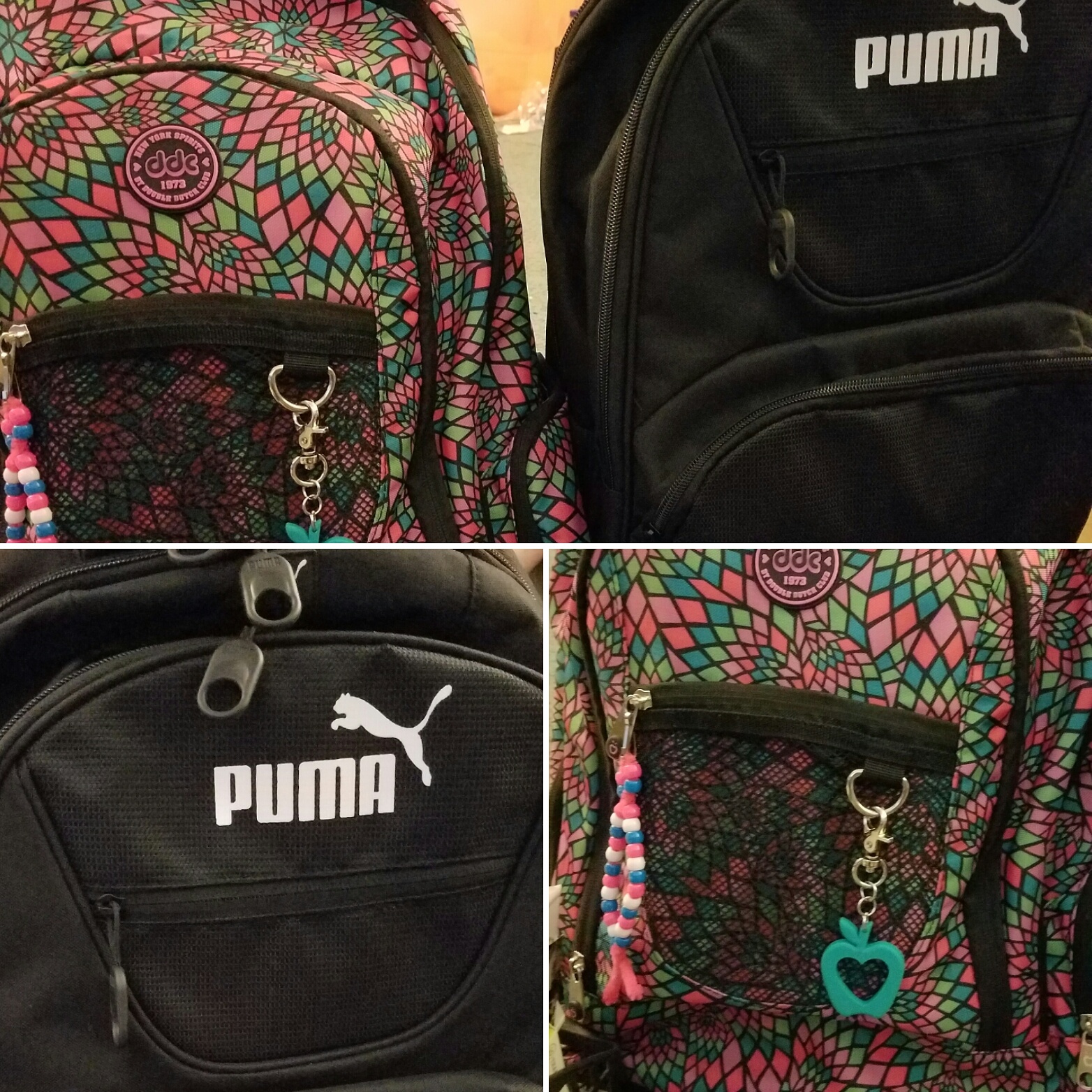
Backpacks are packed and ready to go. We’re a little late but family vacation, school physical, no more money, and we’re finally trudging to the finish line. Or the starting line for a new school year.
On Friday, I met a bird lady at a local event here in the Capital District. Actually, while she only brought birds for her demonstration, her husband describes their work as from mice to moose. And to be fair and less flip, she wasn’t a bird lady, she is a wildlife rehabilitation specialist.
Linda, and her husband take in almost any and all animals that need rehabilitation services. Their aim is to get whichever animals can, get back into the wild.
While my kids played at the Carnival going on, I spent my time with Linda learning about the birds and other animals that they care for.
I was fascinated by the birds.
They’re all predators, and in the wild, or at the rehab center, do not hang out together. Their being well fed keeps them from looking for food among each other at the demo. At home, they’re kept in separate cages, like birds together, etc. Of the five birds I met, all but one are New York State natives. Two of the birds are only here in the summer, so when the cold weather comes along, they’re moved indoors until the warm weather returns.
Only native birds are released locally.
I could get pretty close and take photos, even with a flash, but was warned not to go behind them. They don’t like that.
I was surprised at how much training and licensing goes into running a rehabilitation center and taking care of the animals. There’s state licensing and for the birds you also need federal. After taking coursework, there’s a test that must be passed. To teach and have the demos like the one I attended, you need additional training and licensing, even for a former teacher like Linda.
I called the smallest a grumpy cat owl. Look at his face, and you’ll see what I mean. She’s a Screech Owl named Maid Marian.

Maid Marian. Screech Owl
The Kestrel Falcon is Mr. Piffles, and there’s a Mrs. Piffles back home. He’s one of the summer birds.

Mr. Piffles. Kestrel Falcon.

Mr. Piffles. Kestrel Falcon. Showing off. He did this for me several times so I could get a good picture.
Pygmalion, or Piggie is a Broadwing Hawk. He’s also a summer bird.

Pygmalion or Piggie. Broadwing Hawk.
Shakespeare the Barn Owl was the most regal, the most uncaring, keep looking but don’t touch me aristocratic looking when he wasn’t turning his head regally or falling asleep.

Shakespeare. Barn Owl.
Last but not least, we have the oldest of the group, twenty-year old Annabelle. She’s a Prairie Falcon from the desert. She was a breeder in Texas. When she passes, she has a home in a museum in western New York.

Annabelle. Prairie Falcon.
Visit their Facebook or Website to learn more about what they do and how you can help them.

The great thing about most of these activities is that even though they may seem too young for you elementary age child (or even middle school), when you couple the activity with a younger child, your older one will have just as much fun.
Find activities that are active, outdoors, and hands-on, not to mention creative.
1. Water Play
Even without a pool, you can still have water fun on those really, really hot days. Use a sprinkler. Use water sprayers or water guns. Use small bowls or containers of water. If you do use containers, some very important CAUTIONS to keep in mind:
Do NOT leave children unsupervised no matter how small the container is. Children can drown in as little as two inches of water.
Do not leave your containers standing out when they’re not in use. The standing water breeds mosquitos and other icky things. Pour out the containers. If you must leave them outside, store them upside down. Rinse them out before and after each use.
2. Movies
Grab some movies ahead of time from the library for that inevitable rainy day.
3. Craft Projects
Visit the Nifty (for crafts) and the Tasty (for recipes) Facebook pages for fun activities.
4. Pinterest
Visit the Summer with Bubba board for some great activities, both fun and educational.
5. Barnes & Noble
B&N has a summer reading program that will give your child a free book after they read for so many hours. It is a limited selection but they are all age appropriate and free books are fabulous!
Put any other suggestions/links in the comments below.
Have a great summer!
This activity needs a little prep before the winter recess (or spring break) begins. If you know your kids well, you can use this with any age, but I’ve always geared these tote bags towards early childhood up to about first or second grade. Again, adaptability is the key.
Each tote bag contains themed activities or a planned outing. for example, the library tote can store your finished library books until the next time you visit the library or your library tote can contain books that your kids rarely read or new books to create a library for the day in your home.
1. Library – include books that your kids haven’t seen in awhile. Add card stock, colored pencils, markers, and crayons to make bookmarks. Include journaling paper for book report, reviews, sketch paper for adding illustrations, paper for extending the story (ie. fan fiction for kids).
2. Beach – Throw in those leis from the variety of birthday parties your kids have attended. Include a bathing suit and towel for each child. Don’t forget the sunglasses and water bottle. Put in a CD of dance music and a camera for selfies. You might also want a big, wide-brimmed straw hat to keep the sun out of their eyes.
3. Get Crafty – All the things. Paper, tape, feathers, popsicle sticks, pipe cleaners, glue, chalk, yarn, string, whatever you can think of. Collect some recycling in anticipation of the week recess: toilet paper and paper towel tubes, egg cartons, tin cans (washed, of course), newspaper, magazines. Pirate themes are always fun. Toilet paper tubes make great binoculars and wind socks. Paper towel tubes make periscopes, telescopes, Olympic torches. Use your imaginations and enjoy the creative time together!
4. Dress Up – Hats, shirts, dresses, Mom’s and Dad’s shoes, neckties, scarves. Don’t forget the leftover Halloween costumes too.
5. Back to Nature – Construction paper, glue. Include paper bags to collect the nature items with. Pre-make scavenger hunt sheets where the kids can check off what they find and draw pictures or use a digital camera to take photos of the scavenged items.
6. Animal Hospital – Include a variety of stuffed animals, reusable bandages, a doctor’s kit with stethoscope and blood pressure gauge. Use washcloths as blankets. Pretend ice packs or real ice packs as long as they’re leak-proof.
7. Kids Cook – Aprons, chef’s hats, preferably kids’ sized. Cookie cutters, sprinkles, food coloring, measuring cups and spoons, bag of chocolate chips, can of frosting, box mix for cake or brownies or cookies. Box of Jello.
What tote bag activities can you add to this list? I’d love to hear your suggestions in the comments.
At my kids’ elementary school it has been the tradition that the fifth grade field trip at the end of the year goes to the Six Flags. It’s an adventure, it’s exercise, it’s outdoors, and it’s friendships. Recently, this year when my son is in fifth grade, they decided that the field trip isn’t educational enough so it was canceled.
My first reaction was can’t you let kids be kids.
My second was that as educators they should know that there is education in everything, and Six Flags is no exception.
Instead of canceling it, they could have created learning experiences within the field trip experience. Scavenger hunt. Math problems when buying food or souvenirs. Map-making. Journal writing. These four ideas were literally just off the top of my head as I typed this. It’s sad that an entire school and school board couldn’t come up with a compelling reason to continue this fun tradition as these students go on to middle school and thoughts of career and puberty.
There are so many ways in your everyday to keep learning alive. My three favorite things are:
1. Read. Read. Read. I’m constantly talking about my Kindle Fire, but it’s not the machine as much as what it allows me to do with my limited time and my limited space.
Read the books sitting on your shelf for years. Re-read child favorites. If you like historical fiction, check out some of that history on the Internet or the Outernet, like at your local library.
2. Visit a local museum or historical site, or take a tour of the local attractions as if you were on vacation. I’m often surprised at how much has happened in my little corner of the world. Instead of trying to get away to do fun things, stay home and do what the tourists come to your neighborhood for, and learn something new!
3. Google. When you’re scrolling down your Facebook newsfeed, click the link, read it, and then hit Google for more information on the subject. It’s amazing at how much is left out of those quick posts. Get the other side of an opinion piece. Find out the history of what’s going on in the headlines.
Most importantly, remember that learning is fun, and it’s not all taking place in a formal classroom between the ages of 5
five and twenty-five.
“Education cannot be neutral. It is either positive or negative; either it enriches or it impoverishes; either it enables a person to grow or it lessens, even corrupts him. The mission of schools is to develop a sense of truth, of what is good and beautiful. And this occurs through a rich path made up of many ingredients. This is why there are so many subjects — because development is the results of different elements that act together and stimulate intelligence, knowledge, the emotions, the body, and so on.”
“If something is true, it is good and beautiful; if it is beautiful; it is good and true; if it is good, it is true and it is beautiful. And together, these elements enable us to grow and help us to love life, even when we are not well, even in the midst of many problems. True education enables us to love life and opens us to the fullness of life.”
— Pope Francis, Address with Italian school teachers, parents, educators, pupils and other workers, May 10, 2014
Whether we know it or admit it or not, life is a constant series of learning new things. More and more of us are redefining what getting an education is. It used to be over 60s were considered a non-traditional student. Then, housewives who were trying to break back into the work force. Then the second careerists were non-traditional, and then the youngish ones who made bad choices or were waiting to have enough money.
Now, all these groups and more are less non-traditional and more changing with the times. Schools are needing to adapt through course requirements, including credit for practical experience and travel and life lived to new financial aid options, although this will always financial information even though parents are paying less and less if any of their child’s college bill.
When I started college, it was expected that I’d go. As much as I wanted to write, I was encouraged to go into something practical. I was pre-law. There was never any question about paying for school. We never even talked about it. My parents paid from that moment through all of my formal secondary education. I was stuck on a trajectory that I would have liked to have changed.
I’ve will be spending the better part of this week in a classroom, expanding my knowledge, meeting new people, meditating in nature, contemplating my journey so far. Spring Enrichment with my Diocese is still new to me, but it si also comfortable. I have my notebook, my pen, my camera and I am ready. There is something kind of spiritual about being in a classroom, especially hearing new things about religion and its place in history. Imagining myself there is something I’ve always reflected on my readings, whether they be Scripture or historical text. I’ve since discovered that this form of contemplation has a name: lecto divinia. I had always called it daydreaming. 😉
This week’s immersion into so many Catholic ideas and opinions give me the thoughts that not only do I belong but I can continue to grow as a spiritual person while learning something new.
If you could go back to school (or start), what would you choose to study?
Would you change careers?
In this, Children’s Book Week, what is your favorite children’s book?
 Griffins and Ginger Snaps