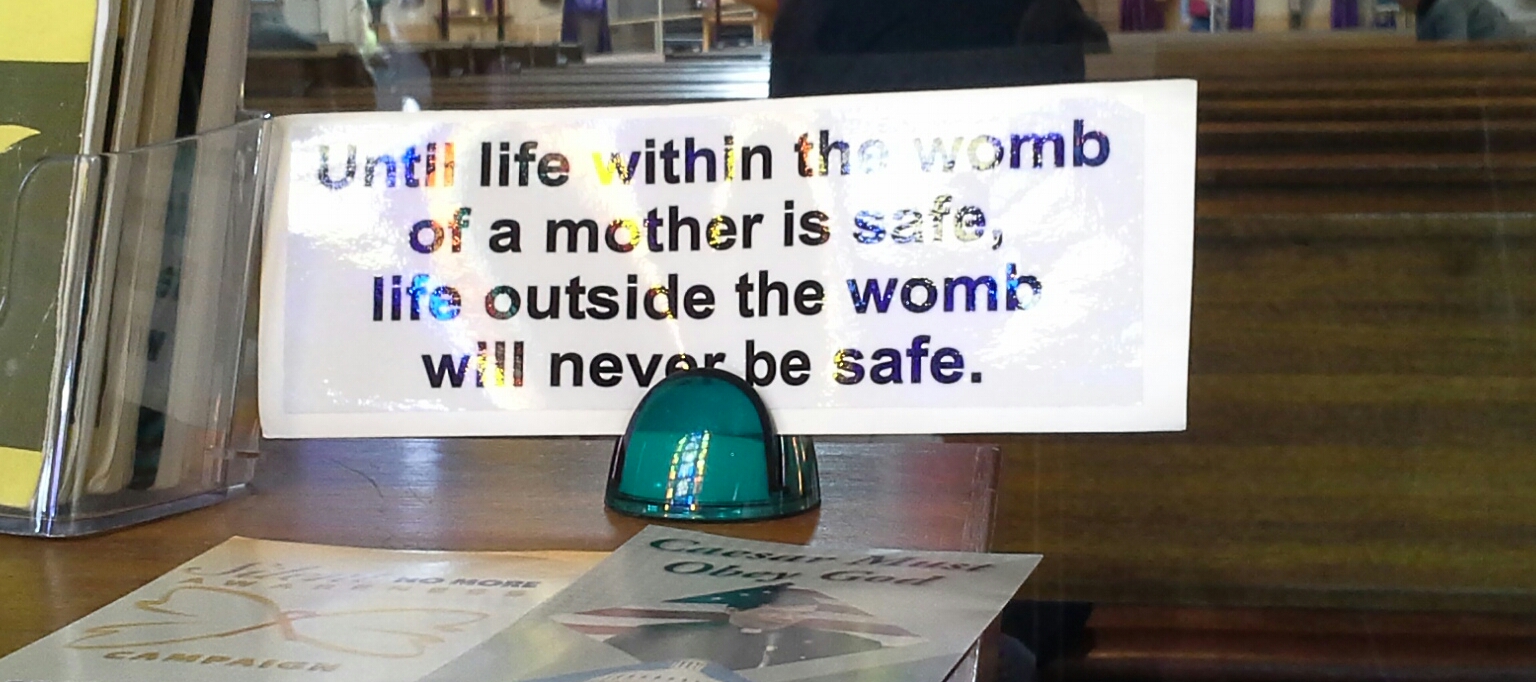
(It says: “Until life within the womb of a mother is safe, life outside the womb will never be safe.”)
(*Note: I saw this earlier today and I had an opinion on it to share. Not all of my reflections this Lent will be on my positive journeying through the forty days. I have many things that cross my mind in a day, and this was today’s.
Trigger warnings for abortion and choice.*)
I could not disagree with this more. In fact, I find it offensive that this is part of a so-called pro-life campaign.
In fact, I think the opposite is true: it is our obligation to care for those already born and through education and appropriate birth control, abortions will, and have been going steadier, lower.
The false equivalency of a fetus and a grown person having the same safety concerns tells me that the person who wrote this sign doesn’t understand the real issues that women in this country, pregnant or not, face on a daily basis.
Is abortion really less safe than being born without a spinal cord or a brain stem?
Is abortion really less safe than starving and dying in poverty?
Is abortion really less safe than living in a chronically abusive household?
Do we really care more for our unborn than our already born? Our persons of color? Our single parents? Our foster kids? Our child victims of rape who are forced to carry babies to term when their emotional states and their physical bodies are not ready for it?
Shouldn’t we begin with taking care of those outside the womb first? If we can’t get that right, how can we presume to know what’s the best options for inside someone else’s body?
We also know that a fetus could not survive on its own without its physical attachment to the mother, the host, unlike people who are already living, breathing, thinking human beings. It is not a symbiotic relationship; it is strictly one-sided. If you remove the baby from the situation, the mother will still be alive. The opposite is not true.
I would prefer less bumper sticker sanctimony and more real world options without the attack on pregnant women at every turn.


