Gospel Women – Week 3

Standard

Today is the third week of the retreat workshop/contemplation/art commune that I’ve been taking. We spend the week reading and thinking about the two women, and then after a short discussion, we art.

I’d like to share with you the readings for anyone that was interested in doing this at home.

The first woman of the Gospel is the woman caught in adultery. The reading can be found at John 8:1-11.

Our second woman is the woman who anoints Jesus in Bethany. That Scripture can be found at Mark 14:3-9.

Later this afternoon or tomorrow, I’ll share what  came about in today’s hands-on portion.

What Ihave found in the past two weeks and four readings thus far is that we can not only see ourselves in these Gospel women, but often we see the women around us, who encourage us to look at things a little differently and who love and support us. I can only hope to be one of those women to someone else.

A Surprise from the Pulpit

Standard

I wrote this soon after the mass on Divine Mercy Sunday, and shared it on my Facebook page. I wanted to also share it here.

Whenever the topic of abortion comes up in a church setting or with church people, I tend to hold my breath. I don’t know how many people are aware of my pro-choice stance. If asked, I try to be clear that I am for women’s reproductive rights in all the forms that women choose to use them. My most vocal place is probably on my Facebook and Tumblr, and no one from church, save one, is on Facebook or knows about Tumblr at the moment. That’s not to say I’m hiding my beliefs, I don”t think I do, but that’s how it’s been.

I had been looking forward to our Bishop as presider of the Divine Mercy Mass a few weekends ago. When I entered, I was handed a song-sheet and offered a relic to venerate, which I did.

I was early so that I could participate in the recitation of the Divine Mercy Chaplet, before the start of Mass. I find those group chaplet recitations and rosary prayers very moving.

The Mass went as it usually does except that it was the Bishop and there were four other priests in attendance plus the deacon. It gives the feeling of something special; not that each liturgy isn’t special in its own way, but the larger group of religious gives it a certain presentation. We have a really good music ministry and they are always outstanding and were on this day as well.

When the Bishop began his Homily with a reference to an unnamed political candidate who proposes punishing women for abortions, I cringed. I could feel my body tense up. I didn’t expect him to endorse this candidate. It also wasn’t because I expect my clergy to come out and talk about pro-choice or reproduction in any way that is not Catholic doctrine. This is something I accept within the church. In the particular case of my priest, he’s never brought abortion up in a political way; only as part of the prayer of the faithful for life, from conception until natural death, etc. with the exception of promoting 40 Days for Life. I usually add my own two cents of prayer silently to include all those who I feel should be included, and who are most often excluded – the women in their most difficult moments.

So when the Bishop brought up Donald Trump, not by name of course, I held my breath.

He talked about how that isn’t the way we should be thinking about the women who have abortions. He never once mentioned preventing abortions, banning abortions, birth control, adoption, none of it.

What he talked about was how we focus on the baby and we should be focusing on the women. He also used the word women, not mother. He talked about how women have their reasons for abortions and when they have them, we need to support them. Whether it’s their choice or their only choice, we need to show them this compassion we talk about. Real pro-life people don’t tell these women that they’re going to hell or that they’ll be punished. Real pro-life people are there for the women after their abortions and without judgment.

I’ve never heard such a pro-choice sentiment from a clergy person let alone a Bishop.

Of course, I know he’s not pro-choice, but this is the first time I’ve heard someone of his stature talk about women using another choice other than carrying the fetus to full term and having the baby.

I was pleasantly surprised on his focus towards the women.

Compassion and mercy are not talking points from Pope Francis; they are a way of living and I for one am happy to see it outside of the media and inside my own parish and diocese.

Among Women

Standard

[Note: This is a repost of yesterday’s. I decided to divide it into two posts – one the actual reflection on the readings and the second to come later this week on the art project and what each item means to me and to the overall design.]

Today was the second of four weeks spent reflecting on women in the Gospel and the Gospel Women in our midst. We begin each week with a prayer, and are given a glimpse of the two women we will be reading about and reflecting on as the week goes by. We think about last week’s two women and then create art as reflection of them. Or, as I hash-tagged it on Instagram, #artastheology.

I often talk about how I use writing in many ways, including as therapy, and as theology, reflection, meditation. I would claim myself not to be an artist, but in the few retreats that I’ve been fortunate enough to be a part of led by artist, Brother Mickey McGrath, I’ve discovered a calmness from the act of coloring, and that has led to simple drawings, tracings, and copying. You can see some of my work on the pages of my website. I’ve tried to stop demeaning my art as an example to my son, who has the potential to be a true artist. He has the talent for it.

We’re supposed to reflect on them through the week, but it wasn’t until this morning that I connected to the Bent Over Woman and the Syrophoenician Woman. I sometimes have trouble connecting to parables and the abstract as well as picturing myself in ancient Jerusalem. I can also see things a little too literally. I’m not bent over, so what do I have in common with her? We don’t really know anything else about her.

But I recognized myself in her quiet; her being there, but not there for anyone else, unnoticeable, unimportant. Jesus doesn’t wait until he’s called upon; he takes the initiative, he heals her, and that’s all. It’s done.

With the Syrophoenician woman, she is there for her daughter. Jesus tells her no. She’s not one of his people, and he’s not going to help her. She talks back to him. She tells him, no, you will listen to me. She stays polite, she makes her point, and he rethinks his position. Maybe he admires her persistence, her love for her child; maybe even her impertinence.

This shows me once again that we have the ability to see ourselves in these women. We hear their stories but do we really hear them? How long does it take for us to listen?

There are women throughout the Gospel. Jesus surrounded himself with women; they were his disciples. Mary Magdalene was the first person to report the Good News. Most of the women in the Gospels aren’t named; only a handful of them, and each of them, named and unnamed,  have something to teach us, to show, to tell.

These four weeks are opening our group up to us as Gospel women and reminding us of the women in our midst who embody the Gospel, Jesus’ words, His Word, and his example.

When we were “dismissed” to begin our art project, we were introduced to the items we could choose from. How will our art reflect the two readings (The Bent-Over Woman and The Syrophoenician Woman) and how are we reflected in them and with the art items?

Piles of letters, feathers, fabric, words, magazines. All things that look like nothing until we choose what appeals to us, and make it into something of our very own. No formal direction, no preconceptions, just letting the spirit work.

One of the items I chose were puzzle pieces; they were there to represent that everything fits together,  it is all connected and interconnected, and after I decided on them, I remembered my words on my prayer bead: Connect, Interconnect.

It really is all connected.

[NOTES: The Bent-Over Woman (Luke 13:10-17), The Syrophoenician Woman (Mark 7:24-30)]

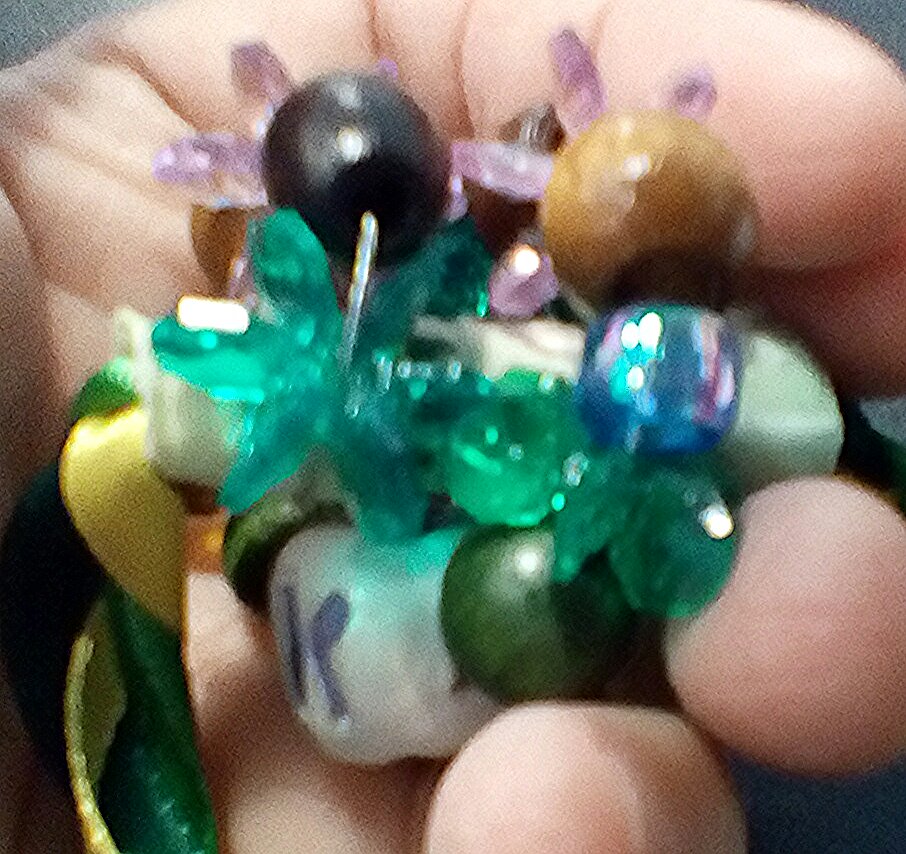
My Everlasting Gobstopper Prayer Bead (Title Change)

Standard

Today was week one of a four week mini-retreat I guess I’d call it. I hadn’t realized that there was an art component, but Brother Mickey and my son’s hesitation to explore his own talent has me stepping out more and more in the artistic realm. It’s not museum quality, but I’ve been pretty happy with what I’ve worked on.

The theme for the four weeks is exploring and meditating on the women of the Gospel as well as the Gospel women in our own lives. We all know them, and this series of exercises will let us dwell on them and ourselves with the guidance of the women mentioned in Scriptures.

Every week we will hear two readings and have the week to think on them. Lecto Divinia was mentioned as a tool which is one that I enjoy. When we return, we’ll talk about our week away and work on some kind of art that reflects our reflections.

Today, being the first day, we reflected on why we’ve come to this type of workshop and we set out to make a prayer bead. It’s not quite a bead. Some of us went long like a rosary. Some of us made necklaces, bracelets, danglies, and whatever else struck our fancy.

Mine is a necklace that i’ll wear the next four weeks, and then I will probably convert it to a danglie.

It’s something tangible to hold onto while I’m reflecting or meditating or sit next to my keyboard while I’m writing.

I anchored mine with a bell. I like d the idea of a little bit of noise in the silence of meditating.

Today’s silence was a bit too relaxing – I think I fell asleep. No one said anything, but I still feel as though I missed some parts of the talking bits.

When mine was finished, it reminded me of an everlasting gobstopper. Watch Willy Wonka making them, and then look at my photos from this morning.

image

image

image

image

Entering the Holy Door

Standard

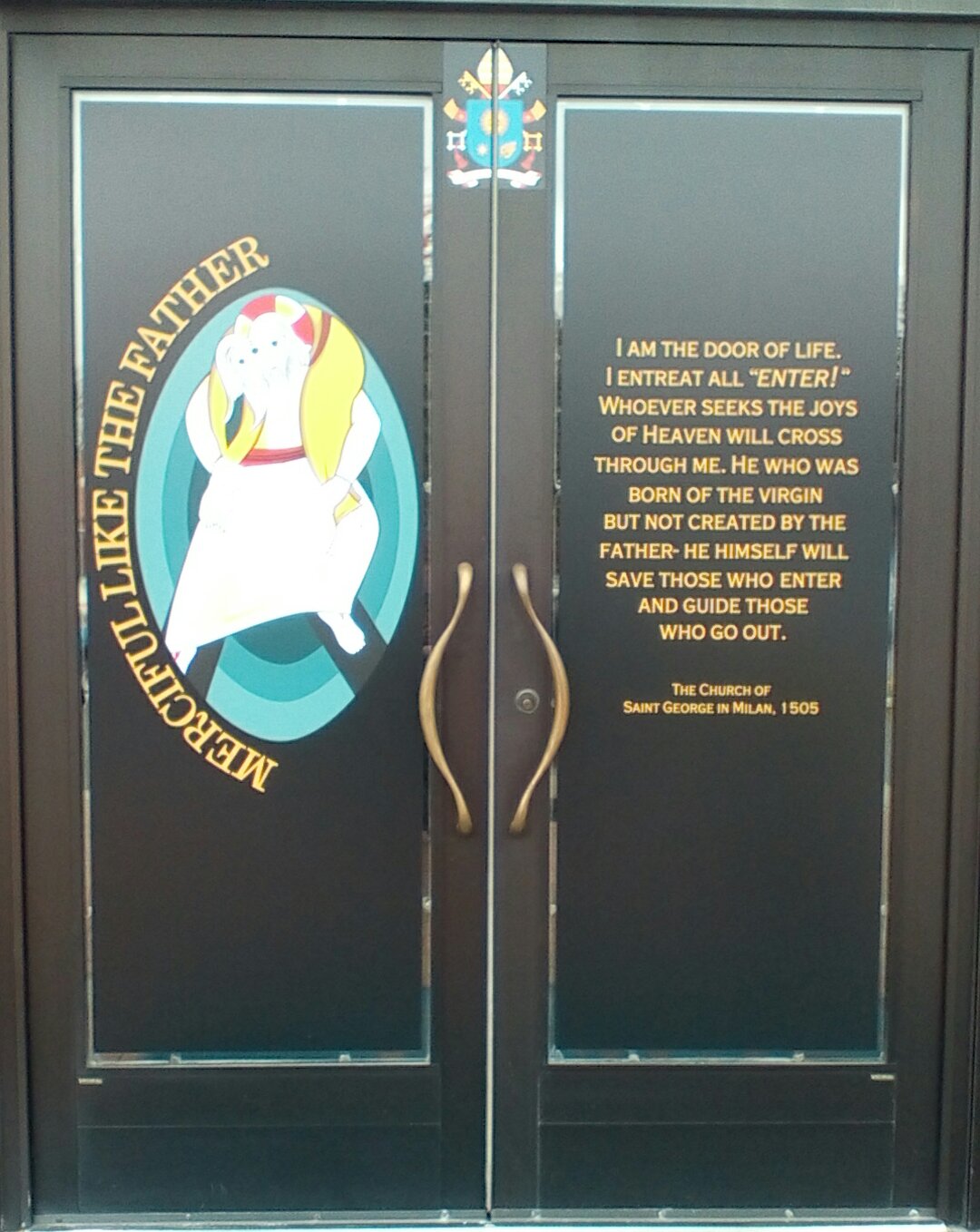
I was on retreat when my parish’s holy door went up officially. The Pope announced that there would be a Jubilee Year of Mercy, and there would not only be a Holy Door at the Vatican, but at every Cathedral across the world. This Pope is nothing if not inclusive. He walks the walk, which is one of the many reason that I am so fond of him. I was very excited to have joined the church about the same time as his election to Bishop of Rome. Without ever having met him, I felt welcomed by the world church as much as I had been welcomed by my parish church,.

I had planned on going through the Holy Door at our Cathedral, but was very excited to learn that our parish was one of a handful that was permitted to have our own official Holy Door. People have come from as far away as a two hour drive to walk through our holy door.

The one thing about walking through the door wasn’t that I could easily do it. it’s not a regular door. There is a purpose to it. The people who enter through those doors should do so with a purpose, with a reason and a contemplative mind. Like all doors, walking through this one is a beginning, not an objective.

Continue reading

Should a Day of Service Be Used to Evangelize?

Standard

I know several of my readers are religious and I’m kind of curious what people think. I’m part of a committee with my church to organize and hold a parish wide day of service. We were discussing our mission and our “slogan” (for lack of a better word), and one person objected to not including Jesus in the promotional materials and our language of introduction when we go on these service opportunities.

I objected to that overt evangelizing once we get to the service location. The locations are places like soup kitchens, nursing homes, hospitals, etc.

His main point was that we’re doing this in service to Christ and walking in his steps, and we should be expressing that to the people we’re volunteering with.

I obviously don’t believe we should ignore the fact that we are coming from the church. And expressing Jesus’ influence and mission as part of our recruiting of parishioners to volunteer is clearly appropriate. I also don’t have a problem with telling the people we’re working with that we are with the church and this is our day of service, that we’re volunteers and we’re excited to be there and even that our faith influenced our volunteering for service.

I do think, however that there’s a difference between evangelizing and serving and we need to be aware of what our mission is as a volunteer and follower of Jesus.

Our mission as volunteers is to walk Christ’s path.

That may not the expectation or interest of the random person we’re working with whom we’ve never met before.

I’m not suggesting hiding our Catholicism or that we are doing this as part of our works of mercy, and I’m not even afraid of offending people, which is the word my acquaintance used. It’s not about offending or not offending.

It’s about respecting.

I think that the majority of people we’ll be encountering will be at-risk, whether they’re kids or elderly, poor or other marginalized groups, and they shouldn’t feel blackmailed into being prosthelytized to just to get a special service. Or to feel that if they don’t listen to the Jesus time-share lecture, they shouldn’t participate.

For anyone who’s ever experienced that (and I have been on the receiving end of condescension of my own faith and the hard sell that I was following the wrong religion). It’s a turn off. More than that, it’s not just offensive, it’s painful to be on that side, to be the other.

Maybe I’m being overprotective of a group that doesn’t exist in this case, but I really do think it’s more important to be there in the moment and not worry about giving the message of Jesus. Our being there doing Jesus’ works is sending the only message we should be concerned about; the tangible message of helping our neighbors, of service with mercy and humility. That includes letting our actions dictate our works, and not our words.

I think we need to take into account the diverse nature of these types of places and include everyone without excluding anyone.

Pilgrimage in the Year of Mercy

Standard

“This (Holy Year) is the opportune moment to change our lives!” the pope has said. “This is the time to allow our hearts to be touched!…May pilgrimage be an impetus to conversion.”

– Pope Francis

This is what Pope Francis said when he opened up this Jubilee Holy Year of Mercy. I touched on the idea of what a pilgrimage is a few weeks ago, and as I proceed through this holy year, I’m still wondering.

I have several plans that involve retreats and learning; contemplation and writing, and I’m not sure where one activity ends and one begins.

Is that a pilgrimage? A retreat? A holiday?

And where does mercy fit in?

I honestly don’t know, and part of this year for me is looking for my own form of mercy; for me.

I’m much better at giving mercy to others, forgiving and letting things go, but I still haven’t done my pre-Easter penance for reconciliation, not because it’s too hard, but because it involves another person and that is the hardest thing to ask of me.

So I ask you:

What does this mean for me in particular as I take my retreats this year, and sort of a partial pilgrimage?

Or just wander through my notebook and my Kindle finishing projects and beginning others?

At the end of this holy year, will I have traveled enough to find my mercy?

Our parish is one of the lucky ones that is not a cathedral, but still has a Holy Door to enter. I’ve walked through it once, earlier in the year, simply as an introduction to myself and to G-d of my intentions, but I will be going through it again after some prayer and meditation.

It gives me joy to see it whenever I go to my church, and it also gives me the reminder that the year is not over yet. I still have time to find my way, and my way begins through that door.

image

Incense

Standard

Incense is a large part of Catholic ritual. Two years ago at my Holy Thursday Mass I was standing in the back of the church waiting for the procession. I was to carry the oil of catechumen. I had spent the previous two years looking for signs and when I looked toward the front, I watched the incense rise and rise and then as it fell again in twisting spirals of smoke, its wisps joined into the shape of a Star of David. And then it was gone. I had received my sign.

Breathing in the incense at not only last night’s Holy Thursday Mass, but nearly every time I have seems to transport me to the ancient times and lands of my people. I haven’t gone anywhere but it’s drier, it’s sandy and my mind can’t help but wonder how these rituals and beliefs got started. History is an amazing thing. FAith is also. There is something about the scent of the incense traveling through my nose, reminding me of a place I’ve never been, but will always belong to.

Holy Wednesday

Standard

On Palm Sunday, we read the Passion of Christ for our Sunday Gospel. our palms were blessed with holy water and we sang Hosanna. This is one of those times during the Mass that many voices are heard: the narrator, the priest as Jesus, Peter and others voiced by one person and the crowd, voiced by the rest of the congregation. In my mind, when we are the ones calling for Christ’s crucifixion it is our reminder that we are all with sin and all seek salvation.

Christ dying for our sins isn’t a free pass to continue sinning; it is only the beginning of our salvation.

Throughout this Holy Week, the Gospels remind us of the difficult week that was in store for Jesus and his disciples.
In today’s homily our Deacon called it Silent Wednesday. When I went to look that up Google offered me the question, ‘why is the D in Wednesday silent?” Not quite, Google, but thank you for reminding me that wording is everything.

It is Silent Wednesday because we are unsure of what Jesus did on this Wednesday. There is no mention of his actions, although we assume this is when Judas put his betrayal into action. For that reason, it has also been called Spy Wednesday; spy having a slightly different meaning in ancient/medieval times and related to ambush. (There are a few Biblical scholars that have expressed the idea that the actual crucifixion took place on Wednesday, but I think that still needs some more research.)

For the modern Catholic, we look at Judas, the betrayer, the catalyst to Jesus’ crucifixion and wonder how as his friend, he could have done such a thing, betrayed his friend, his close friend. We can’t imagine any of us doing that to Jesus, and for me, it baffles the mind.

It causes me to think of the times I was betrayed or betrayed someone close to me. how did I feel? How did they? I know in one instance it took years of grudgingly thinking about this person before I finally dismissed it. I’m not sure if it’s forgiven, but it’s not as important in my life. I have a long memory and some grudges are really insignificant regardless of how much they hurt in the moment, even the later. moments.

I let go more now. I really do try to have no grudges. It’s hard. It’s human nature to blame someone else, and if they’re actually guilty, well, why not then?

But then I think – Jesus forgave Judas. He didn’t blame him personally. He forgave Peter for disavowing their friendship and hopefully Peter forgave himself.

Today is the day to think about that forgiveness and how hard it is and can be to forgive someone, to move forward in meaningful ways.

Reflect on those times you were forgiven and those times you forgave and try to hold the feelings of forgiveness and letting go in your heart on this quiet, Silent Wednesday.