From Death into Life

Standard

image

There is a line in a hymn, I think it’s sung at funerals or as they’re called in the Catholic church, Mass of Christian Burial. It goes, “from death into life.”

I began attending this celebration of life by accident in one of my early days of attending Mass. I was there, and I couldn’t leave without drawing unnecessary attention to myself, so I remained, hidden in plain sight, in one of the back pews, wishing I was invisible, feeling as though I didn’t belong in such an intimate family gathering. I was, however, wrong – this mass invites the community members, the congregation; to be in communion with the family, to send their loved one on their next journey. I followed the program, I sang along, I prayed, and I found something in that service. I think my first funeral service was for a woman named Dottie. I still have her program in my church papers that I’ve collected and saved.

After that first time, I continued to go to the Rite of Christian Burial when it occurred during the daily mass time. I almost never knew until I arrived at church, and after one or two more, I found great comfort in this Mass.

But I still didn’t get it – that death into life bit.

I could never understand that phrase. How can you go from death into life?

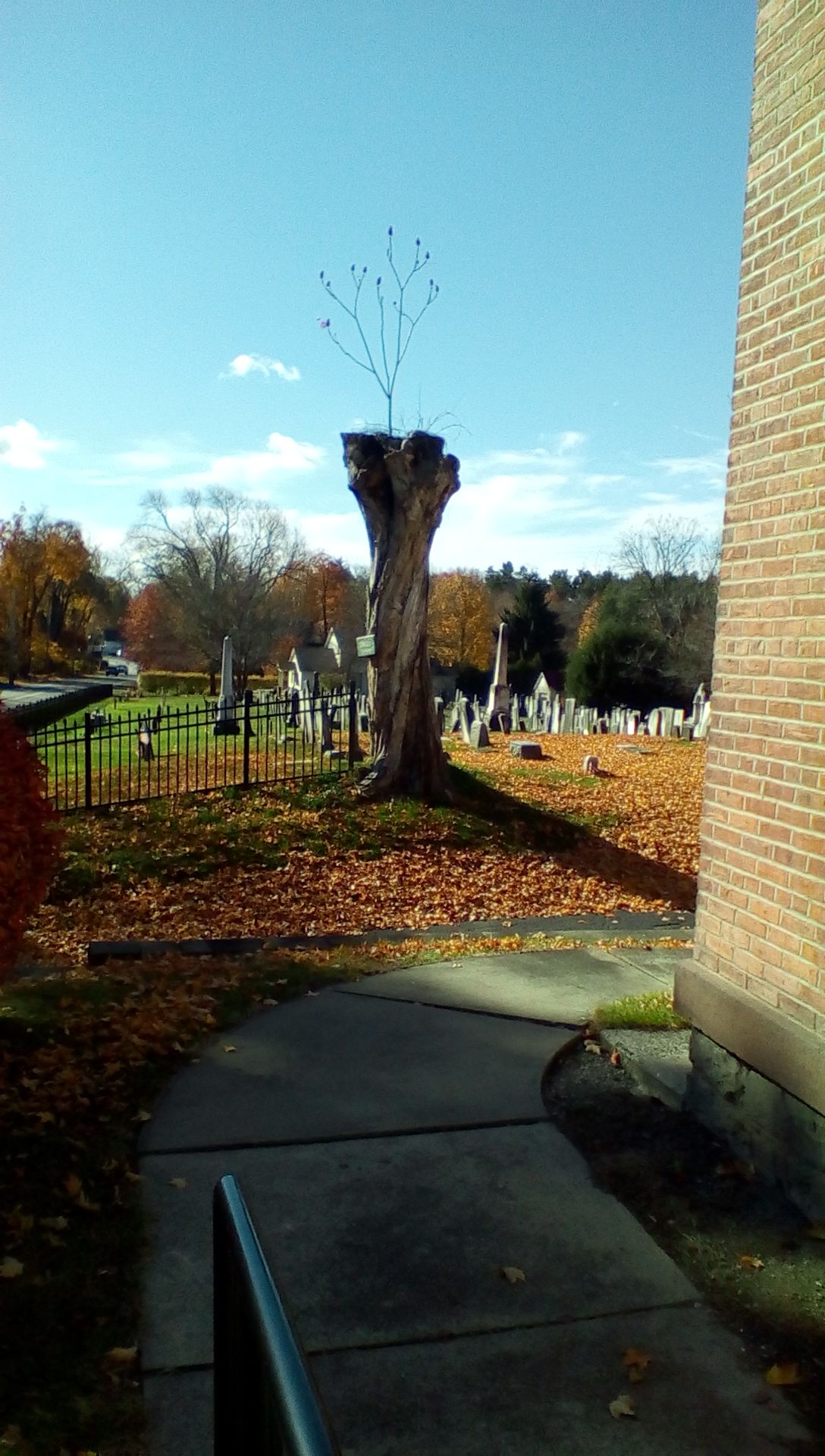
It wasn’t until after my spiritual conversion, and after passing this tree, always on my way to my writing workshop.

On the way to the library, I passed the church adjacent to this tree, and the cemetery that surrounds this tree, and one spring day it was gloriously sunny and bright, and the green leaves had sprouted and grown.

I could see them bright against the white of the siding on the church building; this delicate new growth rising from the fallen tree, its life long thought buried and gone.

This was when I could grasp death into life, life from death, the infinite from finite, everlasting life from our journey on earth.

Now, when I sing the hymn, I picture this tree when I sing death into life.

Celtic Cross

Standard

image

Long before I was Catholic I was enthralled with Celtic knotwork, including crosses. I didn’t collect crosses but I admired them. Looking intently at the weaving, the criss crossing where two lines meet. Knotwork is a most appropriate description. I look at the twists and the turns and the loops and all I can picture is a knotted rope. Thick, muslin colored, braided rope, fringed and frayed at the ends but the beauty in the center never ending. Never ending, like a circle, but more elaborate, each one different from the other.

Look at any Celtic cross and tell me how it’s not the perfect blending of artistry and spirituality.

It’s a good note to end this week on.

Thursday Travels – Writing Space

Standard

image

Today I am in a writing place. Sometimes, the traveling is far, and sometimes it’s close by. I’ve had this on my mind to write since July, and I’ve finally say down with my computer to start it. Twelve hundred words in and its started. Writing places are special. They can be at desks, tables, coffee shops, parks, and in beds. I’ll get back there this afternoon.

Stuff and Things – Rosaries

Standard

image

image

My First Rosary

Growing up Jewish, rosaries were as unfamiliar to me as the Chinese language. I’m not sure I ever saw one outside of a television show, and even then it would have been a fully habitted nun.

When I first began attending Mass, the woman sitting in front of me prayed her rosary before the mass. Every morning I would walk in, sit behind her, and glance over her shoulder as she worked the beads. It was both equally intriguing and foreign to me.

In the Fall of 2013, I traveled to Williamsburg, Virginia to participate in a LARP (think dinner and a show except there’s no audience) and Premiere Viewing of Supernatural. I was staying with a friend who was working on props for the event. Among her prop work, she gave me my first rosary, the one in the second picture, that she made for me by hand. It’s beautiful. It is in my two favorite colors: greens and silver. I was touched that she would spend the time and honor me with her gift. As soon as I returned to New York, I brought it to my priest to bless it. It is primarily the rosary that I use. It not only brings me closer to G-d and Jesus and the Blessed Mother, but it also ties me to friendship and love here on earth.

In the first picture are my other rosaries. These were lovely gifts from special people who helped foster my Catholic education.

In the first photo, from left to right:

This gold rosary is very shiny and has the delicate features of a necklace. It was sent to me for Christmas after my baptism from my dear friend and godfather. He stood up for me as a witness at my Easter Vigil, but more importantly, he introduced me to the practicalities of knowing Jesus: compassion, forgiveness, and loving one’s neighbor no matter what. Those three things, those ideals, changed my heart and my life forever.

Second in line is the rosary I’ve already spoken about.

Next is the white one. This is from the Shrine of Our Lady of Fatima. I was given this by the RCIA teachers who taught me the class on Mary. They are a couple who I know from my memoir writing workshop, and they have a large devotion to Mary. They collect Mary statues and pictures/icons from all over the world, and they are magnificent. This rosary comes in a little clear box with a gold picture of the shrine/Fatima icon.

The fourth is not actually a rosary, but a chaplet. Chaplets have less beads than a rosary, and are personal prayer devotionals. This one is the chaplet of St. Anne’s, and was a gift on my baptism day from another couple who taught me during the RCIA program.

I don’t pray the rosary daily, but I will often be called to at the oddest moments, and I try to stop, take a breather, and pray.

Stuff and Things – Y Ddraig Goch

Standard

For those of you who don’t speak Welsh, the subtitle translates to The Red Dragon. The Red Dragon, Y Ddraig Goch is the national symbol of Wales, and in addition to being pictured on the official flag, it is pretty much on everything else in country.

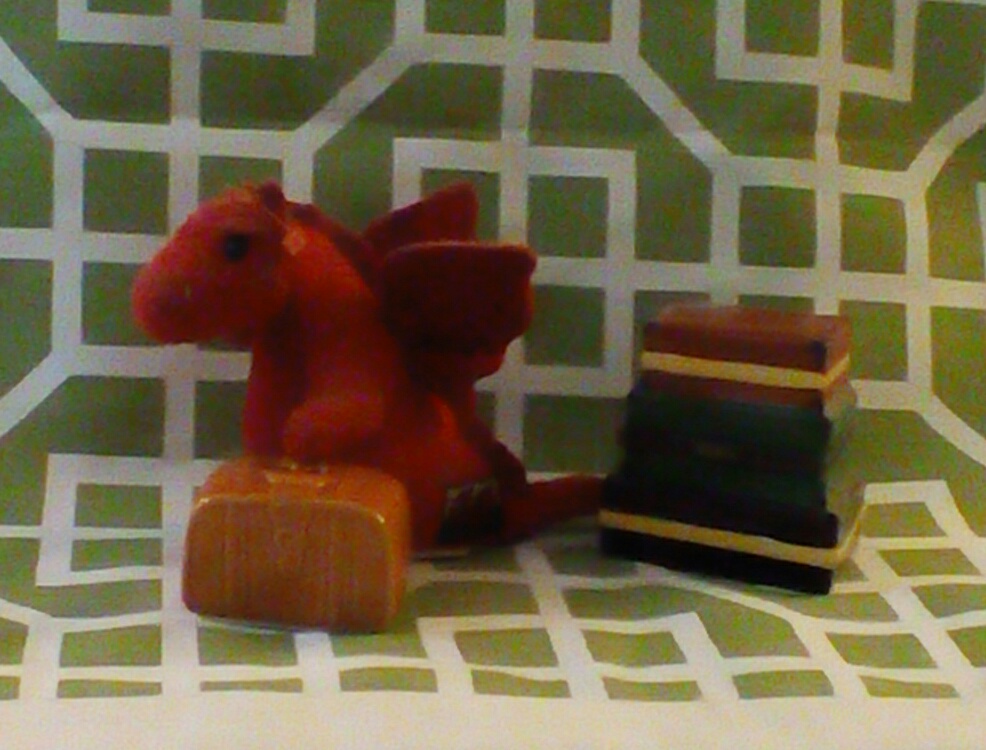
When I was there, I picked up stuffed red dragons for each of my three kids, but for myself I got this little keychain. For the longest time, I had it clipped to my pocketbook, and it went everywhere with me. His tag fell off, but the plastic hangy thing is still attached to his ear. On his left side, as you can see if you squint and zoom in, he has a patch of the Welsh flag attached.

image

A few years ago, I was in the post office, my purse slung over my shoulder with the red dragon hanging in the front. I finished my transaction, and the postal clerk asked if I went to college at Oneonta. It is a state college in upstate New York, and I had in fact graduated from there.

I was confused how she knew that, and she pointed at my red dragon. My response was that it was a Welsh dragon, not an Oneonta red…

And then I realized, and it hit me that I hadn’t realized it before, but the coincidence was ridiculously obvious to me and I chuckled. I might have said that I guessed it was after all.

At college in Oneonta, our mascot was a red dragon. I lost that in the twenty-five years and I’d been carrying around my Welsh dragon and never once associated it with my college mascot.

So in the 1980s I had red dragons, and in 2009, I went back to Wales and got a different red dragon. It only cemented my connection to Wales. There are many threads attaching me to the land, and their only connection is me. In my mind, it makes sense. It’s a faith thing.

Thursday Travels – Llanrwst, North Wales

Standard

image

One of my favorite pictures from my visit in 2009.

Across the bridge to my left is a wonderful tea house. Excellent cup of tea and scone with cream and jam. I was too nervous to take photos “publicly” so I don’t have any from inside. As I recall now, though, there may have been a sign that said no photos, but I don’t precisely remember. I was very conscious of not being a typical tourist, but I’m not sure that if I went back that I would care about that. I love taking and looking at photographs. I love the view through the lens.

Behind me is a circle of standing stones. At the time I thought they were ancient stones and I gave them that reverence. When I arrived home, I did some research and discovered that those stones were placed there to commemorate the 1951 Eisteddfod. Fun fact: my friend’s grandfather won the crown at that year’s competition. He was a well respected and well known broadcaster for television and radio.

On the river you can see two swans, who were happy to pose for my other pictures.

Another fun fact: This bridge is said to be one of the ones designed by Inigo Jones.