St. Ignatius Feast Day

Standard

St. Ignatius was well born and privileged. He was a soldier and loved the women. How does that kind of a person become a saint? Well, you’d be surprised to read about the backgrounds and beginnings of most saints.

During his military career, he was wounded in Pamplona when a cannonball ricocheted and broke his leg. He returned to the family castle in Loyola where he underwent several surgeries, setting and rebreaking of his leg, and all of this without anesthetic. While he recovered, he would walk with a limp for the rest of his life.

During his recuperation, Inigo as he was called then had visions and felt the call to the priesthood after his sister gave him books on the lives of Christ and the saints when the chivalric romances he requested could not be found.

When he was able, he went on pilgrimage to the Holy Land to walk in the footsteps of Jesus. He returned to Europe and eventually wnt to France and attended university.

He and six of his companions there swore vows to their lifelong work. He, along with Peter Faber and Franicis Xavier went on to found the Society of Jesus or The Jesuits as they are also known. In 1540, they were approved by Pope Paul III. Pope Francis is a Jesuit, the first Jesuit to be elected Pope.

Ignatius was the first Superior General of the Order and was called the Father General.

One of their practices is called The Daily Examen, which I like to pray in the evening. It is a quiet way to go over your day, see where G-d and Jesus were part of your day, and how you can make tomorrow better. (These are my interpretations of the examen.)

They also practice a contemplation known as the Lectio Divina or sacred reading, in which you put yourself in the Scripture stories, and pray on what you see there. There are five steps to this contemplation technique: prepare, read, meditate, pray, contemplate.

This article from the Jesuits’ website is a nice introduction: Everyday Ignatian: Patience and Lectio Divina.

Celebrating Mary Magdalene

Standard

Today is the Feast Day of Mary Magdalene.

I am not going to talk about her “reputation” which is based in sexism and misogyny, but I’d like to remind people that she is now called the Apostle to the Apostles. She was the first to announce the resurrection of Jesus Christ, and she deserves to be called out for her willingness to tell the Good News to the men (and others) in hiding. (Parenthetically, I am not suggesting that there was no danger to his male disciples; of course, there was, but dismissing her for so long has really bothered me (and many others).)

This was one of my very first Tiny Saints. It was important for me to have that visual and tactile representation of St. Mary Magdalene.

I treasure her independence, her leadership, her bravery. I appreciate how she stepped out of her comfort zone, and can still, after all these years influence us in all the good ways that she was influencing Jesus and all the people surrounding Him.


Think of the ways and the people who have influenced you in the Gospel, the Good News, and how you can use Mary Magdalene’s example of independence, leadership, and bravery. What other ways can you meditate on these values and bring ourselves forward in our best and brave way?

Feast Day of St. Kateri Tekakwitha (in Canada)

Standard
(c)2025

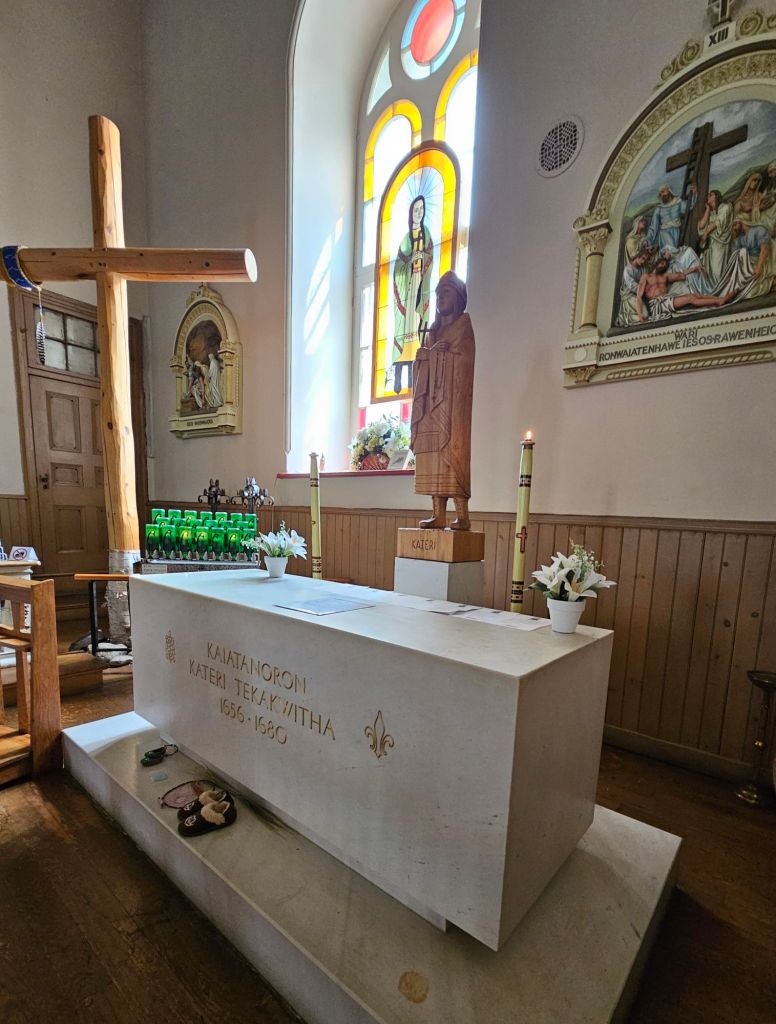
This is the feast day of St. Kateri Tekakwitha. She died on this day in 1680 at twenty-four years of age. Since that time, miracles have known to have occurred through her intercession. In two more days, is the anniversary of my own conversion.

The photo above is at her tomb where her earthly remains rest at the St. Francis Xavier Mission Church in Kahnawake, Quebec. This is at the National Canadian Shrine of St. Kateri Tekakwitha.

I’m looking forward to the celebration of her feast day in the US in July, and my visit to this shrine and her tomb in June, partly for intensive research, but also hopefully to attend mass while we’re there.

St. Kateri, pray for us.

St. Therese of Lisieux

Standard

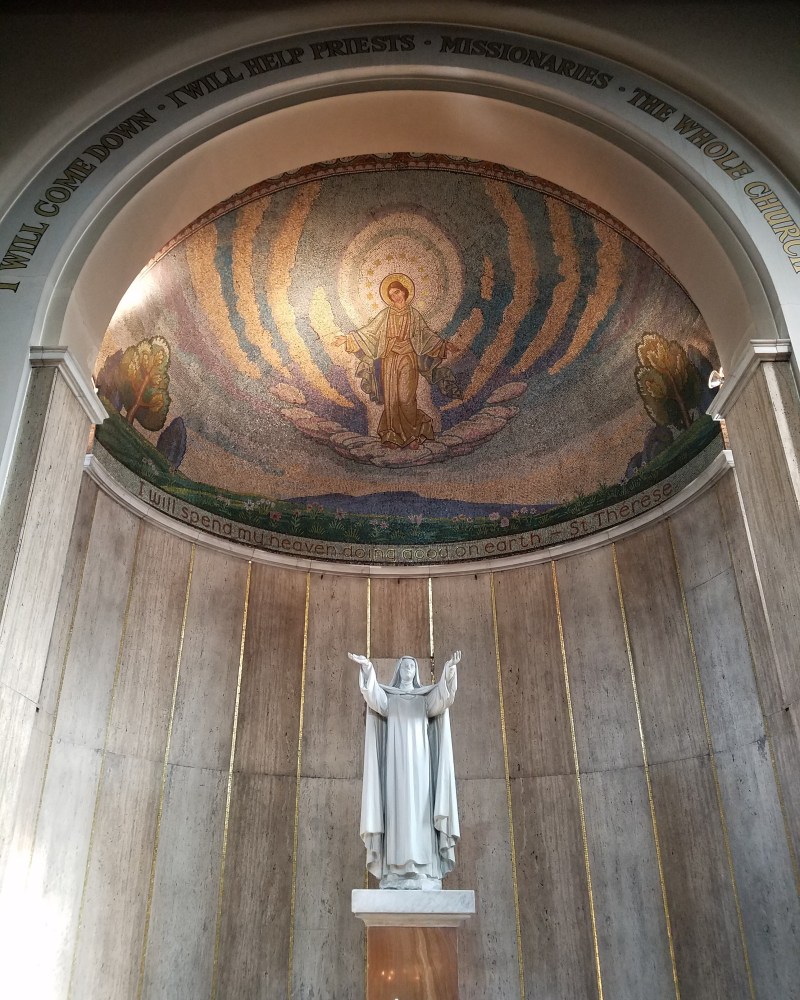
Shrine of St. Therese of Lisieux.
Niagara Falls, Ontario, Canada.
(c)2023

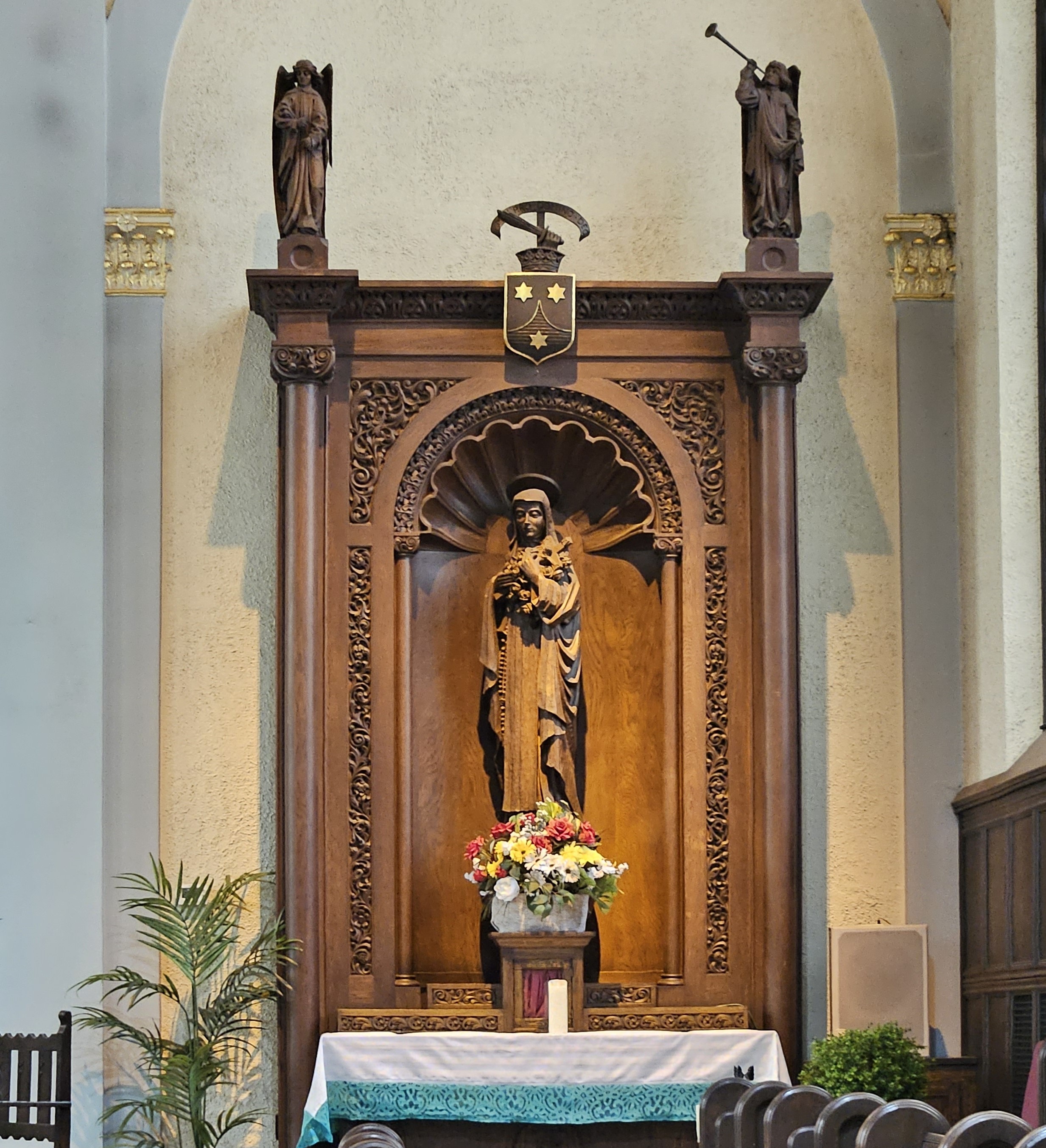
Next weekend marks the second anniversary of the death of my priest. In some ways it feels like yesterday and in others it feels like decades since he’s gone. I don’t know if it’s been a disadvantage or an advantage coming into the church so late in life that I’ve only had one priest up until recently. He was a guiding force in my welcome and acceptance in the parish and the Catholic faith, borne from his being Christ in the world through love, care, and guidance.

This weekend holds two saints’ feast days that I strongly relate to Father Jerry. Yesterday marked Saint Jerome’s feast and today is Saint Therese of Lisieux. Jerome was Father’s given name, so there is the obvious connection, and he held a strong devotion to St. Therese, also known as the little flower. When we visited Northern Ireland for the burial of my mother-in-law’s ashes, we stopped in Dublin, where I had the fortune to visit and pray at a shrine of St. Therese. I brought home a postcard for him, knowing that he was devoted to her. At the time, I hadn’t known that she has a much closer shrine, northwest of here in Niagara Falls, Ontario, just over the border. From that shrine at the Monastery of Mount Carmel, the roaring Falls could be heard and if you could get high enough even see the Horseshoe Falls.

The Monastery of Mount Carmel has two shrines; one inside the chapel where I attended mass, and one outside. The outside one was at the end of a path guided by plaques with many of the things that St. Therese is known for having said, culminating in a round clearing bordered by flowers, several park benches and centered with a statue of St. Therese in white marble, holding a cross and an armful of roses.

Those plaques are shared below. I hope they can be read on their own, or prayed with as you like.

Take some inspiration from her words and life.

Continue reading

Feast Day of St. Jerome (of Stridon)

Standard

St. Jerome was known for his writing. He translated the Hebrew Scriptures from Hebrew to Latin, which was unusual at the time since most people translated it from a controversial text called the Septuagint, also called The Greek Old Testament. He is the second most prolific writer of in ancient Latin Christianity. The first is Augustine of Hippo, who actually had no problem with the original Septuagint.

As a result, perhaps, he is the patron of translators, librarians, and encyclopedists as well as archaeologists, students, Biblical Scholars, and against anger, the latter of which I believe stems from his widely known bad temper.

As a student in Rome, he indulged his hedonistic side, but also attended the catacombs of Rome to visit the martyrs and Apostles there. There were early inscriptions and wall art that I imagine he studied, although he referred to the place as giving the feeling of the terrors of hell.

To put it simply, Jerome was a person of contradictions, some of which can be sourced as his being a student, a constant learner, and a voracious reader and writer. He had a group of women who surrounded him that read his scholarly works, and several were turned towards a life of consecrated virginity and the ascetic monastic life. This had a negative impact on these wealthy women’s donations, and he became at odds with the Roman clergy.

He is considered a saint in the Catholic Church (and a Doctor of the Church there), Eastern Orthodox, Lutheran, and Anglican.

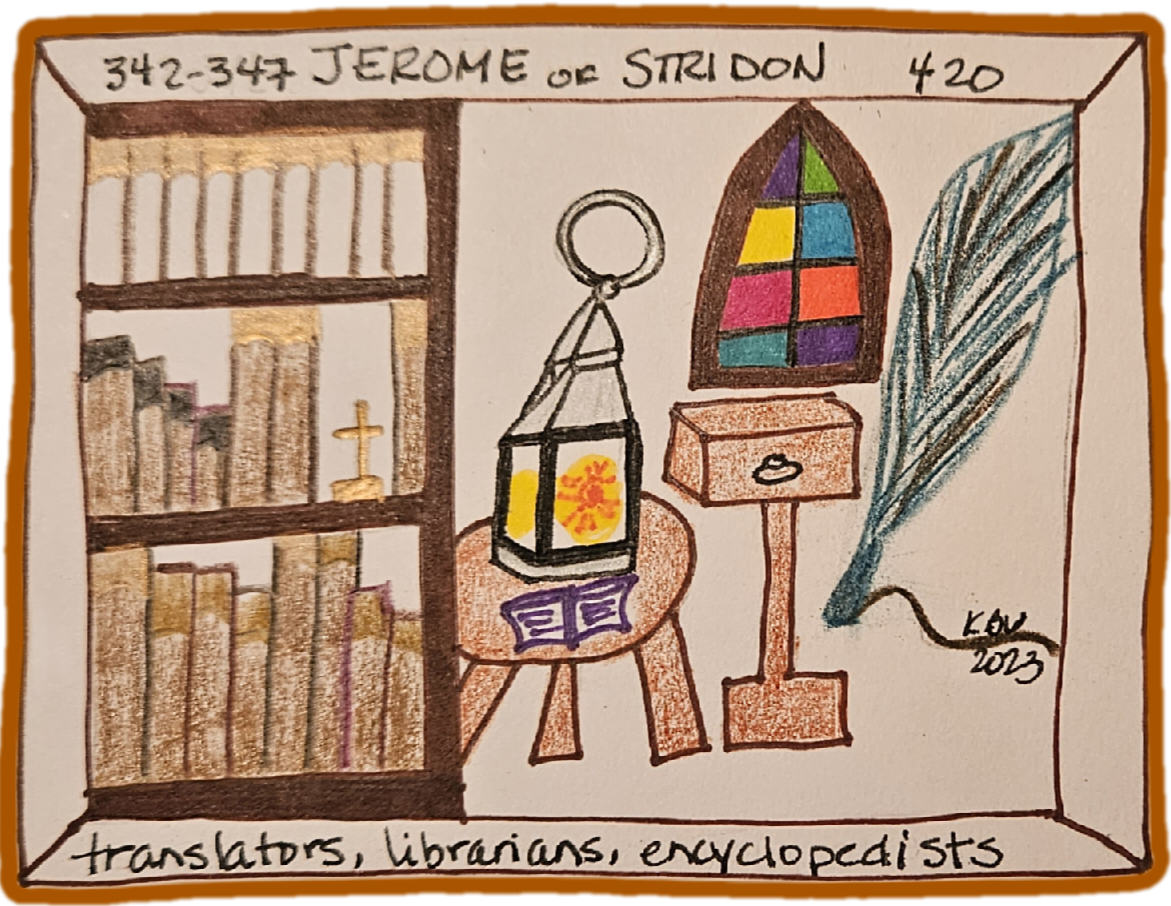
His iconography is often depicted in libraries and/or scriptoriums surrounded by books, parchment, vellum, and writing implements. He sits at a desk, holding a quill. He is also depicted with a lion having apocryphally removed a thorn from one’s paw.

In my sketch below, I have chosen to leave the lion and the saint outside the view as we look into his small cell of scholarly works.

Feast of St. Kateri Tekakwitha

Standard
Chaplet of St. Kateri Tekakwitha.
(c)2023

Since I’ve been sharing quite a lot about Kateri Tekakwitha, I thought I’d share this older picture from when I tried to visit her shrine in Quebec at the Kahnawake Village of the Mohawk Community. I had been searching for a chaplet of St. Kateri and was unsuccessful before my trip. I had planned to pray the chaplet for my Cursillo friend who was living his Cursillo weekend while I was away. Since I didn’t have a beaded chaplet, I drew one (left side), and brought that with me to pray at Kateri’s empty tomb, located across the street from the church of St. Catherine of Alexandria.

It was a very emotional and spiritual site, and just like in New York near the Mohawk River, I could hear the rapids from behind the empty, marble coffin, a sound similar to the sound near her baptismal spring at her Fonda shrine. I was there in contemplation for some time and prayed the chaplet from my sketchbook. Upon arriving home, I was able to locate a beaded chaplet, which I will pray today for St. Kateri’s feast day.

Kateri is the patron of the environment, fitting as Indigenous people are the caretakers of the land, as well as a patron of others including Indigenous People and ecology and people in exile.

My Patron, St. Elen

Standard

Today is the feast day of my personal saint, the one I chose for my confirmation, St. Elen of Caernarfon. She and her homeland has touched me in many ways, and I was privileged a few years ago to pilgrimage to one of her holy wells in the small town of Dolwyddelan in North Wales. She is the patron of traveling and travelers and ironically, when I visited the town of Dolwyddelan and the Castle there, I was walking distance (even for me) from my future saint’s holy well. There are so many connections that I shouldn’t be surprised anymore.

St. Elen’s Well. Dolwyddelan. (c)2022
Continue reading

St. Brigid’s Day Book Rec

Standard

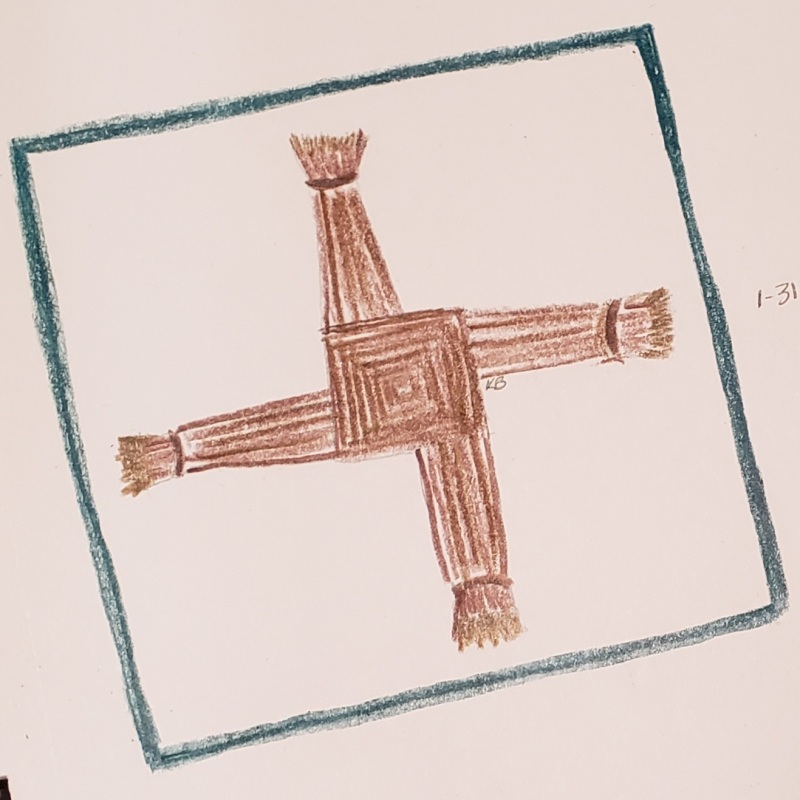
St. Brigid may be remembered as turning water into beer or the legend that she midwifed Mary in the birth of Jesus, but for those of us hoping for women’s advancement in the church, she preached to her flock, and founded a monastery for men and women, and became abbess there. Several of her images are shown with her holding a Bishop’s crosier. While there is some dispute if she was an actual bishop, she was the leader of both monasteries and the Abbess of Kildare is considered as the superior general of the monasteries in Ireland. Regardless of her official capacity as a pastor, Brigid’s oratory at Kildare became a centre of religion and learning, and developed into a cathedral city. [1]

Personally, I’m disappointed that when I visited Ireland a few years ago that I was so close to Downpatrick and didn’t visit. Her relics aren’t there any longer (not since 1538) but I still would have liked to have visited especially since the relics of Patrick, Brigid, and Columba (Columcille) had been there and all are said to have been buried there.

Imbolc dates back to ancient times and Celtic tradition has it beginning the night of February 1st and continuing through February 2nd. This speaks volumes, to me at least that this tradition was adopted/co-opted by the early Christians in the Celtic world. February 2nd is Candlemas, which commemorates the presentation of Jesus in the church. Imbolc is about halfway between the winter solstice and the spring equinox and foretells the coming of spring. Groundhog’s Day is February 2nd and he also foretells the coming of spring, whether after six more weeks of winter or right around the corner.

Beginning next year, St. Brigid’s Day will also be a public holiday in the Republic of Ireland.

So many things in our myths, traditions, and religions are interconnected; not all of them by chance or coincidence. Some were intentionally brought forward by the church to include the “pagans” in their conversion to Christianity. This feels almost like a “gentle Crusade” rather than at the point of a sword when they encouraged Jews and Muslims.

I’ve just completed reading a Celtic spirituality book that has nine chapters describing different Celtic ways along with the intertwining of Christianity. The second chapter was focused on St. Brigid and what she brought to Celtic spirituality in this author’s opinion: the Sacred Feminine. Celts had a tremendous respect for the feminine and how it balanced the world they lived, and we live in.

The book is an easy read. I chose to read one chapter a day. That let the information gradually process. There is also prayer and an appendix that would lend itself to daily prayer and meditation in the Celtic tradition.

Sacred Earth, Sacred Soul by J. Philip Newell can be found or ordered from bookstores, national and independent. I read most of my books on my Kindle; this is the link for Amazon Kindle’s version.


[1] Herbermann, Charles. St. Brigid of Ireland, Catholic Encyclopedia, 1913. Public Domain.

[In my interpretations of St. Brigid’s religious life, I would appreciate any corrections from those expert in such things.]

Feast Day of St. Mary Magdalene

Standard

I fully intended to write a reflection today on Mary Magdalene. In the past she’s gotten a bad rap, mostly from historical inaccuracies, misogyny, and bad faith takes, and in more recent years is re-emerging as an inspirational saint for girls and women alike.

As I searched for previous links to share at the end today, I discovered something I wrote in 2019 that really contained all that I wanted to say and I decided to share that link instead.

Mary Magdalene.

Enjoy this feast day of the Apostle to the Apostles, and follow the links at the end of that original reflection to read more on Mary as well as women’s roles in the church.