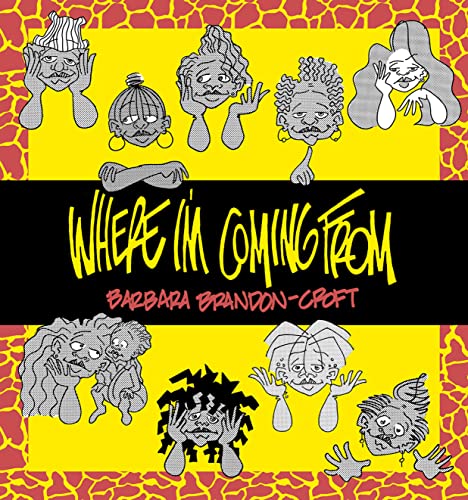
Barbara Brandon-Croft has a new book out, reflecting on her place as the first African American woman with a syndicated comic strip. Where I’m Coming From: Selected Strips, 1991-2005 hit shelves last month.
In this Washington Post article, author Michael Cavna tells us about Brandon-Croft’s beginnings, her social commentary through comics, and learning from one of the best and first African American comic strip writers, her father, Brumsic Brandon Jr. He told her three steps described the cartoonist’s job, and she repeats those words, almost as a mantra:
I’m including two links. One is the original article I read: How Cornrows Were Used by Slaves [sic] to Escape Slavery in South America, which details the idea that women braided escape maps into their hair as well as messages. The second article is from Snopes that doesn’t discredit this theory despite no tangible evidence. As been told, just because we don’t know if it happened, doesn’t mean that it didn’t happen. There are many ways that African Americans used to keep themselves safe in order to survive slavery and emancipation from slavery, including communicating with each other and traveling north to freedom. Whether mythology or history, it is important to know all aspects of the African American experience from their arrival on these shores, almost exclusively involuntarily.
An additional thing that I learned in regards to language is that in South America this type of hair braiding was known as “cane rows” as opposed to “corn rows” because the crop there was sugar cane.
We are all bound up together in one great bundle of humanity, and society cannot trample on the weakest and feeblest of its members without receiving the curse in its own soul.
Frances Harper, We Are All Bound Up Together, 1866
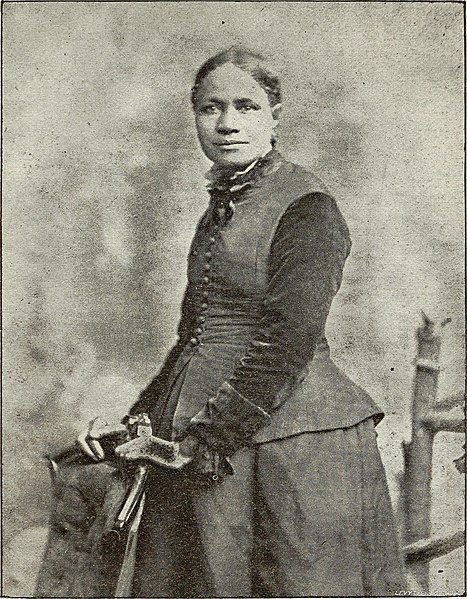
Frances Ellen Watkins Harper. Public Domain
Frances Ellen Watkins Harper was a voice of Black Suffragists. She was born in 1825 in Maryland to free African American parents. Her parents died when she was young, and she was raised by her aunt and uncle. By the age of 21, she had written her first small book of poetry, Forest Leaves and ultimately published 80 poems. More than a decade later she became the first African American woman to have published a short story, The Two Offers. She co-founded the National Association of Colored Women’s clubs.
While working as a teacher in Pennsylvania, a law was passed that free African Americans in the North were no longer allowed into Maryland, her home state. They would be imprisoned and enslaved.
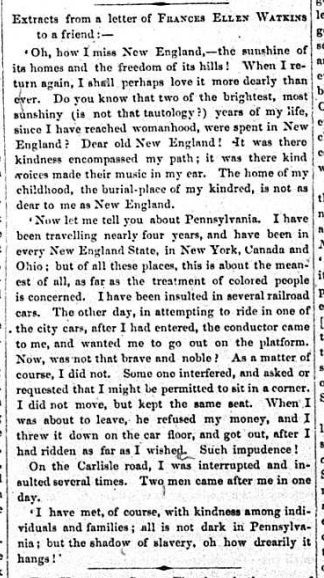
She refused to give up her seat on the trolley, and only got up when she reached her destination as chronicled in The Liberator, page 3 as seen below.
From The Liberator, Page 3 1858 Public Domain
Her famous speech, We Are All Bound Up Together, read in 1866 at the Eleventh Women’s Rights Convention held in New York City, can be read here.
She spoke at the National Woman’s Rights Convention in New York, held in 1866. The organization split over the suffrage of African American women and were opposed to supporting the fifteenth amendment. Harper left the group, and with Frederick Douglass and others supporting the amendment joined together to form the American Woman Suffrage Association. She was often the only Black woman at the women’s conferences. Through her life, she continued her advocacy for intersectionality (see- it’s not a new idea) in suffrage.
She spent the remainder of her life teaching and encouraging equal rights and education for African American women and founded and/or directed several clubs and organizations for African American women, including the National Association of Colored Women’s Clubs and the Pennsylvania Women’s Christian Temperance Union.
Some of her writings include:
Forest Leaves, poetry, 1845
Bury Me in a Free Land, poetry, 1858
Moses: A Story of the Nile, 1869
Light Beyond the Darkness, 1890
In Memoriam, Wm. McKinley, 1901
Trial and Triumph was one of three novels originally published between 1868-1888 as a serial.
Her first novel, Iola Leroy, or Shadows Uplifted was published in 1892. It was thought sentimental, but it also highlighted several serious social issues at the time, some of which remain today.
As a writer, I am always drawn to the writing lives of the people I choose to profile, and I was pleased to see that Harper was a mentor to other African American writers, including Mary Shadd Cary, Ida B. Wells, Victoria Earle Matthews, and Kate D. Chapman.
Stagecoach Mary (Mary Fields of Cascade, Montana) Public Domain
Stagecoach Mary was a mail carrier on a star route between Cascade, Montana to St. Peter’s Mission. She held two four year contracts with the United States Postal Service beginning in 1895, and received her stagecoach that she drove to deliver the mail from her friend, the Mother Superior of an Ursuline Convent, originally in Ohio, but now missioning in Montana.
I should also mention that she was the first African American woman to carry the mail (only the second woman to do so) and in her time she became a Wild West legend.
Sounds intriguing, doesn’t it?
Mary Fields was born in 1832, most likely in Tennessee, into slavery.
As times change, so does language. Since I’ve been in school and up until recently, we’ve referred to the “slaves” in the South (or elsewhere in the world). This denies the people their humanity. It tells the reader/listener that their only value was as a slave; that they are slaves at the heart of their being. But of course, that’s not true. They are people first. Men, women, and children who were kidnapped and enslaved and their children born into slavery and enslaved. These two links should help with the explanation:
She was freed with other enslaved people after the Civil War. From that time, she worked as a servant and laundrywoman on riverboats up and down the Mississippi River. She worked for the Dunne family until the wife died. John Dunne sent her to live with his sister, a nun and Mother Superior of a convent, where Mary lived and worked. She became very close with Mother Mary Amadeus Dunne and after Mother moved to Montana to mission with the Jesuits, Mary eventually followed her and helped nurse her back to health.
As if that wasn’t enough, Mary Fields wore men’s clothing, drank, smoked cigars, shot guns. She was tough and intimidating, two traits needed to be an independent contractor working alone on the frontier.
At some point, the bishop barred her from the convent after an altercation with a co-worker/colleague involving guns. To be fair, I can’t imagine that it would have been palatable for a man to be answering to a woman, an African-American woman and that may have played into some of the friction between them. Of course, it can be hard for any two headstrong people to work together.
It was then that she contracted with the Postal Service to become a star route carrier. She drove her stagecoach on the route with horses and a mule named Moses.
Star Routes were named such after their motto/mission of Celerity, Certainty, and Security in delivering the mail. They were denoted on paper with three asterisks: * * *, thereby becoming “star” routes. This name was renamed Highway Contract Routes in 1970.
She retired from her role as a mail carrier when she was 71 and lived on in town becoming one of the more popular figures of Cascade. She was praised for her generosity and kindness, especially to children. When she died in 1914 at 82, her funeral was one of the largest ever seen in the town.
She was very popular – schools closed on her birthday. When an ordinance was passed disallowing women from enjoying the saloons, the mayor exempted her. When her house burned down, volunteers rebuilt it.
Born a slave somewhere in Tennessee, Mary lived to become one of the freest souls ever to draw a breath, or a .38.
Gary Cooper, Montana native, writing for Ebony in 1959
In a companion to my recent post Black History in Film, I’m sharing the NAACPLegal Defense Fund‘s link on Black Media & Black Culture. The NAACP LDF has put together a list of over 50 works recommended by the staff of the Legal Defense Fund. It showcases their mission to “defend, educate, empower.”
This single link offers links to their recommendations with how to view, read, or listen to them.
Included in the list are books, both non-fiction and fiction as well as for younger readers, television shows, movies and films, podcasts, and of course, music, which, as a white person, I say where would we be without Black music and its influences across every genre.
Visit your local library or e-library and see what’s available.
If you’d rather buy, this link will take you to a list of 149 Black-Owned Independent Book Stores.
In addition, Haymarket Books is offering three FREE e-books:
I have chosen to simply list a few books by Black authors for you to begin reading while we are still in Black History Month. Google them, Buy them, Check them out of your local or e- library. But however you get them, read them, and enjoy them.
The Fifth Season by N.K. Jemisin
Their Eyes Were Watching God by Zora Neale Hurston
Black Leopard, Red Wolf by Marlon James
The Underground Railroad by Colson Whitehead
Go Tell It On the Mountain by James Baldwin
My Sister, the Serial Killer by Oyinkan Braithwaite
And don’t forget the poetry: Langston Hughes, Maya Angelou, and Amanda Gorman
The photo at the top of this post is from the website: Book Source Banter. They have many books to get to know there.
I am trying to share Black History, especially if I can find it through Black voices. I saw this on my timeline on Spoutible (open to the public on Thursday – there will be a review coming then). As a studier of history, I am always surprised to discover something else that I didn’t know. It is so important to keep our minds open to learning new things. If you know of someone not on this extensive list, please add them in the comments.
Somehow it is expected to fit all of Black History into the shortest month, and the more we study Black History, we find that it encompasses all history, from the African continent to the New World. I usually post a link to a terrific Black History Resource, but unfortunately, it is coming up with a 404 error. I hope to find it again soon. I’m hoping it has just moved since it really covered so many aspects of the diaspora.
This post will share links to some online offerings to get everyone started.
First, beginning on February 6, you can sign up to join the Black-owned Tw*tter alternative, Spoutible. It is definitely having some growing pains, but as a pre-registrant I’ve been using it since yesterday and it looks like this could be the one. On the 6th, I’ll be creating an account linked to this website, so join me.
Second, this link highlights free online resources for kids, and while the website says, “It’s never too early to teach children about Black history,” I believe it is also never too late for anyone to learn what’s been missing from mainstream curriculums, and in the case of Florida, being eliminated.
This information was originally shared here a little more than a year ago. The compiler of the information at the links has continued to update and maintained it so all of us can learn more about Black History throughout the year.
Author and activist, Charles A. Preston maintains this Google doc on his own. I discovered him from a random Twitter post last year, and feel fortunate that I did.
The multi-folder Google doc is chock full of information about many aspects of Black History from Afro-Futurism to Zora Neale Hurston and many others in between. I believe he is continuing to update it. When using his folders, remember to give him credit as well as linking to his Twitter or website (linked below).



 Griffins and Ginger Snaps