Mental Health Monday – Focus

Standard

I made a small graphic thinking about what helps me focus when things get to be too much.

(c)2025

I began to think about where I begin my mental health awareness. How do I become self-aware and how do I keep on track and moving forward?

These four squares came to me in simple ways. They are both simple and entrenched in my way of being. They are my touchstones. They are not necessarily yours. You will find your own touchstones and ways to cope with whatever comes up daily.

In a similar vein, I’d like to share an exercise that I did on a recent retreat with the Dominican Sisters. The main topic was time and how time affects our priorities and ways we can use to change them and shift where we spend our time. While this retreat wasn’t geared towards mental health and awareness of mental health, time plays an important role in how we perceive our mental health challenges and push and pull until we’re being intentional with our time and our mental health, emphasis on health.

Below I explain the exercise, and hope to come back to it in a couple of weeks. I plan to think my own choices and perhaps begin again.

Continue reading

Mental Health Awareness Month

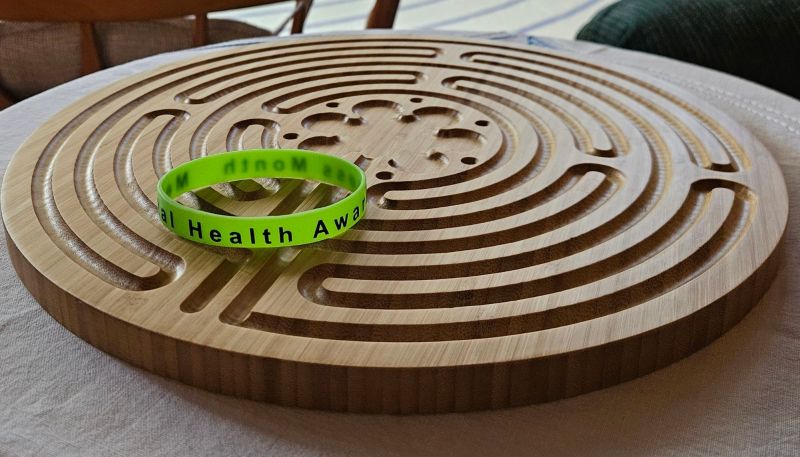
Green rubber bracelet with the words: Mental Health Awareness Month, resting on a wooden, finger labyrinth
Standard

An Overview of the Month Ahead

Today is the first of May. It is the first day of Mental Health Awareness Month.

Mental Health Awareness Month has several facets. The two that I find most helpful are

  1. make the outside world aware of what mental health is, what struggles we all face, what can be more difficult struggles some of us face, and letting go of the stigma, encouraging talk and sharing coping tools.
  2. Make yourself aware of your own mental health. Where do you struggle? What are some of your coping plans and tools for getting through a rough patch? Or even just an annoyingly mediocre patch? What’s in your toolbox that still works for you?

In other words, assess yourself, share your struggles, challenges, and successes and be there for others in explaining mental health, coping, and the ongoing recovery. Be there for yourself and for others. Some days you can only do one of those, and that’s okay.

Beginning on Monday, I will be publishing a weekly column called Mental Health Monday. I have done many of these throughout the previous several years. Search through the tags to see older but still valuable approaches and coping tools. Sometimes, we forget and rereading and reestablishing some of them again is a valuable tool.

Reassessment in recovery, I find, is ongoing.

None of the strategies and coping tools that I post this month are intended to suggest you forego medication alternatives. I take medication – both prescription and supplemental, all with my doctor’s input and approval. I wouldn’t be here without medication. Don’t let anyone shame you for taking care of yourself. Just like getting from point A to point B, there are many different roads to travel. Very rarely is there just one way, and one (or more) of them is the right way for you. Changing direction is okay, too.

Recognizing a better way and adapting.

Just as a counter has a take a penny, leave a penny dish, in mental health, take a strategy, leave a strategy.

We are all here to help each other.

The tag “mental health monday” is your dish to choose from.

I’ve always thought of my depression, anxiety, and mental health struggles as a journey – a period of recovery with no tangible cure; only moving forward in my mental health, my mental space, my mental recovery.

This is my path and sometimes we cross paths. This is us crossing paths and offering insight, motivation, and ways to keep getting through.

Writing Advice – Stephen King

Standard

Stephen King is one of the most prolific writers in the world. I’m embarrassed to admit that I have never read any of his fiction. Not one. I’ve also never seen the movies except part of Stand by Me. His genre of horror has never been something in my wheelhouse, but I did admire him as a writer and a person. I follow him on Twitter and he wrote a magnificent essay on JK Rowling for Time magazine.

The one book I did manage to acquire and read was his memoir/advice for writers book, On Writing. I found it engaging, brilliantly written and so beautifully in his voice. Writing this reminds me that I should re-read it just because.

Here are a few of his quotes that I feel drawn to: 

  • The scariest moment is always just before you start. After that, things can only get better.
  • Let me say it again: You must not come lightly to the blank page.
  • You go where the story leads you
  • If you want to be a writer, you must do two things above all others: read a lot and write a lot.

  • I’m convinced that fear is at the root of most bad writing.

Stephen King’s Writing Toolbox is a strategy after my own heart. I love the idea of tools and toolboxes to get us through everyday life – that specialized item that is exactly what we need right at that moment in time.
Two Interviews with Stephen King

with The Independent (from 2017)

with The Atlantic (from 2013)