
http://www.vox.com/policy-and-politics/2016/12/21/13967504/twitter-young-journalists-coates
journalism
Gwen Ifill (1955-2016)
StandardGwen Ifill was one of the most respected journalists of our time. I’ve watched her for years, both on NBC and PBS. She was always happy to be where she was and reporting the news. She was a true journalist. I will miss her, especially her insight for the upcoming politcal year.
Halloween and Political Statement
Standard
As Walter Cronkite said, “Freedom of the press is not just important to democracy, it is democracy.”

My Halloween costume this year is a political statement. I’ve been shocked and appalled by the number of attacks, both verbally and physically on journalists in the past year and throughout this election cycle, mainly from one side in particular.
There is a reason that freedom of the press is in the first amendment; it is that important.
We can’t let serious presidential candidates mock journalists for their disabilities.
We can’t let candidates refuse press credentials to mainstream, reliable, longstanding investigative journalistic newspapers like The Washington Post, the paper that broke the Watergate scandal.
At the same time, we can’t let them issue credentials to their friends.
We can’t let campaign employees (Lewandowski) assault journalists (from Breitbart no less).
We can’t let journalists (like Amy Goodman) be arrested for inciting and disorderly conduct when she is working as a journalist (and has been for more than 20 years) and covering an important news story that you just don’t like (ND pipeline).
I’m certain that I’ve left out at least half a dozen incidents that I can’t recall at this moment.
This is for every journalist kidnapped while doing their job. At the most recent White House Correspondents’ Dinner, President Obama honored Jason Rezaian, journalist released from an Iranian prison. He stated, in part, “This year, we see that courage [Jason Rezaian] in the flesh and it’s a living testament to the very idea of a free press, and a reminder of the rising level of danger, and political intimidation, and physical threats faced by reporters overseas.” [And I would add, here at home as well.]
This is for David Bloom who died doing his job.
This is for Daniel Pearl who was murdered for his religion.
This is for Bob Woodruff who got a traumatic brain injury doing his job.
This is for Spotlight, the Academy Award’s Best Picture for 2016.
This is for every journalist who went to jail for protecting a source.
This is for the First Amendment and the freedom of the press.
Nellie Bly, 5 May 1864
StandardToday, in 1864, Nellie Bly was born. Visit A Mighty Girl on their Facebook for some reading suggestions about Nellie and travel. Recently I’ve read and recommend Ninety Days: Nellie Bly and Elizabeth Bisland’s History-Making Race Around the World by Matthew Goodman.
Prompt – Pack a Bag
StandardI’ve been going to town reading a ton of library books. Most recently I finished Eighty Days: Nellie Bly and Elizabeth Bisland’s History-Making Race Around the World by Matthew Goodman.
I’m sorry to say that I had never heard of Elizabeth Bisland, whose birthday was a few days ago. It sounds like, as unexpected as her voyage was, she had a much better time.
One of the jabs against Nellie Bly going around the world was that it was impossible for a woman to travel lightly, carrying all kinds of steamer trunks and hat boxes. However Nellie Bly did it, in not only less than eight days, but carrying ONE BAG, a sturdy gripsack (pictured below).

Photo of Nellie Bly, public domain
Today’s prompt is just that:
you’re traveling around the world, and can only carry one bag*. What would you bring?
*I’ll be as generous as the airlines: one bag (any size but you have to be able to carry and lift it for storage) and one personal bag.
Bob Simon, ’60 Minutes’ And CBS News Veteran, Killed In Car Crash
StandardBob Simon, a news man I respected immensely, has died tonight in an automobile accident in NYC.
For me, Bob Simon is one of those voices that has always evoked trust and integrity, from a very short list that includes the likes of Martin Fletcher, Peter Jennings, Tom Brokaw, and Walter Cronkite.
Ben Bradlee, 1921-2014
StandardMy last post for today is postponed to bring you this link about the death of Ben Bradlee.
Ben Bradlee ran the Washington Post newsroom during Watergate. He, Katherine Graham, Woodward and Bernstein were pieces that formed my writing soul. A faraway dream of journalism was kept alive vicariously through their work.
Martin Fletcher: Breaking News
Standard
Reading about your heroes can be dubious business. On the one hand, this is someone you admire a great deal, try to emulate and without knowing it, they take on the air of mentor through their deeds and actions. On the other hand, when you dig in deeper you find that your hero is merely human, and in some ways it is disappointing to find that they have faults and poor judgment and, well, quite frankly, too much like you than you would have liked.
I found this recently, and then I had to wonder if it was the man I admired who I should blame or I for putting so much emphasis on what really is his caricature, his persona that appeared in the toughest circumstances, in the most dangerous places in the world. Could I expect so much more from him than others? In fact, how could I expect this perfection in anyone?
There were few things I wanted to be when I grew up. I was very much an idealized version of a stereotype. I didn’t want to be a pilot; I wanted to be a stewardess. I didn’t want to be a doctor; I wanted to be a nurse. I didn’t want to be a cowboy; I wanted to be an Indian maiden captured and rescued (so not only was this a gender stereotype, but a racist one as well.)
I also wanted to be a writer.
But not just any writer; a journalist.
These were the mid-70s. Women politicians in my neighborhood were the rage: Bella Abzug, Liz Holtzman, others resigned to the annals of my childhood memory.
But all the information flowed through the newspapers. Nixon had resigned. I adored Woodward and Bernstein. They were my heroes then. I wanted to be them. It didn’t hurt that Robert Redford was in the movie version – in fact, I’ve yet to read their book. Lou Grant had moved on from Mary Tyler Moore’s station manager and was now the editor of a prestigious newspaper in California. I loved the female journalist, Billie Newman, just as tough as her desk partner, Joe, curly red hair of which I was more than a little envious of with my straight dark brown hair, not black. I should have red hair. (Eventually, I did, and I do, but I’ve left the curls to the perms of the 1980s.)
Television was big in our house. When I hear teenagers talk about jumping the shark, I know that they have no real clue. I watched Fonzie jump the shark literally and figuratively finding his way into the pop culture vernacular forever.
We were a political family. My parents voted every year. They both worked for the post office, at that time a government job. We celebrated Memorial Day and the Fourth of July. I was on a first name basis with Peter Jennings, Tom Brokaw, Walter Cronkite and all of their successors.
For today’s Middle East news bulletins, most would know the name Richard Engel, but my foreign correspondent was (and is) Martin Fletcher.
One of the benefits of knowing Martin through television is reading his books with his voice ringing clearly in my head. He has a distinctive accent and voice; I would recognize it from the television even if I wasn’t paying attention. Like Peter Jennings, if Martin Fletcher was talking in the middle of the day, pay attention; it is something important.
I’ve always considered Martin an American correspondent despite his British accent. After all, his accent wasn’t the prim and proper British accent that most people were used to here in the States. His was….different. Now I know that his growing up in London to German and Austrian Holocaust survivors melded their accents with those around his family to give him a unique pitch to his words. It offered me an expertise in what he was talking about simply by virtue of sounding not like the other journalists. It was also noted that Tom Brokaw was in the New York studio while Martin was in the thick of it, whether that be in Kosovo, Rwanda or Israel, where he made his home with his wife and three sons.
I was expecting Walter Cronkite on the road. All knowing, non-plussed, quiet, reserved, straight-laced, very much a desk jockey, going out, getting the story, filing the story, filming against the backdrops of war.
This was not Martin Fletcher.
I was shocked to find that he is a human being. I was also shocked to find my own moralistic, narrow-minded, prudish reactions to his life as a cameraman/reporter/journalist twenty-something.
He drank.
And passed out.
He swam naked.
He had sex.
He and his friends were constantly involved in debauchery (his word) and my reaction was so much of what happened to my quiet, reserved, British-accented journalist? Was this also Woodward and Bernstein while they got the story? Rossi and Newman? (Fictional, I know, but still, they would never!)
Well, no. He’s not any of them. They also weren’t in war zones, interviewing warlords stealing humanitarian aid and selling it, talking to the maker of the bomb that injured his family’s close teenage friend and killing her two friends. They weren’t climbing mountains in Afghanistan during the Soviet occupation, getting the story but trying to avoid the Soviets and getting himself killed.
He skirted land mines, trusted murderers’ bodyguards to safeguard him and his crew while they got the story out, filmed a woman dying of starvation, compromised his morality knowing that the story must get out, the truth to the world.
It was dangerous; it was life-changing; it was mentally sapping. Sometimes it was too much.
As much of his private life surprised me, I needed to remind myself that I was ten when he was living this kind of life, not to mention that in hearing his older voice that I am used to as an NBC viewer does sound funny when he recounts his younger, freer days. As he reminds me throughout the book, and in reading this glimpse behind the curtain of the evening news that I remembered was when I thought of becoming a journalist, the story was the most important thing. Always the story.
Journalists risked their lives – the story was that important.
There are hardly any like Martin Fletcher anymore. Everyone has a smartphone. We have citizen journalists on every street corner. Think about recent events in Iran and Egypt including the Arab Spring where the news got out through Skype and banned pictures through Twitter. I first saw Trayvon Martin’s story on Tumblr weeks before the mainstream media caught up to the social justice advocates reblogging there.
I still don’t know if this is a book review, a classroom book report, mini-biography, or op-ed on the life of a journalist. It could be all four, I suppose.
I’m still not sure why I let the dream of being a journalist drift away. Even at twenty, I don’t think I had the stamina for that kind of life. I am at once both afraid and in awe.
While I said at the start that dissecting your heroes can be a dubious affair, the three dimensional insight into someone like Martin Fletcher is invaluable to me. He is human; and so am I.
Helen Thomas, 1920-2013
Standard
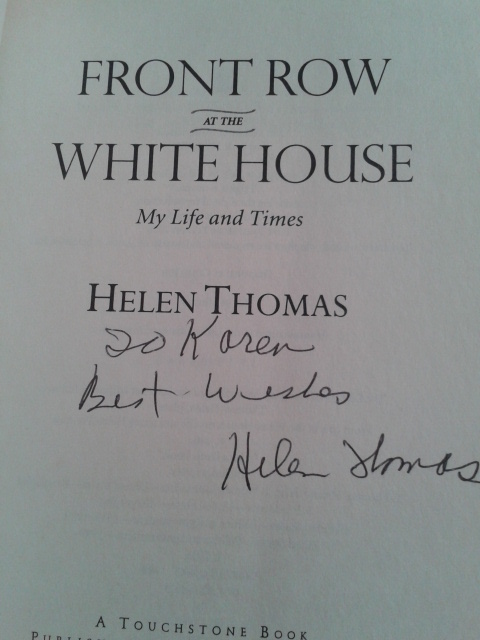
Journalistic icon Helen Thomas died today at the age of 92, a month before her ninety-third birthday.
In my opinion, the freedom of the press is the most important piece of the Bill of Rights. Information is power and an honest, questioning press is what the public needs to make informed decisions and as an additional checks and balance on the government.
For me, Helen Thomas in particular will hold an important place in my writing heart alongside giants Bob Woodward and Carl Bernstein and fictional writers, Lou Grant’s staff and Jessica Fletcher. Growing up in the 70s at the height of Watergate, the Feminist/Equal Rights Movement, Civil Rights Movement and the Space Age, there is a special place for print newspapers and information dissemination.
For a political junkie like me, there was no mistaking her distinctive voice, her cadence, the way she asked her questions, covered in sugar until the question mark at the end dissolved all pretense that she was a pushover. The only woman for a long time in the White House Press Room she made her mark on nine presidencies, receiving surprised looks, some eye rolls and above all respect. We were reminded this morning that she was first – the first woman in the Press Corps, the first woman President of the White House Correspondents’ Association, the first woman member of the Gridiron Club.
I met Helen Thomas once, in the fall of 2001. She was the guest speaker at a Chamber of Commerce luncheon. I don’t know how I managed to get a ticket, although it was open to the public. I sat next to the city of Albany (our capital) Comptroller. It was very exciting and lunch was actually very good despite those types of things usually not very. The ticket price came with a copy of her book, Front Row at the White House and she would sign it, (but there was no guarantee of that) if you waited in line. At some point, they cut the line off; it was getting late and Ms. Thomas had other places to go, but I believe after waiting quite a while the woman in front of me was supposed to be the last autograph. I wouldn’t leave the line, though. I didn’t create a scene; I just ignored the handlers. For a writer, for me, this was one of those moments that if you walked away you would regret, and I ‘m glad I stuck it out as you can see form the photograph.
She was a small woman, shorter even than me, but her person was huge. She had a smile and manner as big as the room itself. I don’t remember what she said, but I do remember that she was warm and kind and encouraging to whatever I had expressed. It was one of the thrills of my life.
I haven’t mentioned the incident in 2010 and her retirement. I think that there are many times when we feel very strongly about a subject and we say things we shouldn’t and express things in a way that we shouldn’t. This doesn’t excuse anything; it just accepts that things can be very complicated.
I would prefer to remember Helen Thomas for all the barriers she broke, the firsts she was, and the truth seeking she did throughout her career keeping Presidents on their toes and the Public informed.
 Griffins and Ginger Snaps