
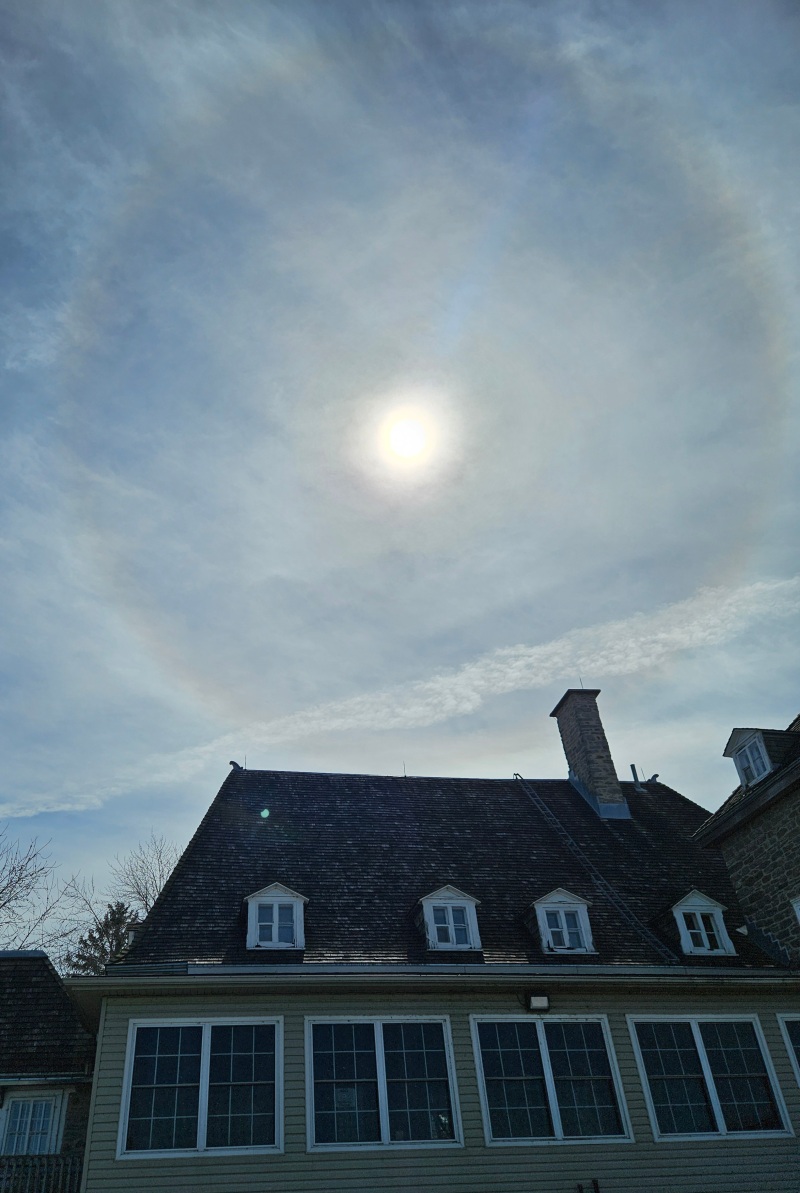
We spent eclipse weekend in Montreal, Canada. Once we were shut out of Syracuse (too expensive) and Plattsburgh (no room at the – or any – inn), it wasn’t a difficult decision to go a short distance further. I love being that close to the border, and luckily our passports are current.
Because of the research I planned to do while we were up there, I thought we’d pop our chairs down at the park near the Ile de Tekakwitha on the Mohawk territory/Kahnawake. We scoped it out the night before and the parking looked extremely limited, but we were still hopeful. We would decide when the time came. As darkness settled in, we drove out to the main road for dinner – Robbie’s Smokehouse!
On Monday, we woke up bright and early; adventure awaited!
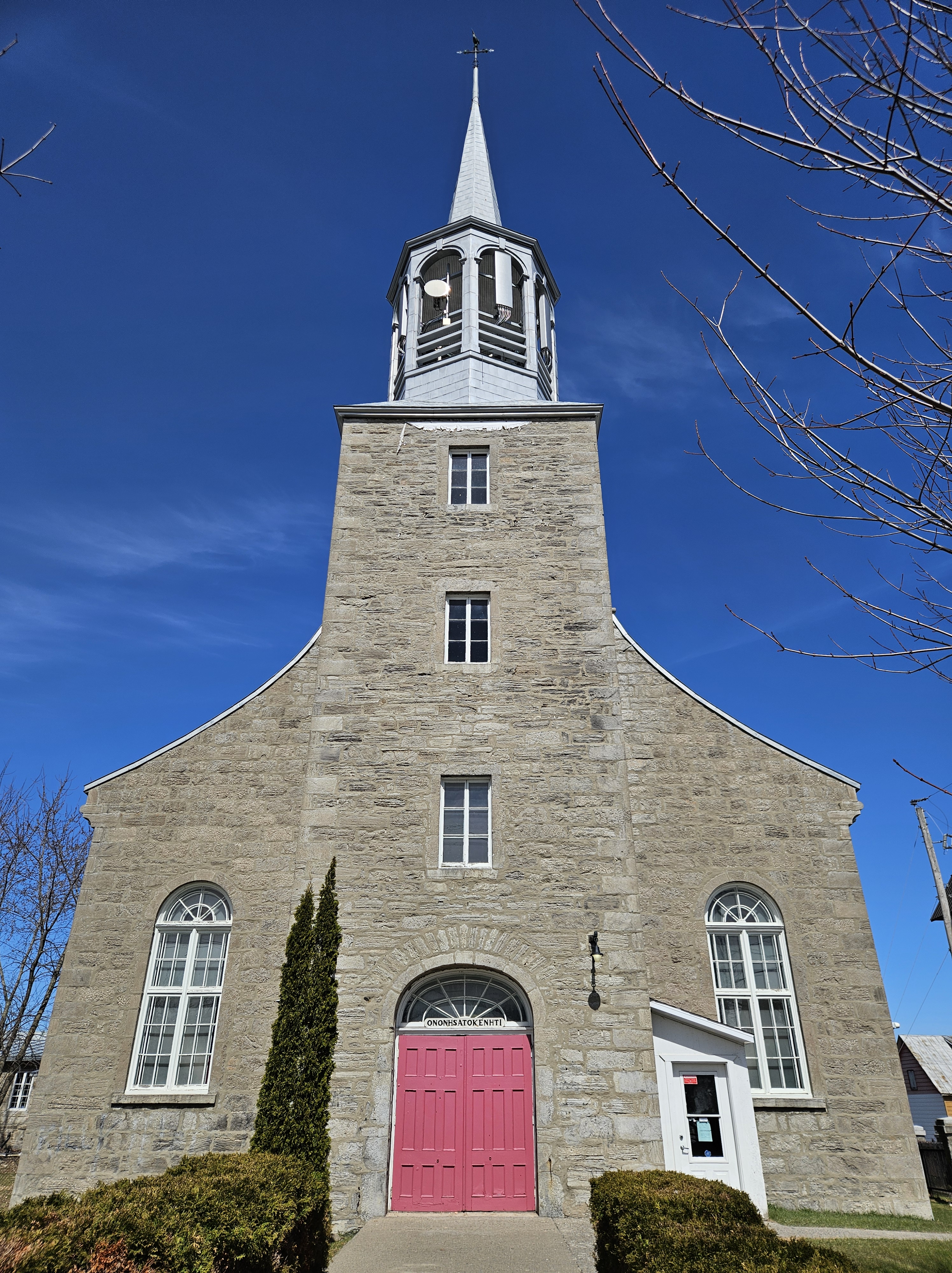
St. Francis-Xavier Mission Church,
Kahnawake, Quebec.
(c) 2024
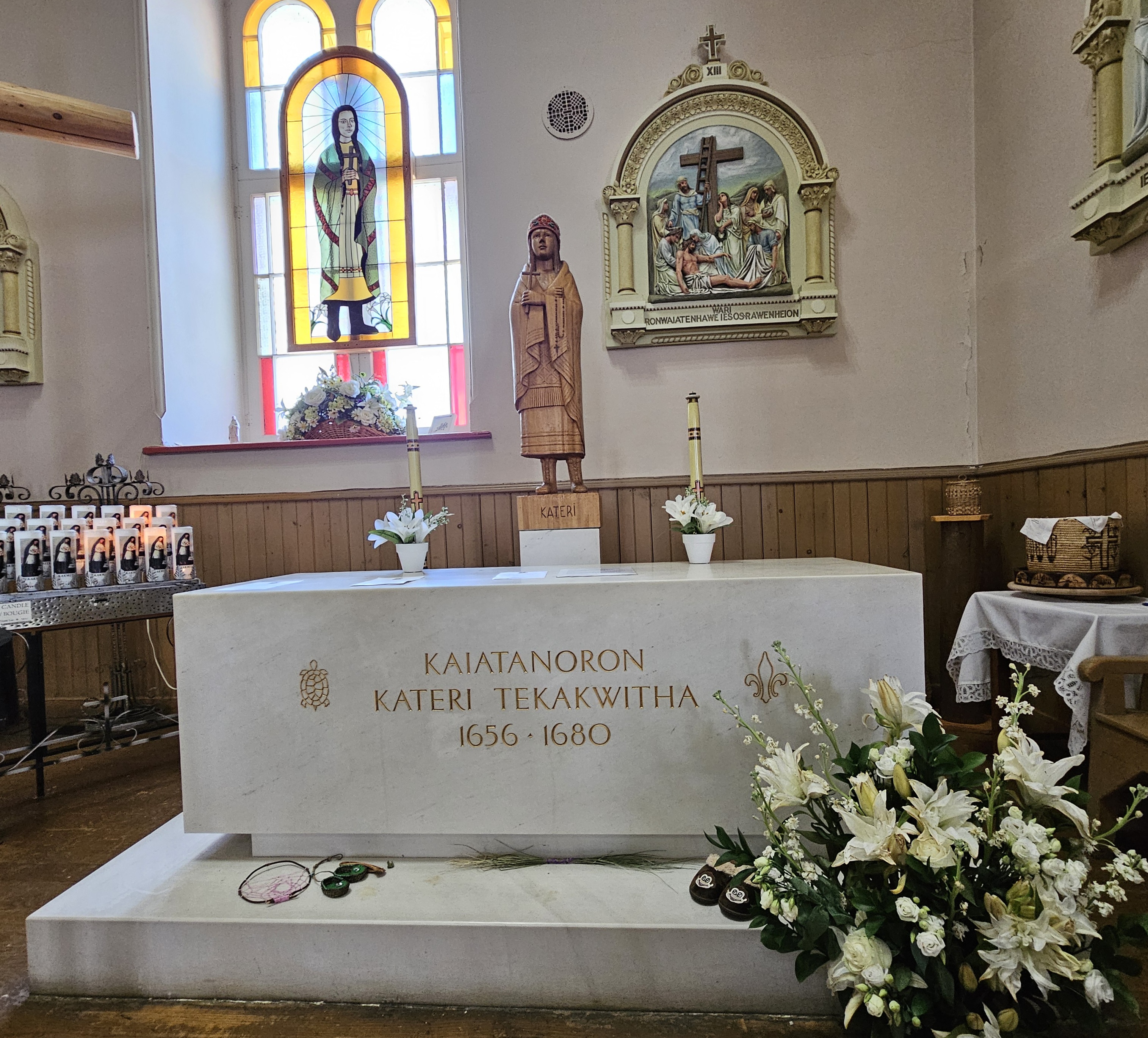
My son and I spent a little more than an hour at the Canadian Shrine of St. Kateri Tekakwitha. I had contacted them the week before about visiting, and I was able to look through their museum that housed some of the Jesuit religious items as well as some Mohawk bead work and to take some photographs for my work-in-progress book. I pointed things out to my son and was pleased that I remembered some of the history to relay to him. One of the volunteers also popped in now and then to point something out.
When the staff mentioned the eclipse, I asked if we could stay out back, and they were just lovely about it. I was happy. There were several parking spaces across from the church and on the side between the church and the Kahnawake welcome center. I kept thinking that many more people would be there on the back lawn of the church as it got closer to eclipse time. The back of the church faces the St. Lawrence Seaway, and from there we could see some of Montreal including the St. Joseph Oratory, which is located on what we were told is a “sleeping volcano.” The Honore Mercier Bridge that spans the St. Lawrence River from Montreal to the Kahnawake Reserve can also be seen.
While my son and I were looking through the exhibit, he suddenly pointed out the window and the bow of a huge ship was sailing slowly past. It seemed close enough to reach out and touch it. It filled the entirety of the four-paned window. That was unexpected.
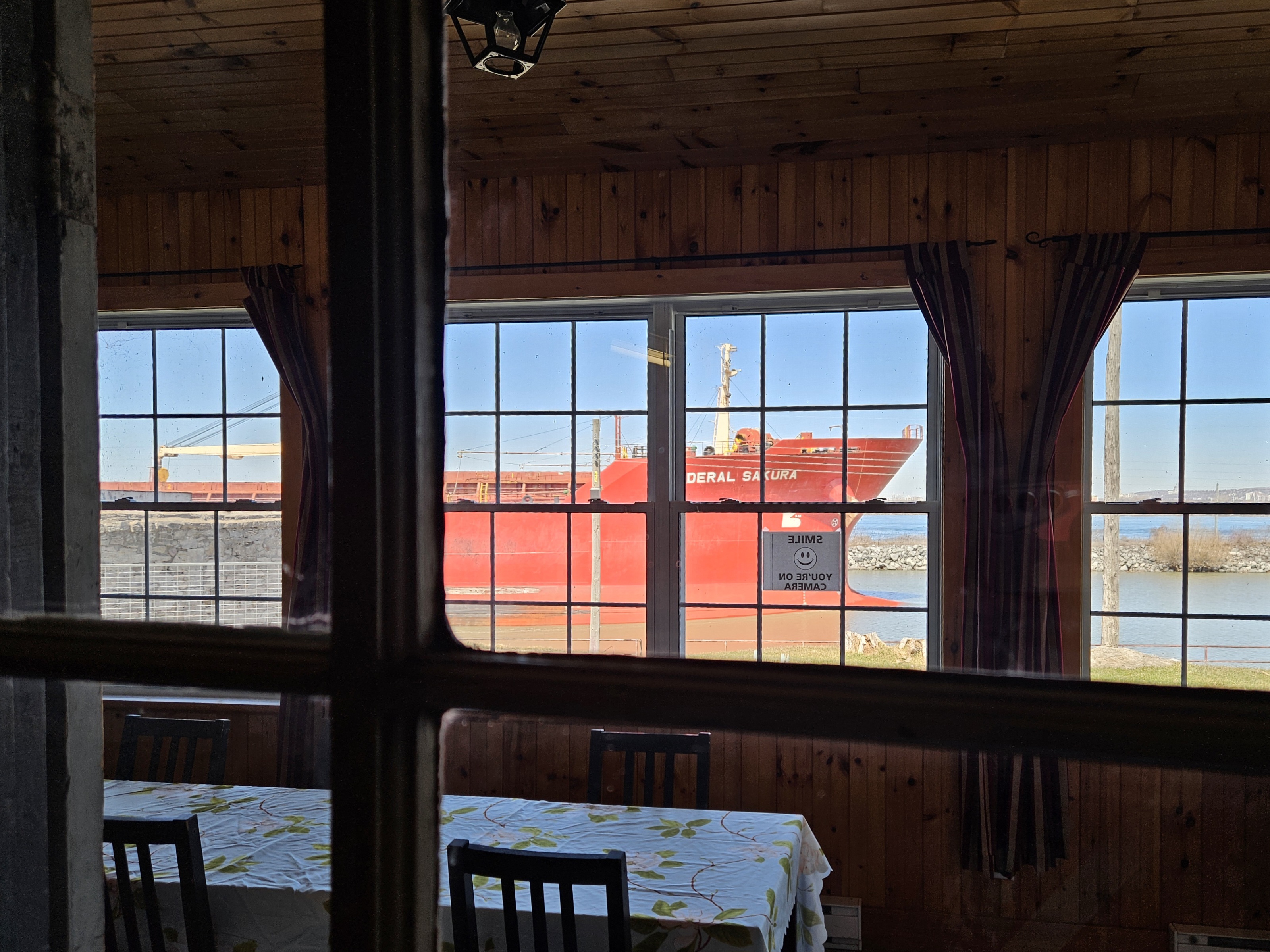
Kahnawake, Quebec, Canada.
(c)2024
We met our family in the back while the church staff preferred the parking lot. We all thought we had the best spots to view the sun.
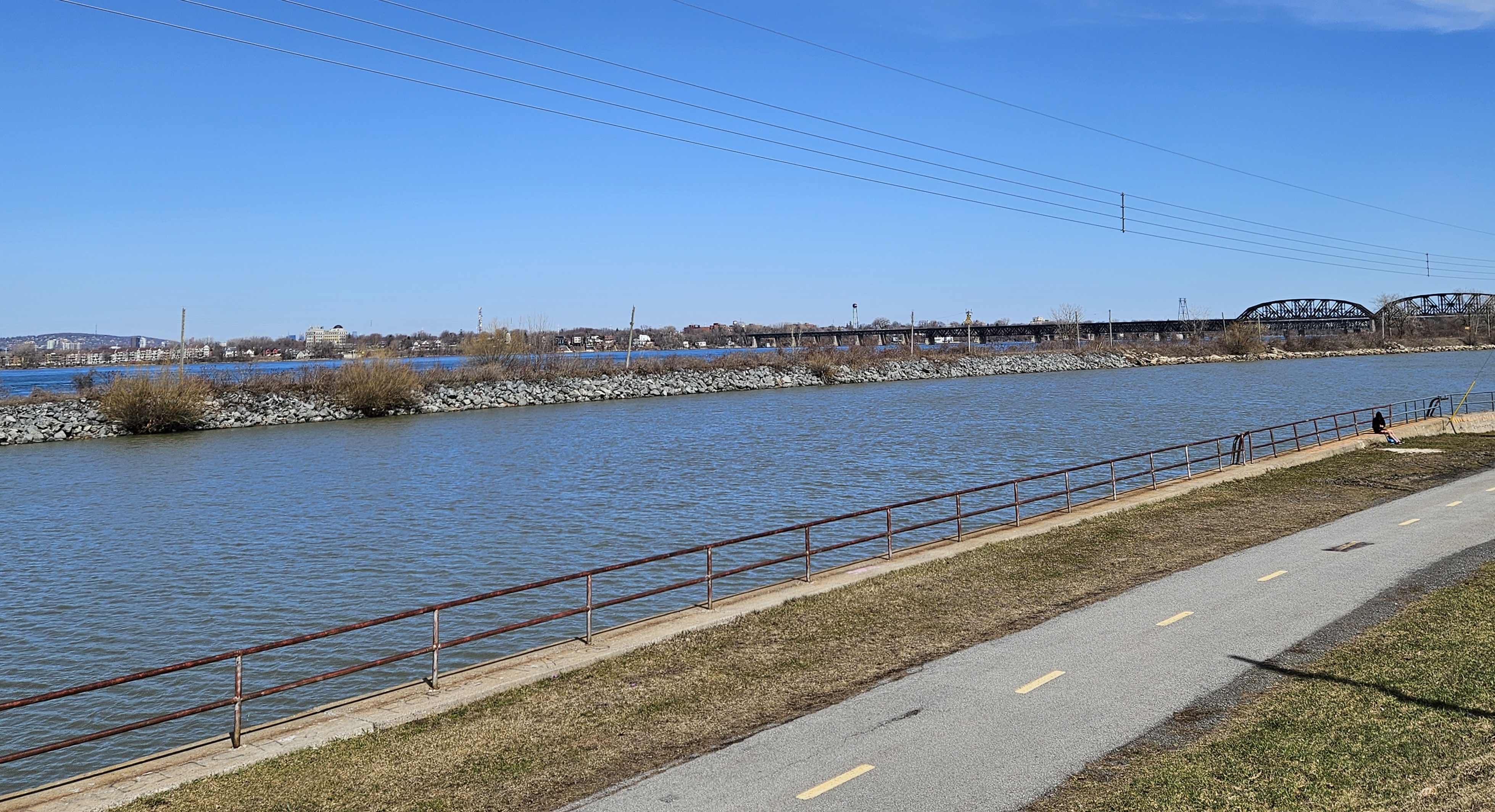
(c)2024
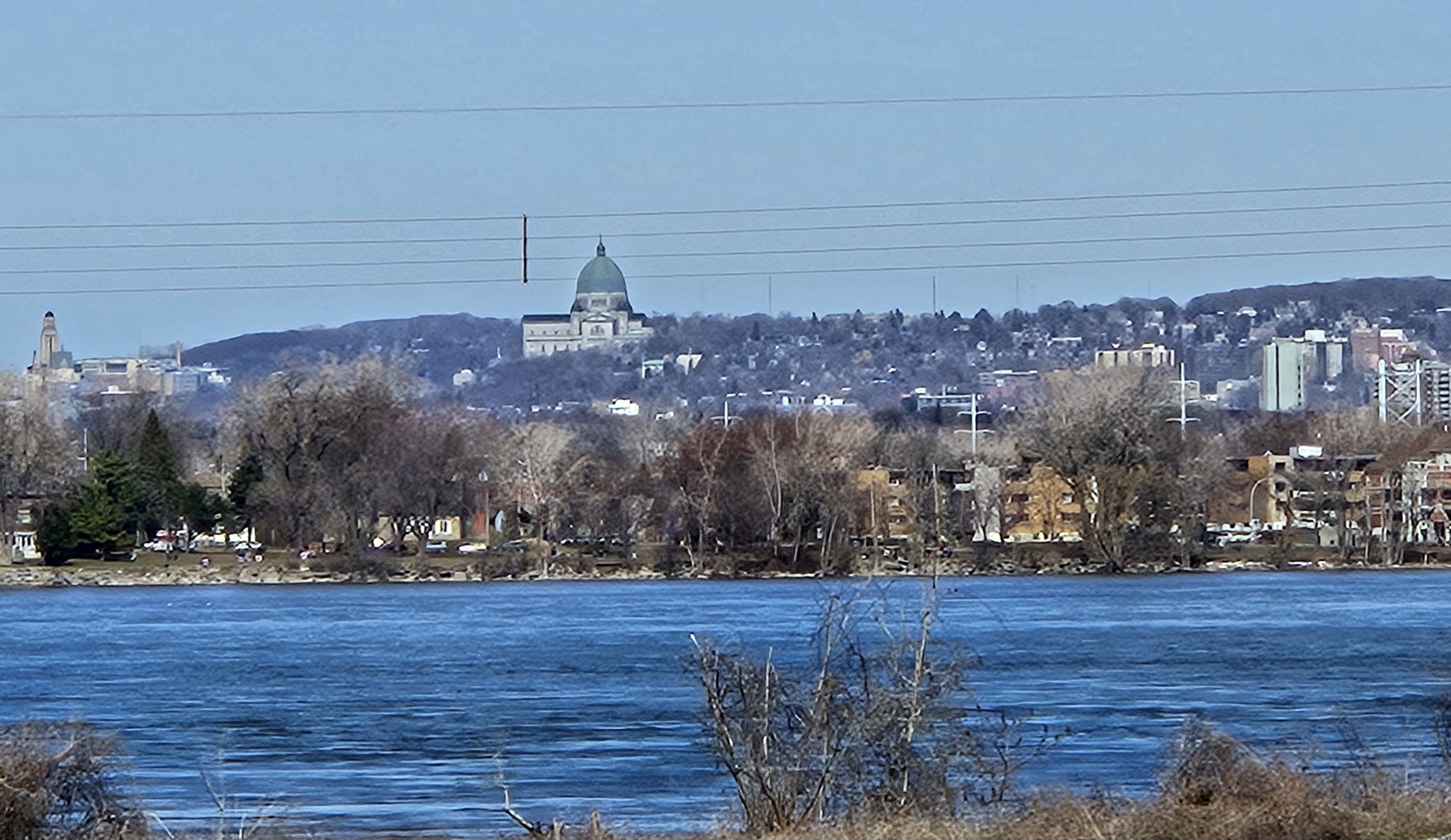
(c)2024
St. Francis-Xavier Mission Church
Kahnawake, Quebec, Canada.
(c)2024
There were so many feelings invoked that a lot of them can’t be described with words. We set up our chairs with our backs to the water, facing the sun which was right over the older part of the church. It was surreal. I considered us to be on holy land, even though this was not where St. Kateri lived. Her relics were moved here in the 1970s, but this was still an important Mohawk Christian settlement, dating from 1716 with a permanent structure constructed in 1720. The flat wall at the back of the church has a poster of Kateri that is a print painted in 1696 by her spiritual director, Fr. Claude Chauchetiere. This poster hung at the Vatican for her canonization. The original is in the museum of the church in what was once the rectory and also the officers’ quarters of the old Fort St. Louis. Above that poster, in a small niche is a clay-colored statue of Kateri. It was hard to see with the sun shining so brightly. At the top of the bell tower is a weathervane, with what looked like a rooster on top. It was just simply a peaceful place to be, and I was so glad that we decided to venture out to see the full eclipse and that we could see it in such a unique and special place.

(c)2024
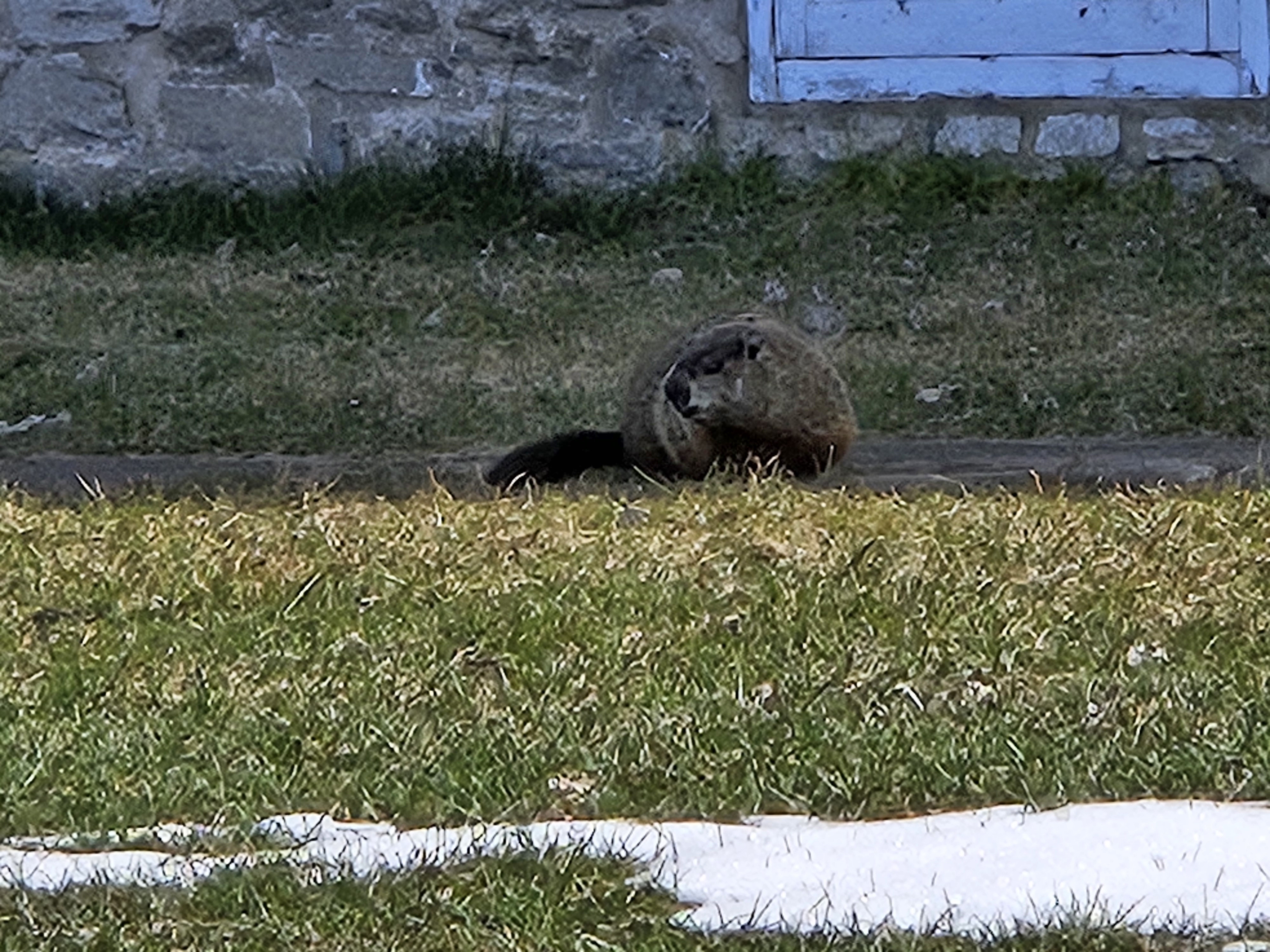
It was hard to distinguish between full sun and partial eclipse without the special glasses until about three-quarters of the way through the eclipse. At that point, the sun’s shine on the ground became dimmer as if night were falling despite it being barely after three. Once it hit the three-quarter mark and there was only a crescent visible through the glasses, the air began to get chilly, and a wind began to blow. The sky darkened as if clouds had formed, although they hadn’t, and the water behind us grew dark also. At some point, the automatic lights for the back of the church came on and we noticed how much darker it was. It was so very cold and windy; I wish I had a blanket. My daughter was the smart one in our group as she had brought her blanket and remembered to take it out of the car. As the sky changed and its blue deepened, the night birds began to chirp, loudly and all at once, the gnats that were swarming around us on all sides, disappeared. The beaver that had been keeping us company as the moon moved across the sun went back under the church to hide.
I had been told by “those in the know” that it would be so dark we wouldn’t be able to see our hands in front of our faces. This was not the case. I don’t know about anywhere else, but it was a creepy, dusky, eerie darkness, deep but not black, not indigo, but the sky on a stormy day. It was very obviously not the color of a typical afternoon in Montreal at three o’clock.

St. Francis-Xavier Mission Church.
Kahnawake, Quebec, Canada.
(c)2024
We just thought it was amazing.
We sat with it and took a couple of photos, but more than anything, we just sat with it. Being there under the moon, blocking the sun, and after a little over a minute and a half, it was blindingly light again. The barest of motion of the moon passing by and the sun was brilliant again. It took another minute or so for the sky to lighten a bit more and the wind to cease, but the birds stopped singing and the gnats returned in swarms. It quickly warmed up.
I sat with the enormity of the moment for a bit longer, but soon it was truly time to go. We had a long drive home even though we weren’t leaving for another couple of hours. Let everyone else sit in traffic. We would eat dinner and buy our Canadian candy before we got on the road south.
When the eclipse was over, and we were getting ready to leave, my husband asked why there was no one else at the church with us; (there was one couple who got engaged during the totality!). At first, I simply shrugged, but then as I thought more about it, I realized that this church (and others) were originally settled and now living in a duality of sorts, two sides of the same coin.
While the Mohawk Catholics were devoted to their church and their Saint, others in the Mohawk nation and on the reserve are not as supportive about the situation of the church. This has been the case throughout their history, but in recent years with the discovery of mass graves in Kamloops, British Columbia at the Indian residential schools, it has become more of a minefield to dodge. The mission church has had instances of graffiti on the front stone walls and on the red, wooden door. There have been protests. When we visited during the covid pandemic in 2021, there were hundreds of shoes laid out in front of the church gate to represent the 215 children found in Kamloops. There is still a sign on the adjacent telephone pole with the number 215 on it. There are also signs throughout Kahnawake that depict an orange hand with ‘every child matters’ written. There are orange handprints across the stone wall that borders the Seaway behind the church. I hadn’t noticed it right away, but while I was taking a photo of the back of the church for a text to my godmother, I saw that someone had spray painted “genocide” on the roof.

(c)2024
I feel a certain sympathy for the Mohawk faithful. Obviously, they were equally victims of the colonization and the land grab, their grandparents and families went to the residential schools; some survived. Many still have the emotional (and physical) scars from those days. The mass grave not only brings that up, but it also reminds that it is not entirely in the past. It is in the now.
It was a stark reminder that my faith towards Kateri and her intercessions must be tempered with what white Europeans did to her people, not only in her time, but after and across this continent. Sometimes it’s hard to reconcile that and to accept the roles of the historical oppressor and the present ally and supporter simultaneously.
The Jesuit influence is strong in the Quebec area. Simply driving north from the border in New York and counting the number of streets, avenues, boulevards, and towns named for saints, I stopped counting them after I got to twenty. For Catholics in the area, this is a part of their heritage including the First Nations population, but that doesn’t discount that the Jesuit Fathers, or “Black Robes” as they were known to the Mohawk, had an equal influential relationship with the French government, and were often France’s representatives in New France, establishing a stronghold more north of the border than south where the English made more inroads.
The relationships were much different on either side of the border, and more welcome in Quebec, especially after 1655 when peace came tentatively. The Jesuits were both supportive and dismissive of the First Nations/Native Americans they encountered.
I know from my own reading and research into St. Kateri that several of the descriptions given of her persecution were more than likely exaggerated, whether due to malicious reasons or simply bigotry and racism, I don’t know. In reading the views of Michael Kanentakeron Mitchell displayed at the Kateri Shrine in Fonda, NY, much of what the Jesuits described were also likely misunderstandings and/or misinterpretations of Mohawk culture. The Mohawk village of Kateri’s time, even in New York, had several different tribes living among them as well as those of the Longhouse (religion) and Christians, living side by side. It’s been described to me as a United Nations. I imagine that Kateri’s extended family did have doubts and misgivings about her choosing a different way, however, with Kateri’s mother being a Christian herself, she would have been baptized in time and taught the catechism. The only reason she hadn’t been was her mother’s death when she was four years old. It doesn’t help that when Kateri died, she was described as having her skin turn lighter and becoming beautiful. While this is a typical description of some saints upon death, a golden glow or shine on the skin, the racism felt by the Mohawk hearing this in later years has a way of erasing her heritage. There is still conflict among her people about her place among them.
All of this was present in some way among us as we marveled in nature and Creation, and the sun’s brilliance can only be dimmed for so long.
 Griffins and Ginger Snaps