Celebrating Mary Magdalene

Standard

Today is the Feast Day of Mary Magdalene.

I am not going to talk about her “reputation” which is based in sexism and misogyny, but I’d like to remind people that she is now called the Apostle to the Apostles. She was the first to announce the resurrection of Jesus Christ, and she deserves to be called out for her willingness to tell the Good News to the men (and others) in hiding. (Parenthetically, I am not suggesting that there was no danger to his male disciples; of course, there was, but dismissing her for so long has really bothered me (and many others).)

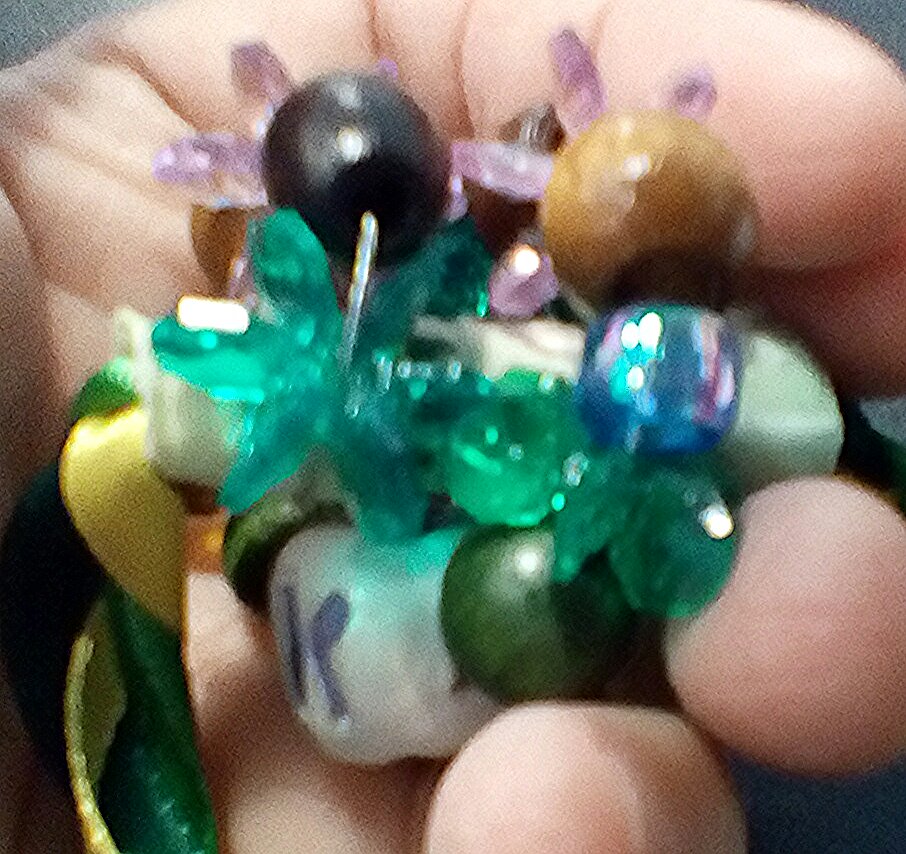
This was one of my very first Tiny Saints. It was important for me to have that visual and tactile representation of St. Mary Magdalene.

I treasure her independence, her leadership, her bravery. I appreciate how she stepped out of her comfort zone, and can still, after all these years influence us in all the good ways that she was influencing Jesus and all the people surrounding Him.


Think of the ways and the people who have influenced you in the Gospel, the Good News, and how you can use Mary Magdalene’s example of independence, leadership, and bravery. What other ways can you meditate on these values and bring ourselves forward in our best and brave way?

Among Women

Standard

[Note: This is a repost of yesterday’s. I decided to divide it into two posts – one the actual reflection on the readings and the second to come later this week on the art project and what each item means to me and to the overall design.]

Today was the second of four weeks spent reflecting on women in the Gospel and the Gospel Women in our midst. We begin each week with a prayer, and are given a glimpse of the two women we will be reading about and reflecting on as the week goes by. We think about last week’s two women and then create art as reflection of them. Or, as I hash-tagged it on Instagram, #artastheology.

I often talk about how I use writing in many ways, including as therapy, and as theology, reflection, meditation. I would claim myself not to be an artist, but in the few retreats that I’ve been fortunate enough to be a part of led by artist, Brother Mickey McGrath, I’ve discovered a calmness from the act of coloring, and that has led to simple drawings, tracings, and copying. You can see some of my work on the pages of my website. I’ve tried to stop demeaning my art as an example to my son, who has the potential to be a true artist. He has the talent for it.

We’re supposed to reflect on them through the week, but it wasn’t until this morning that I connected to the Bent Over Woman and the Syrophoenician Woman. I sometimes have trouble connecting to parables and the abstract as well as picturing myself in ancient Jerusalem. I can also see things a little too literally. I’m not bent over, so what do I have in common with her? We don’t really know anything else about her.

But I recognized myself in her quiet; her being there, but not there for anyone else, unnoticeable, unimportant. Jesus doesn’t wait until he’s called upon; he takes the initiative, he heals her, and that’s all. It’s done.

With the Syrophoenician woman, she is there for her daughter. Jesus tells her no. She’s not one of his people, and he’s not going to help her. She talks back to him. She tells him, no, you will listen to me. She stays polite, she makes her point, and he rethinks his position. Maybe he admires her persistence, her love for her child; maybe even her impertinence.

This shows me once again that we have the ability to see ourselves in these women. We hear their stories but do we really hear them? How long does it take for us to listen?

There are women throughout the Gospel. Jesus surrounded himself with women; they were his disciples. Mary Magdalene was the first person to report the Good News. Most of the women in the Gospels aren’t named; only a handful of them, and each of them, named and unnamed,  have something to teach us, to show, to tell.

These four weeks are opening our group up to us as Gospel women and reminding us of the women in our midst who embody the Gospel, Jesus’ words, His Word, and his example.

When we were “dismissed” to begin our art project, we were introduced to the items we could choose from. How will our art reflect the two readings (The Bent-Over Woman and The Syrophoenician Woman) and how are we reflected in them and with the art items?

Piles of letters, feathers, fabric, words, magazines. All things that look like nothing until we choose what appeals to us, and make it into something of our very own. No formal direction, no preconceptions, just letting the spirit work.

One of the items I chose were puzzle pieces; they were there to represent that everything fits together,  it is all connected and interconnected, and after I decided on them, I remembered my words on my prayer bead: Connect, Interconnect.

It really is all connected.

[NOTES: The Bent-Over Woman (Luke 13:10-17), The Syrophoenician Woman (Mark 7:24-30)]

My Everlasting Gobstopper Prayer Bead (Title Change)

Standard

Today was week one of a four week mini-retreat I guess I’d call it. I hadn’t realized that there was an art component, but Brother Mickey and my son’s hesitation to explore his own talent has me stepping out more and more in the artistic realm. It’s not museum quality, but I’ve been pretty happy with what I’ve worked on.

The theme for the four weeks is exploring and meditating on the women of the Gospel as well as the Gospel women in our own lives. We all know them, and this series of exercises will let us dwell on them and ourselves with the guidance of the women mentioned in Scriptures.

Every week we will hear two readings and have the week to think on them. Lecto Divinia was mentioned as a tool which is one that I enjoy. When we return, we’ll talk about our week away and work on some kind of art that reflects our reflections.

Today, being the first day, we reflected on why we’ve come to this type of workshop and we set out to make a prayer bead. It’s not quite a bead. Some of us went long like a rosary. Some of us made necklaces, bracelets, danglies, and whatever else struck our fancy.

Mine is a necklace that i’ll wear the next four weeks, and then I will probably convert it to a danglie.

It’s something tangible to hold onto while I’m reflecting or meditating or sit next to my keyboard while I’m writing.

I anchored mine with a bell. I like d the idea of a little bit of noise in the silence of meditating.

Today’s silence was a bit too relaxing – I think I fell asleep. No one said anything, but I still feel as though I missed some parts of the talking bits.

When mine was finished, it reminded me of an everlasting gobstopper. Watch Willy Wonka making them, and then look at my photos from this morning.

image

image

image

image

An Advent Message

Standard

“Those who err in spirit shall acquire understanding, and those who find fault shall receive instruction.”
-Isaiah 29:23-24

From the beginning of my journey with the church I have often said that on the days that I went to sit in the church pews, the Scriptures spoke to me. Whether a random page read or a specific Mass reading or Scripture, and of course the homilies; they had, and continue to have a prescient quality, speaking of things that should only be known in my own mind. They often mirror what I’m thinking and unexpectedly offer insight and clarity into whatever is troubling me or weighing on my mind. This holds true for even the most seemingly innocuous things.

On a Monday morning at the start of Advent, I was getting ready to leave for Mass. I was running late, but I still had to get through my morning rituals. I was dressed, but I needed my jewelry. I don’t wear much, but I wear pretty much the same things daily. In addition to my mother’s ring and my earrings and triquetra necklace, I have two bracelets that I often wear – a corded bracelet with a stone that says Balance, and a metal one with crosses on it that caught my eye when it was on clearance at Cracker Barrel. I don’t wear a lot of religious things, but I liked it. For some reason I made the decision to leave both bracelets at home; if I wanted them later, I could get them after mass.

There was the opening hymn, the reading, the responsorial and the Gospel. My priest began his homily with the following words:

“Our faith is not a piece of jewelry to adorn…”

Pretty sure, my mouth dropped open.

He continued and I listened intently.

He talked about resisting change and embracing change.

He reminded the congregation that we are all called to be missionaries.

I just read that! I’ve been reading Pope Francis’ The Joy of the Gospel. I’m really just trying to absorb as much as I can from sources I respect. I want to learn more. I need to. I had just gotten to the part about pastors and how best to write their homilies using the joy of the gospel. The entire book was a reminder of what we’re all looking for in the words and thoughts of the Gospel. I’ve found acuity there that I hadn’t been looking for. This section really spoke to me in regards to my upcoming session with the RCIA candidates. I’ve been wondering how to approach my day with the catechumens, and it’s been very frustrating. I’m not a public speaker, and this is a small group, but it’s still not easy to anticipate how to do it. It is very much anxiety filled.

In this section, and other spaces in his book, Pope Francis gave me some perspectives on the catechetical program that I’ve just become a part of. I hadn’t thought about those perspectives before. It’s been very helpful for that, and it’s been very rewarding spiritually to hear the Pope’s words in relation to the Word.

The biggest thing that I’ve encountered is my relationship with Jesus and how the Holy Spirit works to guide us in the right direction. Of course, not literally how the Spirit works – it’s all a mystery, but when it happens, it is unmistakable that it is indeed working.

And then on that morning at the beginning of Advent, I hear the very same thing from my priest.
We are all missionaries. Preaching isn’t dictating morality; it isn’t dictating rules to live by – we all know the rules that we should be living by; preaching is sharing our relationships with Jesus.

Evangelizing isn’t about changing minds, but broadening them. It should always be a positive, and that is the one thing that I’ve found at my parish; every encounter to bring me closer to G-d, and welcome me in is a positive, never a negative.

That doesn’t mean that we’re all on the same page all of the time, but we are respectful and we truly, truly care about each other. I love my priest. I adore him. He is the epitome of a pastoral and spiritual guide. After hearing his homilies and Masses or after speaking with him in any capacity, I always feel content and uplifted as well as able to take on whatever task I’ve been pondering.

I leave with clarity. Perhaps, not every answer answered, but the questions are productive, the path is clear; for a little while anyway.

This year, in fact I have three more RCIA sessions, I have a yearlong writing assignment that I will talk about next week, and I have my pilgrimage for the Year of Mercy. I’m still exploring exactly what that means.

But what I was really reminded of on that day in early December wasn’t that I’m a missionary or an evangelist, but faith isn’t a piece of jewelry that we put on and take off at whim, or to match our clothes for that day; it is with us always and like other things, we have the ability to share it, even if we’re trying to share it with ourselves.

I was reminded of a meditation from The Word Among Us, on December 4th :

‘You are a “work in progress,” and that’s perfectly fine with God… Now, ask yourself again, “What do I have faith for?”’

The Cock Crows

Standard

In today’s Gospel, more than denying the Christ, Peter is abandoning a friend, his close friend. How long had he traveled with Jesus? How long has he witnessed for him? He left his livelihood and his family and his home for Him. Jesus asked him to build his church.

Today he deserted him, not once but three times. This is probably the hardest to read for me. How many times have I abandoned a friend because I was afraid of someone else’s response? It is so much more than being selfish or simply looking out for yourself. The amount of fright and sadness felt by Peter I’m sure was palpable. He wasn’t just afraid of what would happen to him from the crowd if he admitted to his friendship or to his discipleship, but also his reaction to Jesus seeing his betrayal and immediately forgiving him. The shame and relief were probably at war with each other.

The hardest part is not only asking for forgiveness but forgiving yourself.