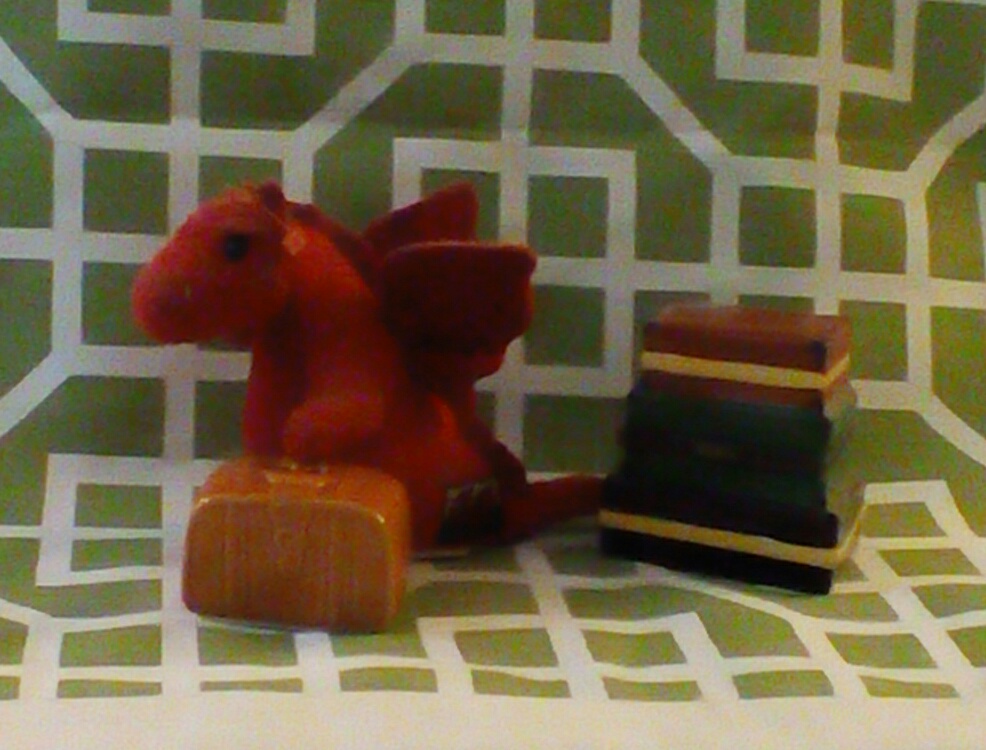
Yr Hen Galan

Standard

I mentioned yesterday about the plethora of New Years that I observed and set goals for in the past few months with the Chinese New Year coming in just a couple of more weeks.

Little did I know that I was forgetting one: the Welsh New Year or Hen Galan.

I discovered on Facebook that it began with the switch to the Gregorian calendar and it was yesterday! As I wrote and posted, I had no idea that I’d missed one!

Some more reading: New Year’s Traditions in  Wales

If we keep our eyes and ears open, we learn something new each day.

Recipe – Jacket Potatoes

Standard

Recipe

Jacket Potatoes

I will usually use 1 1/2 large potatoes, but use your judgment for your appetite.

Take the potatoes, wash, dry, and poke holes on four sides with a fork. Bake for 1 hour at 400*.

When the potatoes are ready, cut them in half. Put two or three halves in a cereal or soup bowl.

Keep the potato flesh in the skins, but mash it a little with some butter.

Add to the potato whatever you like. my personal preferences are:

chopped up chives,

bacon pieces (real bacon, not bits),

shredded cheddar cheese (or your favorite flavor), and

a dollop of sour cream.

Jacket potatoes are very versatile. You can smother them with chili, leftover hamburger meet, pasta sauce with meat (I’d recommend mozzarella for that one), broccoli, beef stew leftovers. The options are endless.

They make a great lunch, and pair them with a hearty salad, and they can be very filling for dinner.

– – – –

Recently, we had jacket potatoes for dinner. We’d run out of groceries except for a 5lb. bag of potatoes, and some odds and ends in the fridge. No one wanted to make dinner. When I suggested potatoes for that dinner, my husband thought I was being crazy, but since he didn’t have to make the meal, he went along with it.
It’s funny how the simplest thing can seem like the best, most wonderful, unique food on the planet. The first time I had a potato as a main dish like this I was in England in the eatery at Warwick Castle. My friend and I were on a three week adventure through the UK, and we were watching our pennies. We still had another week to get through with the cash we had on hand, and as any tourist place, even twenty-odd years ago, the castle’s food was expensive.

Looking though the menu, we both chose this odd but very interesting sounding thing called a jacket potato. It really was an oddity. A baked potato with stuff in it. It was huge. It was like the size of two potatoes with what looked like four ounces of cheddar cheese on top. I loved it. I came home that spring and started making them for my lunches.

Many years later, upon returning to North Wales, I visited another castle. This one was Caernarfon, 13th century built by Edward I to subjugate the Welsh. They had a gift shop, but no place to eat on site. It didn’t much matter; there were enough places to choose from in the small town.

I ended up in an alleyway, called Hole in the Wall. Too narrow for a car, but perfect for walking or bicycling. There were several places along the small lane, and at least three restaurants all on the same side of the lane, and I chose the cafe across from where the bell tower used to be. The stones that made up the tower and surrounded the bell were still there but half of the stones were missing so one side was open.

Appropriately named The Bell Tower Cafe, it was a tiny place, maybe ten tables, mostly filled with regulars, a variety of ethnicities all speaking the lyrical Welsh language. They were all getting a good, hearty British breakfast. It looked amazing, but I had already eaten breakfast at the hostel, toast and jam. I watched as the steam rose from the white tea someone had ordered. In searching over the menu, I discovered that old favorite from Warwick – the jacket potato. I had that big potato covered in cheddar cheese with a salad and a soda, and it was delicious. I went back the next day and had the exact same thing.

50-35 – The Alarm

Standard

Equal to Duran Duran for favorite bands growing up, and continuing into adulthood is The Alarm. I had a cassette that I played in the car constantly. I knew every word of every song. It didn’t hurt that they were Welsh at a time when I was obsessed with Welsh history and culture, something else that never went away.

The Alarm also holds another distinctive place in my life’s history.

In 2008, they came out with a new CD – Guerrilla Tactics. I wanted this album desperately.

In 2008, we were barely on the internet. I hadn’t even joined Live Journal then, we had no wifi – wifi was available but we didn’t trust it, so we had to be plugged into the wall. I had my first laptop, its own experiment into personal computing.

When I signed onto Amazon, well, actually, I had to create an account because I had never ordered online before, but when I signed on, I had a choice. I could buy the CD for $14.99 or I could download the MP3 version of the album for $9.99.

I actually thought about this for a couple of days. Eschew this new digital world and spend more money or give in to my innate cheapskate, get the album digitally and save the $5.

Eventually, I chose digital.

It was the first digital music I ever bought, and I listened to it always, over and over again. I transferred it to my new mp3 player, another new bit of technology that I had just discovered.

It opened a whole new world of digital media, and despite my going kicking and screaming into each new thing, I still went.

Eventually. 

50-29 – Wales, The First Time

Standard

​When I first arrived in Wales many years ago, I didn’t know how profoundly it would affect me and change my viewpoint of everything. It wasn’t until years later that I discovered the word for what I was feeling: hiraeth. Hiraeth isn’t homesickness, but a longing, a yearning for one’s homeland, and it is not so much that you know it when you feel it, but the emotion of hiraeth is so much more than its literal definition. In fact, it doesn’t really have a literal definition, but a broad emotional meaning. It’s spiritual.

Wales, that first time, was in so many ways, a surprise. I wanted to visit a castle, not realizing that the castles I associated with Wales were English castles used to subjugate the Welsh people rather than built by the Welsh to protect them and their interests.

Wales is a surprise, and never what you’d expect. If you expect rain, the sun will shine. If they say hill, they mean mountain. Their lifeblood is slate and coal, daffodils and leeks, but most of all the people. It’s palpable. No matter where you are in North Wales it seems that you can see the mountains. The English call it Snowdon, but it is Eriyi in Welsh – the haunt of eagles. So much more evocative, isn’t it? So much more poetic like the Welsh lilt and cadence.

That cadence of the Welsh tongue is much like the valleys and peaks of Wales itself. They know their history and remember their independence, although that mostly ended in 1282 with the beheading of Llywelyn the Last and the drawing and quartering of his brother, Dafydd, their blood as much a part of the land as the craggly rocks and the rivers.

My first trip to Wales came about by accident. Luck. Fate even. I was asked to join my college roommate in England. Sure, why not? Of course, there was more to it than that, but that’s the gist of it. I borrowed the money from my brother, who was better at keeping his than I was with mine and off I went.

My roommate asked me what I wanted to do. My only response was, “I don’t care. I want to see Stonehenge and a castle; I don’t care about the rest. I’ll follow you.” She planned it all through trains and buses and hitchhiking, hostels and B&Bs. I followed along, collecting pictures and memories.

We made our way from London at this first day of 1987, a new year. We went westward and south and west again, and eventually entered Wales. I don’t remember crossing the border but Wales was different. Welsh had made a resurgence so all the signs were bilingual. I began keeping a little dictionary in my journal although no one made us speak in consonants. W is a vowel by the way, but that’s another memory.

Wales was different.

The air was different.

The sky was different.

The sheep were different.

It didn’t rain in Wales; at least not the Wales I was in. This was January, and Britain was grey; very grey. It held the first patch of blue sky I’d seen in the two weeks I’d been on this island. It was that perfect cloud peppered Crayola sky blue color that exists nowhere else, its reflection off the quarries deepening it and the snow evening out its perfection. It must be special.

But the sky wasn’t all that made it special. There was a feeling I’d never experienced before, not deja vu, but I had been here before. I don’t know how or if, but physically I’d never, but I was.

How can everyone not feel it?

It was overpowering. I needed to be here, high in the mountains, midnight hikes, counting the stars, not having an historical clue, but knowing that I walked in the footsteps of ancestors, of family, of specialness, feeling as though I’d taken these steps before. This wasn’t restless spirits like I’ve felt at other historical holy places; these were memories, memories of feelings.

Crazy, I know.

There was a weightlessness, a joyful singing in my soul that nothing else compares to. I only imagine this is something of the feeling that people get when they travel to Israel, but I don’t actually know.

It is my spiritual home, an ancestry I wasn’t born to, but I was called on to feel, to be a part of,  to let inside and settle into my soul. It is always there, this feeling of Wales and the Welsh, the people as much a part of the land, and as much a part of me as my own children.

When I went back almost twenty-three years later, I found the feelings still strong with only my research and readings that gave me more context and made it more tangible to breathe in. My footsteps following Welsh princes, understanding how remote a castle stronghold really was breathing the same air, wondering if I would ever understand these feelings.

Even home, I get fleeting glimpses through a looking glass – the wet colored leaves on a rural road and I forget that I’m not in Wales. The hesitation at a roundabout, confused about which way to enter it. The tree outside my church’s window when it rains – it is always a surprise and always a physical reaction and then I realize it’s through a window and I’m not in Wales. These come upon me through no special thought, but there is the realization that Wales is a part of me and who I am, and maybe one day I’ll find out why and maybe even how I have this connection.

50-17 – Manchester

Standard

​I thought I was just afraid to fly. I thought I was really afraid to fly. I had a talisman to hold onto from my friend, a bottle of Xanax from my doctor, and even then I wasn’t sure if I’d get on the plane or not. I’m wasn’t worried (and still not for the most part) about the plane crash landing, but the enclosed spaces get me. I want an aisle seat every time, and that doesn’t really help. It gives the illusion that I have an escape route.

Psychology. It’s mind-boggling.

I didn’t find out until about three years later, but that fear of flying wasn’t a fear – it was anxiety in the form of disorder. It was diagnosed when I was diagnosed with depression, but at the time of this transatlantic holiday, I thought I was afraid to fly.

Continue reading

Top of the Mountain

Standard

Sunday’s Gospel was Jesus on the mountain, well one of them. It’s the Transfiguration as witnessed by Peter, James, and John. They see it, and they’re not sure what they see. My priest called it a mountain top moment, in both the literal and the metaphorical sense. The Transfiguration is pivotal and bridges, through Jesus, the earthly life and the eternal life. Pope Saint John Paul II included the Transfiguration when he added the Luminous mysteries to the Rosary. At a recent day of reflection, Father P talked about those “born again moments” and that reminded me of Father J and his homily on Sunday about mountain top moments. We all have them in various parts of our lives and they all mean something different to each of us in those times.

In my mind during that homily, I was reminded  of a literal mountain top moment that I experienced. I was in college and had the opportunity to travel to the UK with my college roommate. She made all the plans and I followed her. I followed her to the point that I’ll follow you became a running catch phrase for the trip and the rest of our friendship including when I see her today nearly thirty years later. At some point she gave me the the itinerary with a few changes along the way, but I barely knew where we were going before we got there.

That level of trust and spontaneity sounds completely foreign to me, but at that time it was easier to just tag along. It was the trip of a lifetime and whatever happened, wherever we went would be amazing. I had no expectations and that let my mind stay open, probably for the first time in my life.

It was a wonderful trip: New Year’s in London, feeling the magic of Stonehenge, finding out that the buses don’t run on Sundays in Stow on the Wold, snow in the Highlands, but the most filled with wonder moment took place unexpectedly near the top of the Snowdon Mountain in North Wales.

Continue reading

Stuff and Things – Y Ddraig Goch

Standard

For those of you who don’t speak Welsh, the subtitle translates to The Red Dragon. The Red Dragon, Y Ddraig Goch is the national symbol of Wales, and in addition to being pictured on the official flag, it is pretty much on everything else in country.

When I was there, I picked up stuffed red dragons for each of my three kids, but for myself I got this little keychain. For the longest time, I had it clipped to my pocketbook, and it went everywhere with me. His tag fell off, but the plastic hangy thing is still attached to his ear. On his left side, as you can see if you squint and zoom in, he has a patch of the Welsh flag attached.

image

A few years ago, I was in the post office, my purse slung over my shoulder with the red dragon hanging in the front. I finished my transaction, and the postal clerk asked if I went to college at Oneonta. It is a state college in upstate New York, and I had in fact graduated from there.

I was confused how she knew that, and she pointed at my red dragon. My response was that it was a Welsh dragon, not an Oneonta red…

And then I realized, and it hit me that I hadn’t realized it before, but the coincidence was ridiculously obvious to me and I chuckled. I might have said that I guessed it was after all.

At college in Oneonta, our mascot was a red dragon. I lost that in the twenty-five years and I’d been carrying around my Welsh dragon and never once associated it with my college mascot.

So in the 1980s I had red dragons, and in 2009, I went back to Wales and got a different red dragon. It only cemented my connection to Wales. There are many threads attaching me to the land, and their only connection is me. In my mind, it makes sense. It’s a faith thing.

Thursday Travels – Llanrwst, North Wales

Standard

image

One of my favorite pictures from my visit in 2009.

Across the bridge to my left is a wonderful tea house. Excellent cup of tea and scone with cream and jam. I was too nervous to take photos “publicly” so I don’t have any from inside. As I recall now, though, there may have been a sign that said no photos, but I don’t precisely remember. I was very conscious of not being a typical tourist, but I’m not sure that if I went back that I would care about that. I love taking and looking at photographs. I love the view through the lens.

Behind me is a circle of standing stones. At the time I thought they were ancient stones and I gave them that reverence. When I arrived home, I did some research and discovered that those stones were placed there to commemorate the 1951 Eisteddfod. Fun fact: my friend’s grandfather won the crown at that year’s competition. He was a well respected and well known broadcaster for television and radio.

On the river you can see two swans, who were happy to pose for my other pictures.

Another fun fact: This bridge is said to be one of the ones designed by Inigo Jones.

Lost and Found in the Homily

Standard

Today’s homily was all about being lost, and being lost sheep, and the everyday ways we are lost and find ourselves again. I don’t know why, but my first visit to the UK kept popping up in my mind throughout my pastor’s talk. Not just the visit or the trip itself, but all the little times that I was lost there. I don’t think we were ever truly lost,  but those moments seemed so big at the time, and even now they stand out in a seemingly unrelated homily that included my pastor being lost in the snowy woods with his dog.

My first thought of being lost in England was standing in the rain. I don’t think we had umbrellas, but we were looking at a map and it was raining. It was a cold, poking kind of rain that covered my glasses  We were years away from little wipers on your eyeglasses.

At that time, we stayed at youth hostels and you can’t spend the daylight hours at a hostel, even in the cold, winter months, so we were up and out every morning. I don’t remember where we were heading on this day, just that we didn’t know where we were, and we needed to look at our map.

We were surprised when an older woman came out of her house and across the street with an umbrella and showed us where we were, and how to get to where we were going. She said to go across the field we were standing next to – it was faster if a bit muddy. We weren’t sure about going across someone’s property, but she said it would be alright. We took it.

It was definitely a shortcut.

When we crossed the border into Wales, I hadn’t realized that I was lost, but I knew that I had been found. I talk about this aspect of my trip often, so I won’t be redundant, but it is a significant thought of being lost even if I hadn’t known it at the time. It was, and continues to be a sacred place for me.

We also found ourselves lost on Craigower Hill just above Pitlochry in Scotland. We kept climbing up and up and up. We didn’t quite make it to the summit, but we made it pretty close. We slid down and had to start again about halfway up, and then it started snowing.

Luckily we found ourselves at the bottom eventually at The Moulin Inn for some fabulous lasagna and cider.

We became stuck in the Cotswolds having planned on leaving on Sunday, and not knowing that the buses don’t run on Sunday. The hostel warden took pity on us and let us in earlier than their usual evening opening. He also loaned us books and told us some of the history of the town, Stow-on-the-Wold.

Being lost in Edinburgh, in the snow, at two o’clock in the morning was better with a new friend than alone.

This was a three week trip in January with my college roommate, and these are only a handful of memories that popped up during the homily on lost sheep.

Being lost isn’t so bad. I know I’m never alone and what all of these anecdotes remind me is that no matter how long you’re lost or where, there is always a way out, a way to be found, a way to find yourself and that trip was one of those places and times that I did.

(Reading: Jeremiah 23:1-6)