
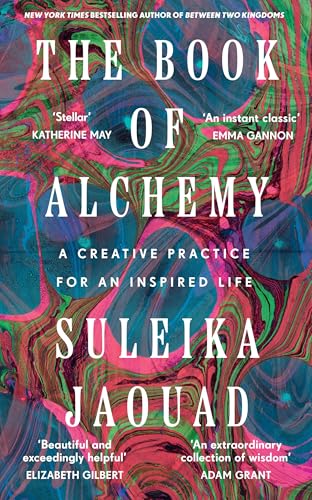
Within the last fifty days, I shared with you my intention to begin and complete a one hundred day project following Suleika Jaouad’s The Book of Alchemy. I’ve read her chapter introductions, and then each of the ten essays by various authors, absorbed their stories, dove into the prompts, and for the most part wrote for as long or as short a time that my essay needed.
Before I get into the weeds of this project and process, I would like to readily admit that I think I’ve succeeded in my non-stated goals. I am writing every day; not just these prompts, but working on my book, writing posts to publish on my website, taking notes for future writing projects.
Because the authors are so varied in their backgrounds, their writing styles, and the stories they choose to share, one thing that I’ve been doing is thinking and contemplating what I want to write about, how much of my personal experiences I want to share, and really concentrating on continuing to grow as a writer. I’m seeing that many of the prompts can be blended together, I can create multi-part essays and longer pieces, and there is a lot of inward looking. I can see going back again to some of the prompts and expanding what I’ve already written, starting the prompt anew, continuing or creating a chapter/monthly series on one or more of the prompts.
I do intend to share some of what I’ve written with the world.
Word counts are not the end all be all of writing. I could easily write over 1000 words a day, but is it worth reading? Not if it’s crap. Having said that, it’s still important to have touchstones to know where I am in the writing process. While the essays I’ve written with these prompts can be left as standalone pieces, some may be refashioned, edited, and of course, everything can be made better.
For the fifty days so far, I have written approximately 25,133 words, which amounts to 503 words per day. Some days there were a hundred words written, some seven hundred, and there were one or two days when over a thousand words were completed.
While the book gives you no special rules, and you decide what you want to get out of the project, I started with six simple suggestions that I fashioned for myself. They were to keep me on task, accountable, and focused.
A reminder of those rules (there are seven now). For the most part, I followed them diligently except where noted, and this is how I’ve done so far):
- No looking ahead. I’ve been pretty good about this one. I may glance at the next title, but I haven’t read anything early. I’ve also tried to avoid noticing the author. If the author is more well known it can influence how my reading goes. There was one who I am not fond of in a personal way, but I still read their essay and responded to their prompt. You can’t always choose where a writing prompt will come from when you’re out in the world.
- Read each section of the chapter on the day. I’ve been pretty good about this one also. I start each day, whether it’s first thing in the morning or during my lunch hour, and I read the essay, read the prompt, think for a minute and begin to write.
- Once I read that day’s essay and prompt, I usually copy/paste the prompt onto a new document. Each day is saved as Day #, so at the end of one hundred days I will have one hundred documents. I am halfway through the hundred days. I’m in the middle of the 51-60 section. In addition to the individual documents I created a separate document with a chart that includes the subject, the numbered day and date, the author’s title and name, and how many words I’ve written for that prompt. I also added two columns to gauge what subjects the essays fall under as well as what blog category they might work in.
- I decided that I would do this entire project on my kindle. No going back and forth to journals or paper and not on my computer. One thing that ensures is that I can always do it – my kindle is always with me. This has worked except for a couple of prompts that required drawings or photos. When I’ve done something outside of the kindle I take a photo and upload it so it can be part of how I want my project to be.
- Then I write. My rule about the writing is that I do not wait until later. If I don’t have time to write, then I don’t read the essay. I read the essay, the prompt, and I write on the prompt. Then I keep writing until I’m done. It’s different each day. Some days are 250 words, and some are over 700. I don’t do the word count until I’m finished. There have been a couple of instances where the writing was intentionally postponed. I have not just not done the writing, but one prompt asked that we sit outside and observe for fifteen minutes. When I read this essay and prompt it was already dark out, so I waited until the morning, going to work extra early so I’d have time for the observation and the writing. Another prompt was to sit in the dark, so I waited until my house was quiet to do that one. There were two that were too emotionally taxing that I couldn’t do them in the moment. I needed to give myself a break from the emotions brought up by the essay as well as contemplating where I wanted to go with my own essay. I feel as though I’ve held onto the spirit of the rule in that I’m not procrastinating or being lazy in the writing and the project.
- I do a spell check before I save the document. Spell check has saved me! It also gives me an opportunity to re-read and possibly edit and add some thoughts to the original essay. Since it is still in the moment, I don’t mind the little changes and touch ups. I also note if this is something that would benefit from readdressing and/or coming back to with more thoughts at the end of the hundred days.
- I don’t re-read. I usually don’t but on occasion I will. I want each piece to convey my intention so I might skim through it and make sure that it says what I want it to say and that it reflects the intention of the prompt.
Overall, I am very pleased with myself. I’ll check in after another twenty-five days have passed, and that will lead me into the homestretch.
For those following along, I offer this prompt for you to work on in this week:
Where is your least favorite place to write?
Most favorite?
We all have them; let’s jump-start some out of the box ideas for creative spaces!
 Griffins and Ginger Snaps